


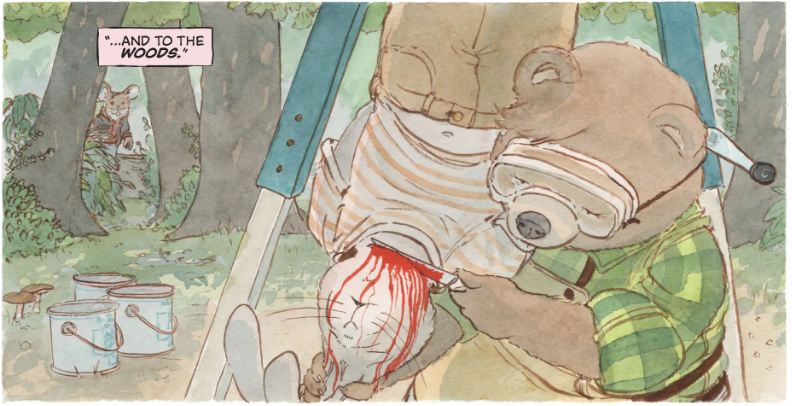
In 2023, Patrick Horvath made his comics debut with the critically acclaimed Beneath the Trees Where Nobody Sees. The comic follows the misadventures of Samantha Strong, an anthropomorphic bear who spends her days working in a general store in a sleepy small town, and, occasionally, kills people from out of town. Things get rather messy when another serial killer comes in and starts publicly displaying his kills. Over the next three years, Patrick Horvath would continue the series in one-shots. During New York Comic Con, we had the chance to interview him about the comic series.
The interview has been edited for length and clarity.
SEAN DILLON: How are you doing Patrick?
PATRICK HORVATH: I’m doing well, thank you very much for having me.
SEAN DILLON: Now, why did you want to make a comic about a serial killer bear living in the Midwest?
PATRICK HORVATH: The inspiration from it came from a drawing I did in 2017, and it was just a random daily drawing that I did. It was an anthropomorphic bear walking down the hillside with an axe. I was a big fan of Richard Scarry’s Busytownbooks when I was growing up. And the thought was, “Oh what if there was a serial killer in Busytown and like, you know, none of the other townsfolk knew about her” and of course she did the killing in the city and I was like, “You know that’d be interesting.” And then I was like, “You know what would be interesting, if there were like two serial killers,” and it made her whole life very problematic. And then that was the main inspiration. I find serial killers in general to be very fascinating to deal with. Because they’re so terrifying and then there’s a fascination with how an amoral brain navigates problems. It’s terrifying and fascinating at the same time.
 SEAN DILLON: Are there any other sketches that you’d like to expand upon into comics?
PATRICK HORVATH: I definitely have. Sometimes it’s a sketch. Sometimes I’m doing the dishes, and I have an idea that just like randomly pops in my head, and I’ll just write it down. All that stuff just ends up on a Google doc, like a couple of paragraphs on a page. And if I ever like have a chance to expand stuff, then I’ll turn it into a bigger idea.
SEAN DILLON: So, how do you go about designing your characters like Samantha or Mocha, for example?
PATRICK HORVATH: Oh I just kinda do a bunch of iterations until it settles into a consistent character. Sometimes the first sketch that I did that inspired the story, does not look like Samantha. I did an anthropomorphic bear, but design wise, it does not look like her at all. So it’s kinda interesting. I just kept chipping away at it until I had something that I was finally like “Oh yeah! This! That!” and it was sorta consistent.
SEAN DILLON : So, prior to working in comics you were a filmmaker?
PATRICK HORVATH: Yeah.
SEAN DILLON: You worked on the movie Southbound?
PATRICK HORVATH: Yes.
SEAN DILLON: When working in the visual language of comics, how does it differ from working in film?
PATRICK HORVATH: I mean, just as a medium it’s extremely different. There’s motion and there’s time. With film you’re just at the mercy of the film, and you can’t stop it. You can’t go back a page easily, especially if you’re in a theater. You’re just stuck there and have to experience the story in a linear, chronological fashion. With comics, the power is in the reader’s hands, quite literally. And the reader’s also completing what’s happened in between the gutters, right? I feel like there’s a part on the audience where they have to bring a lot more to it. And what’s interesting is that I’ve noticed that the effect on readers, as I speak to folks who have seen my work personally versus people who have seen my movie work, it feels a lot more intense with comics. And that experience has been very interesting. I was kinda shocked by that.
SEAN DILLON: Yeah, one of the things I noticed about your style was the watercolor usage. What made you want to use watercolors as opposed to say, more traditional dots?
PATRICK HORVATH: I ended up settling on using watercolor and wash because I am super comfortable with that. I really can’t stand digital color, myself. I’m like really bad at it. If I was good at it, then I would have done it like that, but because I’m like so not good at it, I ended up being like “I don’t want to waste the time trying to teach myself to be better at it when I already feel natural and comfortable doing watercolor and wash”. I have done digital coloring in the past. And I might in the future, if someone else does it. But for this, and for a lot of projects, I feel like doing [them] in watercolor and wash is a lot more fun for me.
SEAN DILLON: What actually goes into the process of making the comic? Do you start with a full script, or do you just have a general idea of what’s going to happen on the page?
PATRICK HORVATH:First I make a whole outline of the entire arc; and then I break that up in between the issues. And then, at that point, it depends on! Like the first go around, I wrote the whole script out for every issue, and then I went and drew the whole thing. For Rite of Spring, I did like half; I’d written out the script and then done it. And then, we were kinda losing on time. I had the outline for what was gonna go in that issue. And then I’d do like a sentence for each page, of what was gonna be in that page. And then I’d just start drawing, and then I’d do the layouts based on that, and then I’d do the writing. Now I kinda do a combination, specifically for Rite of Spring. For whatever reason, I can do it more quickly that way.
SEAN DILLON: Yeah, with Rite of Spring you focus on the character of Monica Breuer, who has expereinced a tragic event. What made you want to write about her instead of continuing with Samantha’s perspective?
PATRICK HORVATH: I was doing Issue 3 of the first arc, and at the end of it there’s a funeral for Martin the Goat. Which is sort of a spoiler. Anyway, at this funeral [Samantha] is sort of acknowledging that, [although] she didn’t murder Martin, she understands that she’s caused this kind of trauma for a lot of families of her victims. And there was something in that where I was like “Oh! If I ever get the chance to do a follow up book, it would be like from the perspective of a family member of one of her victims. And because we all know the duck, let’s just make it the duck.” The story just kind of sort of formed really quickly out of that. And I also got the idea for the follow-up, Book 3. as well.
I really wanted to see a cumulative effect that was all fallout from her actions, directly. A lot of that is Monica, but it’s also Pauline. And you see how she has responded to the trauma that she had from the first book. And also Birdy the Turtle and how he’s sort of changed his life and reaction to all that. As well as the times of the ’90s and technology.
SEAN DILLON: I was just about to ask about that. Your book has a very specific sense of time, with the first book taking place in the late 80s when serial killers were less and less common in the public zeitgeist. Then going into the early days of the internet with your second book. And now, with the third volume, you’re going into the beginning years of the War in Iraq.
PATRICK HORVATH: [LAUGHS] They have a forever war!
SEAN DILLON: Why did you decide to go for this route, as opposed to say, the more timeless quality of something like Wind in the Willows or the like?
PATRICK HORVATH: Oh sure, sure, sure. Why make it so directly tied to our world? The thing of it is, especially when I got to Rite of Spring, I think I was reassessing. I think I may have mentioned this elsewhere too, but I realized that I was reassessing my childhood through what I now know of that time. The surrogate for me is Lewis, the mole [in the first volume]. He’s like a child in the first one [and] you don’t really see him that much. But it’s like basically like a loss of innocence, in the first one. The second one is like adolescence [and] the world becoming meaner because you start to learn more about it. And then the third one is young adulthood, and it’s very disenfranchising. T
SEAN DILLON: Yeah, your dad was murdered by a serial killer, and your mentor is a serial killer!
PATRICK HORVATH: Yeah, yeah, yeah! And the world is the world, and we had this horrible event that we all went through as a country, and now there’s this forever war. Like is anything safe? You know what I mean?
SEAN DILLON: So, you talk about Woodbrook as a community, but what actually goes into developing the town itself,from an architectural perspective?
PATRICK HORVATH: Oh, a lot of that was inspired sort of through like my own nostalgia for the town I grew up in, which is Burlington, Iowa. And then I also got a lot of inspiration from Montpellier in Vermont. And, if you’ve ever looked it up, you’ll see they have a cute main street. A lot of the buildings for the main street are these really cute two/three level things that are all sort of like lining the streets with awnings and I took a lot of visual inspiration from that place. Honestly a lot of Woodbrook is based on that.
SEAN DILLON: So, obviously this is a book about talking animals and what not, but there’s also a degree of nature. Like, I remember in the first volume you have that scene where Samantha is on the run and goes into the woods and she runs across a bear at a river? How much research did you go in for the wildlife aspects?
PATRICK HORVATH: I mean, in terms of actual animal behaviors, not a ton. But in terms of visual references, like a bunch. The same thing with the anatomy. When you see any sort of gore or whatever, I wanted it to be fairly realistic, so that it felt grounded in an upsetting way.
SEAN DILLON: You’re the main artist on the book, but you’ve also been working with Hassan Otsmane-Elhaou and Nathan Widick. What do they bring to the book?
PATRICK HORVATH: So Hassan Otsmane-Elahou does all the lettering. He elevates the whole thing, as far as I’m concerned. I hand in the art and when he’s done with it, I get back the comic [and] it feels complete. He does stuff that really grounds it dramatically and the delivery of the stuff just with his work with the balloons. He has this really incredible attention to detail. He has a great knack for experimenting with stuff, and he’ll throw in an idea. And like 99.9% of the time, it’s awesome! And they’re just like ideas that he has that just kinda feel like in the spirit of the scene. And it very much adds to it, like in the greatest way. It’s invaluable.
And then, Nate Widick– so, I was introduced to him just through IDW because he was their designer. We didn’t even talk about this, but he did all the interior front cover credit pages. And he just, as a riff, decided “Oh what if they like had a community newspaper?” And I got wind of that when he was doing that, and my editor was like “Can you give a list of all the businesses you have?” Because we gotta build out all the streets, I was thinking of different shop names, or whatever. And I had like a half dozen or something like that at the time, and I kept coming up with more. And he was like, “they want to do ads that show up in the newspaper for the credits.” And I was like, “That’s awesome – cool!” And so Nate just ran with this idea of building it out, and then he just turned it into this evolving thing where for like every issue or chapter or whatever, you can see like there’s like blood splatters on it, there’s writing on it. And you realize that this is collected by Nigel. You don’t know that until you get to like probably issue five or something. And then when we talked about Rite of Spring, he was like ‘What should we do?” And I was like, “Well, it’s the beginning of the AOL age, it’s easy.”
SEAN DILLON: Oh yeah! Oh god!
PATRICK HORVATH: …everyone’s on the internet.
SEAN DILLON: I felt so much nostalgia for my childhood with those pop-ups! Jesus!
PATRICK HORVATH: Yeah, yeah, yeah! And that was all Nate’s idea! I mean, I told him it could be early internet, and then he went off to the races with it. We also have something really cool planned for the third one.
SEAN DILLON: Last year, Samantha appeared in a DC annual event comic, DC K.O., how did that happen?
PATRICK HORVATH: [LAUGHS] It was totally random for me. I’ve been talking to DC about doing work. I did an Adam Strange story for their DC horror anthology. We’ve also talked about possibly doing something else, like I’ve pitched stuff. So I was definitely on their radar. But I had no idea until San Diego last year, and then IDW asked me “DC would totally be interested in having Samantha be in DC K.O., what do you think?” And I was like, “That’d be awesome! Okay!” [LAUGHS] And I didn’t realize to what extent though. And then it wasn’t until Jim Lee had that announcement here at NYCC last year at his panel; and they had the big reveal photo, that had Samantha really prominent onit. And I was just like “Oh this is a much bigger thing than I thought it was going to be!” And it very much blew me away. I was totally not ready for that.
SEAN DILLON: Are there any characters in particular that you’d like to work with?
PATRICK HORVATH: I don’t have anything specific that I want to work with, necessarily. Although, I randomly came up with an idea that was like a backwards way of finding myself in a Ghost Rider story. And I was like, “Oh I guess I would do a Ghost Rider story.” So I would do a Ghost Rider story! But I would do all sorts of stuff. Batman [was already] locked in [and they said] you can do whatever else you want. And then the more I looked around and thought about it, I was like. “Oh, Adam Strange would be great!” I’ll work with whatever basically. But yeah, for whatever reason, Marvel, I’ve got like a random ass Ghost Rider story. [LAUGHS]
