


It’s been nearly six months since NVIDIA CEO Jensen Huang surprised GTC 2026 attendees and viewers all around the world with the reveal of DLSS 5. This new version of NVIDIA’s Deep Learning Super Sampling suite would focus on significantly enhancing game visuals using a machine learning model, with Huang calling it the company’s most significant graphics breakthrough since the debut of real time ray tracing in 2018 and the “GPT moment for graphics.”
The reveal would, however, quickly prove highly divisive among gamers and developers, with some praising its massive graphics improvements and others criticizing the technology for changing the games’ original style.
Since then, NVIDIA has kept working on it largely on the down low, except for a demonstration at the recent SIGGRAPH, which also revealed the targeted Fall 2026 release window. We were therefore expecting to have to wait longer, but today’s news is that NVIDIA DLSS 5 will officially be available starting on September 3 at 9 PM Pacific Time, with NBA 2K27 as its debut game.
We learned that and a lot more during a gamescom 2026 presentation and hands-on with the technology. Of course, just a few hours later, someone at Visual Concepts screwed up by uploading a version of the new DLSS 5 .dll in the game’s files, and Pandora’s box of hacking and injecting this unofficial version of the technology literally everywhere began in earnest. For the purpose of this article, though, we’ll focus strictly on NVIDIA’s official word. There will be plenty of time for everything else.
What DLSS 5 Actually Is, According to NVIDIA
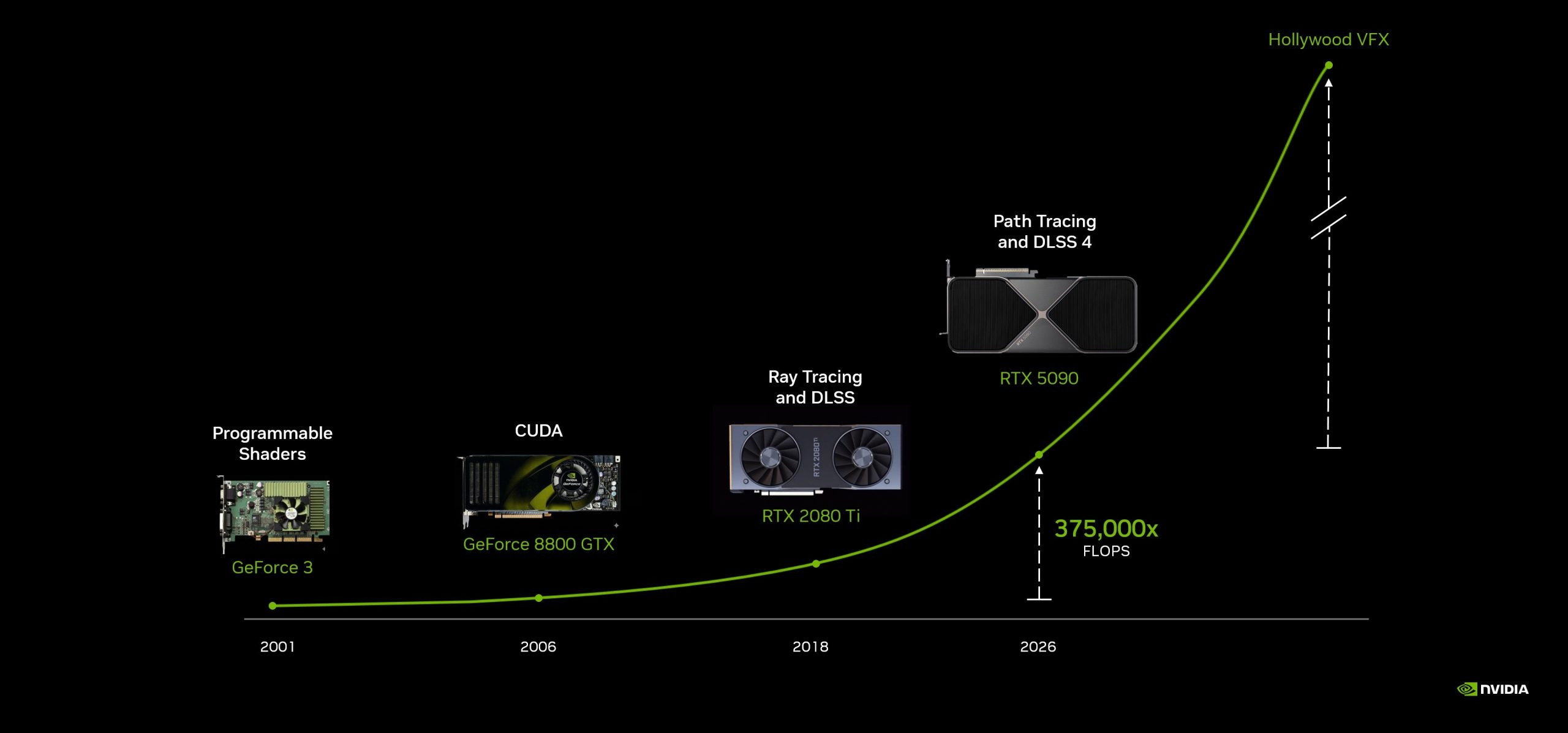
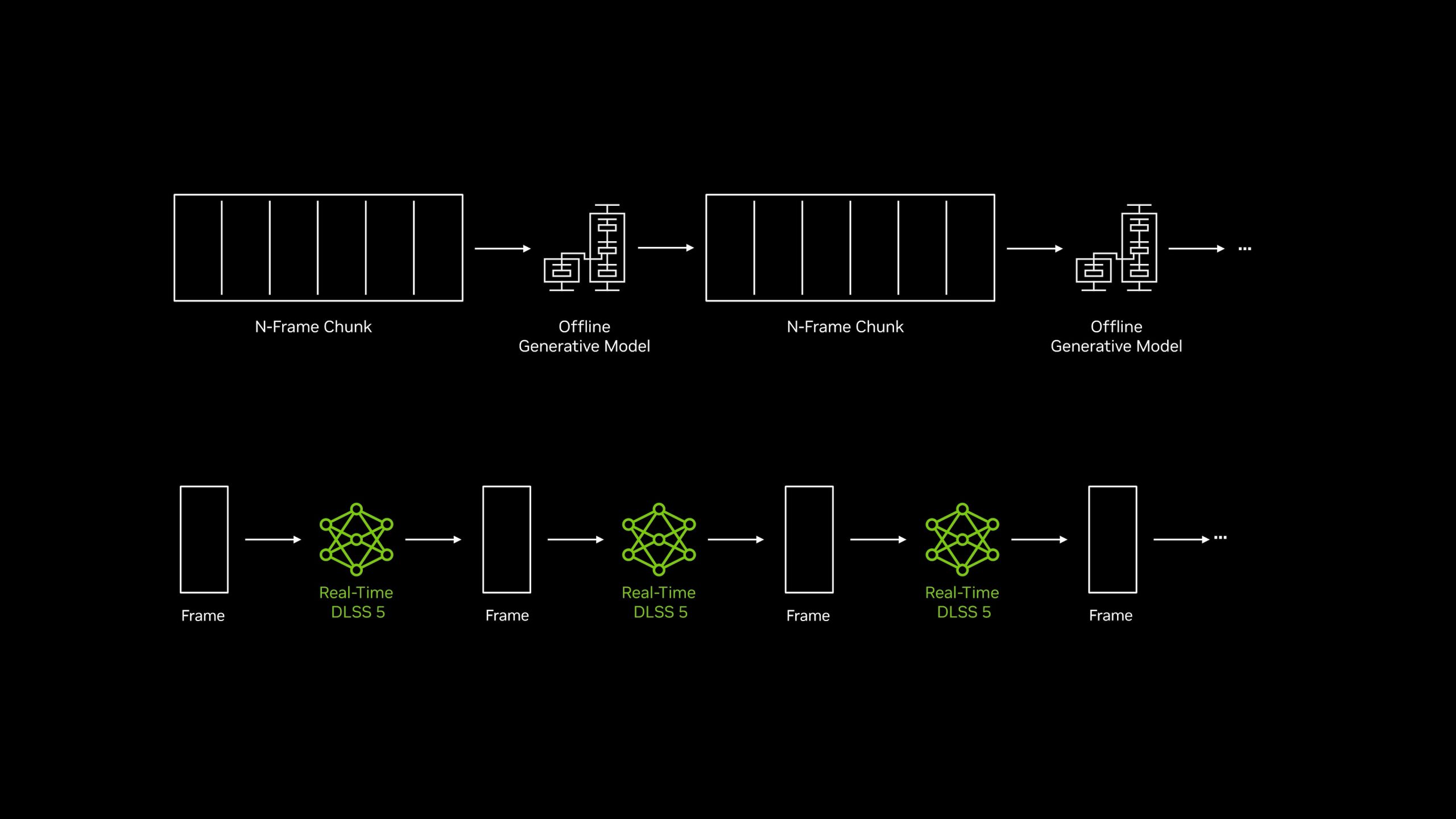
NVIDIA’s official framing for DLSS 5 is 3D-guided Neural Rendering, and the company’s engineers spent a good chunk of the presentation explaining why. The setup is a fork in the road toward photorealism. On one side is the path the industry has been walking since 2001: a scene, PBR textures, path tracing, a camera, and a rendered image with relatively accurate lighting and geometry, produced in real time. On the other, there’s the generative path: a dataset, training, a model, and a generated image with convincing lighting and materials that is probabilistic and, crucially, not real time. NVIDIA was blunt about the limits of the second route, showing three generations from identical conditioning inputs that differ from one another, and a diagram of an offline model chewing through N-frame chunks. That is fundamentally incompatible with interactive gameplay.
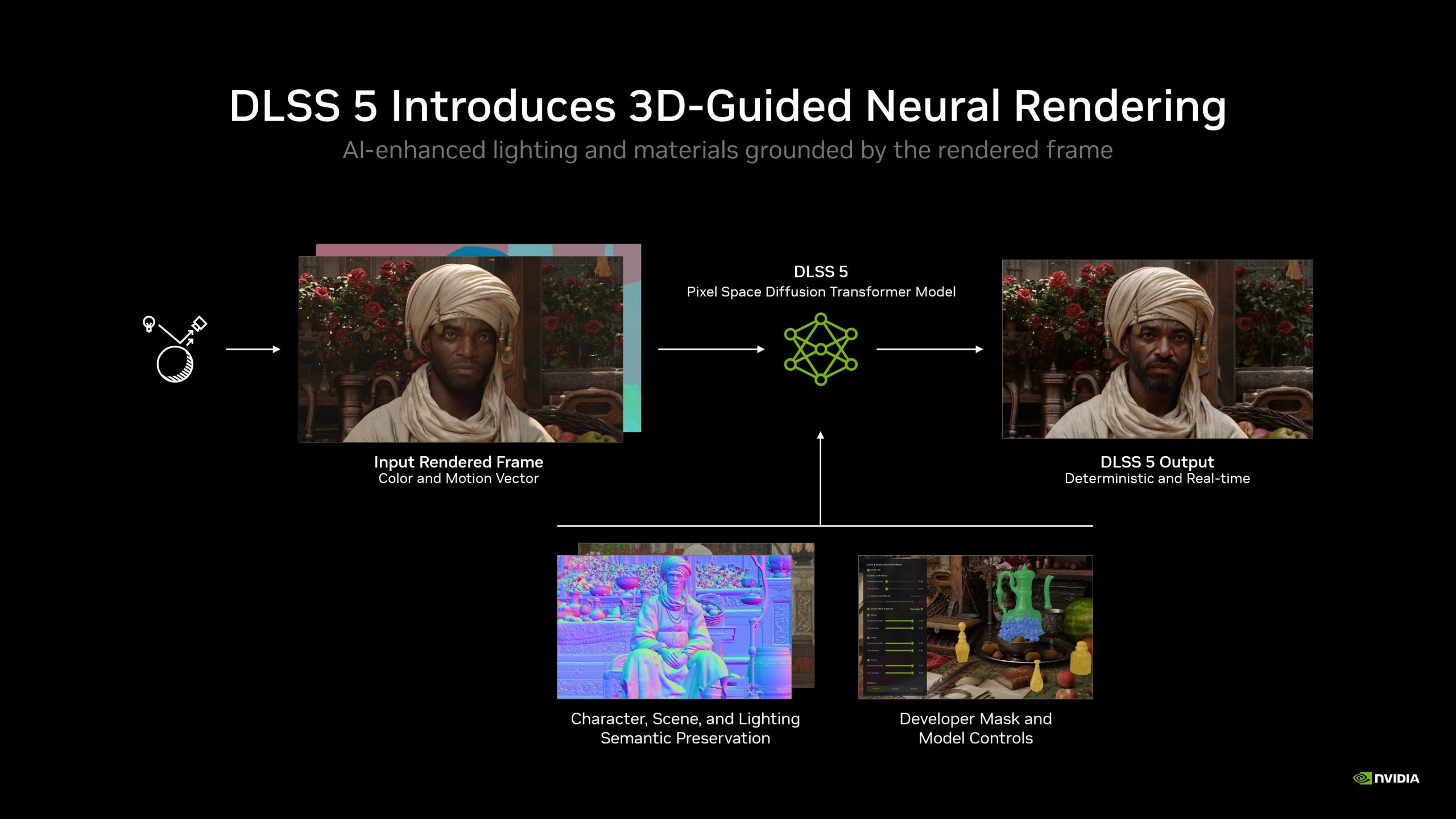
DLSS 5 is NVIDIA’s attempt to take the desirable half of the generative approach and bolt it onto the rendered frame. The technology is a pixel space diffusion transformer model that takes the rendered frame’s color and motion vectors as input and outputs an enhanced frame that NVIDIA describes as deterministic (that means they are always the same, unlike your regular genAI model) and, crucially, real time. The training targets are worth listing, because they explain what the model is being asked to protect rather than invent:
- Character identity: face, silhouette, costume
- Scene semantics: objects, materials, relationships
- Lighting semantics: direction, intensity, mood
- Camera and composition: viewpoint, framing, perspective
Alongside the rendered frame itself, training draws on:
- Surface albedo
- Surface normals
- Lighting semantics
- Motion vectors
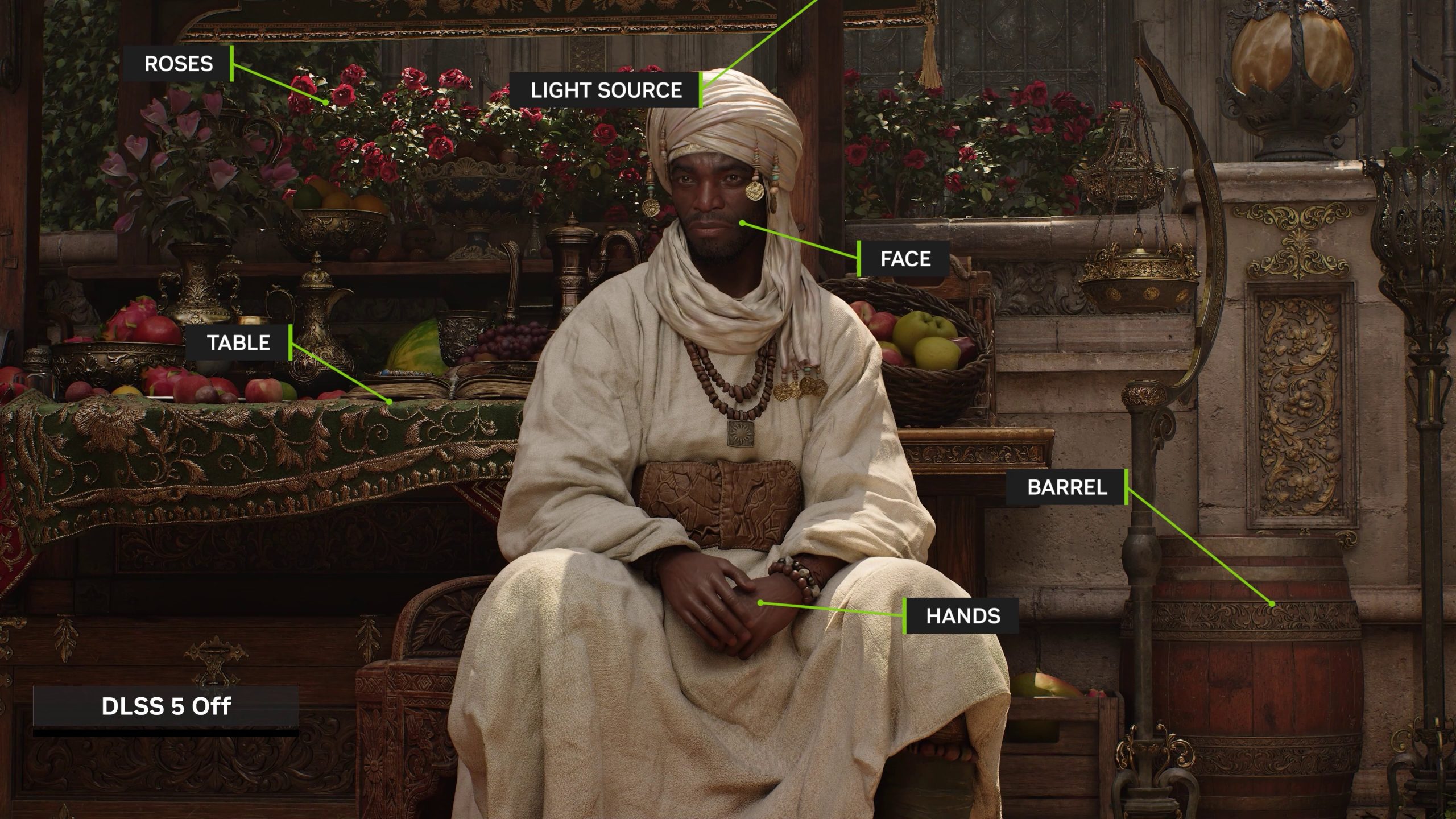
The grounding argument came through loud and clear in our conversation with NVIDIA. The model, we were told, reads the rendered frame the way a person reads a photograph. A shadow underneath a leaf tells it where the lightl and reflects accordingly. It implicitly infers the time of day, and in the sunny scene we were shown, it added a blue cast because it had worked out that the sky above must be blue
Nobody tells the model any of this. As NVIDIA put it, it is doing generation, but that generation is grounded in 3D geometry and, according to the engineers, is pixel-accurate, to the point that the final output will even include pixelation if that’s what’s in the original rendered frame. That grounding also explains one of the more useful clarifications we got: DLSS 5 does not accept text prompts from either gamers or developers. Text was described as simply too abstract for such a task, which is why DLSS 5 only takes the rendered frame and builds the output from there.



Artists Still Direct the Final Frame Thanks to Plenty of Knobs
The most substantial change since the original GTC reveal is the degree of control now in developers’ hands. NVIDIA confirmed that what Jensen Huang showed in March was a research model, and that the version demonstrated at gamescom is faster, more realistic, and most importantly, a lot more controllable.
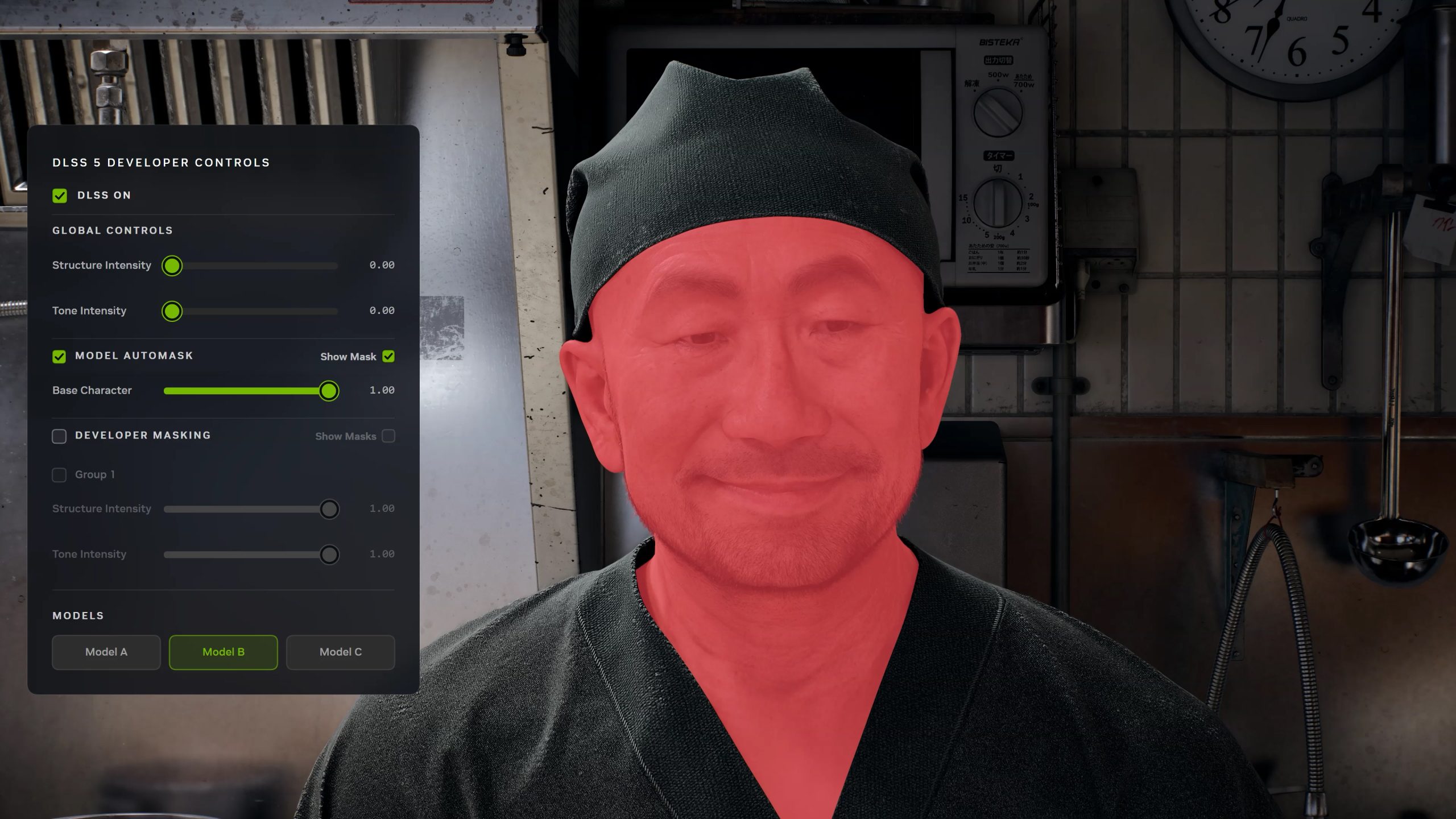
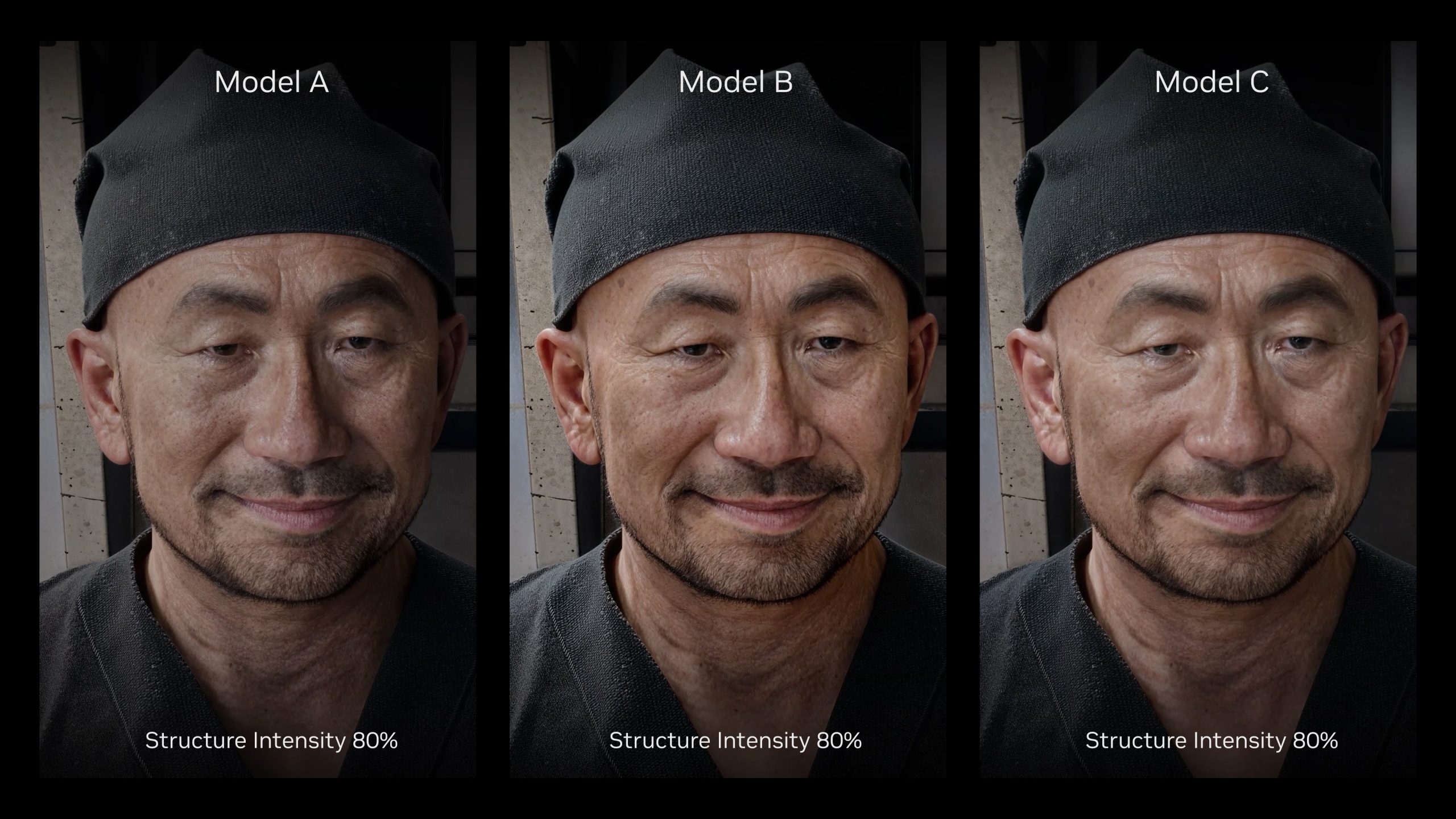
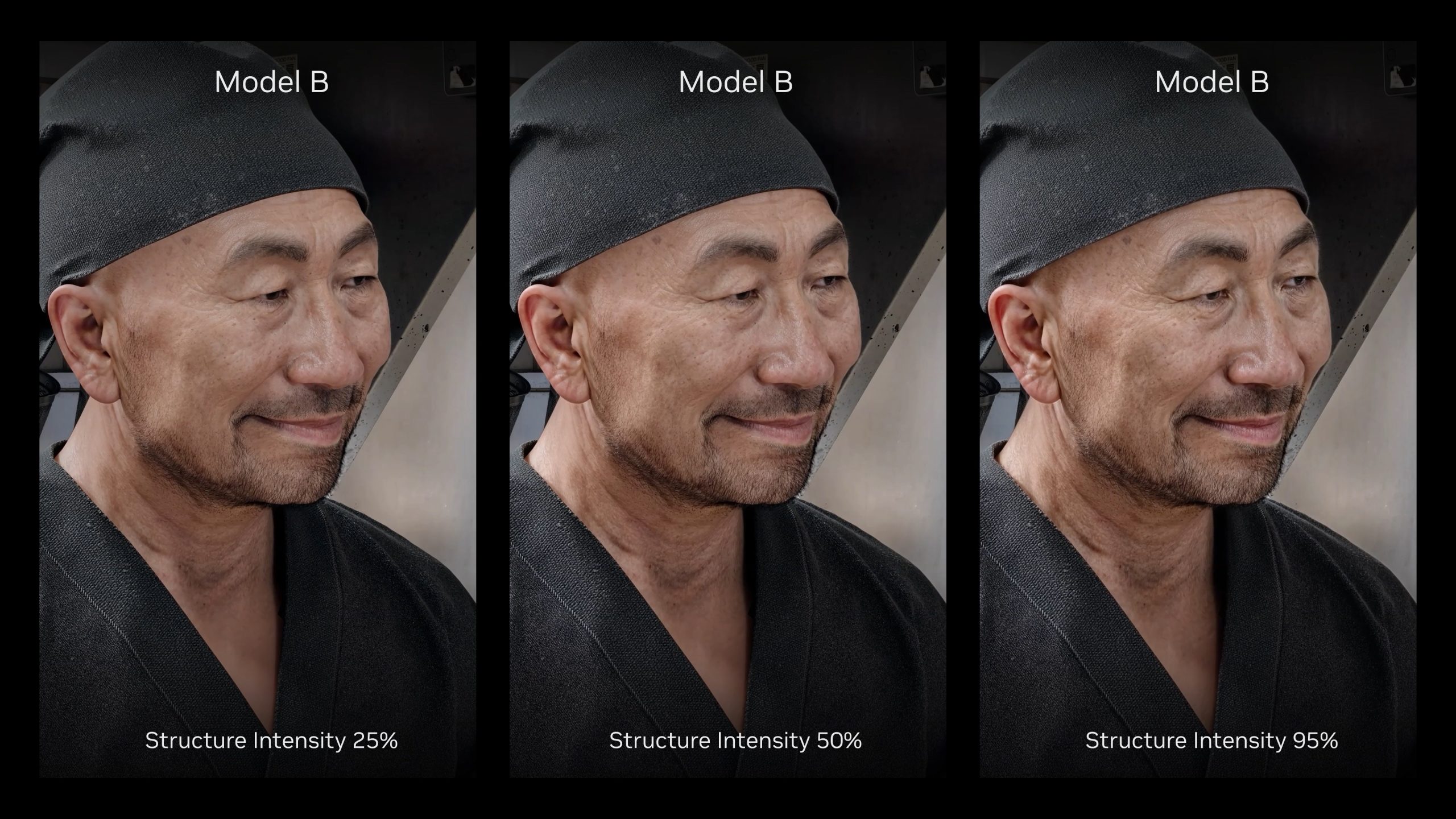
That control comes in four flavors. Structure Intensity governs high-frequency details, such as ambient occlusion, contact shadows, reflections, and subsurface scattering. Tone Intensity, on the other hand, handles low-frequency details such as broader lighting and color response. Both run from zero, which is the untouched base frame, to full, and both can be applied globally or per object. Masking can be manual, with the game engine feeding masks straight to the model, or automatic. And developers can even pick between different model weights entirely, labeled Model A, B, and C in the demo, which produce visibly different results at identical intensity settings.
The automasking feature is particularly important. Because the model already understands what a character is, the engine doesn’t need to supply a mask at all. In the demo, the Base Character mask picked up the face, skin, and hands as a single coherent entity despite them being different materials, and NVIDIA told us this holds up even with characters far from the camera and with many characters on screen at once, as was the case when checking out the NBA 2K27 crowd.




On the Faces, and on that Infamous Resident Evil Image
Since the loudest criticism of the GTC reveal concerned characters and faces rather than metals and materials, I put that directly to NVIDIA. The answer was unambiguous: the generation is entirely grounded in the underlying texture and normals, which already define the character’s identity. If a character’s edges are pixelated by TAA, for example, DLSS 5 will not nudge the character by a single pixel to clean it up. It does not change the underlying geometry at all, and therefore it won’t change the shape of a face; any differences are merely due to the improved lighting.
I pointed out that one specific screenshot caused most of the post-reveal ruckus: Grace’s close-up from Resident Evil Requiem. NVIDIA acknowledged that in that case, the before-and-after comparison was not properly aligned. The character was caught mid-animation, opening and closing her mouth, and the two clips were cut at different points, which is why the mouth appears open in one clip and closed in the other. A YouTuber, NVIDIA noted, had already called this out. The company’s position is that the stark difference everyone latched on to was due to a video editing problem rather than the model, and that even the GTC build was pixel-accurate.



Performance and Hardware Support
NVIDIA also shared a chart tracking DLSS 5’s efficiency, which was the most impressive part of the presentation. In March, the model required two RTX 5090s to run. By May, it was running on a single RTX 5090 at roughly 1.45 times the original performance; by July, at around 2.45 times; and by August, at five times, across the RTX 50 series of GPUs, which are the only graphics cards officially supported at this time. The chart extends into September and October with a dashed line, which reads as a signal that NVIDIA expects the curve to continue.
The NBA 2K27 numbers were all captured with ray tracing, DLSS 5, DLSS Super Resolution in Transformer mode, and DLSS Multi Frame Generation 6X enabled:
- 3840×2160, Ultra, Performance mode Super Resolution: RTX 5090 at 370 FPS, RTX 5080 at 232 FPS
- 2560×1440, Ultra, Quality mode: RTX 5090 at 594 FPS, RTX 5080 at 413 FPS, RTX 5070 Ti at 352 FPS, RTX 5070 at 261 FPS
- 1920×1080, High, Quality mode: RTX 5070 at 385 FPS, RTX 5060 Ti at 324 FPS, RTX 5060 at 258 FPS
A separate comparison slide puts NBA 2K27 at 227 FPS with DLSS off against 370 FPS with DLSS on. Of course, that includes enabling the full DLSS stack, with Multi Frame Generation and Super Resolution helping with performance. NVIDIA did not break out the cost of the Neural Rendering pass on its own, though. We’ll have to check that out ourselves once we get our hands on a game build that supports the new tech. As you’d expect, DLSS 5 will be officially integrated into games via Streamline or a UE5 plugin, following the same path as DLSS 4.


Early Impressions: NVIDIA Revolutionizes 3D Graphics Once Again
I mentioned in my post-GTC reveal op-ed article that NVIDIA made several mistakes with that presentation, but the tech itself wasn’t among them. I was very much looking forward to checking out DLSS 5 for myself in person, and when that opportunity came along, I dived right in.
Indeed, following the presentation, we were brought to a demo room where NBA 2K27 was very much playable with the tech enabled. I pointed out that the debut game choice is a bold one: people all around the globe are very familiar with NBA players’ faces, so starting off with that looks like a statement that DLSS 5 can indeed greatly improve a game’s visuals while respecting what the real-life people actually look like. Indeed, we were told by a developer from Visual Concepts that even some of the players themselves were absolutely impressed with their new virtual renditions, having long pestered the studio about improving their in-game appearance.
My frank assessment after playing a bit of NBA 2K27 with DLSS 5 enabled is that this is a generational leap the likes of which hasn’t been seen in a long time. In this console generation, many gamers have complained that there isn’t much visual difference between PlayStation 4 and PlayStation 5 games. DLSS 5 honestly looks like a bigger improvement, finally bringing real-time graphics close to actual pre-rendered CGI, and one of my first thoughts was that PlayStation 6 and the next Xbox will be hard-pressed to surpass it without similar Neural Rendering aid.
The thing is, the hardware constraints (which are only going to get more pronounced now that we’re nearly out of silicon to shrink) required an alternative approach to reach lifelike, or at least CGI-level, quality. As is, real-time rendering is forced to omit countless physical details about how light scatters through hair or seeps into pores, even with path tracing. AI-assisted Neural Rendering is the only real path toward the ultimate goal of 3D graphics: indistinguishable visuals from real-life and/or CGI.
And while the faces are what everyone is talking about with this tech, there are plenty of other details that are enhanced. In NBA 2K27, for instance, the ball, which has always looked more like it floated when you paused a replay, is finally truly grounded in the player’s hands thanks to DLSS 5.
Critically, NVIDIA has empowered developers to fine-tune the look to suit their preferences. They could, for instance, ensure that DLSS 5 applied to everything except the faces. Or they could simply tweak the knobs until they were satisfied; with NBA 2K27, the team at Visual Concepts settled on 0.7 for both Structure and Tone Intensity.
Last but not least, remember that this is a machine learning model. NVIDIA has a proven track record of continually improving its DLSS models, as shown by Super Resolution, Frame Generation, and recently, Ray Reconstruction. There is zero reason to believe the same wouldn’t apply to DLSS 5, so this is merely the beginning. I expect better performance, even more accurate models, as well as models that specifically cater to non-realistic visual styles, such as anime or cel-shading. As a first-generation debut, though, DLSS 5 is mightily impressive.
About the author: With over two decades of experience in gaming journalism, Alessio Palumbo has led the gaming vertical at Wccftech since August 2015. He started working at a young age for Italian websites like Everyeye.it, Gamestar.it, Nextgame.it, and Multiplayer.it before kickstarting the indie English-language publication Worlds Factory as its founder and Editor in Chief.
In the last decade, he has coordinated the overall output of Wccftech’s gaming section, managed PR relations, assigned reviews, produced daily news coverage, edited gaming content as needed, and delivered game reviews.
Arguably, his trademark content is the long series of exclusive developer interviews that have been cited by Wikipedia and by the biggest news media and gaming publications.
His passion for technology also makes him knowledgeable when it comes to gaming hardware and tech. His favorite genres include RPGs, MMORPGs, and action/adventure games.
Follow Wccftech on Google to get more of our news coverage in your feeds.
