

<img src="https://comicvibe.com/wp-content/uploads/2026/07/popculture-happyhour_tile_npr-network-01_sq-8f7dd7b8b06bf1f4d5c063f3752b7b60979624b4-8.jpg” alt=”PCHH”>
Pop Culture Happy Hour
How ‘Hot Ones’ took wing(s)
Pop Culture Happy Hour-07.23.2026
- Download
- Embed
<iframe src="https://www.npr.org/player/embed/nx-s1-5901976/nx-s1-mx-5901976-1" width="100%" height="290" frameborder="0" scrolling="no" title="NPR embedded audio player"> - Transcript
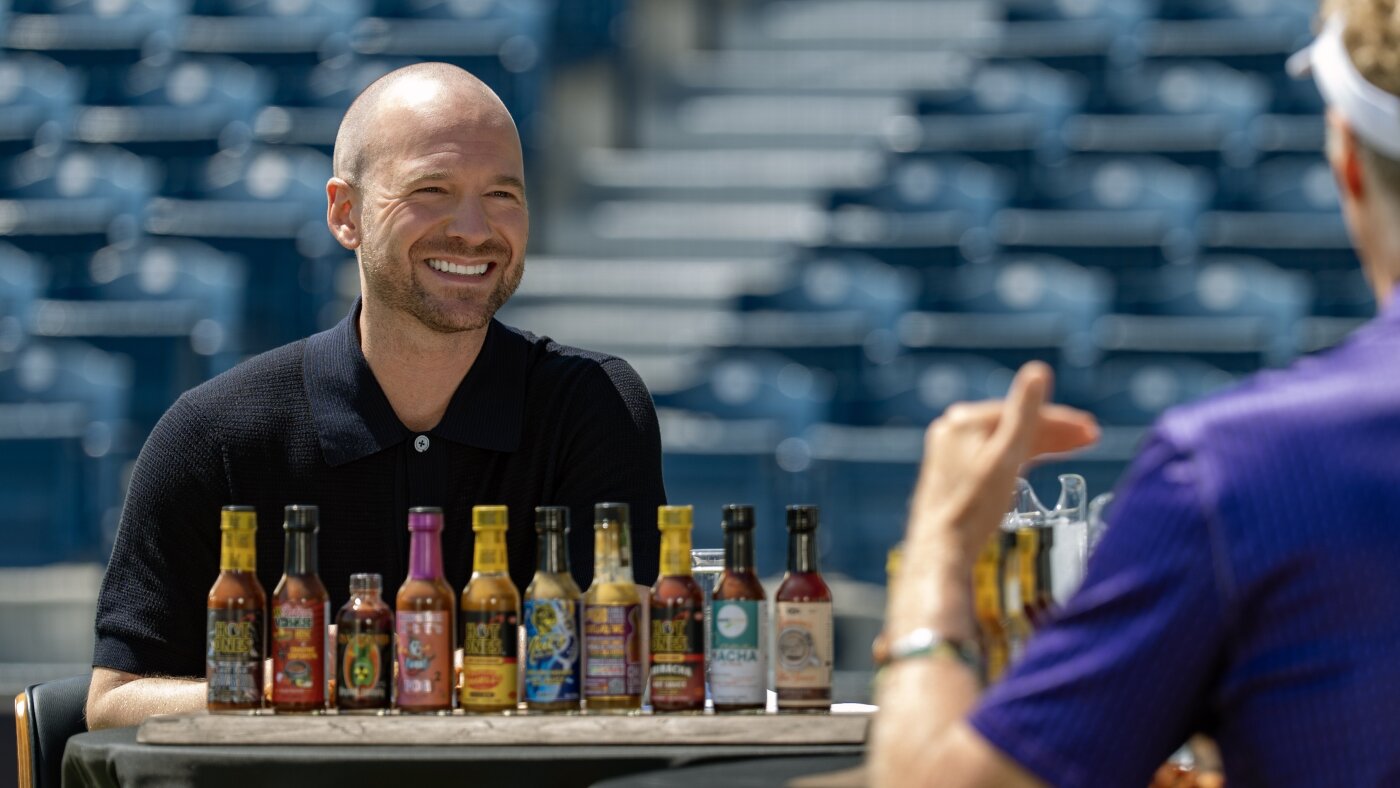
LINDA HOLMES: In the world of celebrity interviews, there’s spicy talk, and then there’s Hot Ones. The YouTube show where famous people answer questions while eating increasingly hot chicken wings is a phenomenon.
GLEN WELDON: Now, host Sean Evans is bringing his wings to Netflix with a series of specials called Hot Ones– Extra Heat, so we thought it would be a great time to revisit our conversation about the show and, specifically, about possibly the best guest ever, Conan O’Brien. I’m Glen Weldon.
HOLMES: And I’m Linda Holmes. And today, in this encore episode of NPR’s Pop Culture Happy Hour, we’re talking about what makes a good Hot Ones guest.
HOLMES: It’s just the two of us today. Glen, I am pretty new to Hot Ones, although I have seen the Conan O’Brien episode, and I have seen some others. But even people who don’t think they have seen it have probably seen some of it if they spend very much time online. So can you give me a little bit of an explanation of how the show works and its presence in kind of meme world?
WELDON: Oh, sure. Because, you know, the first time you heard about this show, you probably thought it was a dumb gimmick because it sounds like a dumb gimmick. It a dumb gimmick. It’s a YouTube show, as you mentioned, hosted by Sean Evans, in which celebrities answer interview questions as they and the host together– that’s important– progress through a gauntlet of 10 increasingly spicy chicken wings or vegetarian, vegan alternatives. The specific sauces change from season to season. The premise, I think, is that these celebrities’ brains will be so distracted by the swirling miasma of pain and gastrointestinal distress that they’re going to answer the questions in a kind of disarming, truthful way.
HOLMES: I have to say, I never feel more square than when I watch this show, and I’m like, that can’t be good for you.
WELDON: It can’t be good for you. We’ll get to that, because the tissues of the gastrointestinal track are famously sensitive. And so–
HOLMES: Yeah.
WELDON: –long-term, you feel for Sean Evans, man. He’s been doing this for years. Different celebrities deal with the heat very differently, which is one big reason why the show works. I got drawn into it the way most people are. You know, you hear about the show, you check to see if any of your favorite celebrities have ever been on it, you see–
HOLMES: Yes.
WELDON: –there’s hundreds and hundreds of episodes. Oh, many of them have. You check it out, and then it’s YouTube rabbit hole time. You just go down.
HOLMES: Yes, yes.
WELDON: But the thing exists in a really interesting place in terms of internet culture, because it premiered in 2015. It was the year the word “meme” kind of filtered down from extremely online people into the general populace. You know, it’s the year your parents learned what a meme is.
HOLMES: Yeah.
WELDON: And this show is a meme engine. It spawns them. If you have ever seen a clip of any celebrity against a kind of Charlie Rose Show black backdrop nowadays, it probably–
HOLMES: Right.
WELDON: –came from Hot Ones. So, there’s the one that many people have seen with Paul Rudd being affable and charming, as is his wont.
PAUL RUDD: Look at us. Hey, look at us.
SEAN EVANS: Look at us.
RUDD: Huh?
EVANS: Who would have thought?
RUDD: Not me.
HOLMES: Love that one.
WELDON: Yeah, you know that one. And there’s also the one with Jennifer Lawrence, who gives in to the panic and confusion that hits a lot of guests on this show around about the seventh, eighth, ninth wing, when they realized that the pain they’re experiencing is not stopping and wondering if it will ever end. And her reaction of kind of sobbing and laughing is– it’s not unusual on this show.
JENNIFER LAWRENCE: OK, is this one bad? What do you mean? What do you mean by shaking it? What are you doing? What do you mean? What do you– what do you mean? [LAUGHS] What do you mean?
WELDON: [CHUCKLES] Oh. I have theories on how and why this show works, both as a meme, in meme form, and also in full episode form. But first, I want to get your take. Well, you’ve dabbled in the show. What have you seen? What have you liked? What have you not liked? What are your thoughts?
HOLMES: Well, I think, as you mentioned, the initial take on this show is that it seems like a tremendous gimmick– and it sort of is. But at the same time, I think if he were not a good interviewer, I would really, really dislike this show. It does have that quality that you mentioned of kind of giving people something else to concentrate on, besides answering questions, in a way that I think introduces an element of unpredictability that’s very difficult to create in a celebrity interview–
WELDON: Sure.
HOLMES: –in this environment.
WELDON: Yep.
HOLMES: People really don’t know how they’re going to react to this. Sometimes people come in thinking that it’s going to be easier than it is, sometimes they think it’s going to be harder than it is, and sometimes, you know, that difference can be very, you know, surprising and engaging.
WELDON: Yeah, and the reason it’s funny is because, you know, we live in a fallen world. And as Mel Brooks likes to say, you know, tragedy is I cut my finger. Comedy is you fall down an open sewer and die, right? So it’s just when you see these isolated images. But also, like, this show, it’s important to say, didn’t invent this very weird genre. You go back with competitive reality longer than I do. And this notion of celebrities, or contestants, I guess, eating disgusting or painful stuff goes back to Amazing Race, who did it in kind of a classy way, and Fear Factor, which kind of did it in a trashy way. And so, when you get those moments robbed of context of just Jennifer Lawrence or just Paul Rudd, that’s funny. But I think the show best works when you see entire episodes because the genius of the show and the thing that sets it apart is its built-in narrative. The wings get hotter.
HOLMES: Yes.
WELDON: Yes, no, the wings get hotter. Poor Sean Evans [LAUGHS] knows exactly what he’s in store for. That guy is trapped in some kind of Groundhog Day loop of mouth pain.
HOLMES: Yes.
WELDON: Poor guy. And fans come to the show with different criteria for what makes a good guest. Some want guests to melt down. Some want them to power through. Some want them to get angry with Sean, which plenty of them do. For me, it’s what you mentioned about coming in thinking you’re going to nail this, right? The guests that come in with hubris do the show a favor by turning it from a narrative into a Greek tragedy, right?
HOLMES: Yeah, mm-hmm.
WELDON: Idris Elba comes in cocky as hell.
EVANS: How do you think you’ll fare today against the wings?
IDRIS ELBA: Uh, I sound pretty confident. I’m pretty confident, and here’s why– because I fear no one.
WELDON: He shrugs off the early wings in a very outsized, performative way. But inevitably, the spice comes for him.
ELBA: Let me ask you a question.
EVANS: Uh-huh.
ELBA: Whose idea was this show?
EVANS: So, see that guy right there in the blue shirt?
ELBA: Yeah.
EVANS: His name’s Chris.
ELBA: What’s your name? Chris, right? Can you fight, Chris?
WELDON: That turn that you just heard takes place– like, that took place over the course of several wings. It was a slow build. But sometimes that same shift can happen in a matter of seconds, as it did when Shaq went on the show.
SHAQ: Kansas don’t know how to do no hot wings. Oh. I apologize, Kansas. Holy–
EVANS: It’s time to reach for that jug.
HOLMES: Hubris. I see what you’re saying. I see what you’re saying.
WELDON: What he supplied there is set-up, punchline, right? That is just hugely satisfying because the proud get punished. And, you know, the fans of the show like to talk about spice lords, which are celebrities who run this gauntlet without being bothered by the spice– your Charlize Therons, your Rachael Rays–
HOLMES: But it’s not always the people you would think.
WELDON: It’s never the people you would think. That’s what I love about it. One notable spice lord was the singer Lorde, right, fittingly enough. This is her reacting to exactly the sameo a fit of coughing up a lung and both kidneys
LORDE: It’s almost bitter.
LORDE: No?
EVANS: –redeeming qualities. You know, I saw how you checked out the tikka masala ingredients. I’m not sure you need to read any further with that one.
LORDE: Yeah, I don’t like it.
WELDON: [LAUGHS] And, you know, I love it when you’re surprised by the Lordes of the world. But–
HOLMES: Right.
WELDON: –when the show works like Celebrity Poker Showdown used to do, it just confirms your pre-existing ideas about a given celebrity, that, as you mentioned, right, the late-night talkshow setup is very stilted. There’s a pre-interview, and everything’s been vetted by their PR team. You know, I would watch Celebrity Poker Showdown back in the day. I would get insights into the personalities. One of the reasons I harbor an advanced love for Judy Greer is based on her performance on that show. She was so cool. So, similarly, on this show, like, you see that Padma Lakshmi has an episode, and you think to yourself, oh, she will, A, be able to handle the spice, and, B, she’ll probably have something to say about them, too. And sure enough–
EVANS: 357,000 Scoville units. It used to be our hottest sauce, and now it’s our second hottest sauce.
PADMA LAKSHMI: Are you sure that’s– I gotta tell you something, and I kind of talk about this in the encyclopedia. The Scoville units are not really empirically correct because the Scoville scale is very arbitrary, and that’s why.
WELDON: This is something I wrote about in the encyclopedia.
HOLMES: She wouldn’t just expect you to take her word for it. She would explain to you why the Scoville units are arbitrary.
WELDON: Absolutely, absolutely. It just confirms your pre-existing thesis. Also, like– you know, it also confirms some pretty ungenerous stereotypes, like when you see that a born-and-bred Midwesterner like Jim Gaffigan or Melissa McCarthy are on the show, and you think, well, they’re probably going to crater, and they crater, it’s weirdly satisfying.
EVANS: Right. I know.
MCCARTHY: [COUGHING] Oh, god! I don’t know what to do.
WELDON: And, you know, sometimes you watch it just to see these celebrities you like being reduced to a kind of babbling incoherence because, I mean, their tongues stop working, their lips stop working.
HOLMES: Right, totally.
WELDON: There is– it’s just they can’t talk. And there is also an intoxicating quality that sometimes happens because they’re answering the questions, but it starts to seem like an episode of Drunk History because they’re a little wasted.
HOLMES: Yeah.
WELDON: And my favorite thing about that is when the rage rolls in, when they realize what’s happening to their bodies, and they just snap back to reality long enough to turn on the host, as many of them do, and as Key and Peele did.
JORDAN PEELE: Whole milk sketch–
KEEGAN-MICHAEL KEY: Milk sketch is the one for me. Milk sketch is the one for me.
EVANS: [EXHALES] All right, you guys ready to do this last one?
PEELE: Last one?
EVANS: What? Last one.
KEY: You know what, Sean?
KEY: Sean.
EVANS: Yeah?
KEY: You go to hell.
HOLMES: I think I’d be very hostile. Like, I–
WELDON: Yeah.
HOLMES: –it’s fascinating. It’s impossible to watch this show and not sit there and think, like, how far could I get up this scale? Because, like, I think of myself as liking spicy food, but to me, that means, like, I order my Nando’s PERi-PERi hot. Like, but–
WELDON: Yep.
HOLMES: –and I have a feeling I would make it to, like, number four or five, and then I would begin to die. But you can’t watch this show and not wonder how you would do. How do you think you would do?
WELDON: Oh, I wouldn’t get very far. I would not get as far as Da Bomb–
HOLMES: Yeah.
WELDON: –which just feels like, you know, kerosene if it were angry at you, like pain–
HOLMES: Yeah.
WELDON: –just pain. It’s not good.
HOLMES: It is fascinating to see the many different ways that people react to this, which, I guess, brings you to your position on Conan’s recent appearance.
WELDON: Yeah, absolutely. I mean, like, Conan went on this show to promote his Max travel show.
HOLMES: Yeah.
WELDON: And he became the best guest ever because he went in determined to become the biggest guest ever, because he went in with a plan. He brought in a human prop, had this recurring bit with a personal doctor of his who was actually his longtime writer and producer, José Arroyo, which felt like such an old-school, corny, like, Carson bit–
HOLMES: It did.
WELDON: –or a Steve Allen bit.
HOLMES: It did.
CONAN O’BRIEN: Dr. Arroyo.
JOSE ARROYO: Yes, sir.
O’BRIEN: Can you get a baseline pulse here.
ARROYO: Yeah.
O’BRIEN: It’s getting– it’s starting to race a little bit.
ARROYO: Oh, sure, sure.
O’BRIEN: You’re just choking–
ARROYO: That’s typical.
O’BRIEN: You’re just choking me.
ARROYO: So sorry.
O’BRIEN: No, no, you just feel for the pulse.
ARROYO: Oh, right.
WELDON: But, like, there’s a love of that old-school corniness which is built into Conan. He knows the show well enough going in to make fun of the premise. And he knows how to be memorable. He knows to bring the Idris Elba hubris. He comes in performatively being a jerk, dismissing the early wings as nothing, saying they are, like, cool whipped cream, [CHUCKLES] then saying that the people who make and watch the show don’t know what real danger is.
O’BRIEN: Conan’s is going to get– oh, he’s going to have a hot– this isn’t even– I’ve yet to had any spice at all.
EVANS: And you know what? I’ve got a little eye watering. I think you’re going to teach me.
O’BRIEN: I think that’s because you’re meeting your idol.
WELDON: And the amazing thing, the thing that makes it iconic, is that he keeps this up even when it hits him.
HOLMES: Yes.
WELDON: He’s saying, this is nothing, I’m fine, even as he starts to sweat and drool and turn red. That only makes him go in further. He starts to slather the wings in sauce. He starts to smear them across his cheeks, around his nipples. He starts to guzzle incredibly hot sauce straight from the bottle, which makes him start screaming and babbling and guzzling milk and dribbling it out of his mouth. And it gets a little gross because–
HOLMES: Yeah.
WELDON: –he is in such obvious pain and refuses to admit it, which makes it even funnier. And it gets crazier and more iconic.
O’BRIEN: These aren’t the rantings of someone who’s had some bad chemicals and overdid it to be funny and relevant to people who are at least 50 years younger than him! This is a guy who’s just being on a show! And it’s legitimate.
HOLMES: It’s interesting that his approach is so different from practically everybody else that I have seen do this. Although, obviously, I haven’t seen nearly as much of this as you have. He went in planning to take over the show in a different way than I think most people do.
WELDON: He even brings at the end there, it’s legitimate, this show. He’s inserting a little dig at the YouTube nature of the show, which is part of the stupidity of what he’s doing, because he did all this for a little YouTube show. Now, that is a hugely popular one, but try explaining to your parents why he bothered to do that. They will not get it.
HOLMES: Yeah.
WELDON: Here’s the thing, and I didn’t mention this in the piece, but he became the greatest guest of all time. He became a spice lord, not a spice legend. To do that, he had to break the show. He broke the premise of this show. This show might not work anymore because he went in screaming, foaming, chaos gremlin. Where, Linda, do you go from that?
HOLMES: Yeah, but what Conan was doing was, to me, so clearly somebody who showed up with an exact plan for a performance from A to Z. I don’t think somebody like Jennifer Lawrence goes in with that same approach or even, like– like, I don’t think Paul Rudd necessarily sat there ahead of time saying, I’m going to go in, and at some point, I’m going to say, look at us, look at us. It’s those little spontaneous things that I think have made the show funny. I mean, you and I are of similar age. Do you remember Crispin Glover going on David Letterman and–
WELDON: Sure.
HOLMES: –kind of freaking out? That didn’t kill David Letterman, right? It wasn’t like, well, Letterman’s got a weird show. This is the weirdest thing that can ever happen. Where do you go from here? You go back to normal things, and you can still have a normal amount of weird. And it can be fun. Now, this is just my opinion, but I saw this as an extension of how Conan is–
WELDON: Yeah.
HOLMES: –more than a discussion of how the show is. I think what you’re seeing in his appearance on Hot Ones is that he is a hustler. And if he’s going to do it, he’s going to do it in the way that is most designed to get the most possible attention.
O’BRIEN: I’m starting to feel some sensations.
EVANS: And you know what, Conan? If you weren’t so braggadocious in this front half, I probably would have stopped you from doing that.
O’BRIEN: You can’t.
EVANS: You know, I would have protected you from yourself.
O’BRIEN: You can’t stop me from being who I am.
EVANS: That’s exactly right.
O’BRIEN: To quote my hero, Popeye, “I am what I am,” OK?
HOLMES: I also think this show is the only show I know where a celebrity goes on with the specific idea that they will do something until they become gross.
WELDON: Yep.
HOLMES: And, you know, if you watch, like, the Gordon Ramsay one, you can just see he’s, like, blowing his nose and blowing his nose and blowing his nose. Because what happens is if you eat enough hot food, you just start kind of exuding material from every orifice.
WELDON: Yep.
HOLMES: And, you know, it’s sort of weird and funny in that way.
WELDON: It’s kind of like the Looney Tunes where Daffy Duck wants to perform a stage act more spectacular than Bugs Bunny, so he blows himself up. I think Conan blew up the show. Is there any going back? I honestly don’t know.
HOLMES: Yes, but I think the danger is not the point. The point is, I think the mild discomfort is more interesting and funny than necessarily the extreme nature of screaming and crying and drinking the hot sauce and everything. To me, it’s the mild discomfort combined with the interview, because many interviews are better when they take place while something is happening, as opposed to when nothing is happening. So you’ll see things like, you know, a magazine profile where it’s like, I went fishing with George Clooney, or, you know, I went with Rachael Ray to get a pedicure. And it’ll be, like, the person’s favorite fishing spot, the person’s favorite pedicure. Those things don’t accomplish what this does, which is forcing someone to answer questions while uncomfortable. And that, I do think, has value. And I do think it accomplishes something interesting in unsettling people who don’t really know what’s going to happen. I think because I like the middle of the show more than the end of the show, necessarily, I’m less worried than you are.
WELDON: Well, I will– I’ll give you this much, right? Because you’re right that this show would not work if this was a press junket interview, and these people were answering questions that they answered a million times. They are disarmed, one, by the intensity of the spice, but two, by the specificity of Sean Evans’ questions, which are incredibly well researched. And so, you can see in their eyes, especially in their early going, these folks are delighted that they’re answering a question that, A, they have not heard before, and, B, that they love to talk about. So when you ask someone about their favorite food at the theater camp they went to when they were 12, the delight that fills them when they can answer that question and know that they are in brand-new territory– it’s not just that it’s a new question, it’s just that they care deeply about the subject.
HOLMES: Yeah.
WELDON: I will say, it would be nice for him to thank his researchers, his producers, occasionally.
HOLMES: Yeah, absolutely. All right, that brings us to the end of our show. Glen Weldon, when it comes to the really important things in the world, you are the man I want to talk to. Thank you for being here.
WELDON: I’m happy to be the capsaicin correspondent.
HOLMES: Absolutely. We want to take a moment to thank our Pop Culture Happy Hour Plus subscribers. We appreciate you so much for showing your support of NPR. If you haven’t signed up yet and you’d like to show your support, and you want to listen to this show without any sponsor breaks, head over to plus.npr.org/happyhour, or visit the link in our show notes. This episode was produced by Liz Metzger and edited by Jessica Reedy. Hello Come In provides our theme music. Thank you all for listening to Pop Culture Happy Hour from NPR. I’m Linda Holmes, and we’ll see you tomorrow.
Accuracy and availability of NPR transcripts may vary. Transcript text may be revised to correct errors or match updates to audio. Audio on npr.org may be edited after its original broadcast or publication. The authoritative record of NPR’s programming is the audio record.
