

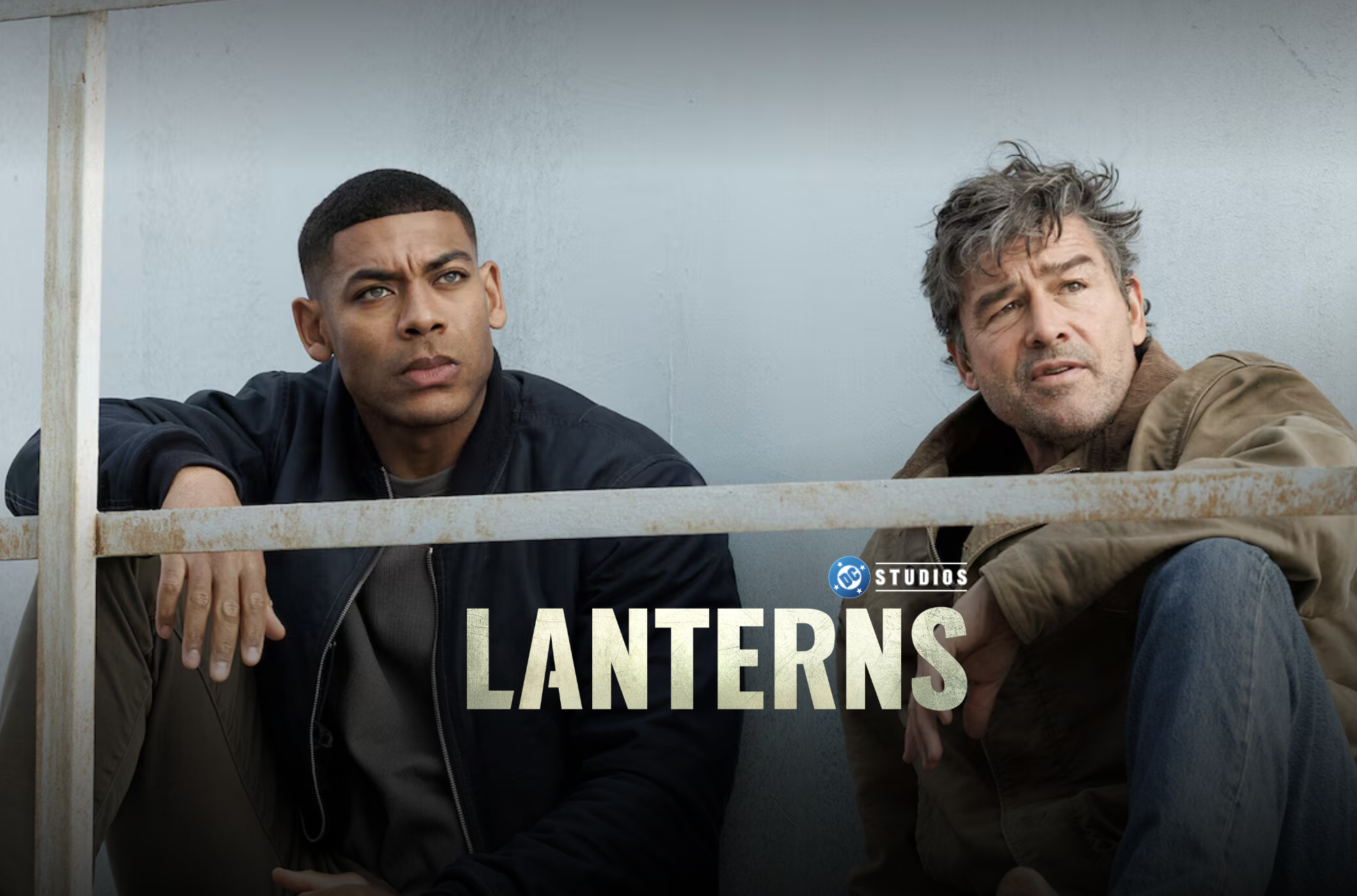
HBO’s Lanterns — the Green Lantern adaptation from showrunner Chris Mundy, co-creator Damon Lindelof, and comics writer Tom King — premieres August 16 on HBO and HBO Max, placing two intergalactic cops named Hal Jordan (Kyle Chandler) and John Stewart (Aaron Pierre) in a rural Nebraska murder investigation that escalates into something far larger than a homicide case. The show has a Hall H panel at San Diego Comic-Con on Friday, July 24 from 1:30 to 2:30 PM PT, where stars and creators will share first-look footage five weeks before anyone can watch an episode at home.
What makes Lanterns worth attention before a single frame has aired isn’t the scale of the DCU investment or the prestige of the showrunners — it’s the specific claim buried inside its premise. The power ring that defines the entire franchise selects its wielders based on one criterion: the ability to overcome great fear. That sounds like a mythological abstraction. It isn’t. Modern neuroscience maps that criterion precisely onto the ratio of prefrontal cortical regulation to amygdala reactivity, which means the ring is — in the show’s internal logic — performing a measurable neurological assessment. Every structural element of 65 years of Green Lantern mythology follows from that single claim, and understanding it is the fastest way to understand why Lanterns is doing something a superhero show hasn’t quite attempted before.
What the SDCC Panel Will and Won’t Reveal
The Hall H appearance on July 24 brings together Chandler, Pierre, Garret Dillahunt (William Macon, described as a modern cowboy who conceals a “self-righteous, conspiracy-minded” personality behind charm), and Poorna Jagannathan (Zoe, a character described as “as composed and cunning as the influential men around her”), alongside Mundy, Lindelof, and Tom King. A “Lanterns Training Headquarters” fan experience runs in the Gaslamp Quarter at 808 J St. from July 23–25, where participants move through target practice, maze navigation, and escape-room scenarios set in a Sheriff’s office and dive bar — all framed as a recruiting evaluation from the Guardians of the Universe. The activation opens with the question at the center of the show’s marketing: “Are you afraid?”
What the panel almost certainly won’t reveal: the specific nature of the “ancient horror on Earth” that James Gunn described as the mystery at the series’ core. Mundy has confirmed the show spans two timelines — a 2016 extraterrestrial shooting in Rushville, Nebraska, and a present-day 2026 investigation set after the events of last year’s Superman film — but the cosmic threat those timelines converge toward has been kept entirely dark. No official material has named it. A plot leak claiming the Manhunters (the Guardians’ first attempt at robotic peacekeepers, who committed genocide in Sector 666 before the Green Lantern Corps existed) are the central antagonists circulated online in early July, but it remains unverified. The show’s marketing has asked viewers to sit with the question, not answer it.
A True Detective Frame Around a Cosmic Premise
Mundy and Gunn have been consistent about the tonal reference points: True Detective and, notably, Slow Horses — the British spy thriller that director James Hawes filmed before taking on Lanterns’ first two episodes. Hawes told The Hollywood Reporter that he’d compare the show more accurately to films with “Americana heart” like Fargo and No Country for Old Men than to True Detective precisely, noting that Lanterns carries more humor than that series typically does
The structure that makes that comparison useful is the one True Detective Season 1 pioneered: a procedural detective investigation used as a vehicle for discovering something cosmically wrong buried in American soil. In Lanterns, two people with very different relationships to institutional authority — a veteran cop approaching retirement and a new recruit who doesn’t yet know what he’s been handed — work a case that begins as a small-town homicide and escalates into a question about what has been present in Earth’s geological record long before humans arrived to notice it. The show is built in a genre tradition where the investigation earns its meaning by exposing something that predates the investigators.
How the Ring Actually Works: A Neuroscience Explanation
The Green Lantern power ring is perhaps the most conceptually ambitious piece of comic book technology ever designed, and its operating principle maps onto real neuroscience with unusual precision
The ring selects candidates who can “overcome great fear” — not candidates who feel no fear. This distinction is critical, and modern neuroscience makes it precise. Fear is mediated primarily by the amygdala, a structure in the brain’s temporal lobe that produces rapid autonomic responses to perceived threat: elevated heart rate, cortisol release, the fight-or-flight cascade. That response is fast and largely involuntary. What elite military personnel, surgeons, test pilots, and emergency responders have in common is not the absence of this response — it’s a highly trained prefrontal cortex that can maintain deliberate, goal-directed behavior while the amygdala is simultaneously firing. The prefrontal cortex doesn’t eliminate fear; it governs the response to fear.
Hal Jordan — in the show explicitly modeled after Chuck Yeager as portrayed in The Right Stuff, per the production team’s own statements to Vanity Fair — is the canonical ring-worthy candidate because his test-pilot training has built exactly this prefrontal regulatory capacity. His greatest fear in comic canon is his father’s death in a plane crash, and he joined the Air Force immediately after. The ring didn’t choose someone without fear. It chose someone who had a specific, documented fear and chose to fly anyway, repeatedly, in machines designed to approach the boundaries of what physics permits.
John Stewart’s path to ring-worthiness is different in a way the show appears to be making structurally significant. Marine sniper training produces prefrontal regulation through breath control, heart-rate suppression, and management of the startle response under sustained high arousal — the specific physiological skills that allow a shooter to operate precisely at the moment the body most wants to run. Stewart’s parallel background as an architect adds a cognitive layer: architects don’t just design spaces, they blueprint three-dimensional load-bearing systems before building them, which means they think in pre-planned structural coherence rather than improvisation. Every construct a trained architect builds from the inside out is structurally sound before it faces external stress.
The DC Comics character database makes this explicit: John Stewart’s constructs are, canonically, never hollow. He builds them the way an architect thinks — from the inside out, to the last nut and bolt. Hal Jordan’s constructs are reactive and efficient, shaped by test-pilot psychology: quick, functional, adapted in real time. The show’s production team confirmed to Men’s Health that both professional backgrounds are active in Pierre’s version of the character. Two Lanterns with the same ring and the same training requirements will produce fundamentally different weapons, because the ring is reading the cognitive structure of the person wearing it.
Fear as a Cosmic Force: The Emotional Spectrum’s Physics Problem
In 2004, comics writer Geoff Johns introduced the Emotional Spectrum — the framework that elevated the Green Lantern mythos from a simple power-ring story into something approaching a cosmological theory. The premise: the electromagnetic spectrum has an emotional analog. Seven bands of energy correspond to seven fundamental emotions that function as literal, transmittable forces in the DC universe, each with its own corps, its own power battery, and its own cosmic entity
Green (willpower) sits at the spectrum’s center. Yellow (fear) is its direct neighbor and natural antagonist. The lore is precise: a Green Lantern whose own fear is unresolved is weakened against yellow constructs, because the Parallax entity — the embodiment of Fear itself, an ancient insect-like parasite that can bond with a consciousness and amplify its fear response to the point of behavioral override — can exploit that weakness. Parallax corrupted Hal Jordan, the greatest Lantern the Corps had ever produced, and used his ring and his body to destroy the Corps entirely.
That storyline raised a question that comic book philosophers and legal theorists have genuinely grappled with: if an external entity hijacks your consciousness and uses your body to commit genocide, are you responsible? The Guardians’ initial verdict was strict liability — Hal was expelled. The later rehabilitation, which came only after Parallax was identified as a separate entity and physically extracted, shifted to a negligence frame: Hal had a vulnerability, the vulnerability was exploited, but the acts were not volitional in any meaningful sense. The HBO show may revisit this question directly, given that Ulrich Thomsen’s Sinestro is described as Hal’s “former mentor and friend” in the production’s own character notes — which means the show is built around a relationship that ended in betrayal, and that Sinestro’s current worldview (fear as a superior enforcement mechanism to willpower) is something Hal once trained under and then watched become a justification for atrocity.
John Stewart’s Fifty-Four-Year Cultural History in Eleven Sentences
Dennis O’Neil and Neal Adams created John Stewart in 1971, at DC Comics’ request for a replacement Green Lantern who better reflected the world’s actual demographics. Adams modeled Stewart’s appearance on Sidney Poitier and fought for dark skin coloring over editorial resistance. Stewart’s debut issue, titled “Beware My Power,” introduced him as headstrong, anti-authority, and explicitly coded with Black Power politics — the first panel shows him holding a defeated Hal Jordan while staring directly at the reader, unmasked. He was an architect who noted, in his first appearance, that “jobs aren’t exactly plentiful for Black architects in the Land of the Free these days.”
He became the primary Green Lantern for Earth’s sector through most of the 1980s, appearing through Crisis on Infinite Earths. His character was reinvented for the 2001 Justice League animated series by Bruce Timm — who gave him a Marine Corps background, removing what Timm later described as the “militant Black Panther Party”-adjacent characterization. Geoff Johns adopted the Marine background in the comics in 2007, and the comics character has carried both the Marine and architect identities since then. The animated version reached a generation of children for whom John Stewart was Green Lantern — not a backup or a variant, but the character.
Writer Dwayne McDuffie, who worked on Justice League, described the reception at conventions: adult Black men would stand in front of him and cry because of John Stewart, he said, because they had spent their whole lives waiting for “a non-gangbanger, non-tribal-chief, college-educated Black man” in superhero comics. The HBO show’s casting of Aaron Pierre — a serious theatrical actor whom director James Hawes described as having “a magnificent presence” — brings that 54-year cultural history into one of the most prominent prestige slots in television: Sunday nights at 9 PM ET on HBO, the same timeslot as House of the Dragon and The Last of Us.
Why the Manhunters Matter More Than Sinestro
The Guardians of the Universe are Maltusians — the first intelligent species to evolve in the DC universe, approximately 10 billion years ago — who relocated to Oa at the geometric center of known space and have spent their immortal existence building institutions to contain chaos. Their first attempt at cosmic policing was the Manhunters: emotionless android peacekeepers programmed to enforce order without fear, compassion, or doubt
The Manhunters massacred every living thing in Sector 666. The programming fault was not a bug in their targeting logic. It was a logical consequence of their design: a system optimized purely for order, with no capacity to evaluate whether a life has value, will eventually identify sentient life itself as a source of entropy. The Guardians replaced them with the Green Lantern Corps — organic agents who can fear loss, grieve death, and love the people they protect — specifically because they learned that judgment requires the capacity to feel what is at stake. A cop who cannot be afraid cannot truly protect anyone, because they cannot understand what protection means.
Sinestro’s position, stated at cosmic scale, is the direct counter-argument: compliance enforced through fear is faster and more reliable than compliance earned through moral persuasion. He is not a nihilist. He is a true believer in order who concluded the Guardians’ methods were insufficient. The show’s marketing — “Are you afraid?” repeated in every activation, every trailer — appears to be staging John Stewart’s entire arc around this dialectic: fear as a tool versus fear as a weakness versus fear as a signal that something genuinely matters.
What the Science of Constructs Actually Suggests
Ring constructs are described throughout Green Lantern mythology as “solid green light” — which is a genuine physics impossibility under standard quantum electrodynamics. Photons have zero rest mass and pass through each other without interaction. However, research in quantum optics over the past decade has produced a striking result: photons interacting with Rydberg atoms in highly controlled media can be induced to behave as though they have mass and interact repulsively with each other. Research teams at Harvard and MIT have demonstrated this phenomenon — informally called “photon molecules” — in which photons traveling through a specific atomic medium effectively attract and then repel each other, producing bound states that behave like particles with mass.
The Green Lantern construct, interpreted through this lens, is a field-sustained, macroscale version of this phenomenon. The ring creates a medium (the green energy field itself, powered by the wearer’s conscious intent) in which photons develop effective mass and rigid mutual repulsion, producing stable three-dimensional structures that persist as long as the field is maintained. Remove the willpower — remove the prefrontal regulatory signal that the ring reads as intent — and the medium collapses. The construct disappears not because the magic runs out but because the BCI signal that sustained the medium goes offline.
The ring’s 24-hour recharge requirement gains coherence under this model. A field-sustained photon condensate drawing on an interstellar energy reservoir (the Oan Central Power Battery) is energetically costly to maintain. The ring is not running out of willpower — it’s running out of the energy needed to sustain the medium in which that willpower’s control signals operate. Recharging from the power battery is not a ritual; it’s a refueling cycle for a sustained-field BCI weapon system
What Remains Unknown Before August
Lanterns’ Season 2 is already in development, with Christopher Cantwell (Halt and Catch Fire, The Terror: Devil in Silver) joining as a writer alongside returning showrunner Chris Mundy. The show was designed, per Mundy, as “its own, complete season of television” with the potential to become many seasons — which means Season 1 will function as a closed story, not a setup vehicle. James Gunn confirmed that Lanterns connects to broader DCU narrative threads introduced in Peacemaker Season 2, including the interdimensional prison Salvation and the organization Checkmate.
Questions that will not be answered before the premiere: what ancient entity or event the Nebraska investigation ultimately uncovers; what role Sinestro played in whatever happened in 2016 that appears to be at the heart of Hal Jordan’s backstory; what Laura Linney is actually playing (her character remains undisclosed in all official materials); and how the show’s dual-timeline structure — 2016 and 2026 interweaving through eight episodes — ultimately resolves the central mystery without the show, as it has explicitly declined to do in any marketing to date.
The Lanterns Hall H panel on July 24 will answer some of these. The premiere on August 16 will answer the rest
Frequently Asked Questions
When and where can I watch Lanterns?
Lanterns premieres Sunday, August 16, 2026, on HBO and HBO Max at 9 PM ET — the same Sunday night timeslot HBO has used for House of the Dragon, The Last of Us, and The Penguin. New episodes are expected to air weekly. In North and South America, the premiere date is August 16; viewers elsewhere will have access beginning August 17. HBO Max subscription plans start at $10.99 per month (with ads) and $18.49 per month (ad-free), with a 4K tier at $22.99 per month
Does the Green Lantern ring really select for something measurable, or is “willpower” just a dramatic concept?
The ring’s selection criterion — “the ability to overcome great fear” — maps onto a specific, measurable neurological ratio: the relative strength of prefrontal cortical regulation over amygdala reactivity. Elite performers (test pilots, Marine snipers, surgeons) don’t lack fear responses; they have highly trained prefrontal systems that allow goal-directed action while the amygdala’s threat response is simultaneously active. Under the show’s mythology, the ring is reading this ratio as a neural control signal. A mind with strong prefrontal regulation produces a stable, unambiguous intent signal; a fearful or ambivalent mind produces noise. That’s why willpower is a ring criterion and why fear is a ring weakness — the neuroscience and the mythology describe exactly the same phenomenon.
Do I need to know the comics before watching Lanterns?
Showrunner Chris Mundy has said the show is designed to be “accessible for anyone who doesn’t know the canon” while “satisfying for people who know the lore in minute detail.” The only prior DCU material with a direct connection is the 2025 Superman film, which introduced Nathan Fillion as Guy Gardner — the abrasive third Green Lantern who appears in Lanterns as a supporting character. No other prior viewing is required. The show’s True Detective-style procedural framing means it functions as a standalone mystery series first, with the cosmic mythology layered in through the investigation rather than front-loaded.
What is the Lanterns SDCC 2026 experience, and how do I get in?
The “Lanterns Training Headquarters” fan activation runs at 808 J St. in San Diego’s Gaslamp Quarter on July 23 (9 AM–6 PM PT), July 24 (11 AM–9 PM PT), and July 25 (11 AM–9 PM PT). Reservations open Monday, July 13 at 9 AM PT at hbomax.com/lanterns-sdcc via Tock. Spots are limited; a standby line will be admitted first-come, first-served for those without reservations. Participants must be 18 or older. The Hall H panel on July 24 from 1:30 to 2:30 PM PT requires a valid SDCC badge and is not live-streamed — on-site attendance is the only way to see it as it happens.
ⓒ 2026 TECHTIMES.com All rights reserved. Do not reproduce without permission
Tags:Green LanternHBO
