

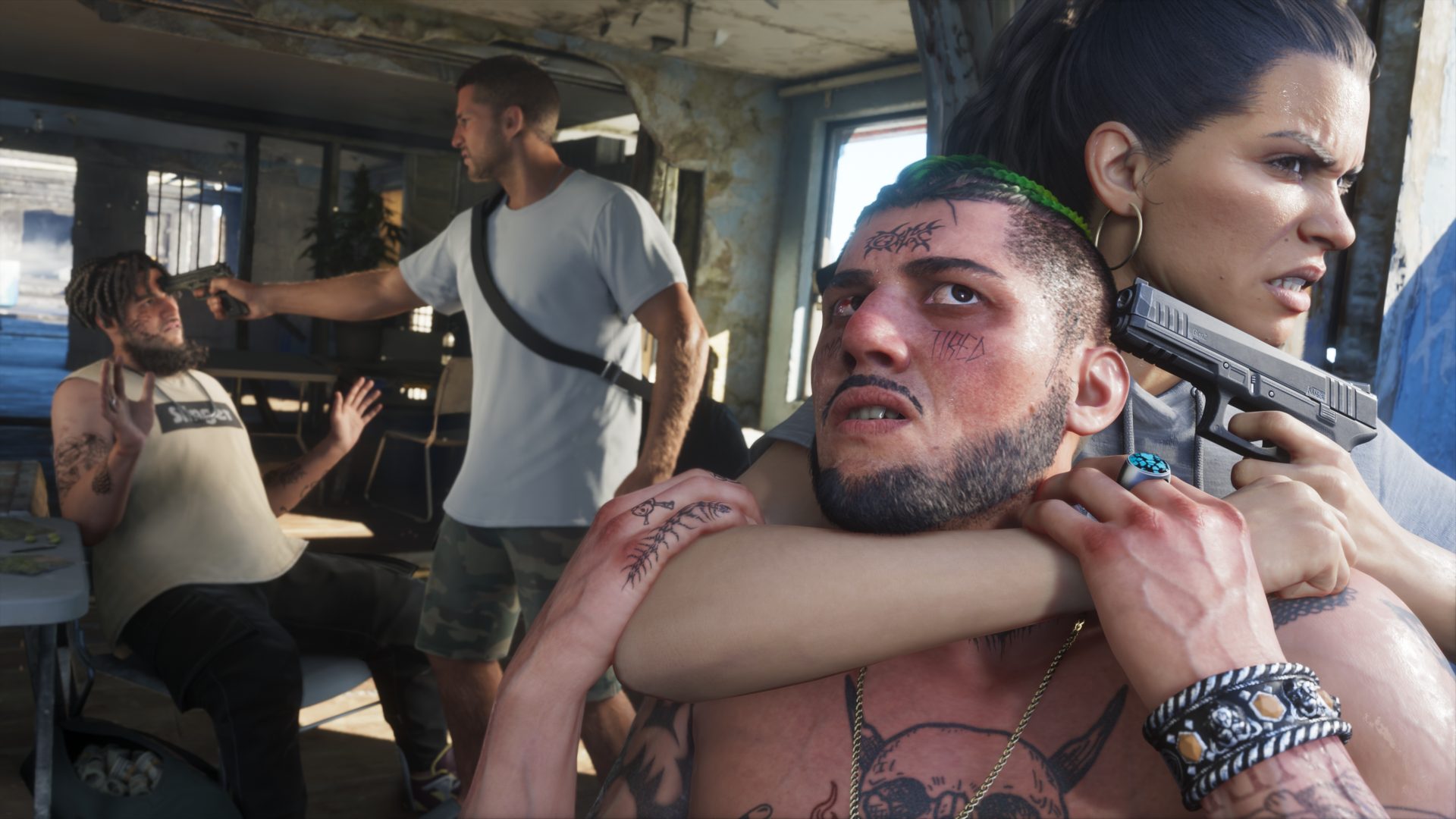



During Grand Theft Auto VI‘s review period, Rockstar Games offered us the chance to send some questions to the developers. Being a tech-focused website, there was a lot we wanted to know about the studio’s design goals for this iteration of the RAGE engine.
Did they try to achieve a frame rate higher than 30 frames per second? What were the rendering resolutions for each system? What kind of challenges did adding ray traced global illumination present, and what was their approach to HDR support?
All of these questions are answered below in a lengthy statement crafted by Jonathon Ashcroft– Senior Vice President of Technology, Chris Oat – Technical Director: Engine and Graphics, and Marc Chambers – Technology Production Director.
It became clear early on that given the scale of the team’s ambition, we’d be targeting 30fps on this generation of hardware. We’ve put a lot of effort into balancing presentation, simulation, and gameplay, as well as ensuring the input latency is vastly improved vs. Grand Theft Auto V and Red Dead Redemption 2. Part of that process was determining our base resolution and upscaling solution. We evaluated a variety of approaches for each console, then selected a combination of each that gave us the look and performance we needed.
- On the PlayStation5 and the Xbox Series X, we’re upscaling a base resolution of 1440p to 4K using our in-house TAA solution.
- On the Xbox Series S, we’re starting from a base resolution of 720p, which is scaled to 1080p using AMD FSR Upscaling 4 (editor’s note: released just weeks ago on Xbox Series).
- On PlayStation5 Pro, we’re taking advantage of PSSR2 to upscale from a base resolution of 1440p to 4K.
On all platforms, the picture is then composited with a 4K UI and presented. For each console, we’ve arrived at our solution through careful evaluation of both the visuals and the performance. We built our core lighting, frame processing, and final presentation pipeline with both HDR and SDR support in mind from the outset. We calibrated our engine’s in-game light and artificial light
We also built a new physically-based material library used to represent every material type you will see in game. From the way muddy alligator skin glistens in the Leonida sunshine, to the way hair and clothing reacts to the dynamic light shows in a nightclub, and the complex lighting interactions of exotic vehicle paint zipping under highway street lights — it was all built to behave according the physical laws of light. Finally, that rendered frame goes through an imaging pipeline modelled after real word cinematic camera and film treatment, much like you would expect of a modern movie. The aim is always to try and create and preserve emersion for the player, so they can experience it as the team imagined it, whether they are experiencing the game in HDR or SDR.
This focus on lighting made it vital for us to ensure we could use the same lighting solution on each console, including the Xbox Series S, where memory pressure posed a bit of a challenge. The results made that a challenge worth overcoming. There are indeed some differences between the implementations per console, as we rebalance the RTGI features to achieve the best presentation based on each platform’s capabilities. As with everything, we tune on a given piece of hardware to achieve the presentation we’re looking for, so there’s no single solution.
I also asked Rockstar a couple of more artistic questions, which were answered separately by the studio’s VP of Art, Michael Kane. You can find them below.

The game’s corners of the screen often seem a little darkened, kind of like a vignette effect. Can you confirm that’s the case? If so, would it be possible to add it as a toggle option for those who dislike it?
Michael Kane, Vice President of Art: Dynamic: The vignette effect is an artistic choice. We currently do not support any toggle, but we have recently identified and fixed an issue where it was becoming stronger than intended in certain circumstances.
In key Grand Theft Auto VI artworks, Jason looks very different from the in-game character, whereas Lucia looks much closer. How did your design for each character evolve through development, and did you have any specific references or inspirations that you can share?
Michael Kane, Vice President of Art: Dynamic: There could typically be a perceptual interpretation of the key art versus in-game, especially for Jason… because both of them are so customizable, we think many players will maybe want ‘their Jason’ to have a mustache or long hair in a certain style or colour etc when they play. So far, we’ve only seen those more diverse looks on him in screenshots and not key marketing art, so that’s the best anchor point for our intention for him – that’s his ground truth, in-game.
Thank you for your time.
About the author: With over two decades of experience in gaming journalism, Alessio Palumbo has led the gaming vertical at Wccftech since August 2015. He started working at a young age for Italian websites like Everyeye.it, Gamestar.it, Nextgame.it, and Multiplayer.it before kickstarting the indie English-language publication Worlds Factory as its founder and Editor in Chief.
In the last decade, he has coordinated the overall output of Wccftech’s gaming section, managed PR relations, assigned reviews, produced daily news coverage, edited gaming content as needed, and delivered game reviews.
Arguably, his trademark content is the long series of exclusive developer interviews that have been cited by Wikipedia and by the biggest news media and gaming publications.
His passion for technology also makes him knowledgeable when it comes to gaming hardware and tech. His favorite genres include RPGs, MMORPGs, and action/adventure games.
Follow Wccftech on Google to get more of our news coverage in your feeds.
