

Image: Screenshot/Scarlet Spider
, one of the biggest buzzes in the comic book world surrounded a brand-new miniseries featuring Godzilla attacking Texas, appropriately titled Godzilla vs. America: Texas (Godzilla vs. Texas on the covers). The King of the Monsters, among the most recognizable fictional characters on Earth, would tromp through the Lone Star State fighting other kaiju (Japanese for “monsters”) while wrecking beloved institutions. One variant cover by Austin-based artist Matt Frank promised Godzilla vs. Houston, with the monster eating a space shuttle over I-45’s iconic “Be Someone” graffiti.
But it never happened.
Godzilla decimated Austin, San Antonio, Corpus Christi, and Dallas (twice), but didn’t find time in his busy mayhem schedule for the state’s largest city. What gives?
Dylan Dusebout, marketing manager and event organizer for Bedrock City Comics, originally requested the variant cover from Godzilla vs. Texas’s publisher, IDW. He recruited Frank to make it as an homage to Houston (Frank began making Godzilla fan art in 2007, before becoming arguably the best-known official artist for the monster in America). But when Dusebout asked IDW if ‘Zilla would ever hit here, the publisher evaded the question. IDW did not immediately respond to a request for comment.
“It’s really a shame that Houston doesn’t appear properly in the book,” Frank said in an email. “As I understand it, the other artists weren’t locked in until kind of late in the process, and two of them happened to be Dallas residents (hence the repeated location). I suggested a few Houstonian artists when the initial plans were discussed, but IDW could have been looking for a particular combination of artistic styles, experience, and availability.”
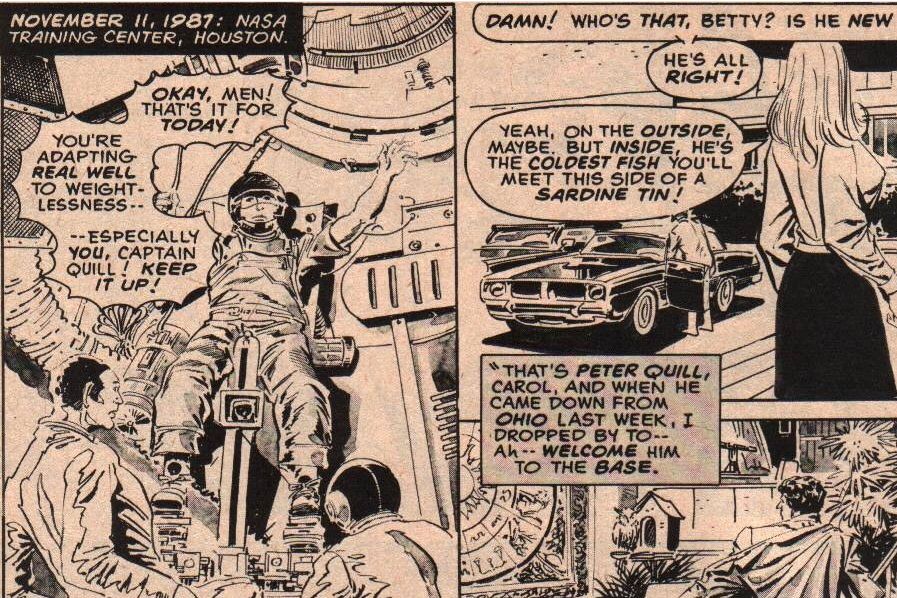
Houston often ends up left out of the pages of comics. A mention of Space City is so rare that its entire history as a comic book location fits in a single article. As far as our research could uncover, the city’s first appearance was in Marvel Preview #4in January 1976, which also marked the first appearance of future Guardian of the Galaxy, Star-Lord (aka Peter Quill). His original incarnation is far darker than the irreverent outlaw played by Chris Pratt in the Marvel Cinematic Universe. After Quill’s father doubts his newborn son’s parentage and dies of a heart attack trying to kill the baby with an axe, he grows up disassociating constantly about alien worlds to escape a grim childhood with his loving, mentally ill mother.
Image: Screenshot/Starlord
After she gets killed by invaders in a flying saucer, a grown-up Quill moves to Houston to undergo astronaut training. A bitter and angry man, he makes many enemies despite his excellence. Eventually, he leaves Space City for actual space—and his ultimate career as a superhero. And that would, more or less, be the last time Houston mattered in comics for 15 years.
That changed when local creator Terry Moore self-published his serial Strangers in Paradise. From 1993 to 2007, the story tackled the love lives of queer Houstonians involved with an international assassination organization. Strangers in Paradise is one of the most influential comics of all time, paving the way for modern, creator-owned indie publishing and LGBTQIAP+ representation. Everyone from Brian K. Vaughn (co-writer of Dune3) to Stjepan Šejić (writer of the DC Black Label Harley Quinn comic Harleen) were inspired by Moore, but none of their stories ended up in Houston. The town that made Strangers in Paradise come to life was still a wasteland.
Indie comics continue to be where Houston gets the most attention. Film director, writer, and photographer Gary Watson, who grew up here, conceived of his dystopian story, After Twilight, after witnessing the growing appreciation for Christian nationalism in the early 2000s. He released a short-film version in 2004 and adapted it into a self-published six-issue comic that came out in 2012.In the series, the entire state of Texas is under an authoritarian theocracy, and an underground resistance made up of marginalized people takes up the fight.After Twilightalso eerily predicted SB8, the 2022 Texas law that rewards people who turn in those who have any involvement with abortions. It includes a gruesome scene where a sexual assault survivor is stoned to death by having a dump truck drop masonry on her.
Watson says Houston’s diversity was a key factor in his decision to set the story in his hometown. In a way, it’s the logical evolution of Moore’s version of the city. “If anyone were to ask me which city in Texas would be most likely to have a multicultural movement rise up against a dystopian state government, Houston…would be my best bet,” he says. “I’d imagine some of the population of Houston would embrace this new government, but it would be rejected by many others, especially those who would be marginalized by a patriarchal theocracy.”
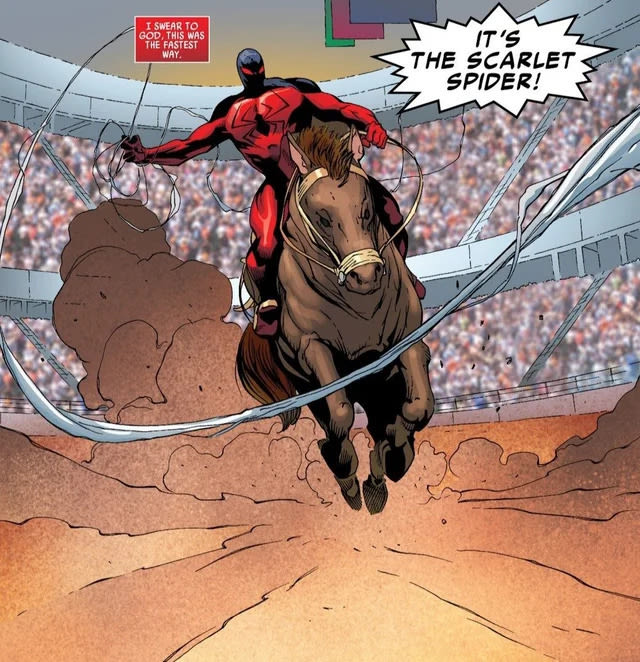
The same year that Watson published After Twilight, Houston would return to the pages of Marvel comics in a big way with its first dedicated Big Two superhero. Character Kaine Parker began as one of the many clones of Spider-Man, launching as a murderous villain before undergoing a redemption arc and trying to escape the country. On his journey south of the border, his stop in Houston turned into a series of heroics as the latest incarnation of the Scarlet Spider. The series bearing his name ran for 25 issues.
Scarlet Spider was a modest hit. It was definitely fun to see a web-slinger try to get across Houston’s flat landscape with comparatively fewer skyscrapers than the other big cities. Kaine often hitched rides on top of cars on the freeways, swearing at the traffic. Writer Christopher Yost and artist Ryan Stegman were keen to set a story outside of New York City and even traveled down to Houston to study the city. According to an interview in Outsmart, the two found eager fans on Twitter who suggested cool locations, especially in River Oaks and a scene at the Houston Rodeo.
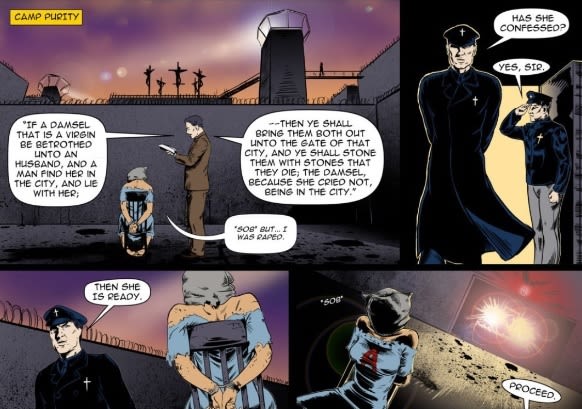
Image: Screenshot/After Twilight
It wasn’t technically the first time a Spider-Man had landed in H-town. In 1982, Foley’s paid to use Peter Parker and the Hulk in a comic-book-style advertisement that appeared in the Houston Chronicle and included a brawl at the Rodeo. However, it was barely a story and is not listed in the official Marvel database.
Building off the legacy of Strangersand After Twilight, a fair amount of Kaine’s supporting cast is queer. In fact, one could argue that LGBTQIAP+ themes are the defining aspect of Houston’s role in comics. Virtually every major appearance of the city involves queer representation—even, technically, Star-Lord’s, though he wasn’t revealed as bisexual until 2020.
That’s certainly true of 2022’s Made in Korea by writer Jeremy Holt and artist George Schall, the most recent story set here (or, at least, in the area). The graphic novel takes place in a near future where childbirth is extremely rare. Desperate couples have instead turned to raising android children. One of them, Jesse, gets shipped to a Conroe couple after a secret augmentation grants her full sentience. Unfortunately, freedom of thought leads her to befriend a pair of disturbed school shooters. Much of the storyline was inspired by Holt’s life. As a child, he traveled all over the country for his dad’s job in the oil industry. That included a stint in Montgomery County.
As Holt broke into the comics business, they recall struggling to tell stories that resonated with audiences. Writing about Houston, however, was the catalyst that helped them finally feel able to reach their full potential. “I had to take a long, hard look, and I realized I needed to write my own experiences,” Holt says. “So, I just started weaving in literal places I’ve been and literal experiences I had gone through.”
Texas sort of haunted Holt. It was the first place they experienced active shooter drills in schools as an IT professionaland served as the backdrop while he lived and worked in Houston as a non-binary person. Both were major influences on Made in Korea. In the book, Jesse undergoes a series of gender evolutions over the course of the story, a process inspired by Holt’s experience. If the book had been a bigger hit, its sequel would have explored that aspect more, Holt says.
But ever since Made in Korea, Houston has gone dormant again. Godzilla said he’d visit but never did. Holt and Frank believe that the deeper concentration of writers and artists in Austin is what’s keeping Houston from making a bigger splash. Still, there is a rich history of comics set in Houston, including an attention on LGBTQIAP+ representation that is frankly unique in the industry. It’s a place of unique stories and strange possibilities, on the rare occasion that someone sets a tale here.
