

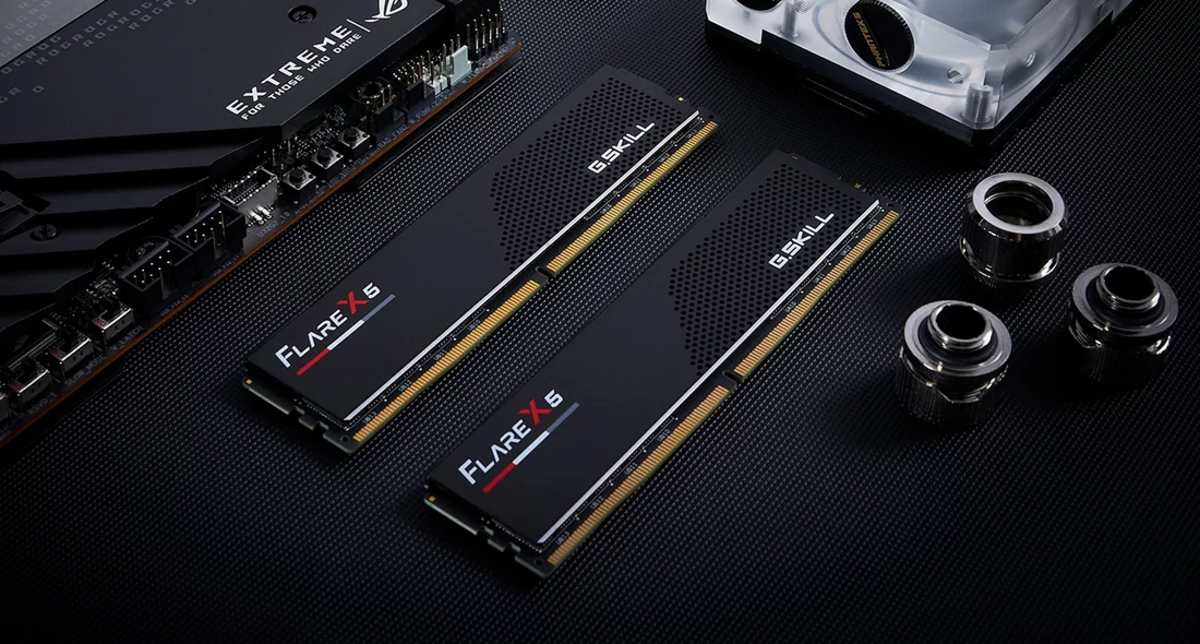
G.Skill <a href="https://www.back2gaming.com/news/g-skill-launches-flare-x5x-series-ddr5-memory-with-amd-expo-ultra-low-latency-support/” rel=”nofollow noopener” target=”_blank”>announced and began shipping the Flare X5X series on August 31, 2026, marking the second retail entry in AMD’s EXPO Ultra Low Latency ecosystem — and surfacing a specific piece of DRAM physics that every Ryzen builder making a memory decision right now should understand before spending anything. The Flare X5X improves on a standard EXPO DDR5-6000 kit not by running at a higher clock speed but by extending the interval between mandatory DRAM refresh cycles to roughly four times its standard length — a change that cuts real memory latency by 5 to 7 nanoseconds without touching the headline transfer rate. For non-X3D Ryzen builders, independent testing shows that translates to 7 to 15 percent more gaming performance at 1080p depending on the title. For Ryzen X3D owners, who are the majority of AMD’s high-performance desktop audience in 2026, it delivers near-zero benefit in most games — and that distinction is the most important thing this article can tell you.
What EXPO ULL Actually Changes at the Hardware Level
AMD’s EXPO — Extended Profiles for Overclocking — stores certified memory configurations in a reserved section of the module’s Serial Presence Detect (SPD) chip, the small onboard memory that tells the BIOS how to configure the memory controller at boot. Standard EXPO (version 1.1) stores the primary timings: clock frequency, CAS latency (CL), and three related values. The BIOS reads them, applies them, and the memory runs at its advertised speed with one toggle.
EXPO Ultra Low Latency — part of AMD’s EXPO 1.2 specification — adds four sub-timing parameters: tREFI, tRRDS, tWR, and VDDP voltage. Of these, tREFI is by far the most impactful.
tREFI is the refresh interval: the time between cycles in which the memory controller forces every DRAM cell to recharge the capacitor that stores its data. DRAM is dynamic precisely because those capacitors leak charge continuously and must be periodically refreshed or the data disappears. The JEDEC standard for DDR5 sets this interval at approximately 7,800 nanoseconds under standard operating temperature conditions. A typical standard EXPO profile runs tREFI at around 11,677 cycles (approximately 3,892 ns). The EXPO ULL profile in the Trident Z5 NeoX — the first EXPO ULL retail kit — extends tREFI to approximately 46,707 cycles (roughly 15,569 nanoseconds): about four times as long as the standard EXPO profile’s interval. This change comes directly from TechSpot’s published timing tables. During that extended window, the memory controller is not locked out servicing refresh housekeeping — it is available to handle CPU requests. That is where the latency reduction comes from.
The tRRDS timing is shortened from 8 to 4 cycles, reducing the delay between consecutive row activations in the same bank group and allowing faster sequential memory access patterns. The tWR reduction — from approximately 90 to 72 cycles — shortens how long the controller must wait between completing a write and issuing the next precharge command. These figures are confirmed in TechSpot’s full comparison. The VDDP voltage lock is a fourth addition that standard EXPO does not include: it fixes the voltage supplied to the memory controller’s I/O layer, which becomes important for stability when the controller is handling aggressive refresh intervals without the safety margin of frequent resets.
Why EXPO ULL Cannot Be Retrofitted
That VDDP addition points to something the explanation above understates: the reason EXPO ULL requires physically different memory is not arbitrary marketing — it is the physics of extended tREFI.
When tREFI is quadrupled, each DRAM cell must retain its charge state for roughly four times as long before the controller refreshes it. At higher temperatures, DRAM capacitors leak charge faster. A standard EXPO chip that passes its production tests at the standard tREFI may fail to retain data reliably at the extended interval, particularly as the system warms up. G.Skill addresses this by binning chips for stability — selecting and testing DRAM ICs that have been confirmed to sustain their stored data for the extended refresh window without errors across a specified temperature and voltage range. The VDDP lock then ensures the memory controller itself remains stable under these conditions.
This is not a software optimization that can be downloaded or a setting that can be unlocked is a physical prerequisite. Any standard DDR5-6000 kit running manual tREFI extension at similar values without this binning would be gambling with data integrity at load temperatures
What the Flare X5X Actually Specs Out At
The debut Flare X5X configuration is a 32 GB (2×16 GB) kit running at DDR5-6000 with CL36-36-36-76 primary timings. G.Skill has not confirmed a specific DRAM IC vendor at launch — details that matter for comparison shopping, since the secondary timing profile varies across G.Skill’s lineup. For reference, the Trident Z5 NeoX CL36 ULL kit — a different series using the same EXPO 1.2 specification — also ships with CL36-36-36-76 primary timings but carries a tighter secondary timing set at other positions, as confirmed by independent timing table analysis. Whether the Flare X5X matches that full secondary profile or ships with a different configuration has not been confirmed; buyers comparing listings should verify before assuming parity.
What is confirmed: the modules carry no RGB lighting, use a black PCB and flat dark metal heat spreaders, and measure at standard DIMM height — a practical choice for builds using large air coolers with limited clearance. G.Skill has stated every kit undergoes in-house validation testing before shipment.
How Much Faster Is It — and for Whom
AMD’s internal testing, conducted on a Ryzen 7 9700X across more than 30 games at 1080p, claims a 4 percent average FPS improvement over a standard EXPO DDR5-6000 configuration and a 13 percent improvement over JEDEC-default DDR5. AMD published these Computex claims and attributes the testing internally.
Independent testing from TechSpot, published July 15, 2026 and covering five games across the Ryzen 7 9700X and Ryzen 7 9800X3D at both 1080p and 4K, shows a more textured picture. On the Ryzen 7 9700X (a non-X3D chip), the CL36 EXPO ULL kit delivered:
- Cyberpunk 2077 at 1080p: 7 percent higher average frame rates
- Marvel Rivals at 1080p: 9 percent higher average frame rates
- Assetto Corsa Competizione at 1080p: 8 percent higher average and 11 percent higher 1% lows
- Baldur’s Gate 3 at 1080p: 15 percent higher average frame rates
- Marvel’s Spider-Man 2 at 1080p: 9 percent higher average frame rates
On the Ryzen 7 9800X3D, the same CL36 EXPO ULL kit produced:
- Cyberpunk 2077 at 1080p: virtually no improvement (1 percent)
- Marvel Rivals at 1080p: 2 percent — within noise
- Assetto Corsa Competizione at 1080p: 3 percent average
- Baldur’s Gate 3 at 1080p: 9 percent — a genuine exception
- Spider-Man 2 at 1080p: 11 percent — another exception at heavy ray tracing load
At 4K across nearly every title and both CPUs, performance was effectively flat — the GPU was the bottleneck regardless of memory timing. TechSpot’s 4K results show memory configuration made no meaningful difference at that resolution.
The X3D pattern is structural: the 9800X3D’s 96 MB of stacked L3 cache dramatically reduces how often the processor needs to access main memory. In most gaming workloads, the chip sees DRAM so infrequently that optimizing its latency has little effect. The exceptions — Baldur’s Gate 3 and Spider-Man 2 at 1080p — are games whose AI processing and asset streaming impose DRAM access patterns that the cache cannot fully absorb. For the majority of games at the resolutions most buyers use, the X3D cache renders EXPO ULL investment unnecessary.
What Motherboard BIOS You Need
Enabling the EXPO ULL profile requires a BIOS that incorporates AGESA 1.3.0.1 or later — the AMD firmware layer that adds the ability to parse the expanded EXPO 1.2 profile stored in the module’s SPD. Without it, the memory boots at its standard SPD speed and the ULL profile is simply ignored.
ASUS, MSI, and Gigabyte have pushed AGESA 1.3.0.1b updates to both 800-series (X870, B850) and 600-series (X670, B650, A620) boards. Coverage on 600-series boards varies by specific model — check your motherboard manufacturer’s release notes before purchasing an EXPO ULL kit, as some 600-series models are still awaiting updates. ASRock has also released 1.3.0.1b builds for supported AM5 models.
This means buyers with older X670 boards are not necessarily excluded, but they need to confirm their specific board has received the AGESA 1.3.0.1 or 1.3.0.1b update before expecting EXPO ULL to function.
Does EXPO ULL Need to Deliver Perfection for the Flare X5X to Be a Buy?
No — but the pricing context does.
When G.Skill’s first EXPO ULL kits (the Trident Z5 NeoX series) appeared at retail in late June 2026, the CL28 configuration reached $999.99 for 32 GB — 79 percent above standard kits. AMD VP David McAfee had stated at Computex that EXPO ULL kits would be priced “effectively the same” as standard EXPO memory. That expectation was not met at launch.
The pricing pressure is structural. AI demand has redirected DRAM capacity toward high-bandwidth memory and server DDR5, shrinking supply of consumer memory significantly. IDC projects 2026 DRAM supply growth at 16 percent year-over-year — below historical norms. SK Hynix’s CEO warned in July 2026 that supply will lag demand for years. Analysts across the board do not expect meaningful consumer DRAM price relief before mid-2027.
G.Skill has not announced pricing for the Flare X5X specifically. Given the Trident Z5 NeoX CL36 pricing pattern, Tom’s Hardware estimates the Flare X5X CL36 may settle at approximately $509.99 — roughly $10 above the standard Flare X5 series — if G.Skill follows a similar pricing structure. That price has not been confirmed, and buying before pricing is disclosed adds unknown-premium risk on top of an already expensive market.
Who Should Buy the Flare X5X — and Who Should Wait
If you are building or upgrading an AM5 system around a standard Zen 5 chip — a Ryzen 7 9700X, Ryzen 9 9900X, or similar non-X3D processor — and you are gaming primarily at 1080p in CPU-bound conditions, EXPO ULL is a real performance lever. The TechSpot data shows 7 to 15 percent gains across tested titles, with the strongest improvement in heavily threaded workloads like Baldur’s Gate 3. The Flare X5X makes that improvement available without manual sub-timing tuning in the BIOS.
If you are running a Ryzen X3D processor — a 9800X3D, 9700X3D, or any chip in the X3D line — EXPO ULL almost certainly does nothing for you in the vast majority of games. The L3 cache is absorbing the memory bottleneck that EXPO ULL targets. Spend the money elsewhere.
If you are gaming at 4K in GPU-limited conditions — which describes most high-resolution gaming rigs — the memory timing is irrelevant regardless of CPU. Save the premium entirely.
If you are building or upgrading and the timing can wait: TechSpot’s advice is to avoid DDR5 purchases at current prices if at all possible. Analysts do not expect consumer DRAM prices to ease before mid-2027. The Flare X5X’s value proposition is only meaningful once its specific price is known — and that price has not yet been disclosed.
Frequently Asked Questions
What is AMD EXPO ULL, and how is it different from standard EXPO?
Standard EXPO (version 1.1) stores the primary memory timings — clock frequency, CAS latency, and a few related values — in the module’s SPD chip, enabling one-click overclocking to the advertised speed. EXPO Ultra Low Latency (EXPO 1.2) extends that stored profile to include additional sub-timings: most importantly tREFI (the refresh interval), tRRDS (row-to-row delay), tWR (write recovery time), and a VDDP voltage lock. The practical result is that the memory controller spends less time in mandatory refresh cycles and more time serving CPU requests, cutting effective latency by 5 to 7 nanoseconds compared to a standard EXPO kit at the same frequency — confirmed by TechSpot benchmarks — without any manual BIOS tuning.
Does EXPO ULL help if I have an AMD Ryzen X3D processor?
In most games, no — and this is the single most important caveat for 2026 buyers. Ryzen X3D processors stack up to 96 MB of additional L3 cache on top of the standard Zen 5 die, which dramatically reduces how often the CPU needs to access main memory during gaming workloads. TechSpot’s independent testing found near-zero performance differences between standard EXPO and EXPO ULL on the Ryzen 7 9800X3D in titles like Cyberpunk 2077 (1 percent) and Marvel Rivals (2 percent). The exceptions are heavily CPU-bound workloads like Baldur’s Gate 3 (9 percent on 9800X3D) and Spider-Man 2 at 1080p with ray tracing (11 percent). If you own an X3D chip and play a broad game library, EXPO ULL is not recommended as a priority purchase.
What BIOS version do I need for EXPO ULL to work on my AM5 motherboard?
Your motherboard BIOS must include AGESA 1.3.0.1 or later — the AMD firmware update that enables the motherboard to parse the expanded EXPO 1.2 profile data stored in EXPO ULL memory. Without it, the kit boots at its standard SPD speed and the ULL profile is ignored. ASUS, MSI, and Gigabyte have released AGESA 1.3.0.1b builds for both 800-series (X870, B850) and 600-series (X670, B650, A620) AM5 boards, but coverage varies by specific model. Check your motherboard manufacturer’s support page for a specific BIOS release that lists EXPO ULL or EXPO 1.2 support before purchasing.
Is it worth buying EXPO ULL memory in the current DDR5 market?
Only if your CPU and use case can benefit (see above), and only once pricing for the Flare X5X specifically is announced. The broader DDR5 market in 2026 is in a historically inflated state driven by AI data center demand diverting DRAM wafer capacity away from consumer channels. Mainstream 32 GB DDR5-6000 kits cost $399 to $479. TechSpot explicitly recommends against DDR5 purchases unless unavoidable. Analysts see no relief before mid-2027. G.Skill has not yet disclosed Flare X5X pricing. Until that number is public, any buying calculation is incomplete.
ⓒ 2026 TECHTIMES.com All rights reserved. Do not reproduce without permission.
