

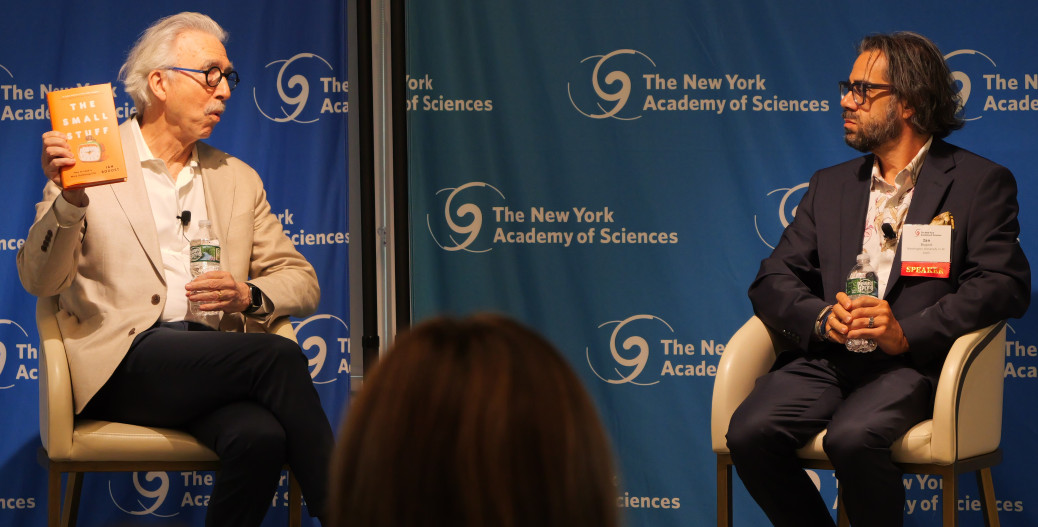
Academic and writer Ian Bogost dives into the philosophical dimensions of AI, including how to break the “efficiency loop” in favor of meaningful experiential learning opportunities.
Ian Bogost, PhD, the Barbara and David Thomas Distinguished Professor at Washington University in St. Louis and a contributing writer at The Atlantic, joined Academy President and CEO Nick Dirks for a wide-ranging discussion about video games, artificial intelligence, and culture. Their “fireside chat” was part of the 2026 Blavatnik Science Symposium. It comes on the heels of Prof. Bogost’s recently published book The Small Stuff: How to Lead a More Gratifying Life.
Prof. Dirks began the talk by focusing on Prof. Bogost’s early days as a video gamer, and how his interest in games in the 1980s influenced what has become an immensely interdisciplinary academic career.
“I was interested in art and literature and computing. I grew up with the microcomputer which was a terrific blessing,” Prof. Bogost said. “Games were like this place where art and creativity and computation met. That was what interested me about it, not the games themselves.”
“Living in a Simulation”
The 1999 blockbuster film The Matrix took the idea of “living in a simulation” from the fringe to the mainstream. This theory was further developed in philosopher Nick Bostrom’s 2003 paper Are You Living in a Computer Simulation?
Prof. Bogost saw these connections between gaming and simulation, specifically when building computational systems that depicted something in the real world. An example of this might be a golf video game. He said that he often applied his humanities background to his work in the technology and media industries in the late 90s and early aughts.
“This idea was very familiar. What human beings do when they construct art of any kind, or anything really, is they create accounts of reality and we call that representation,” said Prof. Bogost. “So there’s not really truth as such, or at least not in the simple way, but we create it in part through the ways that we express and give form to our ideas of the world.”
Applications to Early AI
The ideas around simulation theory and representation theory can be traced back to the origins of AI. The concept of AI was first coined by computer scientist John McCarthy at Dartmouth College in the mid-1950s as he and his colleagues were pondering ideas around whether machines could exhibit intelligent behavior. While this may seem adjacent to the “imitation game,” as developed by computer pioneer Alan Turing, Prof. Bogost points out that he thinks many people misinterpret Turing’s intent. Instead of debating whether machines can be intelligent, Prof. Bogost argues that the true test should be whether a machine can be interesting, compelling, and persuasive.
“The imitation game is a way of asking if a machine can act like something else in a compelling way,” said Prof. Bogost. “It’s no accident that Turing designed one of the precursors to modern general computation…We ended up with all of these machines that were giving us versions of other sorts of machines.”
For example, a digital spreadsheet today is similar to an analog ledger a century ago. A computer’s word processor software replicates a typewriter. The new technologies transform these old machines into representations that perform different tasks and have different assumptions. All of this connects to engineering in general where the focus may be as simple as does it work?
“And that’s the connection to games and simulation as representation. Is this interesting? Does it fit the bill for the context in which it’s being used?” Prof. Bogost pondered.
He recalled in the early aughts as this technology improved, people began thinking about practical ways simulation could be applied to real-world scenarios. One example of this was fluid and gas dispersion models that might be used by first responders in crisis planning and training scenarios.
Blurring the Line Between Reality and Representation of Reality
Prof. Dirks pointed out that part of scientific research has always involved developing models to isolate and identify certain issues, problems, and questions. While AI technologies like large language models (LLMs) are subject to hallucinations, thereby redefining our understanding of truth, they are fundamentally what we think of as human.
“The human propensity for language and the like is precisely what makes powerful language models begin to invite questions about whether superintelligence will develop at this new level,” said Prof. Dirks. “This, I think, is a perversion of the way in which Alan Turing talked about the Turing Test but it’s nevertheless a way of thinking about will machines become not just more intelligent but will they take over from humans.”
Prof. Bogost said that AI technologies can straddle the line of being both a reality and a representation (of reality).
“When a system uses a complicated, probabilistic model to produce stochastic textual output based on effectively the sum total of human knowledge produced under any circumstances, that doesn’t make it less of a take on the world. It’s just a particular one that will color the way we experience the world by means of it,” said Prof. Bogost.
Robot Rock: The Role of AI in Music Production
Last summer, Prof. Bogost penned an article in The Atlantic provocatively titled “Nobody Cares If Music Is Real Anymore.” In the article he examined Velvet Sunrise, an AI rock band that eventually garnered more than 850,000 monthly listeners on Spotify.
“As for the music: You know, it’s not bad,” Prof. Bogost wrote. “It’s not good either. It’s more like nothing—not good or bad, aesthetically or morally.”
During his fireside chat at the Academy, Prof. Bogost explored more of the philosophical dimensions around AI music. For example, even though some referred to the Velvet Sunrise as a “fake band” the music it created was real. Prof. Bogost argues that “the function of music culturally” has changed so much in recent years that it can be difficult to assess realness or fakeness. He further argues that services like Spotify enable listeners to “vanish into ambiance,” instead of more actively digesting music, which he thinks makes realness versus fakeness less of a factor.
“This is an example of: Will the AI take over? Will it ruin culture?” Prof. Bogost pondered. “But that’s actually not the complete story is it? The table was already set for some of those changes to be palpable and palatable to people.”
Prof. Bogost said this music example is part of a broader paradigm shift seen with LLMs and other AI technologies.
“If we were a little less focused on outcomes, and accomplishments, and goals. And a little more focused on the experience of doing things, we would all be better off,” said Prof. Bogost.
Breaking the “Efficiency Loop”
The talk concluded with a question-and-answer session from attendees. Prof. Bogost fielded questions on everything from creating effective regulatory and economic policy around AI to dispelling the notion that AI is irrevocably damaging the learning and creative process for the younger generation. Prof. Bogost concluded the talk with some guidance on breaking the “efficiency loop” in favor of devoting time to meaningful experiential learning opportunities.
“We got ourselves stuck in this efficiency loop and now we have this set of efficiency machines that help us remain stuck in that loop. Even as we use them, we need to give ourselves space to do invention, and thinking, and creativity, including us making new science,” said Prof. Bogost. “I don’t know that the best way forward is producing more scientific studies and papers as rapidly as possible by means of these technologies either. Otherwise, we’re just as guilty as the supposedly cheating students.”
Watch Ian Bogost’s interview on Shaping Science with Nick Dirks.

Nick Fetty
Digital Content Manager
Nick is the digital content manager for The New York Academy of Sciences and editor of the Shaping Science with Nick Dirks podcast. He has a BA and MA in journalism from the University of Iowa as well as more than a decade of experience in STEM communications. Nick is also an adjunct instructor in mass media at Kirkwood Community College.
