

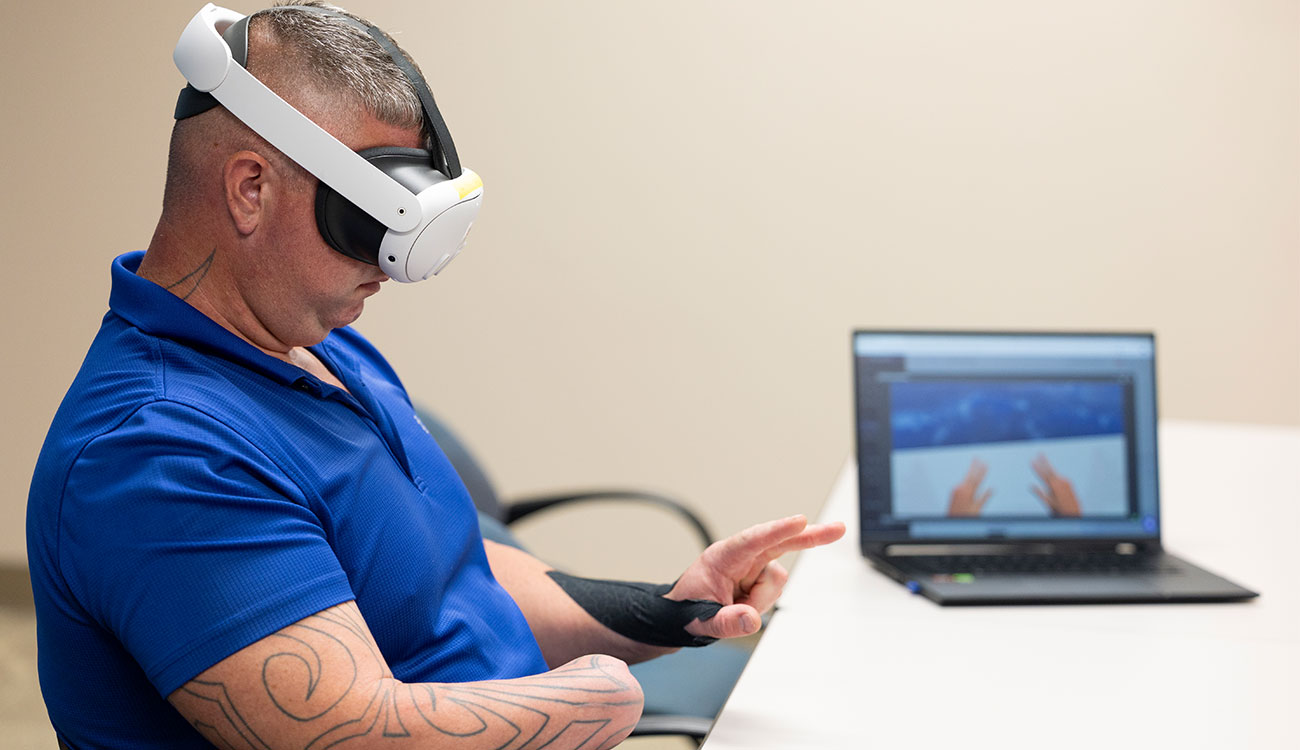
When a 15-year-old girl from Alabama lost her left arm and right leg in a shark attack off the Gulf Coast of Florida, doctors in North Carolina helped her recover—using technology developed in large part by a team of University of Georgia researchers.
Lulu Gribbin spent 77 days at OrthoCarolina’s Reconstructive Center for Lost Limbs in Charlotte, undergoing extensive surgeries to fascilitate her prosthetics. Lulu used virtual reality technology developed by College of Engineering Professor Kyle Johnsen and Ethan Bowmar, who earned his master’s in electrical and computer engineering at UGA, in conjunction with doctors and residents at Axolo Health in North Carolina. It enhanced her recovery, reducing phantom limb pain while preparing her brain for prosthetics.
“This technology reduces pain more than morphine,” said Gribbin of her personal experience. Her story gained national headlines in 2024 and prompted a foundation in her name to raise money for the technology UGA researchers helped create.
Lulu’s story is one of many that illustrates the potential for virtual and extended reality to treat amputees and mitigate impacts of phantom pain.
Retraining the brain
Phantom limb pain is the perception of pain in an arm or leg that has been lost due to amputation. When someone loses a limb through acute or chronic trauma, the brain still expects the missing limb to be there but no longer receives feedback. Other parts of the brain begin to fill that gap, causing pain often described as burning, cramping, or having missing limbs locked in a clenched position
“The only way to keep up with it is kind of how we would keep up with our own bodies and try to work out every day,” said Ryan Serbin, an orthopedic resident physician and researcher at Axolo Health. “In everyday life, you’re always using your hand, so it’s never a problem to keep that part of your brain and connection strong.”
Serbin is one of Axolo’s co-founders, along with attending physicians Drs. Glenn Gaston (a UGA graduate) and Bryan Loeffler, as well as fellow orthopedic resident Ty Frix. Frix earned his undergraduate degree in engineering at UGA, his master’s from the Terry College of Business, and his doctor of medicine from the Augusta University/UGA Medical Partnership.
Axolo Health uses virtual and augmented reality to help retrain the brain after amputation. Members of the company worked with Johnsen and Bowmar to develop VR/XR software and a headset that allows patients to see and manipulate their missing limb. This artificial presence helps reestablish neural pathways and alle
Frix, a long snapper on UGA’s football team from 2009-13, is the company’s connective tissue thanks to UGA’s innovation ecosystem.
“Ty actually graduated even before we were a formal College of Engineering,” said Johnsen. “He sort of had an entrepreneurial spirit.”
Frix originally worked with Johnsen on a startup using Fitbits to track people in health care facilities, then taught an elective class in engineering entrepreneurship at UGA. He opted for medical school after finishing his master’s, performing his residency under Drs. Gaston and Loeffler at OrthoCarolina, one of the leading amputee care facilities in the world.
When a long-time amputee patient described using a family member’s virtual reality headset, seeing a hand and alleght be a way to harness the technology into an effective treatment. Frix immediately suggested Johnsen
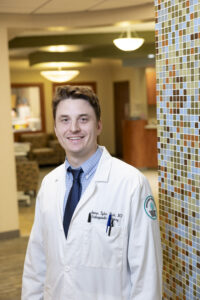
“He’s brilliant, and he runs the virtual reality lab at UGA,” Frix told them. “There’s nobody in the country I would trust more than him to help us work on virtual reality research.”
Johnsen leapt on board, driving to Charlotte to help create a rudimentary version tailored to a single patient. After receiving positive feeback, they began work on a broader VR application.
“At that point, we really knew we had something we needed to explore further,” Johnsen said. “We applied for a presidential seed grant and received additional funding from UGA to build out a more clinical version of this.”
Phasing out pain
Serbin took a year off from his residency to focus on orthopedic research and new technologies. He ventured down a rabbit hole, studying hundreds of articles on established techniques for alleearch on Graded Motor Imagery (GMI)
“I kind of distilled that down to, like, how can we translate this into a VR setting and make it really digestible for an amputee to be able to utilize it?” Serbin said.
Johnsen and Bowmar worked closely with Serbin to develop and build a four-phase VR therapy they call Targeted Brain Rehabilitation (TBR), a completely hands-free, gaze-controlled experience that retrains the brain through guided exercises proven through clinical trials to reduce discomfort and restore a sense of control. Axolo licenses the current software from UGA through Innovation Gateway, the university’s technology transfer hub.
Phase one trains the user to recognize if it’s a right or left hand. The second meditative phase involves imagining an amputated hand moving again. Phase three is mirror therapy—moving the intact limb and reflecting it to convince yourself it is the amputated limb moving. Finally, phase four of the treatment focuses on moving the amputated limb, which is where virtual reality is most essential.
“This collaboration is very unique because there’s these really deep connections that we have. Dr. Gaston is also a UGA alum, and Ty is a former colleague and student of mine. And now Axolo has hired Bowmar as its first employee in the company. It’s not like they’re just contracting me now or I’m just using them. It feels very mutual.”
– Kyle Johnsen, professor, UGA College of Engineering
“In a VR setting you can project anything you want,” Serbin said. “So you essentially project an intact limb onto their amputated limb and train them to think of how to move that limb again. Our system takes them through all four levels within VR, slowly training them to start moving their hand again.
“By the end of phase four, the goal is that their limb pain will be treated, and they’ll be able to use the prosthesis they’ve been fit with.”
Physicians and residents in the North Carolina clinic worked intimately with Johnsen and Bowmar to build each successive phase.
“This collaboration is very unique,” Johnsen said, “because there’s these really deep connections that we have. Dr. Gaston is also a UGA alum, and Ty is a former colleague and student of mine. And now Axolo has hired Bowmar as its first employee in the company. It’s not like they’re just contracting me now or I’m just using them. It feels very mutual.”
The results of the collaboration have been promising. In single-session VR uses, relief from phantom limb pain is essentially the same time (6 to 8 hours) as taking an opioid or anti-inflammatory pain medication. In trials with 60 to 70 upper-extremity amputees, acute patients (immediately after amputation) who are averaging pre-treatment pain scores of 9 are coming down to a 2. Chronic patients are seeing decreases in their pain by more than 50%.
Having registered the technology as a Class II Software as a Medical Device (SaMD) with the Food and Drug Administration, the team is working on a study to send amputees home with their own VR headsets.
“They do a six-week protocol, because we feel like the single session is effective to drop it by 50% but our thinking is that the longer they use this, the better they’re going to train,” Serbin said. “The longer these chronic patients use it, the lower their baseline pain goes.”
“If we can keep patients from undergoing that cortical remodeling, we may prevent a lot of the maladaptive changes that lead to long-term limb pain,” Frix said. “I think that’s an area that we’ve got to do more research on to really explain.”
Relief—and purpose
Much work remains, especially with lower extremity amputee models. They are more difficult to transfer to virtual reality as algorithms with fixed cameras can track hands but not feet. The proprietary work is too new for UGA and Axolo to even discuss in detail.
“We’ve been evaluating a number of different possibilities and tested some with patients now in their clinic, and we actually are on a really good track to be able to address this problem in sort of a unique and easy-to-use way,” Johnsen said.
While the results of the VR treatment protocols show promise in potentially treating amputees before the phantom limb pain ever sets in, seeing real results in those who have suffered chronically are powerful reminders of the importance of the research.
“We have an amputee clinic once a month, and it’s probably one of the busiest clinics, as they come in from all over the place,” Serbin said. “We had just finished phase four, and we’re trialing it on our patients, and I remember the first one I put it on was a patient who said their phantom hand had been stuck in a position for 15 years since her shark attack. She said it was the most agonizing thing, and she tried everything to get her (phantom) hand to move.
“We put the system on her, and when she took it off at the end of the treatment, she was crying. … We had been working on it with Kyle and Ethan for months and didn’t even know if it was going to work. That was the first response we had, and it made me cry.”

1 Comment
Pingback: Meta, Roblox agree to child-safety measures sought by Philippines, minister says - Comic Vibe