

I was excited to take a look at Defender of the Crown: The Legend Returns because it genuinely brought me back to a bygone era of PC gaming. I’ve mentioned in the past that, growing up, I never really had access to many PC games, but one of the few I remember being enamoured by was Lords of the Realmafter seeing it at a friend’s house. And while I didn’t get much time with it, I always yearn for that era of Medieval PC strategy games.
Defender of the Crown: The Legend Returns is certainly a wonderful little trip back to those halcyon days. For better or worse, it’s about as faithful a recreation as one can be of the PC classic while also adding some modern-day enhancements. And while I admire how polished and well presented this classic is, I can’t help but feel like with just a few more enhancements, it could have far exceeded its existing quality.
The story in Defender of the Crown: The Legend Returnsis minimal and effective. It is a battle for supremacy across England in the year of our lord 1149 (or some years after). The king has been assassinated, and the Normans and Saxons accuse each other of the crime. Worse still, the crown itself—the symbol of rule—is missing. The player must lead a campaign to rally the lands, defeat the contesting armies, and claim their rightful place as king.
While it does have a playful sense of faux-history, since the game effectively plays like a board game, the story is little more than set dressing for the gameplay. It’s a fairly straightforward turn-based strategy where players need to build their armies, invade castles for bonus revenue, or hold tournaments to gain either land or standing. It’s a pretty robust collection too, offering not only the MS-DOS original, but a newly enhanced version alongside a deck-building roguelike mode that plays entirely differently from the other two.
In both Retro and Classic mode, players need to strategize between building their army, raiding enemy castles or hosting tournaments effectively, since every action takes a single turn. It can seem a bit chaotic and unwieldy at first, but the more you play, the more you start to understand the core mechanics of the game, and a lot has been done in the Classic Mode to help streamline the experience.
There are quite a few in-game explanations detailing the game’s mechanics, and the Jousting and Swordplay modes have been completely overhauled and feel much more dynamic and playable. The side-scrolling sword fights are especially good, now giving players a block, parry and viewable health bars. However, where Defender of the Crown: The Legend Returns falters somewhat is in its commitment to preserving the function of the original.
While the game’s “tutorials” are certainly helpful, they don’t really go far enough to explain some of the more esoteric features of the game, leaving players at a bit of a disadvantage. Engaging armies in battle is one in particular, where the actual mechanics of battle—utilizing strategies, numbers of units, etc—are never really communicated, and can lead to a sense that these things are purely random.
“But even despite its shortcomings, Defender of the Crown: The Legend Returns is still a genuinely enjoyable game because its old-school fundamentals are still so rock-solid.”
Had Defender of the Crown: The Legend Returnsadded things like seeing your opponent’s army size, or retooling battles a bit, it would have leaned further into its attempt to add QoL features and bring the game into the modern day and made for a much better experience. The same goes for the new Kingdoms mode, which is a genuinely interesting new mode, combining roguelike elements with a card-based battle system that is pretty fun.
Players utilize their cards in battle to roll dice—the total value of which determines who wins the fight. Players draw from an energy pool to utilize cards that increase their dice values or destroy opponents’ dice, and once the player or opponent’s pool reaches zero, the final determination is made. However, this can also be somewhat of a mixed bag, as in one of my runs, having reached the first “boss” opponent, I was put in a completely unwinnable scenario.
I was told in-game that getting a Catapult card would make Boss Fights easier; however, no space on the game’s available map—which opens more as bosses are defeated—gave me such a card. As such, I was left facing an opponent with a higher energy pool and a near-limitless supply of cards that just spawned more dice than I could. I get that it’s a roguelike, but even roguelikes don’t generally put players in completely unwinnable situations.
But even despite its shortcomings, Defender of the Crown: The Legend Returns is still a genuinely enjoyable game because its old-school fundamentals are still so rock-solid. It does require some patience and deceptive thinking in order to get a foothold for the “strategy,” but once it starts working, it really works. It’s similar to playing Settlers of Catanfor the first time—it feels impenetrable until it suddenly doesn’t and becomes incredibly engaging.
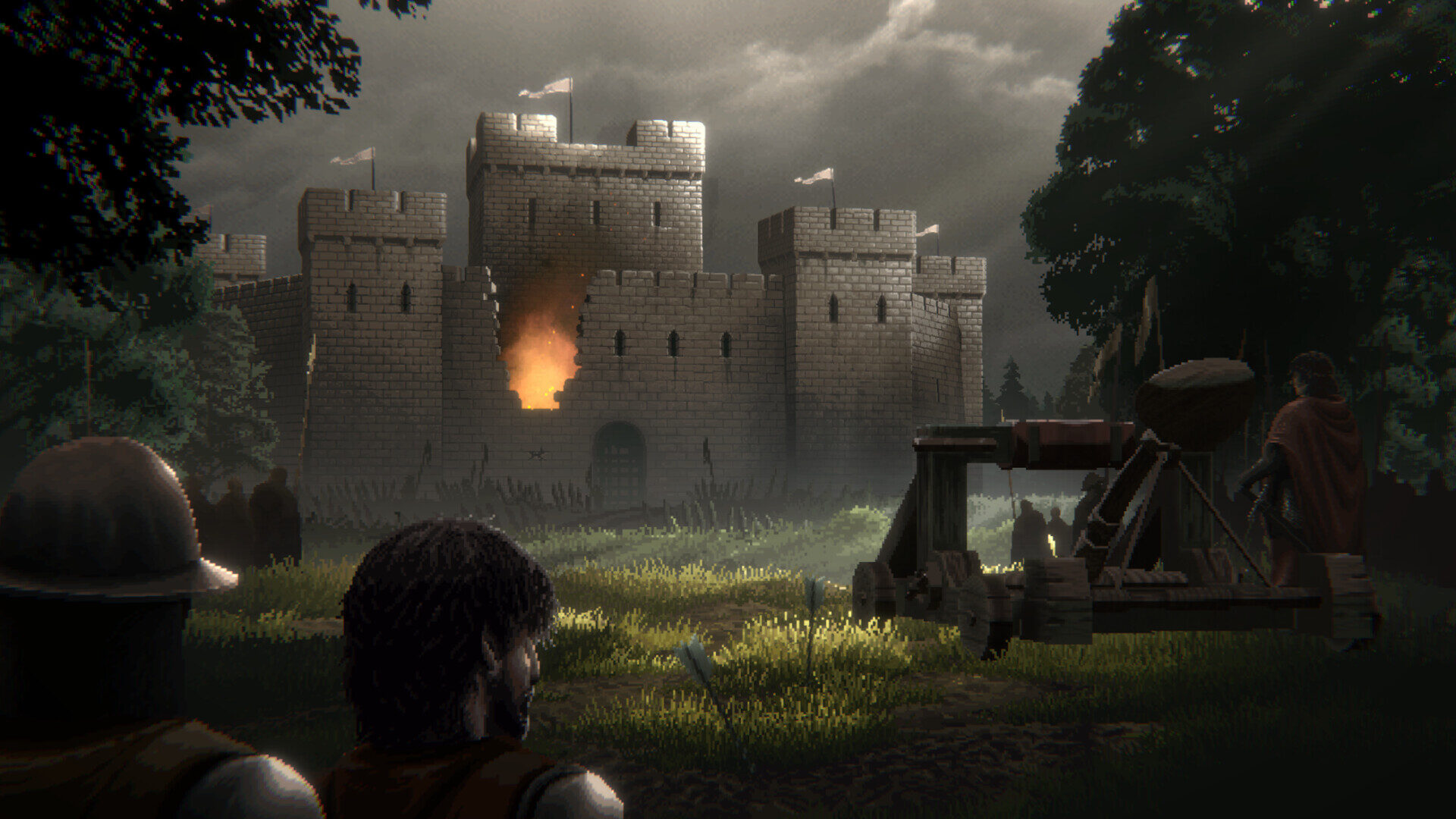
Visually, Defender of the Crown: The Legend Returns genuinely looks great in both its Retro and Classic mode. The Retro MS-DOS aesthetic still really holds up, maintaining a lot of pixelated detail in a way that is just close enough to uncanny to be incredibly charming. The Classic enhanced visuals do a great job combining detailed painted models with a pixelated aesthetic that feels both old and new at the same time. The enhanced audio also goes a long way to capture the spirit of the original but in a bigger, more bombastic way.
If you missed the original—likely because you were born too late—then Defender of the Crown: The Legend Returns is definitely worth experiencing. It may be a bit obtuse at the outset, but there’s still a genuinely fun game in here, plus a lot more to enhance the experience.
