

Virtual reality (VR) has been included in the toolbox of construction practices for some time. So far, the best use case has been in training
In February of 2024, it was demonstrated that it is “significantly more effective in training and education than traditional methods,” according to a study published in the Journal of Safety Research.
A 2025 study from the American Society of Civil Engineers(ASCE) concluded:
The results indicate that the VR user group achieved significantly higher post-test scores and demonstrated greater intrinsic motivation across most dimensions than did the traditional group
Effect-size analyses underscore the practical significance of these findings, suggesting that VR technology and observation methods can significantly enhance learning effectiveness and motivation in challenging and hazardous construction tasks
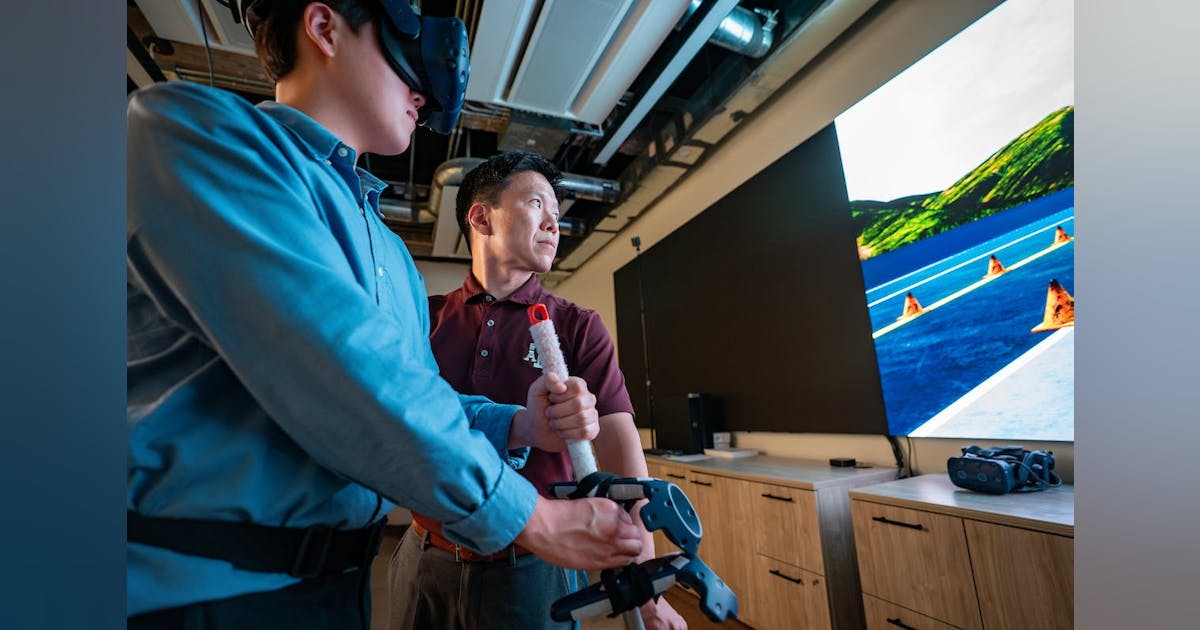
To expand training capability and address the situation where construction workers become desensitized and tune out warnings, Dr. Namgyun Kim, an assistant professor in the Department of Construction Science at Texas A&M University, is studying how to apply AI to VR to improve safety
In collaboration with Brian Anderson, who leads the Learning and Attention Lab, research is being done through a series of studies involving virtual reality simulations, brain activity monitoring, field observations and AI-driven augmented reality systems
The goal of the research is to examine whether immersive, experience-based training can help workers maintain attention to hazards in both controlled environments and active work zones
To determine how training moves to real-world behavior, Kim researched active highway work zones. After completing a VR training, workers returned to their work, where researchers monitored their behavior around live traffic.
The result was that after the training, workers demonstrated increased vigilance, including spending more time looking toward approaching vehicles and traffic while performing roadway maintenance tasks. This type of improved behavior could provide a way to alert workers to become more attentive, thus preventing accidents.
“Now we can say it is effective in real-world behavior change,” Kim said in a statement
The findings suggest immersive simulations may provide a safe way to expose workers to the consequences of inattentiveness before an accident occurs
Expanding his research, Kim is developing an AI-powered augmented reality system designed to provide safety training within a worker’s actual jobsite environment. In this scenario, workers photograph their work area and an AI model identifies potential hazards before generating site-specific safety scenarios through an augmented reality interface
For example, if the system detects an unprotected opening or another fall hazard, it can generate an augmented reality accident simulation directly within the worker’s real-world surroundings. Rather than relying on generic safety examples, the training is tailored to the conditions workers are likely to encounter that day
Combining VR and AI to address a myriad of safety issues is a trend that construction will continue to assess
