

The comics industry can be an inhospitable place. On top of the rigors of producing work they can be proud of and cultivating editorial relationships that can secure future work, comic creators now must also become their own brand ambassadors, publicists, and business representatives.
Jenn Woodall, a Toronto-based screenprinter and illustrator, is no stranger to the demands of her profession, but she has also reckoned with a more daunting phenomenon where creators must navigate the chancy waters of internet hostility, aggression, and violence.
Even in the wake of “movements” like Comicsgate and its implosion at the hands of a self-stoking stupidity, taking a political stance on social issues runs the risk of attracting all kinds of anti-social attention. Woodall’s work has openly explored toxic masculinity, homophobia, and misogynistic entitlement that have come to define the darker side of comics fandom, and following the release of a feminist-themed sticker that went viral, Woodall became the subject of vociferous online scrutiny.
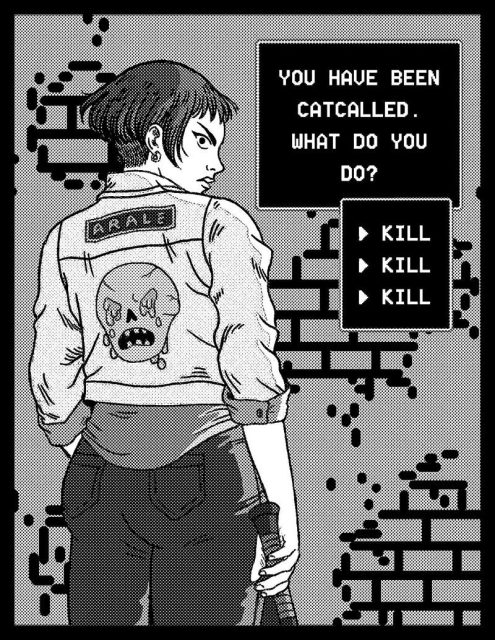
In her new zineShe Must Be Ugly!,Woodall broke down the “Catcall Kill! Kill!” sticker’s effects on her mental composure, and delved into the vicious psychology behind some anonymous internet posting.Ugly! builds on themes Woodall has been engaging with for years in her zinesThe MasterandMagical Beatdown, as well as her comicsDumbassand the forthcomingWorrywart.
In Woodall’s hands, the many hurdles that women face in order to be given a fair shake, the artistic gatekeeping that occurs at the hands of figures possessing cultural capital, and the crippling self-doubt that erodes one’s belief in a painstakingly executed drawing practice, have collectively been explored with a pensive, equable articulateness.
Woodall has perhaps never been more succinct about the state of her own mental health than in the opening pages ofDumbass #1, where she took stock of the internal struggles impeding her artistic output during a long period of writer’s block.
“This past year, I’ve been feeling like a failure,” Woodall writes. “Disappointment comes with being an artist, but a lot of it is really tough. It’s made worse by feeling like nobody understands how much failing sucks.”
“It would be great to just make art, completely unconcerned about my livelihood or public reception,” she continues. “But sadly, I have tied my art to my income … not to mention my self-worth. Besides that, isn’t one of the central goals of the artist to communicate? Isn’t it natural to feel sad when our efforts don’t feel seen? I wish I was so self-assured or independent that these things didn’t bug me. But they do! I’m trying to use this boring angst as creative fuel. Or, maybe I need to actually let myself rest without the mental pressure to create? Either way, I’m so sick of feeling this way.”
In 2028, Conundrum Press will be releasing Woodall’s graphic novelWorrywart, which is currently being serialized through Patreon. Subscribers are mailed out collectible physical zines of the serialized chapters, and upon its completion, the book will be released in a trade edition.Worrywartis itself a reworked version of a mini-comic Woodall drew in 2015, and will feature introspective accounts of her clinical anxiety and OCD diagnosis.
Woodall has provided cover work for IDW Publishing and Boom! Studios. She is an editor forPULPING, an anthology of Ontario-based creators, and a co-organizer of Zine Dump, a Toronto zine fair.
JEAN MARC AH-SEN: Do you recall your first exposure to comics, and the kind of reaction it provoked in you? I realize that there are also second or third “exposures” later in life where a book suddenly expands on a reader’s idea of what can be possible in a medium — can you talk about whether or not you have ever had either of these experiences?
JENN WOODALL: I grew up reading Garfield and Archie comics, so I’ve always been reading comics in some form from a young age. But I remember the first time I was really struck by what comics could be was when I started to read Animerica Extra magazine.
I was a little kid who could only buy issues if I had enough allowance money or if my parents were willing to drive me to the mall, so I didn’t really get to finish any of the stories being serialized. But being exposed to comics like X/1999, Maison Ikkoku and Revolutionary Girl Utena was such an important moment for young me. These 3 manga were really different but it showed me what comics could be and how they could make you feel. I was already watching things like Sailor Moon and Dragon Ball at the time, but reading manga was an entirely different experience and the stories were so engrossing and dramatic. They were definitely stories that were probably aimed at people a little older than me, so I think part of that strong emotional reaction was getting to experience a story that had more mature themes and imagery.
You began your comics career by self-publishing zines, which is often the lot of many creatives trying to break into the industry. What did this kind of freedom afford you in terms of artistic discipline and learning firsthand the economic realities of publishing? Are you grateful for this experience, or do you wish that there was better infrastructure for young artists to obtain work-based training in the graphic arts?
I came back to comics and art while I was working in film doing costumes. I initially studied fashion design in university while a lot of my friends studied illustration. Seeing the art they were producing was a constant reminder of something I wanted to do when I was younger. Because I came back to the idea of making visual art with the mentality of just wanting to try it out for myself, it was pretty fun. I didn’t really have that much ego attached so that always makes things better, at least for me.
I’m really grateful I came to comics through self-publishing because it did teach me so much. I already had discipline as someone who toiled in film, but the discipline to finish a comic is very different. You have to sit at that desk everyday until that comic is finished, and it can be really boring and frustrating. Self-publishing really forces you to learn a lot because you are a one-person production studio. I didn’t even know how to put a PDF together when I made my first zine; I had to get a friend to help me. But every time you start a new project, you learn a new modality that will improve your practice going forward.
You can learn so much just by deciding to do a project yourself. I do think it would be great if there were more opportunities for younger cartoonists to get work-based training that was paid at the same time. I’ve helped quite a few people make their own publications over the last few years and once you give them that training, it’s great to see them be able to do it again by themselves. Self-publishing really gives you confidence and I think that’s why I wish everyone had some experience in that arena. Being the one in control of the means of production is very special as an artist.
You were one of the founding members of the Zine Dump fair, which emerged out of the ashes of Broken Pencil Magazine’s Canzine Festival. Can you walk me through the history of Zine Dump’s inception, and comment about how new artistic spaces often emerge spontaneously from a “mother-of-invention” kind of necessity?
The idea came from my friend, Jonathan Rotzstain. They had the idea to make a new zine fair to fill in the gap that Canzine had left behind. They asked me if I wanted to get involved and I said yes. I had some experience working with TCAF in the past, and I thought it was a great idea. There were seven people in the original Zine Dump planning committee; all seven people are still involved, but we’ve since welcomed two new members this past summer.
I think artists of all stripes are so used to having to create their own spaces and events to uplift their communities. We have to deal with seeing beloved venues close down, events come to an end or just getting pushed out of our neighborhoods. Most of the time, I think the people who want to help artists are fellow artists because we know how important community space is. I love being an artist but objectively, there are many downsides you have to deal with. Community is one of those positive elements that will make you feel motivated to keep going, at least until the next event.
A lot of your work operates in conjunction with your activism and fundraising. You’ve participated in campaigns in support of Palestine and have raised awareness about sexual discrimination and political venality leading to the erasure of protected Canadian green spaces in the province of Ontario. Can you talk about how your political consciousness developed and why engagement with our eroding social conditions is so pivotal to your work?
It’s really hard to pinpoint an exact moment. I think like lots of women, I remember times growing up where I was treated differently than boys in my class. That’s always confusing when you’re small. And then you go to high school and things just become so much worse. Moving to Toronto was probably when I actually began to become aware of the world outside my own little bubble. Once you’re out on your own, you meet so many different people and you hear about so many experiences other than your own. It forces you to challenge what you thought you knew. I think leaving Catholicism behind also gave me the freedom to really critically analyze a lot of crappy opinions I had carried.
It’s so instrumental to my work because I honestly really care about these issues and I want to make other people feel the same way. Sometimes, I’m just so incensed about something, and so my artwork is a way to say, “Isn’t this FUCKED UP? Why is this a thing?” That isn’t a deep answer but that’s really how I feel. Things bother me and it just comes out.
As a teenager, I was so inspired when I discovered the work of Keith Haring and Barbara Kruger; their bold stances really matched their aesthetics. I’ve seen so many instances of people banding together to push back against bad policy, bad proposals, and bad people. I think a lot of the time, it’s a numbers game. Politicians or wealthy people don’t care unless they can see it will harm their wealth or their chances at re-election. I guess I’m trying to do my part by pointing at the stuff that enrages me to draw more numbers in. Of course, it doesn’t always work, but I think lots of artists have this deep need to point to the things they hate to try and spur change.
Magical Beatdown was a zine series that announced your arrival onto the comics scene. Its blend of black humor, feminism, and sensational gore fatalities continues to resonate with readers, and often sells out through its many publishing runs. Can you talk about the inspiration for this series, and whether or not you ever plan to revisit it someday?
It’s very obvious that one of the key elements of inspiration is Sailor Moon. That was my formative childhood obsession, so its influence really leaks into a lot of my work. But aside from that, I was really inspired by sukeban culture in Japan and gory kung fu films like Riki-Oh: The Story of Ricky and Master of the Flying Guillotine. I’m also inspired by common anime tropes, as each volume kind of uses villains from different genres, and it’s infused with that anger from dealing with sexism and street harassment.
This was the first risograph publication I ever did as well, printed byColour Code Printing here in Toronto. Looking back, I think this was kind of ambitious for my second comic ever? I remember I inked the whole comic with a brush on tracing paper. I have no clue why I did that but I guess I thought it was how a professional cartoonist worked.
I definitely have plans to revisit it — the last issue came out in 2022 and I kind of took some time off until 2024 to get my head back into a good place. This series is my baby so I really only come back to write a new issue when I get an idea that I really want to write and draw. I’m hoping maybe next year?
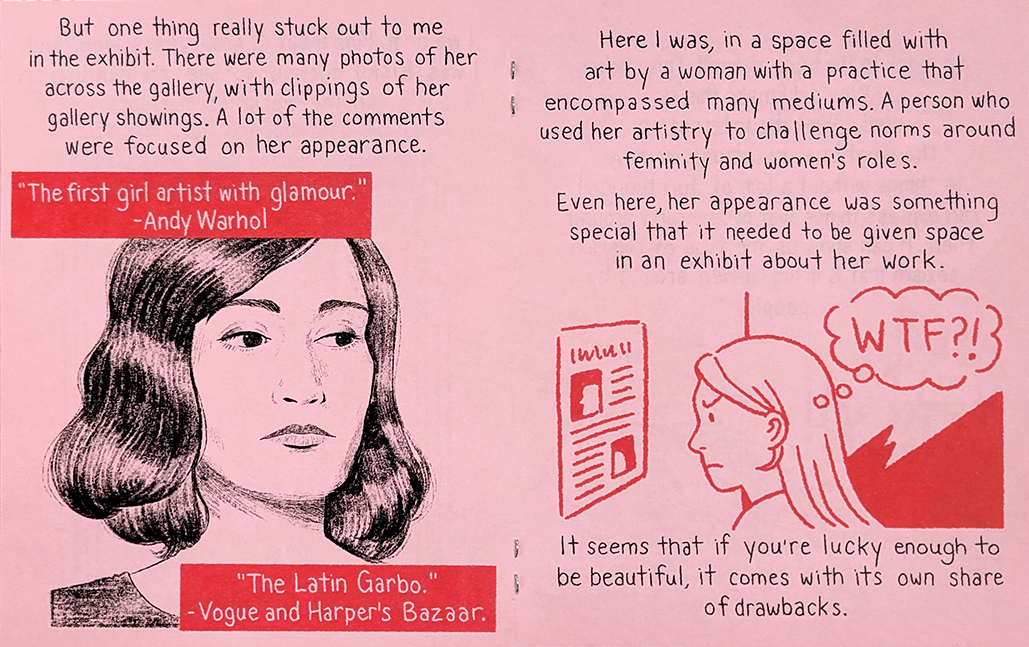
In your new zine, She Must Be Ugly! you write about the hostile, misogynistic internet response to your “Catcall Kill! Kill!” sticker, writing that “Anger from women seems to really make people uncomfortable, so it needs to be categorized and pathologized.” Can you talk about this pathologization of women as a form of institutional misogyny, and why your feminism remains such an energizing impulse in your comic practice?
Historically, women have often been thought of as the more emotional sex (My personal life experience points to the contrary, but that’s besides the point). You have a term like “hysteria” which was coined to describe the “madness” experienced by a person with a uterus. So you have this historical precedent where women are thought of as overly emotional, illogical, and less intelligent than men.
And unfortunately, I think many women internalize this. I definitely did and had to actively unlearn that mentally as an adult. There is a pressure that exists to not express your anger, otherwise you’ll be treated badly and talked down to. And it’s so backwards because if you’re the victim of systemic oppression, of course you will be upset; more upset than somebody who hasn’t experienced it. This expectation of being able to discuss the discrimination you face without getting emotional or upset in order to be listened to is pretty dehumanizing.
I think my feminism is such a pervasive theme in my work because the state of the world just really makes me angry. For a while, I did think that some things seemed to be improving. I used to think that society was always progressing in a positive direction, but it seems like we’re really on a backslide now. We have rights being rolled back affecting cis and trans women, influencers trying to tell us we need to tap into our “divine feminine energy” or getting us to hyper fixate on our faces, bodies, and weight. And that’s not even getting into the rights of women and girls across the world, where education for them is outright banned in some instances.
Why do you suppose that some elements of comics fandom is defined by retrograde attitudes toward women, trans, queer, and BIPOC communities, or narratives that are reflective of real world struggles? I realize that all arts industries eventually consider questions of visibility and equitability, but comics seem to be laboring under these “growing pains” a little longer than most.
I think it’s because for so long, “nerd culture” was the domain of people who were socially isolated. It was so deeply uncool to like comics and anime when I was growing up. I think that unacceptance kind of forces you to find your own little group of like-minded people, and that thing you all like becomes this anchoring factor in your friendships and personality. So when this thing that you got ostracized for becomes popular, I kind of get that some people feel resentful. I remember feeling that way in my early 20s when I started to see video game and comic t-shirts in shops at the mall: “How dare you like that thing! I am the one who truly likes it, because I suffered to be a fan!”
Because nerd culture was so insular for so long, I think it really catered to the majority of its fans, which were men. Women have always been fans of this stuff, but I think many things were tailored to appeal to the taste of men. So now, we have lots of different people who are fans of comics and anime, and those people want to see themselves reflected in what they watch, read, and listen to. But again, I think it’s this bizarre sense of ownership that many people exhibit where they don’t want the thing they love to cater to someone else.
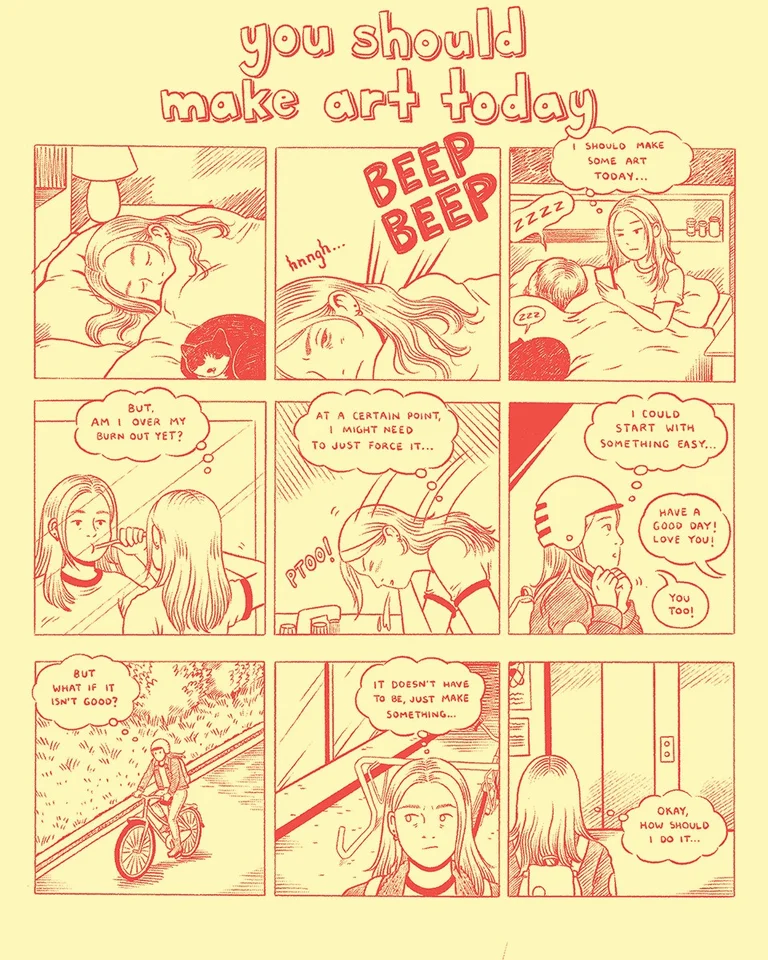
Dumbass is an ongoing comic series that you started as you were coming out of a period of artistic burnout. Can you tell me about this time in your life and why creating a comic about anxiety and self-image was the best way for you to return to drawing sequentially?
Yeah, for sure. I had gone through a really negative experience with a project I worked on in 2022. That flattened me for the better part of a year, where I just didn’t want to draw or really do anything at all. I was really, really depressed. I got a day job in order to pay the bills in late 2023. I’d just do these short little comics at my desk trying to express how horrible I felt. Once I finished a couple, I decided to collect them into an issue of a comic.
I’d seen other cartoonists do one-person anthologies previously so that was part of the inspiration. But I was also just trying to get myself to do anything at all to get back on the horse. I think at that time, all I could really do was try to just get all this noise in my head out on the page. Sometimes, you work on a project and you just aren’t mentally in the right headspace to do it justice. I just decided to lean into making my sad comics and trying to express the complicated feelings burn out brings about.
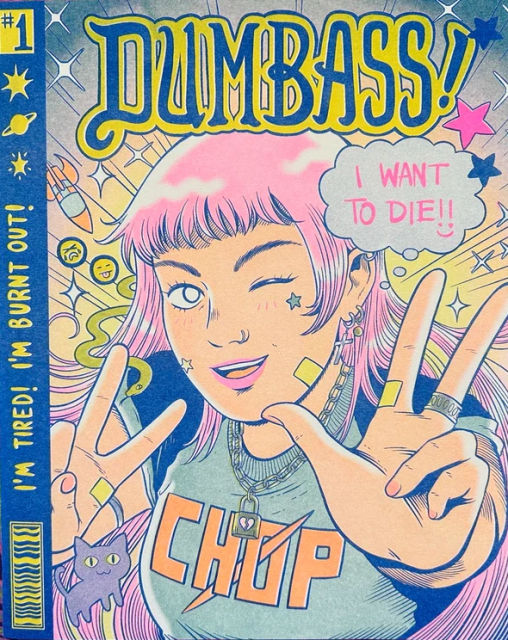
You engage with this idea in Dumbass — or perhaps it’s more of a platonic ideal — of making art “completely unconcerned about my livelihood or public reception” because “the idea of ‘successful’ artists can be a trap.” The trap, you go on to explain, pertains to the way that art is subject to trends and changing tastes, which makes success almost like a game of chance and the “the only marker of value for an artist.” Do you think making art under this ideal is possible? If not, how did your self-conception as an art practitioner need to change in order to continue working?
I think it is possible. But mostly, I think it’s a very small and lucky group of people who get to only make whatever they want and make enough money to live. But way more often, it’s going to be people with a distinct class advantage. If your only job is creating art and you don’t have to worry about paying your bills, you often have income coming from elsewhere. Whether that’s family or a partner, this is very common in the arts.
Speaking for myself, I use my art as a way to prop up a less-than-stellar self-esteem. I get a lot of positive feelings from creating art, sharing it, and just keeping busy on something I enjoy. But that is pretty maladaptive, because nobody can always be busy, despite what hustle culture may tell us. I think one silver lining that comes from failing is the ability to reassess your life.
After I was over being devastatingly depressed, it made me reflect on things. What was I making art for? I’m the kind of person who meets a self-imposed goal and will be happy for maybe a day; but then on the next day, I’ll need to refocus on something else. It’s like a constant chase to feel good and it’s exhausting. It made me realize that even if that project didn’t fail, even if I won a fancy award, what would it change in my life? I’m not talking about money here because that would make a positive material change in my life, but would those other things change my outlook and my attitude towards myself?
In art school, you encounter this attitude that to be a successful artist, you make all your income off freelance. Like having a part-time job is so shameful, and you should be fully living off your practice. I was really hesitant to take a day job because that felt like another failure. But it actually gives me more freedom to draw when I want and the kind of stuff I want, so it isn’t all that terrible.
I think once I started untangling the difference between the things that would genuinely give me self-fulfillment versus things that would give me external validation, it really changed my outlook. That was how I was able to get back to making art, ultimately.
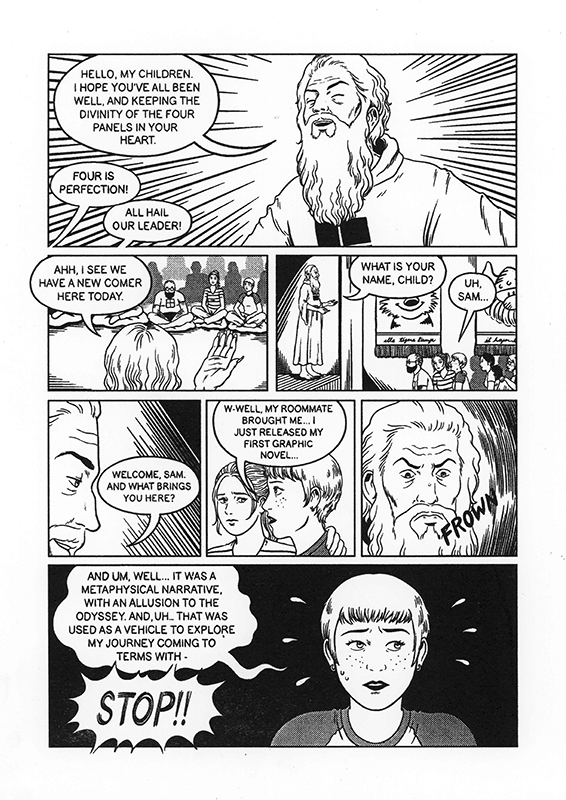
Your new zine The Master depicts an integral moment in the lives of Sam and Chloe, two struggling cartoonists who visit a comics guru that promises to aid “cartoonists who became angry and resentful of the art form.” The “cure” ends up being an artistic fiat whereby cartoonists are only allowed to draw four panel strips to oblige the “holiness of the quadrinity.” Can you tell me about the Chick tracts that inspired this zine and whether or not you had the misfortune of having a mentor figure akin to “The Master?”
I actually never read Chick tracts growing up because I was raised Catholic. And boy, did Jack Chick HATE the Catholics. I only discovered them once I moved to the city as an adult and would find them randomly on park benches. The comics are hilariously, overwhelmingly preachy and are very authoritarian in how to be a good Christian. So that was the main inspiration for “The Master,” bringing this bizarre preacher/cult leader character into the indie comics community to prey upon all the disenfranchised cartoonists.
The closest thing I’ve had to a bad mentor was working in comic retail in the late 2000s. The atmosphere of being a young girl and working in a comic shop at that time was truly awful. I’ve been very lucky that all my mentors have been incredibly lovely people. I interned with Willow Dawson in my early 20s, and Fiona Smyth was a teacher of mine while I was a student at OCAD. I met Avi Ehrlich in 2014 when I was just starting out in self-publishing, and their enthusiasm for my work really gave me a confidence boost. And Annie Koyama has always been encouraging and willing to give me advice when I ask her questions.
Your new book Worrywart (Conundrum Press) is going to continue your exploration of your struggles with clinical anxiety. How did this project begin for you? Given that the book is of a personal nature, how do you want the work to be read and received? Is there an “aesthetics of vulnerability” that you feel that you must engage with on some level?
The original Marie + Worrywart zine was self-published by me in 2015, which contained short little strips about living with anxiety. I personified the anxiety by making it a red blob. Although that comic is detailing my experiences with anxiety, it’s quite surface level when it comes to the real shit I’ve had to deal with when it comes to my mental health. So I wanted to actually write about my real journey with my difficult brain.
I think graphic medicine memoirs are a bit of a tricky subject. On one hand, my GAD and OCD have really impacted the quality of my life. But on the other hand, sometimes I just think about my neurosis and I can’t help but laugh. There was a period of time I was so terrified of germs from my shower that I wore goggles when I bathed. And while I am a fan of a serious graphic medicine memoir, I think some levity is good. The last thing I want to do is write a book that basically makes people feel hopeless. So for me, trying to balance between a serious story with moments of humor is what I’m focused on.
Vulnerability is really important when you are writing a book about yourself and your own painful experiences, obviously. I think Dumbass was more vulnerable for me in a weird way, because it was about my art and identity as an artist. Talking about failure is much harder to me than discussing my mental health. Admitting you failed really bruises the ego, and ego is so important to an artist. I think part of that distinction is that I’m so desensitized to the reality of living with my disorders. They’ve been part of my life since I was a little kid, it’s just something I’m constantly adapting to living with.
You made the decision to serialize Worrywart on Patreon and to offer glimpses of the work while it is in development. Tell me about this decision, and how important you think creators must be “accessible” to a readership in our current publishing paradigm.
I was inspired by a friend of mine who serialized his comic in a mail club format years ago, so that was where the idea came from. But it was really about trying to break the book down into manageable pieces so my brain didn’t get so stressed out thinking about the book and its totality. And of course, it’s a good opportunity for people to see the work in progress and follow along, which is great encouragement for any artist.
Being accessible to fans is so complicated. I’ve personally stopped using social media as often as I used to because the pressure to post and get views is too exhausting for me. I’ve taken steps to put less of myself out there on the internet in the last few years. I definitely think I was online too much for a while there and almost used the internet as my therapist. I love running the Patreon mail club and that level of accessibility I think is perfect.
I think self-publishing is gaining momentum right now because the publishing industry seems to really be struggling. Many artists are questioning the traditional benefits of a big publisher. Everyone I know is struggling financially as well, which is another reason why I see self-published comics and zines thriving.
When you are able to make things yourself and find cheap methods to get your work produced, it’s an easier sell to get someone to pick up your work. Also, just being able to do every part of the process is so gratifying. Taking an idea all the way to a finished physical zine is such a good feeling. And I think demonstrating how accessible self-publishing can be is so important. It only helps our community by sharing those re
