

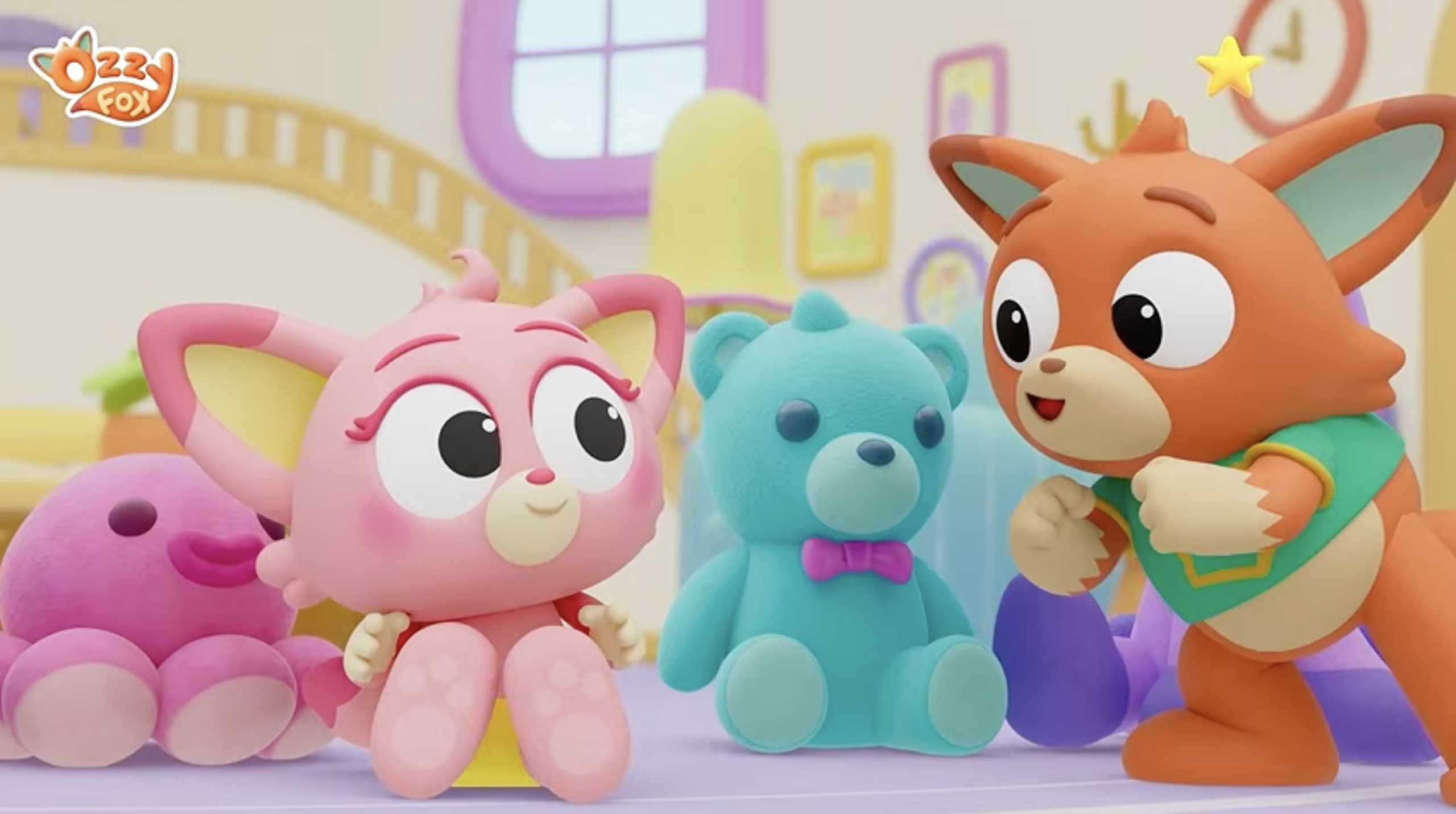
A lot has changed since I first met the team behind Animaj at Walt Disney Studios in Burbank, California, in 2025. Since teasing an upcoming project with Disney a year ago, the AI-boosted animation studio has now produced Ozzy Fox, its first combined project with the animation powerhouse.
Debuting on YouTube and Disney Junior in July and launching on streaming service Disney Plus soon, the preschool-age show features bright colors, catchy songs and a cute family of foxes. It’s drawn and animated by humans, but with an AI assist to speed things up.
In the last year, AI has become a more normalized part of the creative process, popping up everywhere from music to movies. Studios don’t shy away from saying “AI” anymore; they’re using it to make content faster while — at least in some cases — still keeping humans in jobs.
Animaj recently released FlipMove, a “pipeline” combining all of the AI models it has been developing over the past few years into a single tool for its animators to use. The studio has also created an agentic AI workflow, Animaj CEO and co-founder Sixte de Vauplane told the media during the 2026 Disney Accelerator Demo Day.
So what does agentic AI mean for animation? A bunch of agents that have access to AI tools and context about the show so they know when to use each tool, de Vauplane told me last week in Burbank.
“We had one agent reading the notes, another one coordinating to see which kind of model we have to use,” he told me. “Here, what we wanted is to build the ultimate pipeline, CGI pipeline, for animators, for directors, that is built on a closed ecosystem of data.”
The point of AI is to reduce the time from the director’s initial notes on a storyline to the final cut being produced, he said.
“If you can do twice the notes in the same amount of time, that means twice better in terms of quality, and that’s overall what the industry is looking for,” de Vauplane said. “This use of AI, which is artistic-centric, is really the answer we think the industry should embrace.”
Animaj animators have “full control at every frame,” de Vauplane told us. Its closed, in-house LLMs have access to context about the show, drawing style, characters and storylines so that suggestions are customized and fit in with what the team wants to achieve.
When I first met the team in 2025, they told me their technology doesn’t replace animators; it simply making their jobs less tedious. An animator sketches out each of the main poses of the characters, and then AI is used to fill in all the in-between movements of the character that could stem from each pose. An animator tweaks those poses before they’re finalized.
A demo video of the new FlipMove pipeline shows a human-drawn sketch being quickly transformed into a 3D animation, with the AI tools importing the Ozzy Fox house and characters onto the screen, and then also posing them to match the sketch.
The writers and animators involved still have their jobs, David Min, vice president of Disney Innovation, told me; they’re just making content a lot more quickly.
Animaj also recently published its AI manifesto online, calling slop, not AI, the enemy. AI slop is low-quality content being rapidly generated by simple prompts using AI tools online. According to Animaj, collaborative AI tools should be put in the hands of storytellers, “because rejecting AI leaves more ground to those producing slop.”
Its anti-slop message followed headlines upon the release of Ozzy Fox in July that accused it of being AI slop, citing hallmarks such as unfinished backgrounds and the lack of letters and numbers on objects in the show.
The show wasn’t AI-generated; it was created and drawn by humans, with details filled in by AI tools and checked by more humans. But it raises the question: Is slop in the eye of the beholder? And how much AI is enough to call it slop?
The manifesto also argues that AI reduces the cost and speeds up the production of human-created animation, but that every hour saved should be poured back into that human work.
“AI makes more ideas affordable to try: the strange character, the unfamiliar culture, the story nobody would have greenlit,” Animaj says. “We can put them in front of families, learn what moves them and go again.”
