

Credit: ESPNBy Drew Lerneron 07/12/2026
07/12/2026
The one person no one can stop talking about as another Wimbledon was etched into the history books on Sunday wasn’t Jannik Sinner or Linda Nosková, who won the men’s and women’s singles championships, respectively. It seems that, at least for the media freaks who care about how sports are broadcast on television, no one can get enough of Andy Roddick
For tennis fans, that’s no surprise. Roddick has hosted the popular Served podcast for quite a few years now and has spent enough time on Tennis Channel to be recognized by the sport’s ardent viewers as a true talent. But making his Wimbledon television debut on ESPN, Roddick was something of a revelation to the casuals who might only watch tennis a few times a year
I’ll leave the full breakdown of Roddick’s performance and the overall reception of ESPN’s retooled Wimbledon coverage to our friend and contributor Dan Kaplan, who is much more informed about tennis than I am and will have a column out Monday morning with some takeaways from the Wimbledon broadcast. But I want to highlight one particular aspect of Roddick’s debut that should be considered more often across all sports studio shows: the idea of a solo act
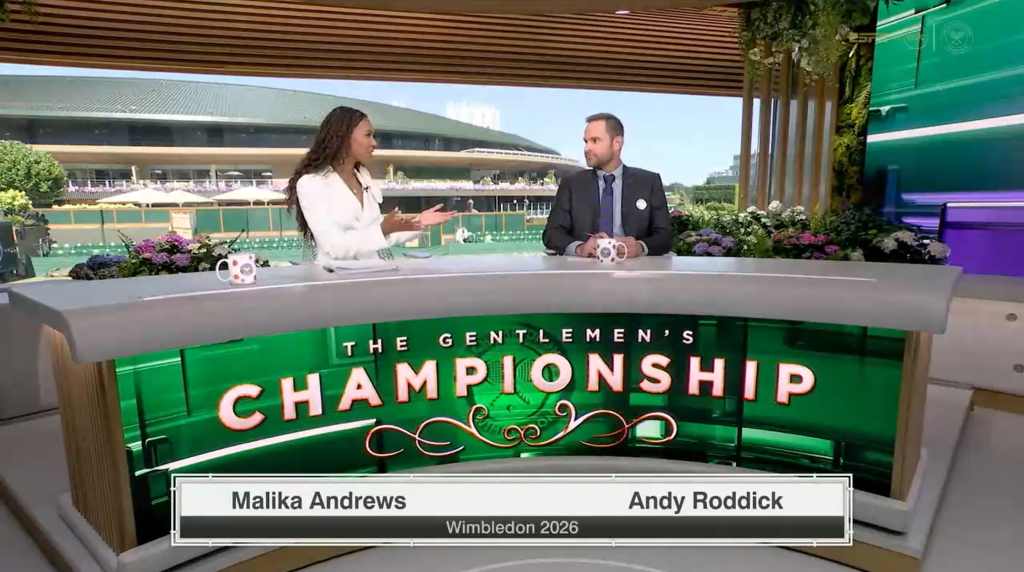
Throughout ESPN’s coverage of Wimbledon, Roddick paired primarily with host Malika Andrews, who was also making her debut as a Wimbledon broadcaster after jumping into tennis for the first time in January as a host for the Australian Open. And in a stark departure from how ESPN has handled Wimbledon studio coverage in prior years, the network opted to do something rarely seen in sports broadcasting nowadays. ESPN kept its lead studio a two-person team: one host and one analyst
The result was something that somehow felt refreshing and new, but also like a complete throwback to simpler times, when studio shows didn’t need to be jam-packed with four or five analysts being traffic-copped by a host who’s faced with the impossible task of wrangling several domineering personalities. Instead, Andrews and Roddick had conversations. Good conversations
A tennis fan, casual or otherwise, listening to Andrews pepper Roddick with questions about whatever match they happened to be analyzing was likely to learn something new in under a minute; a stat, a change in approach one player made to counter the other, the games within a game that aren’t readily apparent to the untrained eye
Tennis is extremely difficult to film in a studio, especially when a match is underway. Analysts have next to no time to get a cogent point across before the next set begins. But somehow, in these brief moments between sets, Roddick managed to answer two or three questions from Andrews and impart some actual knowledge to viewers before the match resumed
Compare that to the 2025 men’s singles final, when ESPN started match coverage with host Chris McKendry and three analysts or reporters — James Blake, Sam Querrey, and Mary Joe Fernandez — in the studio. Then, during the midway points, McKendry and Querrey were joined by another analyst, Brad Gilbert. The post-match studio then shifted things around again, with McKendry and Querrey being rejoined by Blake. The musical chairs among analysts made it impossible to maintain a conversational through line across an entire match broadcast. There was no consistency, leaving viewers with a product that at times felt haphazard.
Those problems were solved this year. And it wasn’t just Andrews and Roddick. ESPN often chose the solo-act approach throughout this year’s Wimbledon coverage. Rece Davis and Chris Eubanks, for instance, paired together for the women’s doubles final on Sunday morning
Some studio shows and sports lend themselves to a more roundtable format. Inside the NBA isn’t the institution that it is without the interplay between Chuck, Shaq, Kenny, and Ernie. But for every Inside the NBA or College GameDay, there are probably two or three NBA Countdowns or Football Night in America — shows that were hamstrung by having too many mouths to feed and not enough time to feed them
To be sure, Andy Roddick is a unique talent. Not every analyst is capable of anchoring an entire studio show. But Roddick translates clear preparation and an abundance of passion for the sport into something that can carry a broadcast. He’s never at a loss for words. He always has an opinion or insight ready to share. And there’s rarely a moment where someone else’s analysis even feels necessary. Roddick delivers his perspective with such authority, you’re practically compelled to believe whatever he’s saying is tennis gospel.
So there’s clearly a skill set involved that makes this work for Roddick, specifically. But the one-on-one format worked throughout ESPN’s Wimbledon coverage, not just with Roddick
Maybe it’d be wise for more networks to take a less-is-more approach to the studio. Find a host-analyst relationship that is truly compelling, and let the host work their magic by drawing information out of the analyst in ways that simply aren’t possible on larger panels. It worked for ESPN’s Wimbledon coverage, and it’d be a breath of fresh air to see other networks consider the solo act more often
