Female characters appear in superhero comics less often than males — but when they are included, how are they depicted?
The recent theatrical release of Wonder Woman briefly catapulted the question of female superhero representation into the mainstream. For some, the character is a feminist icon — even Gloria Steinem wrote about her — and many fans(though not all) felt this wasn’t just another superhero movie, but rather a pivotal moment in the portrayal of women in popular culture.
Why all the fuss? Well, the truth is that the comics industry has had a complicated relationship with female characters. They are often hyper-sexualized, unnecessarily brutalized, stereotyped, and used as tokens. They’re also rare. Only 26.7 percent of all DC and Marvel characters are female, and only 12 percent of mainstream superhero comics have female protagonists.
I decided to look beyond the gender ratio to see if we could learn more about how females are represented. Using characters from DC and Marvel in the ComicVine database, I analyzed naming conventions, types of superpowers, and the composition of teams to see how male and female genders are portrayed.
Strong men; thoughtful women
Three out of five comic book characters have at least one superpower, regardless of gender. When we categorize these powers, we find that there are some clear gender imbalances.
The difference in male and female powers
What‘s that?
Click on a bar and I‘ll explain the power!
Taking names?
Click on a circle and I‘ll list gender-titled characters!
NOTES: Percentages are determined only from characters with powers. In DC and Marvel, 62.4 percent of all male characters have powers, and 62.8 percent of female characters have powers.
ComicVine lists over 100 possible powers; however, we removed all powers for which the difference between genders is not significant at a 95 percent confidence level when performing a t-test. Definitions are from both Comic Vine and Superpower Wiki.
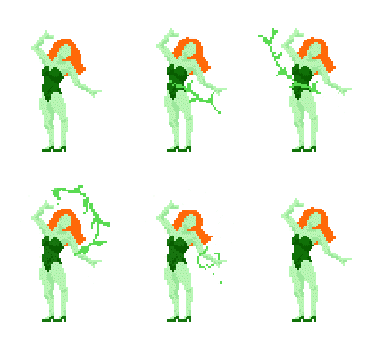
The data suggest that less-physical powers — such as empathy, intellect, and telepathy — tend to be more represented among female characters. Men however, often have highly physical powers, as well as those that involve gadgets. Female characters dominate in relatively few physical abilities; and those where they do are often tied to gender stereotypes. Pheromone control — the ability to generate and control pheromones that affect emotional and physical states, such as sleep, fear, and pleasure — occurs five times as often in a female character. Sonic scream appears in twice as many female characters as male; and prehensile hair — the ability to control one’s own hair — appears in female characters seven times more often.

Token teams and team members
There are over 2,500 teams in DC and Marvel combined. Roughly half of all characters — male and female — are members of at least one team. The number of females on teams is what you would expect given the relatively low number of female characters. That doesn’t mean, though, that female characters are evenly distributed. In fact, 30 percent of all teams have no women, and only 12 percent have more female team members than male. The majority of those 12 percent, however, are exclusively female teams. This means that in actuality, only 4.8 percent of all teams have both male and female characters and have more women than men.
Female percentage of every team
Each dot represents one of 2,862 teams in DC and Marvel.
Particularly interesting are the names of the exclusively female teams — Femizons, Lady Liberators, Female Furies, Holiday Girls, Doom Maidens. A third of all exclusively female team names reference their femininity in some way, and if we look at the all-female teams that are five or more members, that number jumps to half. These groups have gendered names in the way that the male teams generally do not. Only seven percent of their male counterparts with five or more members have a masculine naming reference. Given this highly gendered naming pattern, it seems that exclusively female teams are often specifically defined by their femininity.
Comparing the balance of gendered names
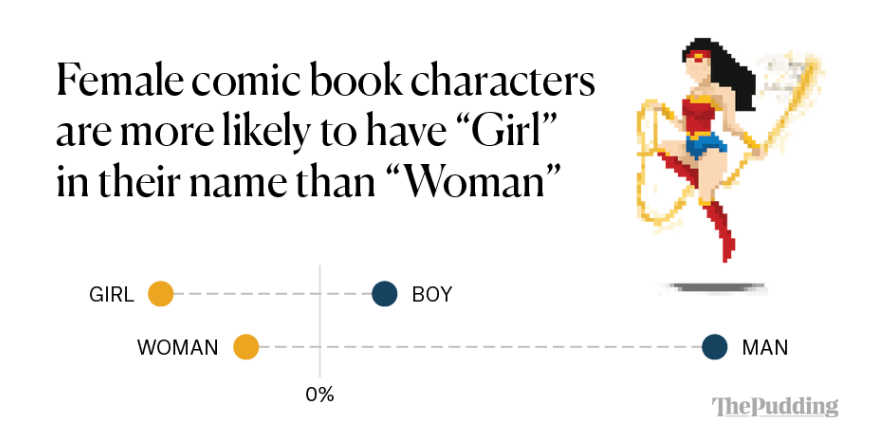
Let‘s look at the percent of female and male characters with equivalent gendered names. For example, we have paired “man” and “woman” as equivalent. Their usage, however, is not balanced: male characters are given “man” far more often than female characters are given “woman”.
Interesting imbalances are found between many gendered naming pairs. Diminutive names — those that may infantilize or denote the younger version of a title — are highlighted.
NOTES: Percentages are determined only from characters with gendered names. i.e. 13 percent of women with gendered names have “girl” in their name.
The names considered “diminutive” are those in red text on the chart. They were chosen by the author, and there are good arguments for both keeping and removing many of these terms. However, the point remains: If we only consider “girl” and “boy” there is still a significant difference: 13 percent for females, 5 percent for males.
In some cases, a character with a gendered name will be listed in the Comic Vine database under their secret identity. For example, there is no Ms. Marvel or Batgirl in the chart above. They are listed in the data as Carol Danvers (and Kamala Khan, etc.) and Barbara Gordon.
Marvel and DC are no longer simply convenience-store singles. Today, they’re blockbuster movies, fast-selling merchandise, drama-filled tv shows, and popular video games. The more we see these characters appear in pop culture, the more their representation matters — especially because female characters form such a small fraction of the whole.
Carolyn Cocca, academic and author of the Eisner-nominated book “Superwomen: Gender, Power, and Representation”, expresses clearly why this is such an important concern. She writes: “If the constantly repeated story is that women and girls are not leaders, are not working in professional settings, are not agents of their own lives but merely adjuncts to others, and are sometimes not even present at all, it can reinforce or foster societal undervaluing of women and girls… As there are fewer female characters to begin with, each is overburdened with representing women as a group.”
To be fair, this problem does not affect comics alone: media in general — includingchildren’s literature, cartoons, computer games and even coloring books — have a history of poor female representation and gender imbalance. And often media reflect our world back to us: while only 27% of Marvel and DC characters are female, that number is only 19% for the United States Congress.
The good news is that things may be changing. Both DC and Marvel have slowly begun to increase the number of female characters in their output. Our analysis did not consider time-series data (we didn’t have it), and characters change over time — Wonder Woman herself has been a feminist activist, a house-wife, a sexualized pin-up, and a kick-ass hero in her 76 years. However, while some features may be altered, established and traditional characters tend to maintain their names and powers. They continue to carry the representative baggage of their past.
Using the ComicVine database, which is fan-edited, information was downloaded for all 34,476 characters in Marvel and DC. The choice of the “big two” was made to cover the greatest breadth and history of characters; these companies have both been around since the 1930s and together they are responsible for approximately 70 percent of the retail market (depending on the month). Data were gathered at the end of April, 2017.
This piece is, unfortunately, only focused on male and female gender. In the database there are designations for “female”, “male” and “other”; however, the decision was made to remove characters that appeared in the “other” category. I had hoped this data would provide insight into non-binary or gender fluid characters in Marvel and DC. Upon closer inspection, however, it was clear that the category is not often used in a gender-inclusive way. Instead, it is primarily used as a label for non-human characters like robots, auras and spirits. Here’s a brief, interesting read about battling this binary model in superhero comics.
Because I gathered every single character from both publishers, there are occasionally duplicates of characters. There’s a good argument for removing them: They over-weight some of the big characters, because it’s usually only the more common, popular characters that are replaced, reborn, or duplicated. However, there’s a good argument for keeping them as well. They can be considered different characters (Batman-X is not the same as Batman, for example), and as such, they have distinct genders. Removing duplicates would mean missing out if the character changes gender. For example: There are many iterations of Robin, and not all of them are male.
Thank you to Tyler Shendruk, who provided invaluable assitance during the data analysis stage, and to Nicole Derksen, who created the illustrations and gifs used in this article.