

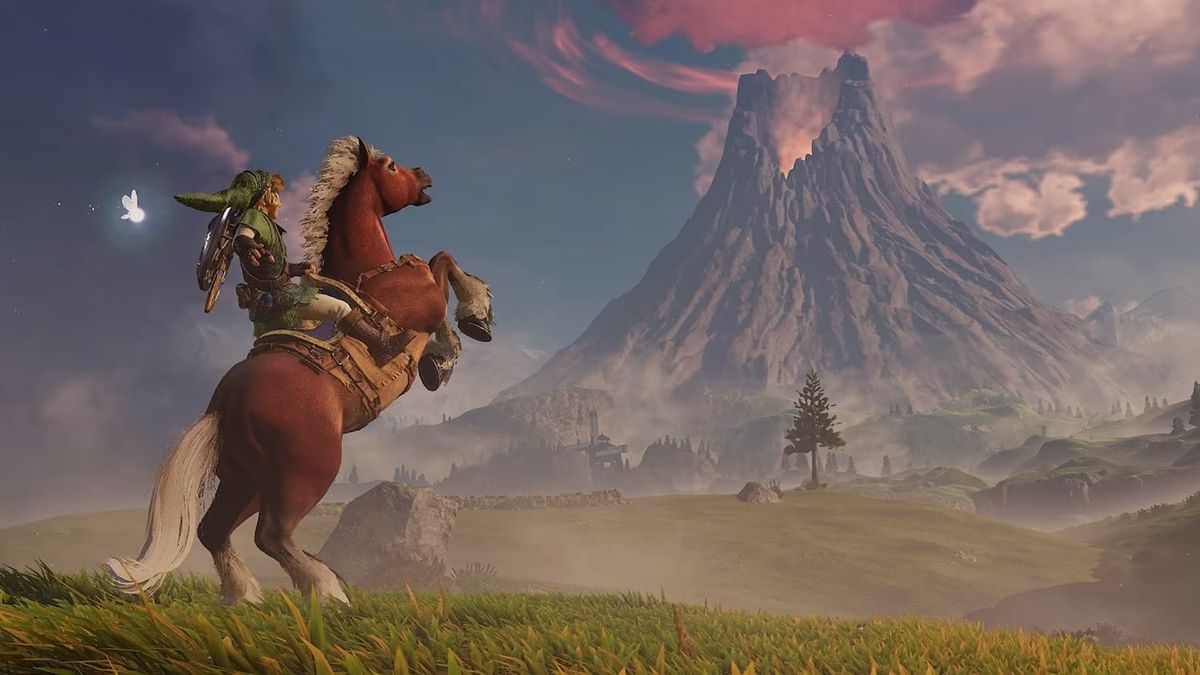
I like the mossy cave leading to the Great Deku Tree, the way the tunnel feels less like infrastructure and more like an accident of nature. Like Link is boring through the wild history of a world indifferent to him trudging through it. Like if he sat down there for a little too long, the roots and vines would grow over him, making him part of the scenery, another detail for someone else to run past. The first in-depth look at Nintendo’s forthcoming remake of The Legend of Zelda: Ocarina of Time is full of details like this, the thoughtful rendering of wood and stone and vegetation, a misty fog that suggests the Kokiri Forest smells richly of mildew.
I didn’t imagine any of this when playing the original version of Ocarina of Time, released in 1998 on Nintendo 64, and remastered with minor alterations on the Nintendo 3DS in 2011. I was busy imagining what has now been rendered in this new version of the game: What the cloth of Link’s tunic might feel like, what I might see if I could move the camera freely around the cobblestoned streets of Hyrule Castle Town, if there was some hidden ruin somewhere in Hyrule Field that only I could find. These questions seem moot in 2026’s Ocarina of Time, a remake that appears from this generous preview to be tremendously faithful to the original and also incredibly solid and rational. It has done all this imagining for me.
In spite of their endless pursuit of realism, video games are at their most powerful in their capacity for abstraction. The game designer’s decision to simulate some things over others, their choices for disguising the hard boundaries of their systems – these are in turn invitations for players to fill in the blanks with a little bit of themselves. To imagine. The Legend of Zelda has always been a potent vector for this imagination, as the 8-bit sprites of the 1986 NES original game were among the first to give players the feeling of a wild world worth exploring. Each generational leap in technology has seen a new Zelda game attempt to recapture this feeling in a new context: The wide-open oceans of The Wind Waker, or the sky islands and pitch-black depths of Tears of the Kingdom.
And so I wonder: Where is my imagination meant to find a home in a game like The Legend of Zelda: Ocarina of Time (2026)? The original is among the most over-examined and thoroughly-praised games in the video game canon, partly because of the way that it rendered the abstraction of previous Zelda games into something more astonishingly lifelike, and partly because there was still plenty of work that the player’s imagination had to do to make its more fully-realized world feel real. There’s also the fact that many come to Zelda games as children, and there is a wide gulf between the imagination of a child and that of an adult. Children will not wonder what Hyrule’s taxes are like.
I am no longer a child, and Ocarina of Time is no longer using a polygonal shorthand to evoke the wildness of Hyrule. Link appears uncanny, strange, as if he is sculpted from a material I cannot place, something not quite wood nor plastic. He would not be out of place in a stop-motion feature, but that’s not what this is. It is a fluid, video game world, appearing on screen at the smooth framerate expected of modern games. As such, it is odd to see him rendered this way. Other characters don’t look as off-putting to my eye; they feel like dolls in the way that I suppose I always presumed they were, little figurines populating a world that feels like a diorama – and it’s here that I see the aesthetic connection to 2019’s lovely, toylike remake of The Legend of Zelda: Link’s Awakening. Maybe I am merely uncomfortable revisiting a character previously known to me as a rough assemblage of polygons, to learn that he too has been changed into a marionette. Still lifeless, except for whatever life I decide to lend him. Maybe that’s not so bad. Maybe through him, I will find my imagination free to wander in different directions. Time will tell.
Mostly though, this new vision of Ocarinaof Time just raises impossible questions for me. I want to know things that are unknowable, to see this game with another’s heart and mind–someone who has only known games in high definition, where abstraction via rudimentary graphics wasn’t the base supposition. What do you wish for when turned loose into the too-green fields of a video game? When you turn the console off for the night and close your eyes, do you long for something you can’t find there? Do you wish there was more?
Zelda games, after all, are different now. They are still interested in evoking wonder, in leaving room for your imagination, but using the language of modern games with their towers and maps full of icons and open-world activities. Breath of the Wild and Tears of the Kingdom stand in opposition to the cruft of games like countless Assassin’s Creed installments and Crimson Desert, with their manic efforts to please the player and constantly give them something to do. They lack the patience for quiet of the modern Zeldas, which are no less dense, but have so much more room for the player. What argument does a remake of Ocarina of Timemake in this context?
Maybe the optimist’s view is that The Legend of Zelda: Ocarina of Time (2026), in its painstaking detail and single-minded reproduction of the 1998 game, is an argument for limitations in a world where the biggest games must do it all – that all the technical resources in the world will not dull the magic of a game with such a careful focus. This could have been a version of Ocarina of Time with new depths to plumb, mechanics that gesture at where the series is now, something that, in crass commercial terms, justifies paying whatever price Nintendo asks for it. But what was shown today resists that: This appears to be exactly the game the world fell in love with in 1998. And all of the increased resources available to its developers now haven’t been used towards making the game bigger, fresher, or novel to those who have played the original endlessly. Instead, in this charitable reading, that time and energy was spent on reconstructing the knotty growth of Hyrule’s forests and oppressive mountains, rendering them even more dramatic. In reasserting that not everything a designer crafts is there for you to climb, to master. Some of it is there just for you to wonder about.
And so I look forward to The Legend of Zelda: Ocarina of Time (2026), to see the ways this new vision is received by a world that is unrecognizable from the one in which I played the game the first time. I want to see where it leads our imaginations, how it collides with this coarser world of casual video game magic, if it fills me with different questions than the ones I had the first time around. I want to know if there’s still room there for me.

3 Comments
Pingback: Judge dismisses Iowan's 'frivolous' Pokémon lawsuit against Nintendo - Comic Vibe
Pingback: Joe Girardi learns about the existence of anime in hilarious fashion - Comic Vibe
Pingback: Nicolas Cage: Sinkhole opens up in front of actor's home in Malibu - Comic Vibe