

Close Menu

    Subscribe to Updates

    Get the latest creative news from FooBar about art, design and business.

    What's Hot

    Netflix Fall 2026 Schedule: All The New Movies And TV Shows Coming Soon

    August 14, 2026

    Ending PS5 discs will lower PlayStation Store prices, says former Square Enix executive

    August 14, 2026

    We Got A New Look At COVR, A “Next

    August 14, 2026
    Facebook X (Twitter) Instagram
    Facebook X (Twitter) Instagram YouTube TikTok
    Comic Vibe
    Friday, August 14
    • Home
    • Comics
      • Comic Vibe News
    • Gaming
    • Movies
    • TV
    • Anime
    • Toys & Collectibles
    • Cosplay
    • Tech
    • Digital Culture
      • Creators & Fan Culture
      • Creator Economy & Fan-Driven Platforms
      • Digital Fandom & Online Communities
      • Metaverse & Virtual Worlds
      • NFTs & Digital Collectibles
      • Virtual Events & Online Conventions
      • Virtual Identity & Avatars
    • Shop
    Comic Vibe
    • Home
    • Contact Us
    • Terms & Conditions
    • Advertise With Us
    • DMCA Policy
    • Privacy Policy
    • About Us
    Home»Anime»A Major Exhibition in Forlì on Japan and Japonism, from the Impressionists to Manga
    Anime

    A Major Exhibition in Forlì on Japan and Japonism, from the Impressionists to Manga

    JamesBy JamesAugust 14, 2026No Comments7 Mins Read
    Facebook Twitter
    A Major Exhibition in Forlì on Japan and Japonism, from the Impressionists to Manga
    Share
    Facebook Twitter

    Festival

    An influence that has spanned more than a century of Western art history and the Western imagination, from the Impressionists to manga, animation, and contemporary cinema: this is the central theme of“Visions of the East.” Japan and Japonism: From the Impressionists to Manga, the major new exhibition of 2027 atthe San Domenico Civic Museum in Forlì. Organized by the Fondazione Cassa dei Risparmi di Forlì in collaboration with the City Administration, the exhibition will be open to the public from February 19 to June 27, 2027, and will be curated by Rossella Menegazzo, Giovanni Gamberi, and Francesco Parisi, with the collaboration of Matthew Winterbottom and Enrico Colle. Cristina Acidini serves as chair of the scientific committee, while Gianfranco Brunelli is the project’s general director.

    The exhibition aims to explore the extraordinary abilityof Japanese art to shape, over time, the Western way of observing, representing, and imagining the world, tracing the transformations of a phenomenon that has influenced painting, graphic arts, decorative arts, and, subsequently, cinema, animation, and popular culture.

    In the mid-19th century, after nearly two centuries of isolation, Japan once again opened itself to the West. The discovery of Japanese culture and art quickly sparked enormous interest in Europe, especially in France. It was precisely in this context that the term “Japonism” emerged, used to describe the influence of Japanese art and style on European artistic movements between the second half of the 19th century and World War I. The term was first used between 1872 and 1873 by the critic Philippe Burty to describe a phenomenon that would gradually take on the characteristics of a true artistic avant-garde. The spread of Japonism was also fostered by the World’s Fairs, in which Japan participated with its own pavilions, beginning as early as the 1862 London Exhibition. Contributing to the understanding of Japanese culture were also the numerous shops specializing inFar Eastern artifacts and the magazine *Le Japon artistique*, published between 1888 and 1891 by the collector and dealer Samuel Bing.

    Utagawa Yoshiiku, Yanagibashi Kamekiyo (The Kamekiyo Inn at Yanagibashi) (1870; from the series *Ryûkô Ryôgoku jiman* (The Pride of Ryôgoku Willow Avenue)). Publisher: Kagaya Kichii; Censorship seal: aratame (examined), with date seal: Year of the Horse, sixth month; polychrome woodblock print, 37.3 x 25 cm (Ōban format); Bologna, Collection of the Center for Far Eastern Art Studies)
    Utagawa Yoshiiku, Yanagibashi Kamekiyo (The Kamekiyo Inn at Yanagibashi) (1870; from the series Ryûkô Ryôgoku jiman (The Pride of Ryôgoku Willow Avenue)). Publisher: Kagaya Kichii; Censorship seal: aratame (examined), with date seal: Year of the Horse, sixth month; polychrome woodblock print, 37.3 x 25 cm (Ōban format); Bologna, Collection of the Center for Far Eastern Art Studies)

    Tsukioka Yoshitoshi, *Takashima Ôiko no hanashi* (The Story of Takashima Ôiko) (1889; from the series *Shinsen Azuma nishiki-e* (New Selection of Polychrome Prints from the Eastern Provinces)). Publisher: Rsunashima Kamekichi; polychrome woodblock print, 35.9 x 47 cm (Ôban diptych, large format); Bologna, Collection of the Center for Far Eastern Art Studies)
    Seiko (Nobitaki, The Leaper) (early 20th century; polychrome woodblock print, 24.1 x 25 cm (Shikishiban format, square); Bologna, Collection of the Center for Far Eastern Art Studies)
    Claude Monet, Footbridge at Zaandam (1871; oil on canvas; Mâcon, Musée des Ursulines)
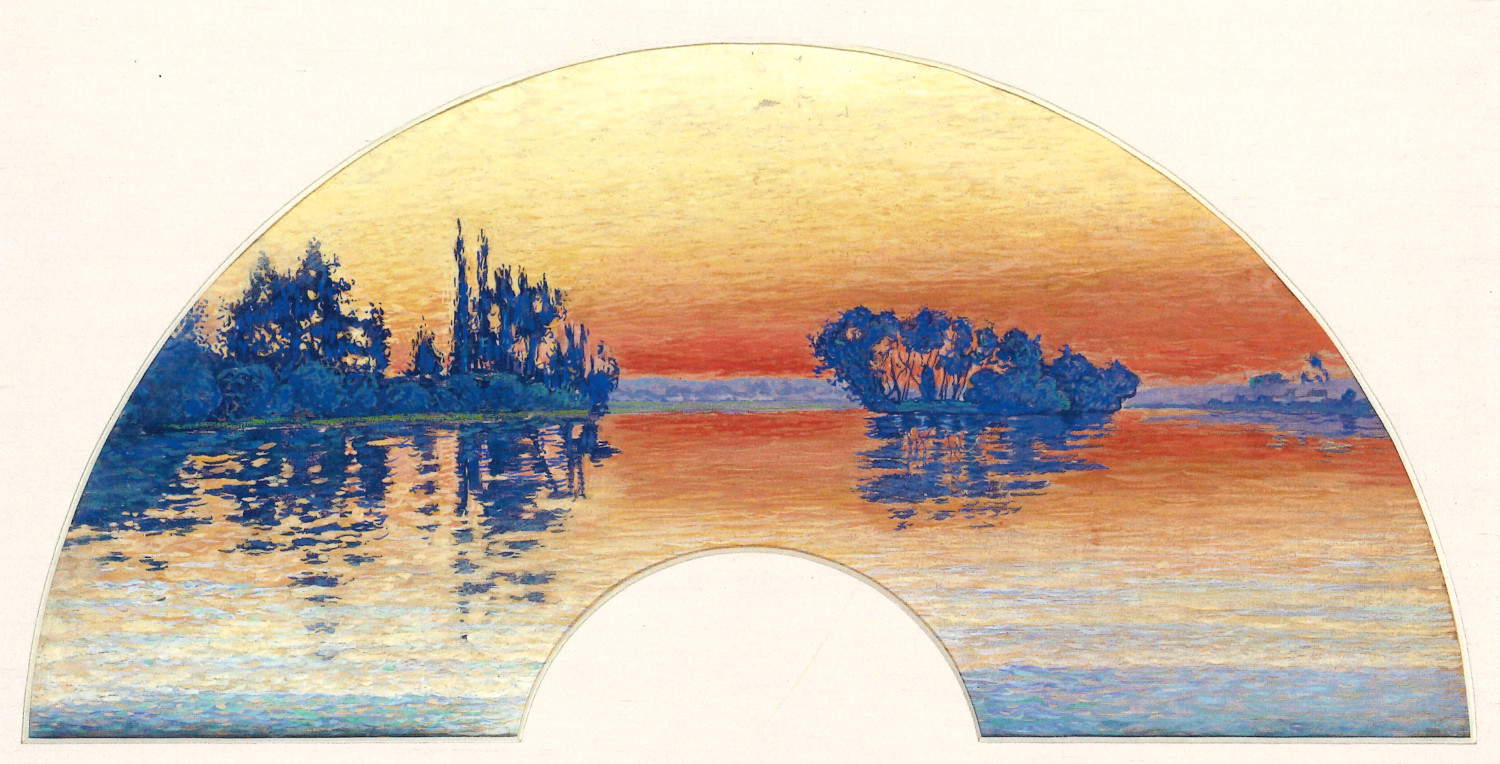
    Paul Signac, Sunset at Herblay (1890; fan painting—oil on silk, 33.5 x 69 cm; private collection)

    One of the main vehicles for the spread of Japanese aesthetics wasukiyo-e woodblock prints, which offered Western artists a formal repertoire radically different from that of the academic tradition. Particularly significant was the transformation in the use of color. Japanese prints employed flat areas of color, devoid of traditional chiaroscuro variations, along with pure colors and sharp color combinations.

    The conception of space was also innovative. In Japanese landscapes, the organization of the composition did not depend on Western scientific perspective but was constructed through chromatic relationships, rhythms, surfaces, and novel viewpoints. These approaches helped challenge the principles of traditional representation and spread rapidly beyond France’s borders, influencing artists in numerous European and American countries. Japonism thus became one of the elements that contributed to the formation of a new international artistic language.

    Among the European artists most interested in the East were the Impressionists and Post-Impressionists. From ukiyo-e prints, the Impressionists drew a new conception of beauty and the relationship with nature, along with the use of luminous colors, more pronounced contours, and a departure from the traditional perspectival organization of planes. The artists were particularly drawn to the possibilities offered by Japanese woodblock prints in terms of color and space. Among other elements, the Impressionists adopted the rapid lines and the characteristic asymmetrical composition. Gauguin and the artists of the Nabis group, on the other hand, focused primarily on the use of color, arranged in flat fields capable of enhancing its decorative and symbolic value, in ways that evoked the works of great ukiyo-e masters such as Hokusai, Utamaro, and Hiroshige.

    The Japanese influence was not confined to painting. Decorative motifs, compositions, and stylistic solutions inspired by Japan also found their way into the world of applied and decorative arts. Elements attributable to Japonism are, in fact, recognizable in the glassworks of Émile Gallé, the Daum brothers, and Louis Comfort Tiffany, as well as in the jewelry designs of René Lalique and Philippe Wolfers.

    The phenomenon was therefore not merely an external influence. Japonism acted, rather, as a true catalyst for Western modernity, accelerating transformations already underway and providing artists with new formal and conceptual tools to transcend the traditional paradigm of representation.

    Leopoldo Metlicovitz, Madama Butterfly (1904; paper / chromolithograph, 144.5 x 103.9 cm; Milan, Civiche Raccolte Bertarelli)
    Claude Debussy, La Mer (Durand, Paris 1905; Private collection)
    Eiichirō Oda (written and illustrated by), One Piece (Wan Pīsu), cover of the first volume of the Italian New Edition of the manga
    Darth Vader vs. Samurai Kabuto: Darth Vader’s helmet and the traditional samurai helmet (kabuto) are linked by a deep stylistic connection. In fact, designer Ralph McQuarrie and George Lucas explicitly drew inspiration from samurai kabuto to create the most famous antagonist in film history

    The exhibition in Forlì thus aims to highlight the international scope of Japonism and its widespread influence across Europe, demonstrating how engagement with Japanese culture took on different forms in various national contexts. The exhibition takes visitors through France, featuring artists such as Paul Gauguin, Henri de Toulouse-Lautrec, Pierre Bonnard, Paul Ranson, and Émile Gallé; Belgium, represented by James Ensor; the Netherlands, with Vincent van Gogh; Austria, through Gustav Klimt and Koloman Moser; Bohemia, with Alphonse Mucha; and England, with Albert Moore.

    Special attention will also be given to Italy and the Italian artists who came into contact with Japonism, including Giuseppe De Nittis, Galileo Chini, Plinio Nomellini, and Giacomo Balla. The phenomenon also involved Italians working in Paris, such as De Nittis and Boldini, and extended to the Anglo-American world, demonstrating just how deep and widespread the circulation of ideas and images from Japan was.

    The exhibition’s narrative is not limited to the historical period of 19th-century Japonism and its impact on modern art; rather, it traces the enduring influence of Japan, extending all the way to contemporary manga,animation, and cinema. From this perspective, the exhibition will explore a phenomenon that did not end with Impressionism or Art Nouveau, but has continued to evolve, entering the international visual imagination and contributing to the emergence of new ways of constructing images, characters, spaces, and narratives.

    With *Visions of the East*, Forlì aims to offer a comprehensive journey through the history of Japonism, from the ukiyo-e prints that captivated 19th-century European artists to contemporary forms of visual expression, highlighting how the encounter with Japanese art played a decisive role in reshaping the history of Western art.
    A Major Exhibition in Forlì on Japan and Japonism, from the Impressionists to Manga
    A Major Exhibition in Forlì on Japan and Japonism, from the Impressionists to Manga

    Le Signore dell'Arte - Palazzo Cucchiari, Carrara - dal 27 giugno al 25 ottobre 2026

    Warning: the translation into English of the original Italian article was created using automatic tools.
    We undertake to review all articles, but we do not guarantee the total absence of inaccuracies in the translation due to the program. You can
    find the original by clicking on the ITA button. If you find any mistake,please contact us.

    Exhibition Forl Japan Japonism Major
    Share. Facebook Twitter
    Previous ArticleCharacterBank’s VR JRPG Knights of Fiona Lands September 3 on Quest and PC VR
    Next Article We Got A New Look At COVR, A “Next
    James

    Related Posts

    Court Rejects Fair Use Claim, Orders YouTube to Unmask Anime Recap Channels

    August 14, 2026

    Attack on Titan Teases New Project With Mysterious Visual Featuring the Original Scout Regiment

    August 14, 2026

    Wind Breaker Chapter 227: Release date and everything we need to know

    August 14, 2026

    Japanese Manga Artist Highlights Importance of Learning about War

    August 14, 2026
    Leave A Reply Cancel Reply

    Our Picks

    Netflix Fall 2026 Schedule: All The New Movies And TV Shows Coming Soon

    August 14, 2026

    Ending PS5 discs will lower PlayStation Store prices, says former Square Enix executive

    August 14, 2026

    We Got A New Look At COVR, A “Next

    August 14, 2026

    A Major Exhibition in Forlì on Japan and Japonism, from the Impressionists to Manga

    August 14, 2026
    • Facebook
    • Twitter
    • Instagram
    • YouTube
    • TikTok
    • Telegram
    Don't Miss
    Movies

    Milo Ventimiglia’s Wife Jarah Mariano Gives Birth, Welcomes Baby No. 2

    By JamesJuly 7, 20260

    Six months afterThis Is UsalumMilo Ventimiglia and wifeJarah Marianoconfirmed her pregnancy, theyannounced the arrival of their second baby together July 6, a baby boy namedRock-Anthony Makoa Ventimiglia. The couple are also parents to daughterKe’ala Coral, 16 months. 

    Julia Garner To Headline ‘Guilty Creatures’ Apple Series Based On Book

    July 7, 2026

    Demon Slayer Infinity Castle OTT Streaming: Date, Time, Platforms Revealed

    July 7, 2026

    Daniel Warren Johnson Returns with Epic New Sci-Fi Series ‘Chainkata’ This November

    July 7, 2026

    Subscribe to Updates

    Get the latest creative news from SmartMag about art & design.

    About Us
    About Us

    Comic Vibe is a pop-culture destination created for fans who live and breathe comics, movies, anime, TV shows, gaming, tech, cosplay, and collectibles.

    Our mission is to deliver engaging news, reviews, features, guides, and opinions that celebrate geek culture in all its forms. From the latest comic releases and blockbuster films to anime trends, gaming updates, cutting-edge tech, and collector culture, Comic Vibe brings everything together in one vibrant hub.

    Our Picks

    Netflix Fall 2026 Schedule: All The New Movies And TV Shows Coming Soon

    August 14, 2026

    Ending PS5 discs will lower PlayStation Store prices, says former Square Enix executive

    August 14, 2026

    We Got A New Look At COVR, A “Next

    August 14, 2026

    Subscribe to Updates

    Get the latest comics, anime, movies, TV, gaming, cosplay, and pop culture news delivered directly to your inbox. No spam—just the stories every fan should know.

    Facebook X (Twitter) Instagram YouTube TikTok
    • Home
    • Contact Us
    • Terms & Conditions
    • Advertise With Us
    • DMCA Policy
    • Privacy Policy
    • About Us
    © 2026 Comic Vibe. Designed by Comic Vibe.

    Type above and press Enter to search. Press Esc to cancel.
