

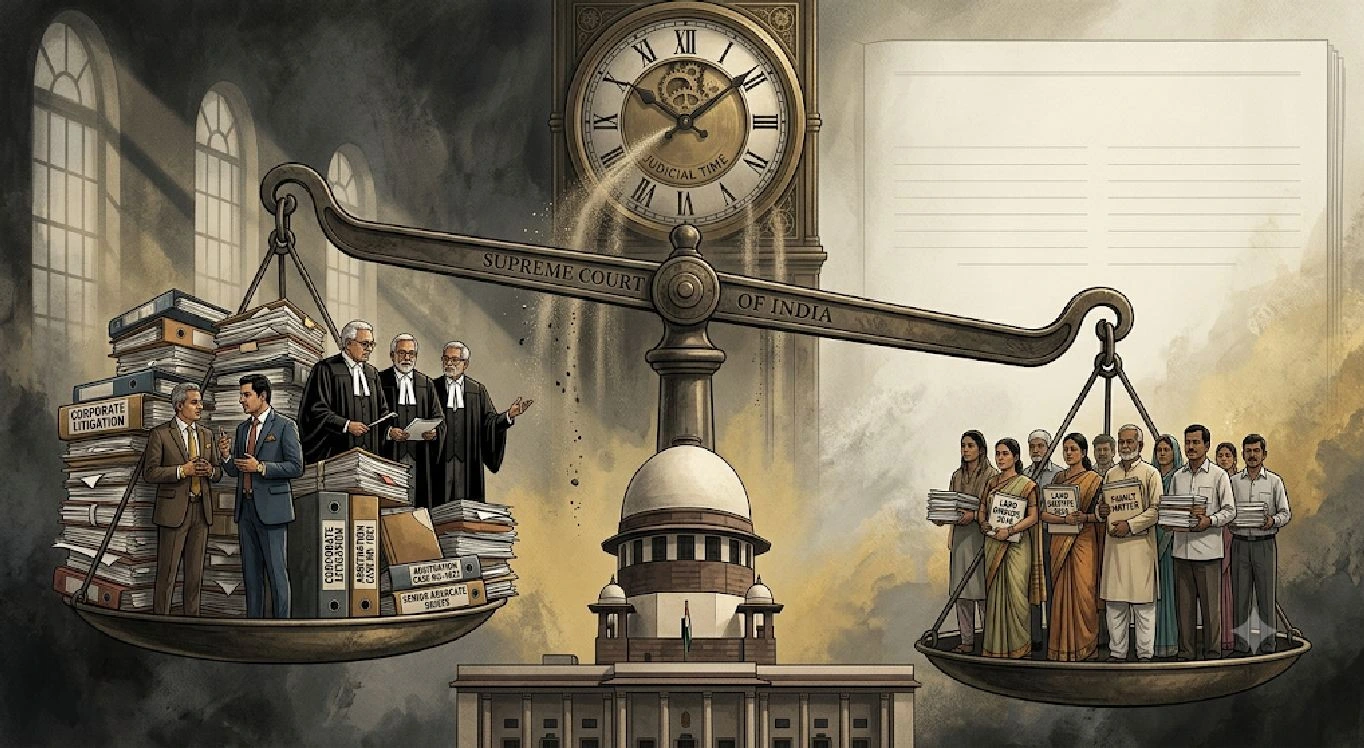
The heightened focus on “luxury litigation” has come against the backdrop of a bitter legal battle involving actress Rehana Khan and her lawyer Rizwan Siddique. The two have been locked in litigation for 11 years, taking their dispute through the Bar Council of India, the Bombay High Court and, eventually, the Supreme Court.
In the latest hearing, a Supreme Court bench of Justices Vikram Nath and Sandeep Mehta imposed a fine of Rs 5 lakh each on the two for failing to approach the apex court with “clean hands”.
The bench did not mince its words. “Each of these parties has come to us complaining of a wrong, and each has been the author of a good part of it,” it observed. “Between them, they have occupied the time of the Bar Council, a High Court and this court for 11 years. That time belonged to other litigants, waiting for relief they genuinely needed.”
The Court went further, making the nature of the litigation itself the subject of scrutiny.
“Litigation of this kind holds a certain fascination, and we do not pretend otherwise,” the bench observed. “But a court is not an auditorium, and the drama of a case is no measure of its merit.”
Stripped of its theatre, the Court said the proceedings revealed a controversy that the two litigants had “manufactured, prolonged and brought to the highest court in the country”, each apparently hoping that the spectacle would distract the Court from their own role in creating it. “We have not been,” the bench concluded.
The significance of the ruling extends beyond the parties themselves. The Supreme Court’s increasing use of the expression “luxury litigation” points to a broader concern: whether financially powerful litigants can use their reant
The Rs 10 lakh imposed in the present case is also symbolically significant. The money is to go to the Supreme Court Legal Services Committee, an institution associated with providing legal assistance to those who cannot afford it. The message is unmistakable: judicial time consumed by litigation that could have been avoided comes at a cost—and that cost should, at least in part, be redirected towards those who genuinely need access to justice.
At the heart of “luxury litigation” is an uncomfortable inequality. A wealthy litigant can afford prominent lawyers, multiple proceedings and, crucially, delay. A financially weaker litigant usually cannot. Such a litigant may not lose because the law is against them; they may simply be unable to afford the prolonged battle required to establish their case.
The phrase acquired sharper judicial currency in December 2025, when a Supreme Court bench, comprising Chief Justice of India Surya Kant and Justice Joymalya Bagchi, declined to entertain a plea concerning bottled drinking water.
The petition sought revision of permissible levels of antimony and Diethylhexyl phthalate (DEHP) in packaged drinking water to bring Indian standards closer to international benchmarks.
The Court regarded the challenge as disconnected from India’s socio economic realities, describing it as “luxury litigation” and, in particularly strong language, as a “rich and urbanised phobia”. The bench observed that if petitioners travelled to the poorest parts of the country, they would understand that the immediate national challenge was water scarcity rather than high-end bottle chemistry.
The ruling provoked debate because the petitioners’ stated concern was not necessarily about elevating packaged water above public water supplies, but about preventing avoidable public-health risks. Yet, the Court’s larger concern was with the allocation of scarce judicial attention: whether the Supreme Court should devote its time to highly technical regulatory disputes when millions of Indians continue to struggle for access to basic necessities such as safe drinking water.
That tension is central to the debate over luxury litigation. Judicial time is a public re constitutional right
Another significant case involved a dispute over control of an educational institution. A bench of Justice BR Gavai, who would later become chief justice, and Justice Aniruddha Bose described the proceedings as “nothing but a luxury litigation between two warring factions to exert control over an educational institution”. The Court imposed exemplary costs, directing each party to pay Rs one lakh to the Supreme Court Advocates-on-Record Association and the Supreme Court Bar Association.
The concern is not new. Earlier, a bench headed by Chief Justice NV Ramana took exception to a counsel seeking permission to file further written submissions in a matter that had already been reserved for orders. “Best not to list these matters. It appears to be a luxurious litigation,” the chief justice remarked.
If there is a sphere in which the idea of luxury litigation assumes an especially stark form, it is arbitration. Arbitration is intended to provide an efficient alternative to conventional litigation. Yet, some disputes have stretched over years while generating extraordinary professional costs.
In Jaipur Vidyut Vitran Nigam Ltd vs HCL Infosystems Ltd, for instance, a three-member arbitral tribunal, comprising one retired Supreme Court judge and two retired High Court judges was paid about Rs 13 crore over seven years.
The problem is not that arbitrators should not be adequately compensated.
The larger question is whether a system designed to provide speed and efficiency can become an expensive parallel universe in which time itself ceases to be a meaningful constraint.
Section 29A of the Arbitration and Conciliation Act, 1996, was intended to impose precisely such discipline. An arbitral award was ordinarily to be delivered within 12 months, extendable by six months with mutual consent. Beyond that, the parties were required to approach the court. The provision also gave courts the power to insist on sufficient cause for extensions, reduce arbitrators’ fees where delay was attributable to the tribunal, impose terms and costs, and even substitute arbitrators.
Yet, research has indicated that extensions were granted in 98 per cent of cases, while adverse costs were imposed in only 2.5 per cent. Arbitration disputes frequently involve large corporations, international businesses and high-value disputes between business families. For parties with deep pockets, the financial burden of delay can become a secondary consideration.
The sharper judicial scrutiny is, therefore, now being directed towards litigation in the courts themselves.
There is, however, an important caveat. Wealth does not diminish a citizen’s constitutional right to seek justice. A wealthy individual, corporation, celebrity or influential person has exactly the same right to approach a court as an economically weaker litigant.
The problem begins when financial strength is used to sustain litigation that has become repetitive, disproportionate or needlessly prolonged.
That distinction matters because the courts are confronting an extraordinary backlog. More than 49 million cases are pending in the district and subordinate courts, against a total pendency of roughly 56 million cases across all levels of the judiciary. The grassroots courts account for more than 85 per cent of the national backlog, and it is at this level that ordinary citizens, the underprivileged and the poor are most likely to seek relief.
Every hour spent on an unnecessary legal contest is an hour unavailable to someone waiting for a genuine remedy.
That may ultimately be the real meaning of the Supreme Court’s growing impatience with “luxury litigation”. The issue is not whether some litigants are rich enough to litigate. It is whether wealth should allow them to monopolise a public institution whose most precious re
Luxury litigation may have reached a tipping point.
—The writer is former Senior Managing Editor, India Legal magazine
