

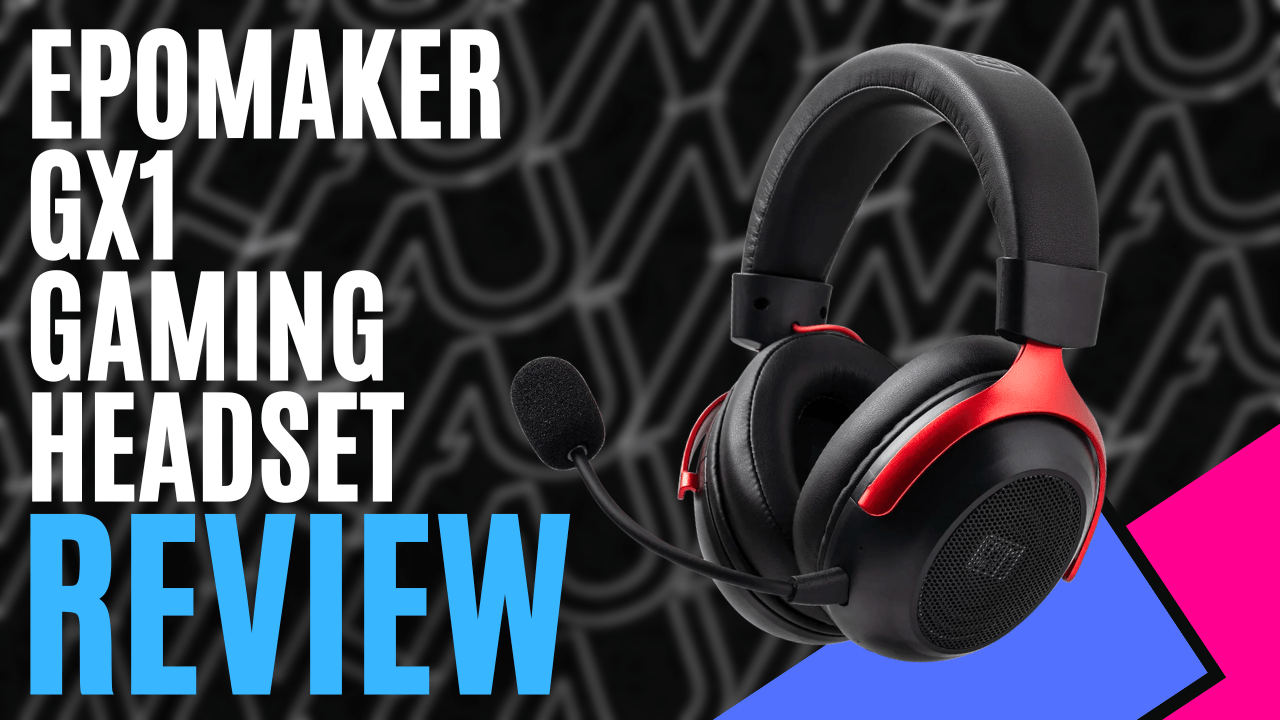
EPOMAKER GX1 Headset, their first foray into the headset market, is listed on their website as “GX1 is aimed at gamers, students and everyday users alike; anyone who wants a wireless headset without committing to a premium price”. I genuinely love their keyboards, so I was excited when the headset came up for review. Let’s see if EPOMAKER has what it takes to break into the crowded headset market.
Opening the box, you are greeted by the headset, a detachable noise-cancelling microphone with a foam cover, a USB-C to 3.5mm audio cable, a USB-A to USB-C cable, a 2.4 GHz dongle, and an instruction manual. The weight comes in at 320 grams and looks like the old style of gaming headsets from the early 2000s; that’s what EPOMAKER does so well with their keyboards I have tested, going back to the past in their styling.
They have nice, breathing rainbow RGB on the outside ear pieces, which look top-notch behind the honeycomb covering over the outer ear, making them look very stylish. The EPOMAKER GX1 Headset comes in four colours: black, grey, pink, and white.
The headband is adjustable with seven different levels, so you can adjust it to fit all shapes and sizes, and it feels super soft against your head, with a soft leather texture on the cup.
On the back of the left headphone, you turn it on by holding the power button down, and a lady’s voice says very loudly, “Power on, USB connected.” I mean, it’s useful information, just very loud. In the same cluster of buttons is the mute button and a button to turn off the RGBs. It would have been beneficial to move these slightly further apart, as I feel, especially since they are all the same shape in the same cluster; you could easily hit the wrong one.
You have a small scroll dial for your volume and a green indicator light to show the headphones are on, if you aren’t using the outside RGB as a visual indicator. On this side, you also have the charging port and the port to plug the microphone into.
On the right-hand side, you have a switch to go between wireless and Bluetooth connectivity. The detachable microphone is an ENC (Environmental Noise Cancelling) microphone perfect for blocking out background noise and testing with friends; they reported it sounded a little bassy and not 100% clear.
The battery is 2000mAh and takes three hours and twenty minutes to charge fully. This gives you 30 hours of usage with RGB on or 70 hours with the RGB off. The earcup is an open-back design, allowing air to pass through the earcup from the rear of the 50mm speaker driver.
This gives them a more natural, clearer sound; the EPOMAKER GX1 Headset also has 7.1 surround sound, although the open earcup design doesn’t block out ambient background noise.
For me as a parent, I like this because I can vaguely hear what’s going on around the house and my wife yelling at me, but I acknowledge that for dedicated gamers, it can be a problem.
Traditionally, open cups aren’t that great for directional noise because the cup doesn’t block outside noise, but after a few hours of Fortnite and Tarkov, I found that wasn’t the case with the EPOMAKER GX1 Headset.
The EPOMAKER GX1 Headset supports the full frequency range of the human ear, 20 Hz to 20 kHz, and I found it excellent when listening to Spotify while working.
The THD (Total Harmonic Distortion) is greater than or equal to 3%, which is great, considering higher-end models are 1%, so the EPOMAKER GX1 Headset punches well above its weight for its price point.
Connection-wise, the EPOMAKER GX1 Headset supports 2.4 wireless connection with 25ms latency, Bluetooth, or the Type-C USB connection. It will work with PC, Mac, and Nintendo Switch. Xbox is only supported through a wired connection, and PlayStation connects wirelessly.
For the price point the EPOMAKER GX1 Headset comes in at, it’s hard to fault the headset. It really punches above its weight and stays on par with some other products at different price points.
For EPOMAKER’s first step into the wireless gaming headphone market, I am impressed. I look forward to seeing how future models progress; if it is anything like their keyboards, the future is looking very bright!

1 Comment
Pingback: Behind-the-Scenes Making-of Video for TV Anime Jaadugar: A Witch in Mongolia Released - Comic Vibe