

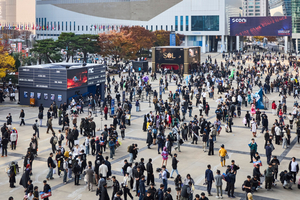
Korea’s biggest game companies are bypassing G-Star for overseas showcases, putting the country’s largest gaming convention at a crossroads.
The G-Star organizing committee last week unveiled the initial lineup for this year’s event, scheduled for Nov. 19-22 at Bexco in Busan. None of Korea’s four leading game companies — Krafton, Nexon, NCSoft and Netmarble — appeared on the list of business-to-consumer exhibitors.
The companies have traditionally operated large booths where visitors can preview trailers and play upcoming titles.
Instead, this year’s B2C lineup includes Korean developers Webzen and Team42 alongside Chinese game companies HoYoverse, NetEase Games, Joker Studio, Bilibili and Century Games.
Organizers said the floor plan had not been finalized, leaving room for additional exhibitors to be announced next month. More Korean companies are also expected to participate in business-to-business programs.
In another sign of G-Star’s changing identity, Wrtn Technologies’ AI-powered creative platform Crack has become the event’s first main sponsor from outside the gaming industry.
The committee said G-Star needs to move beyond games by incorporating fields such as artificial intelligence, webtoons and automobiles.
“It is important to organize an event that satisfies both participants and visitors rather than focusing on attendance figures,” G-Star organizing committee head Jo Yeong-gi said at a press conference in Seoul on Thursday.
“G-Star needs its own distinctive character instead of competing with global gaming exhibitions such as Gamescom in terms of size.”
This year’s event will collaborate with Lee Dong-geon, creator of the hit webtoon “Yumi’s Cells,” which has accumulated more than 3.4 billion views.
Hyundai Motor will also host simulated racing events and display high-performance vehicles at the venue.
Although Korea’s major game companies could still join G-Star at the last minute, they have already committed re
Gamescom will take place in Cologne, Germany, from Aug. 26-30, followed by the Tokyo Game Show in Chiba, Japan, from Sept. 17-21.
G-Star attendance peaked at about 245,000 in 2019. Following the disruption caused by the COVID-19 pandemic, visitor numbers recovered from 184,000 in 2022 to 197,000 in 2023 and 215,000 in 2024, before slipping to 202,000 last year.
“As Korean game developers increasingly target global players, it makes sense for them to allocate repany said
“If G-Star offered a more cost-effective option, there would be no reason for companies to pass on it. They are investing their money and time in Gamescom and the Tokyo Game Show because those events currently make more sense for reaching players worldwide.”
