

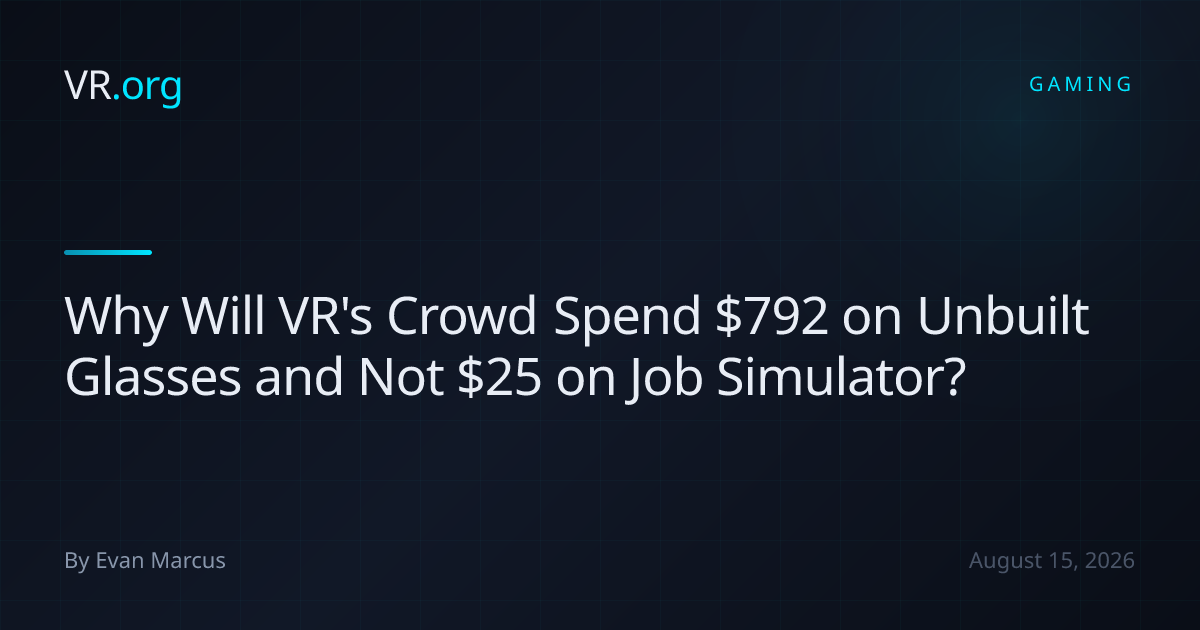
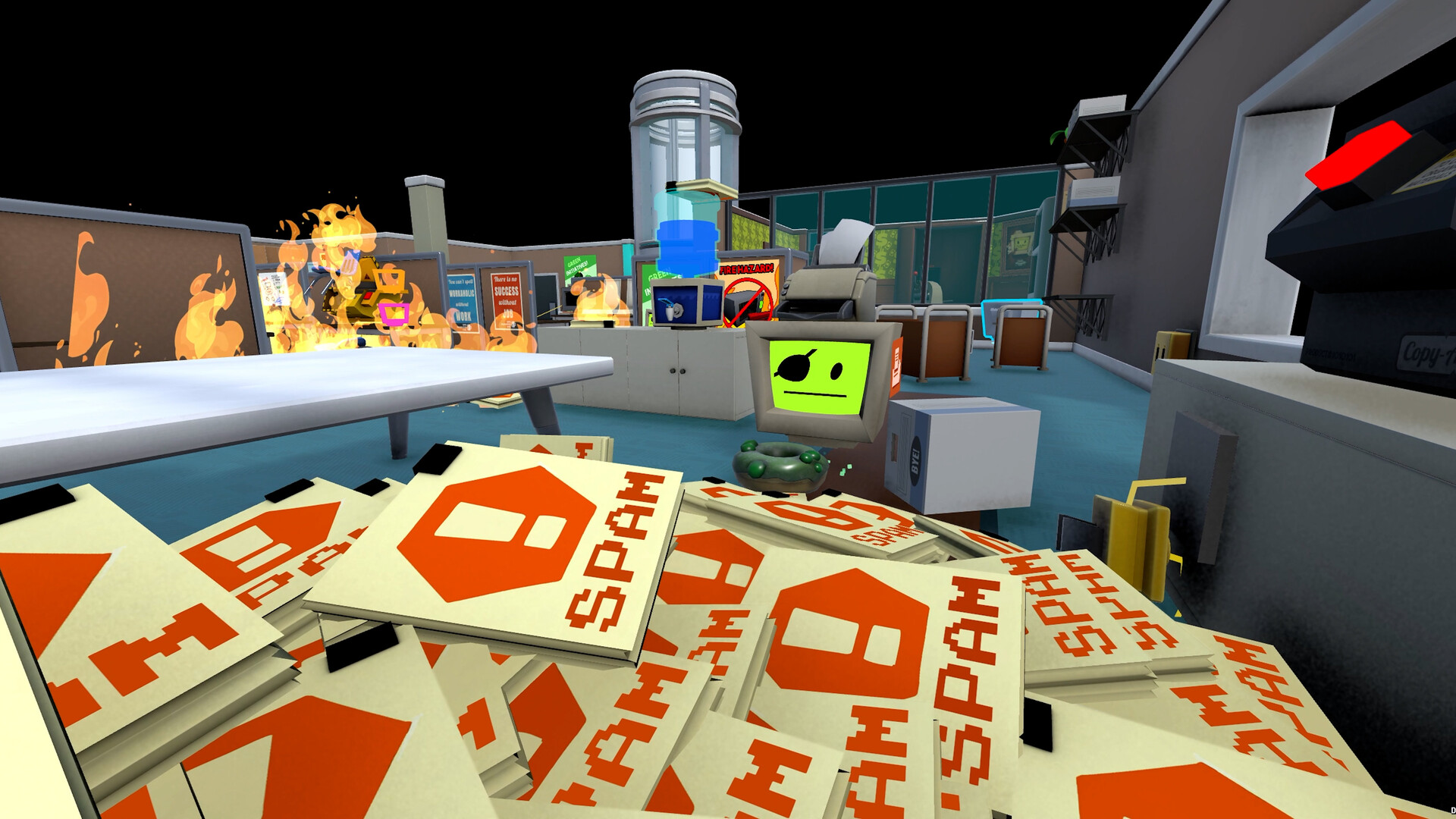
Job Simulator: Human Relations went live on August 11. It is the first thing in that franchise to exist outside a headset in the ten years the franchise has been around, a four-player flatscreen co-op comedy built by FarBridge under license from Owlchemy Labs, and it is asking for $150,000. As I write this it has $14,723 from 211 backers. Twenty-six days left.
A week earlier, a company that almost nobody reading this had heard of in July opened a campaign for a pair of display glasses with no processor and no battery inside them. URXR One. Fifty thousand dollar goal, mid-October ship date, $699 to get in early. It is at $793,716 from 1,002 backers.
Same platform. Same month. The glasses have taken fifty-four times the money.
Six thousand people. That is the entire ask.
Here is the arithmetic that has been bugging me since Tuesday. The entry tier on Human Relations was $20 for the first day and $25 after, and that tier is a copy of the game. At $25 a head, $150,000 is roughly six thousand people. Owlchemy said in January that Job Simulator has crossed six million installs, averaging something like 600,000 a year since 2016. So the campaign needs one out of every thousand people who have ever installed the original to hand over twenty-five bucks.
It has 211.
The 211 are not being cheap about it, either. Divide the total by the backer count and the average pledge comes out at $69.78, which means the people who did show up are climbing into the higher tiers instead of grabbing a copy and leaving. That is exactly what a small, committed audience looks like. Small being the load-bearing word.
Where I have to be fair about this
Four things cut against the reading I just gave you, and I would rather put them here than have you email them to me on Monday.
Human Relations is not a VR game. It is flat, deliberately, PC only, and the pitch is that you can play it with three friends who do not own headsets. So this is not clean evidence that VR games cannot crowdfund. In a way it is worse evidence than that, because taking the headset off is supposed to widen the audience, and the wider audience has not turned up either.
Kickstarter also is not broken for games in general. As of this morning, in the same video games category, a strategy game called Sanctuary: Shattered Sun is sitting on more than a million Australian dollars from 7,174 backers. People fund games on that platform every week of the year, in volume, including games from studios with far shorter resumes than FarBridge’s.
Four days is four days, as well. Crowdfunding runs in a U shape, heavy at the open, dead through the middle, heavy again at the close, and a September 10 deadline leaves a lot of room for a final week. I have watched campaigns double in the last 48 hours. This one still could.
And six million installs is not six million buyers. Owlchemy said so themselves when they announced the figure: free Vive bundles counted, Horizon Plus subscribers counted after March 2025, VR arcade licensing counted. The paying audience underneath that number is smaller than the number. Nobody outside Google knows by how much.
A pledge for hardware is not the same object as a pledge for a game
I think the gap comes down to what the pledge actually buys, and almost none of it is about how much anyone loves Job Simulator.
Put $699 into a pair of glasses and you are buying several things at once: a discount against a $899 retail price, a place in line, the only window you will ever get to own that specific object before anyone else does, and a small clean thrill of gambling on a startup. The product does not exist yet. That is the appeal, not the drawback. Scarcity is the entire product until the box shows up at your door.
Put $25 into a game and you are buying a Steam key, later, at the price it will cost on release day anyway, from a team that will happily sell it to you then. No scarcity. No line. No discount worth the name. What you are really purchasing is the risk that it never gets finished, and in exchange you get a Discord role and your name somewhere in the credits. That is a donation wearing a product-shaped receipt, and most people, reasonably, would rather just hit wishlist.
That asymmetry has always been there. What has changed is how lopsided the money got. Scroll the same live list and you find AIVU, an AI glasses campaign from a company I can tell you nothing about, sitting at $92,774 against a $10,000 goal with 230 backers. Two hundred and thirty people. That is more human beings than have backed a sequel to the second best-selling game in the history of Meta’s store.
