

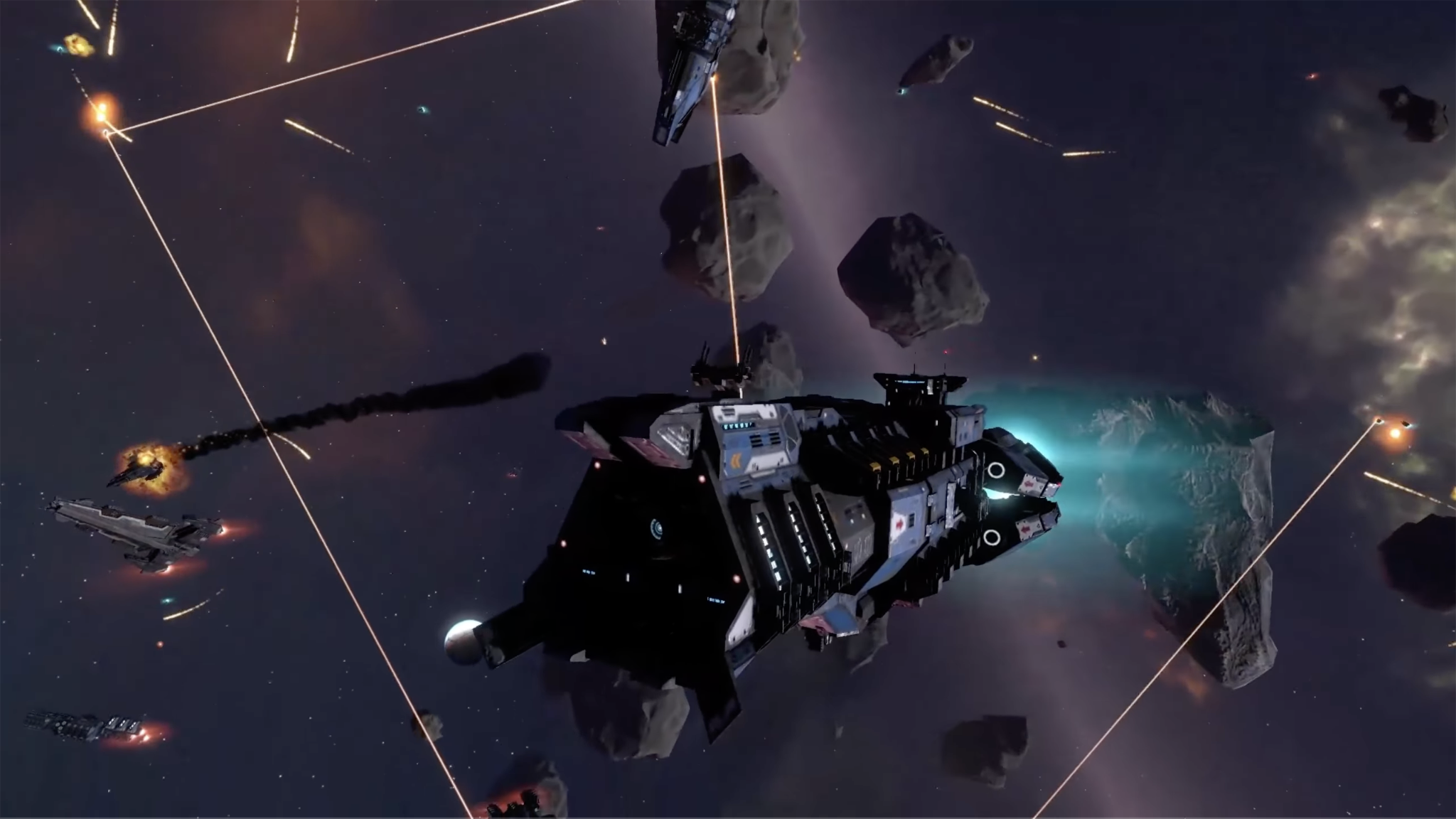
Space real-time strategy has never really worked in VR — until now. At the VR Games Showcase on Aug. 13, SpaceOwl Games confirmed that BattleGroupVR2 will arrive in Early Access on Meta Quest on Aug. 28, bringing to standalone headsets a fleet command game that has been steadily accumulating “Very Positive” reviews on Steam since its PC VR launch last November. The Meta Quest release matters not just as a port but as the moment the game becomes accessible to the far larger population of standalone VR players who own no gaming PC — and with a free demo arriving Sept. 12, there is almost no barrier to finding out whether it’s for you.
Priced at $24.99 (the same on both platforms), BattleGroupVR2 has earned 85% positive across 198 reviews on Steam, with the “Very Positive” designation reflecting genuine enthusiasm from a community that has watched the game grow through a consistent stream of post-launch updates. That nine-month track record of active development is the first thing a Quest buyer should weigh. BattleGroupVR2 is not finished — it is an Early Access title with cross-platform multiplayer, expanded narrative missions, and additional ship classes still on the roadmap — but what is already there has convinced a majority of the people who paid for it that it was worth the price.
The Aug. 13 VR Games Showcase confirmed the date, making this one of the cleanest launch windows for any VR strategy game in recent memory: a confirmed date, a confirmed price, and a free demo to follow on Sept. 12 to reduce the risk for anyone still deciding.
How Bridge-Anchored Design Solves VR’s Oldest Strategy Problem
Real-time strategy games have a fundamental VR incompatibility that the genre has never fully worked around. Traditional RTS design places the player in a disembodied floating camera that roams freely across the battlefield — omnipresent, hovering above units, sweeping across terrain. In VR, that free-camera movement triggers vestibular mismatch: the inner ear registers stillness while the eyes register motion through space, producing nausea. Researchers studying VR game design identified this as one of the core obstacles to adapting the RTS genre for headsets — documented VR RTS design barriers including scaling, navigation, and cybersickness, not incidental problems.
BattleGroupVR2 solves this by eliminating the free camera entirely. The player stands on the bridge of their flagship. They do not move — the game comes to them. A holographic tactical display positioned at arm’s reach shows the surrounding sector, and the player reaches into it to issue orders. Real combat plays out through the bridge windows; the player pivots their body, not a game camera.
That design choice does something researchers considered difficult to achieve in the genre: it preserves VR presence — the visceral sense of inhabiting a space — without making the player responsible for camera locomotion. The flagship’s bridge is a room the player is in, not a shell they look out of. The holographic map solves the scale problem that has plagued VR strategy: rather than shrinking ships to distinguishable-but-tiny icons at game scale, the map abstracts them as glowing readouts at table-height, while the full-scale ships are visible beyond the windows as something closer to an art installation than a clickable interface element.
The third piece of the design is the AI captain system. Because the player cannot zip from ship to ship to manage individual units — teleportation between ships would require constant locomotion — AI captains handle ship-level tactics. The player recruits, levels up, and deploys these captains; the captains execute. This removes the micro-management layer that traditional RTS games put at the player’s fingertips, replacing it with something that feels more like actual fleet command: you set strategic priorities and watch whether your officers can execute them.
This is not a perfect system. At least one Steam reviewer noted that the command feel in BattleGroupVR2 is less satisfying than in its predecessor. Whether that reflects a temporary Early Access polish gap or a structural tradeoff in the design is a question the Quest launch, and the community feedback it generates, should begin to answer.
What the Quest Port Means Technically
The PC VR version of BattleGroupVR2 recommends an NVIDIA RTX 4080 as recommended hardware — a GPU that costs significantly more than the Quest headset itself and requires a desktop gaming system to house. The standalone Quest runs on a mobile ARM processor with a fraction of that GPU throughput, a hard thermal ceiling, and no active cooling beyond passive heat dissipation through the headset frame.
What that means in practice for the Quest version is that the developer — working alone — has had to reduce draw calls, texture resolution, and particle density to hit the frame rate targets (90 frames per second is the Quest minimum for comfortable VR; dropping below it in a strategy game with complex battle effects would be noticeable). The developer’s comment in a community update on the Quest port that they were “still actively working on the Quest port” reflects the genuine scope of that optimization task.
The tradeoff players should understand: the Quest version will look different from the PC VR version. It will likely have simpler visual effects during large fleet battles. Whether SpaceOwl’s single-developer optimization work produces a comfortable, stable frame rate across BattleGroupVR2‘s different game modes — particularly the open-world campaign and Conquest mode, which involve the most persistent content — is not yet publicly known. The Aug. 28 launch will be the first public answer to that question.
What the Game Is About (and Why the Story Matters)
BattleGroupVR2 places the player in the role of a fleet commander working under a shadow: their father’s death, and the mystery surrounding the events that set everything in motion. The campaign’s narrative thrust is personal — restoring honor to the family name — wrapped around a procedurally generated open galaxy where the player mines asteroids, trades commodities, hunts pirates, and forges a reputation sector by sector. As story missions unlock, new characters enter, and the game pulls back the curtain on a larger conspiracy. The developer has described the campaign as roughly halfway complete plot-wise, with more narrative content arriving through future Early Access updates.
The tone is operatic space drama with a grudge at its center — something closer to The Expanse‘s hardboiled political intrigue than Star Wars‘ mythic clean-cut heroism. The crew serves as ambient storytelling; dialogue is delivered with subtitles (added in a recent update), and the bridge is populated with enough detail that standing on it feels like standing somewhere that has history.
This matters to the purchase decision because BattleGroupVR2 is not primarily a multiplayer shooter or a sandbox that exists in the absence of a story. The game offers four distinct game modes — the Open World campaign, Combat Gauntlet (an escalating endurance run against enemy fleets), Conquest Mode (asynchronous territory control where rival player fleets compete even while those players are offline), and Endless mode (a pure score-attack sandbox). A player who cares about story progression should know that the campaign is being built in public and is not finished. A player who just wants to command escalating fleet battles has a fully functional mode for that already.
What’s on the Roadmap Before Full Release
SpaceOwl has outlined a 12-to-18-month Early Access window. The items not yet in the game that are confirmed for the full release include cross-platform multiplayer with expanded ship options — both PvP and cooperative modes between Steam and Quest players — a wider selection of ships and equipment, enhanced narrative missions, more varied procedurally generated events, and expanded audio and cinematic polish.
Some of those items — particularly cross-platform multiplayer — are significant, because the Conquest Mode’s asynchronous territory system becomes more interesting as the player population grows across platforms. The Quest launch is, among other things, a population expansion that could meaningfully affect the multiplayer ecosystem.
The developer has also been transparent about current limitations. Localization beyond English is present but was initially built using machine translation rather than professional localization services, because the cost of professional translation for a project of this scope — across thousands of lines of mission briefings, dialogue, and UI text — is outside what a solo developer can currently fund. Non-English-speaking players should be aware that translated text may read awkwardly in places.
Is BattleGroupVR2 Worth Buying Into Early Access?
The case for buying before the free demo: the game has a nine-month head start of updates, a community that has been actively shaping development, and a developer who communicates in public with notable consistency. The 85% positive rating reflects a game that works as promised at its core — the VR RTS loop is genuinely realized — with rough edges that ongoing updates have been systematically addressing, including the v0.227 ship insurance feature (which cushions the sting of losing a fitted vessel) and ongoing story content additions.
The case for waiting for the demo: you are buying an incomplete game. Cross-platform multiplayer — one of the more compelling social features — is not live yet. The Quest version is entering Early Access without a public performance track record; the developer’s solo-studio scale means optimization issues could exist in edge cases that only a larger test population will surface. And the free demo on Sept. 12 offers a full taste of the core loop at no cost.
Either way, the decision window is clearer than it is for most VR games. The Aug. 28 Quest launch is real, the Sept. 12 demo is real, and the $24.99 price is expected to remain the same whether you buy now or at full release.
Frequently Asked Questions
Is BattleGroupVR2 available without a gaming PC?
Yes, as of Aug. 28, 2026, the game will be available directly on Meta Quest in Early Access as a standalone title. No PC is required. The PC VR version has been available on Steam since November 2025, but the standalone Quest release is new and marks the first time Quest-only owners can play without a computer link.
How does BattleGroupVR2 avoid the motion sickness that makes most VR strategy games uncomfortable?
The game anchors the player’s perspective to the bridge of their flagship — you stand in one place and the world moves around you rather than you moving through it. Orders are issued through a holographic tactical display positioned at arm’s reach, which eliminates the free-camera movement that causes vestibular mismatch (the main source of VR nausea in strategy games). Researchers studying VR RTS design have identified this fixed-perspective design as viable for making strategy games comfortable in headsets.
What is the free demo, and when is it available?
A free demo launches on both Steam and Meta Quest on Sept. 12, 2026. It covers the core game loop — commanding a flagship, managing a fleet, and experiencing the introductory open-world sector — so prospective buyers can evaluate the experience before spending $24.99. The free demo on Sept. 12 means the game is priced the same in Early Access as it will be at full release.
What is the biggest thing missing from the current Early Access version?
Cross-platform multiplayer — both cooperative and player-versus-player modes that let Steam and Quest players compete together — is not yet available. The Conquest Mode’s asynchronous territory system is live and functional, but fully synchronous cross-platform play is planned for the full release. The developer has also noted that professional localization for non-English text (currently machine-translated) is a future goal that current solo-studio funding constraints have not yet made possible.
ⓒ 2026 TECHTIMES.com All rights reserved. Do not reproduce without permission.
