

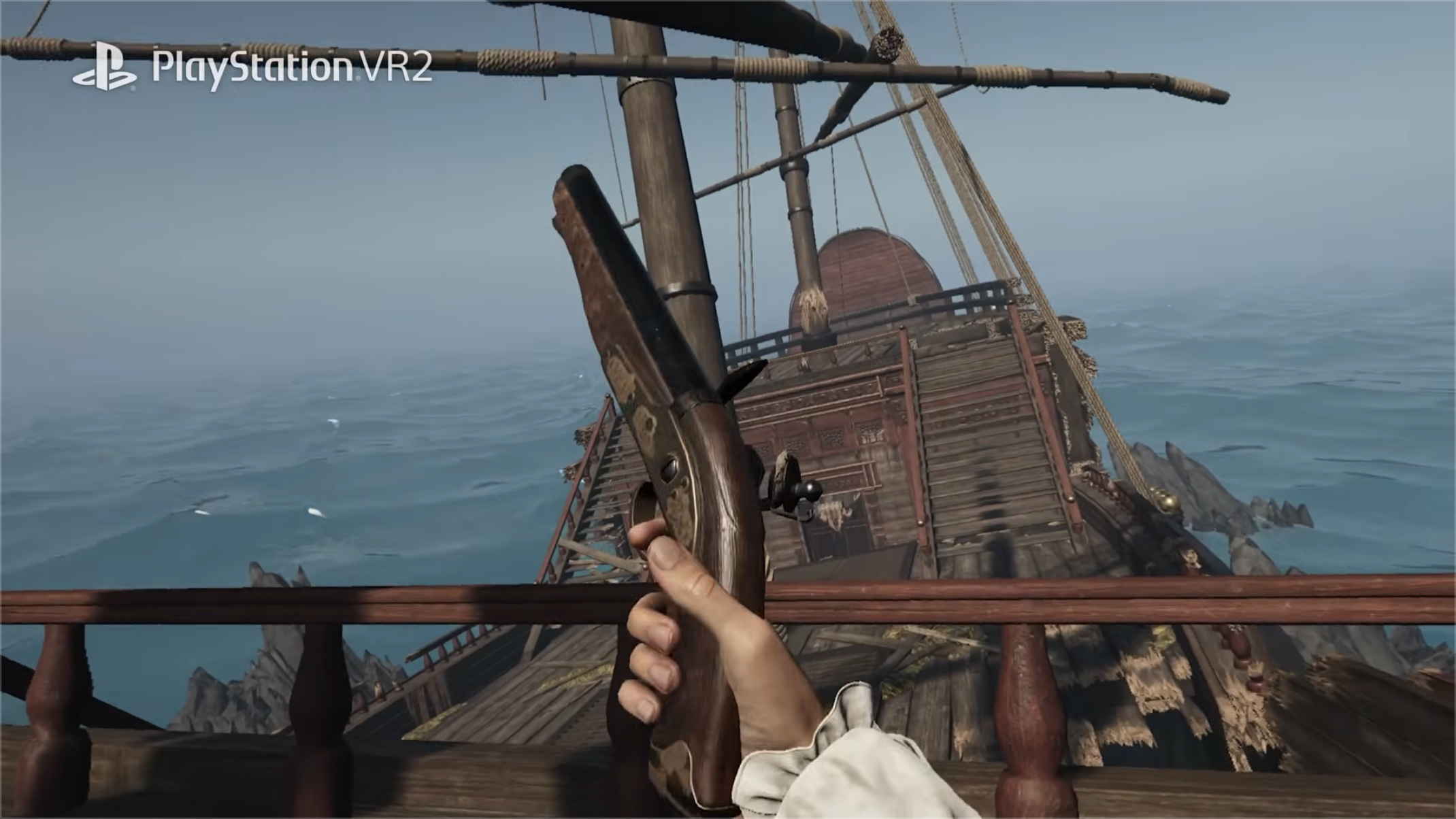
Bootstrap Island arrived on PlayStation VR2 yesterday, bringing the most physics-intensive VR survival game to date to Sony’s headset — and with it, three hardware features that the PC VR version never had: eye-tracked foveated rendering, adaptive trigger resistance, and a vibration motor built directly into the headset body. For PSVR2 owners who have been waiting for a survival game that treats the headset’s hardware as something to be used rather than tolerated, the wait is over.
The PC VR release already earned four out of five stars from UploadVR’s full review, whose reviewer concluded it stands as one of the best survival titles in VR. The PSVR2 version includes all post-launch content updates the Steam release received, alongside the platform-specific hardware integrations.
What PSVR2 Adds That PC VR Cannot
The distinction matters because Bootstrap Island is built around physical consequence. Its systemic simulation means a flintlock pistol left out in the rain will not fire. A campfire caught in a storm will go out. The weather is not decoration — it interacts with every tool and reedict or script around
PSVR2 adds three hardware channels that deepen this physicality in ways that have no equivalent on Valve Index, Meta Quest, or any other PC-linked headset.
The first is eye-tracked foveated rendering. PSVR2’s internal eye-tracking cameras identify where the user’s gaze is focused at any given moment. The PS5’s GPU then renders that specific region at full visual resolution, while treating the periphery at reduced detail — a distinction the human visual system naturally cannot perceive, since peripheral acuity is lower than foveal acuity by design. This is not fixed foveated rendering, in which the edges of the image are permanently downgraded regardless of where the eye looks. Dynamic, gaze-tracked foveated rendering moves with the eye in real time. According to a Unity panel at GDC 2022, combining eye tracking with foveated rendering can improve GPU frame times by up to 3.6x — cutting a 33.2ms frame time to 14.3ms in test conditions. For a game as graphically intensive as Bootstrap Island — dense jungle canopy, dynamic lighting, weather effects, procedural animal behavior — this is not a performance optimization tool. It is an enabler of visual fidelity that would otherwise require hardware well beyond the PS5.
The second is adaptive trigger resistance. Bootstrap Island maps physical actions — drawing a bowstring, cocking a flintlock pistol, hauling a satchel — to the L2 and R2 triggers, which provide variable resistance rather than uniform button pressure. Pulling a bow to full draw now requires the player to work against tension that builds as the string reaches maximum displacement.
The third is headset vibration. This is the feature with no PC VR equivalent. PSVR2 includes a vibration motor in the headset body itself, not just in the controllers. Bootstrap Island uses it specifically during thunderstorms and near-death encounters — the headset shakes against the player’s face. Lilit Palmar, CEO and co-founder of Maru VR, described the intent behind these integrations in the game’s PlayStation Blog announcement: the studio’s goal from the beginning was to create “a VR experience so believable that players forget the real world,” with every interaction from lighting a fire to gathering resources feeling “natural, grounded, and physically intuitive.”
Daniel’s Island: What You’re Surviving
Bootstrap Island casts the player as Daniel, a 17th-century merchant who washes ashore after a shipwreck with nothing: no map, no tutorial, no quest markers, and no second chances within a single run. The central dramatic question the game poses is not whether Daniel will survive — it is how far he can get before the island kills him, and what he will learn in the attempt. The emotional register is brutal and, in the UploadVR reviewer’s word, “disturbing” in places: animals attack at night in waves; rain can kill a fire you spent an hour maintaining; a tribe you haven’t yet approached may or may not respond to your attempt at communication.
The specific detail that clarifies the experience most is the tribe mechanic introduced in the 1.0 release: players must learn to communicate with a local island people whose relationship — friendly, hostile, or somewhere between — opens or closes survival options. A positive relationship allows bartering for resources. A negative one produces outright hostility. Nothing about this is scripted: the relationship reflects the choices the player makes in real time, which means an attempted interaction can go wrong in ways no guide fully predicts.
The game is a roguelite rather than a strict roguelike: death restarts the campaign from the beginning, but specific unlocked items carry forward into subsequent runs. A satchel earned in one failed expedition remains available in the next. The island’s layout, weather patterns, animal spawn locations, and chest contents randomize between runs, which prevents any single strategy from becoming a reliable formula.
Eight Years of VR Experience in a 15-Person Studio
Maru VR Productions is an Estonian studio based in Tallinn, and Bootstrap Island is its first premium game release — but the team behind it is not new to VR. The studio spent eight years building more than 40 different VR experiences before attempting Bootstrap Island, accumulating direct knowledge of what the medium does and does not do well.
The project received institutional backing in the form of a €150,000 grant (approximately $173,355, approximate at time of publication) from the European Union’s Creative Europe Media Programme — representing 50% of the game’s development costs and making Maru VR the first Estonian company to receive EU Creative Europe Media support for game development. The grant came through the same program that has historically supported European film and television production, applied here to an interactive VR project — a signal of where institutional definitions of “media” have moved.
Palmar earned a master’s degree in Entrepreneurship and Technology Management from the University of Tartu and spent fifteen years in business consulting before founding the studio. The 15-person team reflects a deliberate choice to stay small through a development process that began in Early Access in February 2024.
Does the Technical Foundation Justify the Hardware Requirement?
The honest answer from the PC VR launch is: with capable hardware, yes — with mid-tier hardware, uncertain. UploadVR’s reviewer noted that his previous RTX 3070 on a Ryzen 5 5600X ran the game poorly even at minimum settings. The PSVR2 version eliminates that variable: the PS5’s GPU output is fixed, and foveated rendering is designed specifically to allow the game’s visual density to run within those constraints. Whether the PSVR2 implementation delivers the same visual quality as a high-end PC setup (the reviewer used an RTX 5070 Ti with a Ryzen 7 9850X3D for the full-release review) remains to be tested in independent coverage of the PSVR2 version.
What the PSVR2 version does provide that no PC headset can is the headset haptic channel. A player running Bootstrap Island on Valve Index on the most powerful PC available will not feel a thunderstorm in the headset itself. On PSVR2, that specific sensory feedback exists — and for a game whose design philosophy is built around making the player feel the physical consequences of every decision, that distinction is not cosmetic.
Gamertag VR, a reviewer with a decade of VR coverage, called Bootstrap Island the most immersive game they had played in ten years of VR experience. The PSVR2 version delivers the same underlying game with three additional sensory channels the PC version cannot provide.
The game has more than 1,200 reviews on Steam with a “Very Positive” rating. Community feedback includes sustained engagement on survival mechanics, active developer responses to criticism, and a Custom Mode designed for players who want to explore without full permadeath pressure.
The game currently runs a 35% discount on Steam. Minimum PC specifications require an RTX 2070 and 12GB of RAM; the PSVR2 version requires the PlayStation VR2 headset and a PS5. A minimum play area of 2 m × 2 m (6.6 ft × 6.6 ft) is required for roomscale play.
Frequently Asked Questions
Is Bootstrap Island available on PSVR2 right now?
Yes. Bootstrap Island launched on PlayStation VR2 on August 13, 2026, priced at $24.99. The PSVR2 version includes all post-launch content updates that the Steam PC VR release received, plus PSVR2-specific hardware integrations: eye-tracked foveated rendering, adaptive trigger resistance on L2/R2, and headset vibration haptics for storms and near-death encounters.
What does PSVR2 foveated rendering actually do for this game?
PSVR2’s internal cameras track where your eyes are focused in real time. The PS5’s GPU then renders only that region at full resolution, while reducing visual detail in your peripheral vision — a distinction your brain cannot perceive because human peripheral vision naturally has lower acuity than the foveal center. For a game as visually dense as Bootstrap Island, this allows the PS5 to sustain higher visual fidelity in the player’s direct line of sight than it could render across the entire frame simultaneously. According to a Unity panel at GDC 2022, this technique can reduce GPU frame processing time by up to 3.6 times compared to full-frame rendering.
Is Bootstrap Island too hard for a new VR player?
Probably yes, for an entirely new VR user. The game uses stick-based locomotion (with a teleport option) and involves physical climbing, falls, and fast-paced nighttime predator attacks. UploadVR specifically does not recommend it for brand new VR users, though it notes anyone comfortable with stick-based movement should manage the motion side. The survival difficulty — no tutorial, permadeath within a run — is a separate question from the VR comfort one: even experienced VR players will die repeatedly before understanding the island’s rhythms. A Custom Mode allows players to turn off specific survival elements for a less punishing experience.
What happens if the PSVR2 version has the same performance issues as the PC version on mid-tier hardware?
The PSVR2 version eliminates the variable hardware problem entirely. The PS5’s GPU output is standardized, and the PSVR2’s eye-tracked foveated rendering is designed to allow visually intensive games to run within that fixed hardware budget. Whether the PSVR2 version matches or falls short of a high-end PC setup in raw visual quality remains to be assessed in independent reviews of the PSVR2 release specifically, which are expected in the days ahead.
ⓒ 2026 TECHTIMES.com All rights reserved. Do not reproduce without permission.
