

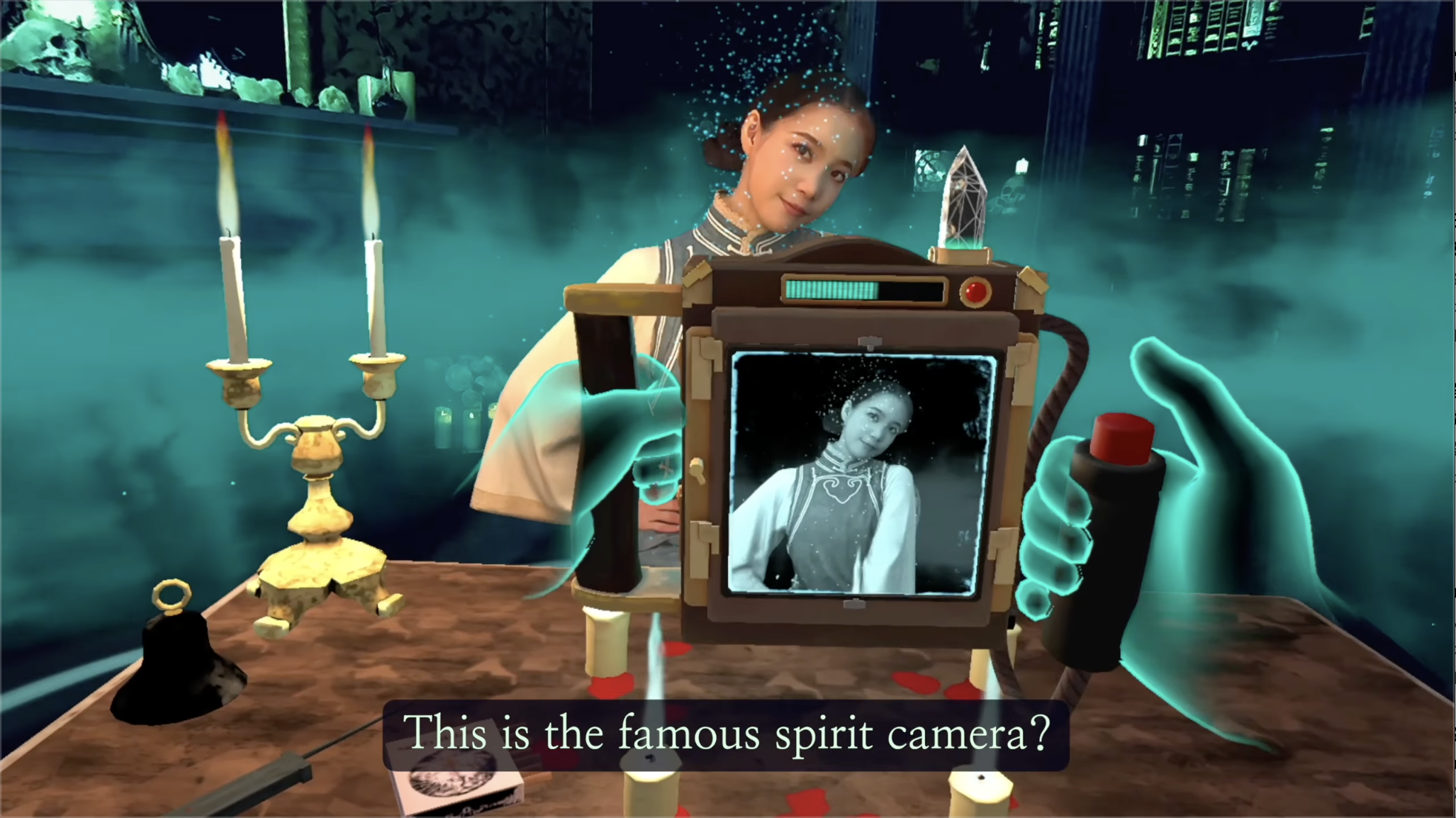
A VR horror game announced at the August 2026 VR Games Showcase is attempting something no supernatural horror title has managed before: placing real actors — people who performed on set, filmed like a movie — as ghosts inside the player’s actual physical home, using a Meta Quest or PICO 4 headset’s passthrough cameras to make them appear to stand between the real couch and the real bookshelf. Spirit Ritual, developed by UK indie studio Nyamyam and debuted at the August 13, 2026 showcase, arrives for Meta Quest, PICO 4, and SteamVR with no release date yet announced.
The distinction matters because VR horror has until now worked in one of two directions. Traditional VR horror takes you into a dungeon you have never visited. Mixed reality horror, the genre’s newer frontier, brings a threat into the room you are sitting in right now. Spirit Ritual does both, and it adds a third element that no current MR horror title uses: the ghosts are not rendered characters. They are full motion video performances by real-life actors, captured and composited into your physical space, as UploadVR’s initial coverage of the announcement confirms.
Why Familiar Spaces Are More Frightening Than Virtual Dungeons
The psychological mechanism at work here is distinct from what makes a haunted house scary in a flat-screen game. Fear researchers and game designers have documented that the VR horror genre’s most effective property is presence — the sensation of physical commitment to a threat that standard gaming removes. Because a player in VR physically turns their head and leans their body, the nervous system responds as though the threat is real, a dynamic explained in depth by VR.org’s investigation into the genre’s psychological foundations.
Mixed reality takes this further by exploiting familiarity. A generic virtual dungeon is frightening, but it is unfamiliar — the brain knows it is somewhere else. A ghost that appears between the player’s real lamp and their real dining table triggers a separate, older response: the violation of safe space. Searches for “mixed reality horror” have grown sharply in the past year, reflecting that players want horror anchored in their actual walls and furniture, not a substitute environment.
Spirit Ritual applies FMV to this effect in a way that deepens it further. A rendered ghost is unmistakably digital. A filmed actor, captured with the techniques used for the 2026 remake of The 7th Guest and other modern volumetric video productions, retains recognizable human qualities — the way clothing falls, the particular way a real human holds still — that a rendered character cannot replicate. Placing that uncanny, almost-human figure inside the player’s own home at 1:00 in the morning is a genuinely new horror proposition.
What the Spirit Camera Does — and What Fatal Frame Did First
Spirit Ritual casts the player as a psychic medium tasked with breaking a demonic curse threatening the life of a woman named Shu-Mei Lin The player’s tools are a conjured spirit board, accessed by bare-hand gestures tracked by the headset’s cameras, and an antique “spirit camera” used to capture and document the ghosts encountered along the way
The camera-as-weapon design is a direct descendant of the Fatal Frame franchise, which pioneered the concept in 2001 with its Camera Obscura — an antique camera capable of exorcising spirits through photography. Series creator Makoto Shibata has described the camera mechanic as designed to force direct confrontation with something frightening rather than allowing the player to look away. Spirit Ritual inherits and extends that logic: in MR mode, the act of raising the spirit camera means aiming the player’s own headset’s viewfinder at a ghost that is standing in their own room.
A closer predecessor is Spirit Camera: The Cursed Memoir (2012, Nintendo 3DS), a Fatal Frame spin-off that used the 3DS’s camera to overlay ghosts on the player’s real environment using augmented reality. That title received mixed-to-negative reviews at launch, largely because early AR technology lacked the depth reconstruction and spatial awareness needed to make the ghosts feel like they genuinely occupied real space. The gap between 2012’s 3DS AR and 2026’s Meta Quest 3 color passthrough is the gap between a ghost on a flat screen and a ghost standing correctly behind a real chair.
How the Technology Behind Spirit Ritual Actually Works
The MR mode’s core mechanism is Meta Quest 3 and PICO 4’s color passthrough pipeline. External cameras on the front of the headset capture stereoscopic color video of the room continuously. Computer vision software computes depth from the parallax between the two camera views, generating a real-time depth map that allows the headset to understand where the floor, walls, and furniture are in three-dimensional space. Virtual objects are then composited over the live camera feed with correct depth relationships — a ghost rendered at two meters from the player appears smaller and partially occluded by furniture that is one meter away. Meta’s own Meta Reality passthrough technology overview covers the underlying technologies in detail.
The “3D FMV” in Spirit Ritual most likely refers to volumetric video or stereoscopic 3D capture — techniques in which actors are filmed simultaneously from multiple camera angles, producing image data with genuine depth information rather than a flat frame. This is distinct from the original 1990s FMV approach, which embedded pre-recorded 2D video sequences inside otherwise 3D environments. Nyamyam has not yet publicly specified its exact capture pipeline. What the trailer reveals is that the actors’ performances appear to occupy three-dimensional space in the headset environment and integrate with the game’s supernatural atmosphere rather than reading as flat video sprites — the failure mode that afflicted Night Trap (1992), Phantasmagoria (1995), and the genre’s first generation. For a detailed breakdown of how volumetric video replaced flat FMV sprites entirely in modern VR productions, see TechTimes’ coverage of the 2026 The 7th Guest remake.
The hand-tracking controls add a further layer. Without physical controllers, the player’s bare hands appear in the game world. Conjuring the spirit board means physically performing a gesture — a small act of ritual commitment that the game’s premise renders meaningful. In MR mode, those hands exist in the same visual field as the player’s real furniture and the FMV ghost occupying the room.
Developer Background: Nyamyam’s First Foray into VR
Spirit Ritual is the first VR title from Nyamyam, a UK indie studio founded in 2010 by Jennifer Schneidereit and Phil Tossell, who met as colleagues at Rare, the legendary British studio behind Diddy Kong Racing and Starfox Adventures. A third co-founder, Ryo Agarie, joined shortly after — also from Rare, where he had served as art director for the Xbox Live Avatars. The founding story is documented in a 2012 Nintendo Life developer interview with Schneidereit.
The studio’s prior titles, Tengami (2014) and Astrologaster (2021), were atmospheric, artistically distinctive experiences: Tengami placed players inside a Japanese pop-up book world and won Apple’s Editor’s Choice award globally; Astrologaster was a comedy about 16th-century medical astrology. Neither prepared audiences for a supernatural horror title. The jump from contemplative art games to MR ghost-photography horror reflects what Schneidereit described as the studio’s founding philosophy — making games “that don’t exist already.”
Spirit Ritual was announcedugust 13, 2026 at 11:00 AM PT (2:00 PM ET), hosted by Jamie Feltham. According to the UploadVR’s full showcase roundup, the showcase featured more than 25 VR game announcements and updates
Platforms and Release
Spirit Ritual will come to Meta Quest, PICO 4, and SteamVR. No release date has been announced. Players can wishlist the game on Steam (app ID 4687530) and sign up for updates at the developer’s Linktree page.
Meta Quest 3, the most widely adopted headset in the platform’s installed base, supports full-color stereoscopic passthrough — a capability absent from the Quest 2, which used grayscale passthrough only. PICO 4, made by ByteDance subsidiary PICO, similarly supports color passthrough. SteamVR support means the game will also run on PC-connected headsets including the recently announced Steam Frame.
For horror fans who have played MADiSON VR — which deploys a similar camera-based horror mechanic, requiring players to raise an instant camera in the dark and wait for a flash to reveal what is in the room — Spirit Ritual‘s approach represents the next step: the camera reveals not a rendered environment but real-actor performances superimposed on the player’s actual surroundings.
Frequently Asked Questions
What makes Spirit Ritual different from other VR horror games?
Most VR horror games take the player into a virtual environment — a haunted house, a dungeon, a space station. Spirit Ritual works in the opposite direction: its primary mode uses the headset’s passthrough cameras to place supernatural entities inside the player’s own physical room. More specifically, those entities are portrayed by real actors filmed in 3D, rather than rendered characters — which preserves the uncanny human qualities that purely digital ghosts lack. The combination of live-actor performances and mixed reality home invasion is new to the genre.
How does mixed reality passthrough actually work in VR headsets?
Current VR headsets like the Meta Quest 3 use external cameras to capture a live color video of the room. Computer vision software processes the two camera views simultaneously to reconstruct depth — it calculates where objects are in three-dimensional space, not just on a flat screen. This lets the headset composite virtual objects (like ghosts) over the live feed with correct depth relationships, so a ghost two meters away appears smaller and can be partially hidden behind furniture one meter away. The entire system runs on-device; no images leave the headset.
What is FMV, and why did it disappear from gaming before coming back?
Full motion video (FMV) games replaced rendered environments with pre-recorded video of real actors. The genre peaked in the mid-1990s with titles like Night Trap (1992) and Phantasmagoria (1995), benefiting from the CD-ROM era’s ability to store large video files. When 3D graphics improved in the late 1990s, rendered worlds became more immersive than flat video, and FMV fell out of use. It has returned in the 2020s through games like Sam Barlow’s Immortality (2022) and, now, in 3D volumetric form in VR titles including the 2026 The 7th Guest remake, because modern capture and compression technology makes live-actor footage genuinely plausible as a horror medium rather than a campy limitation.
Is Spirit Ritual similar to Fatal Frame?
Structurally, yes. Fatal Frame pioneered the “camera as the only weapon” design in 2001 — players fight ghosts by photographing them, which forces them to aim directly at the threat rather than flee. Spirit Ritual uses an “old-timey spirit camera” to capture and document ghosts rather than flee or fight them conventionally. The deeper parallel is that both series use the camera’s viewfinder as a psychological device: raising it means committing to look at the thing you fear. In MR mode, that thing is standing in the player’s own room. For more on how the spirit camera mechanic works in practice, see UploadVR’s announcement coverage.
ⓒ 2026 TECHTIMES.com All rights reserved. Do not reproduce without permission.
