

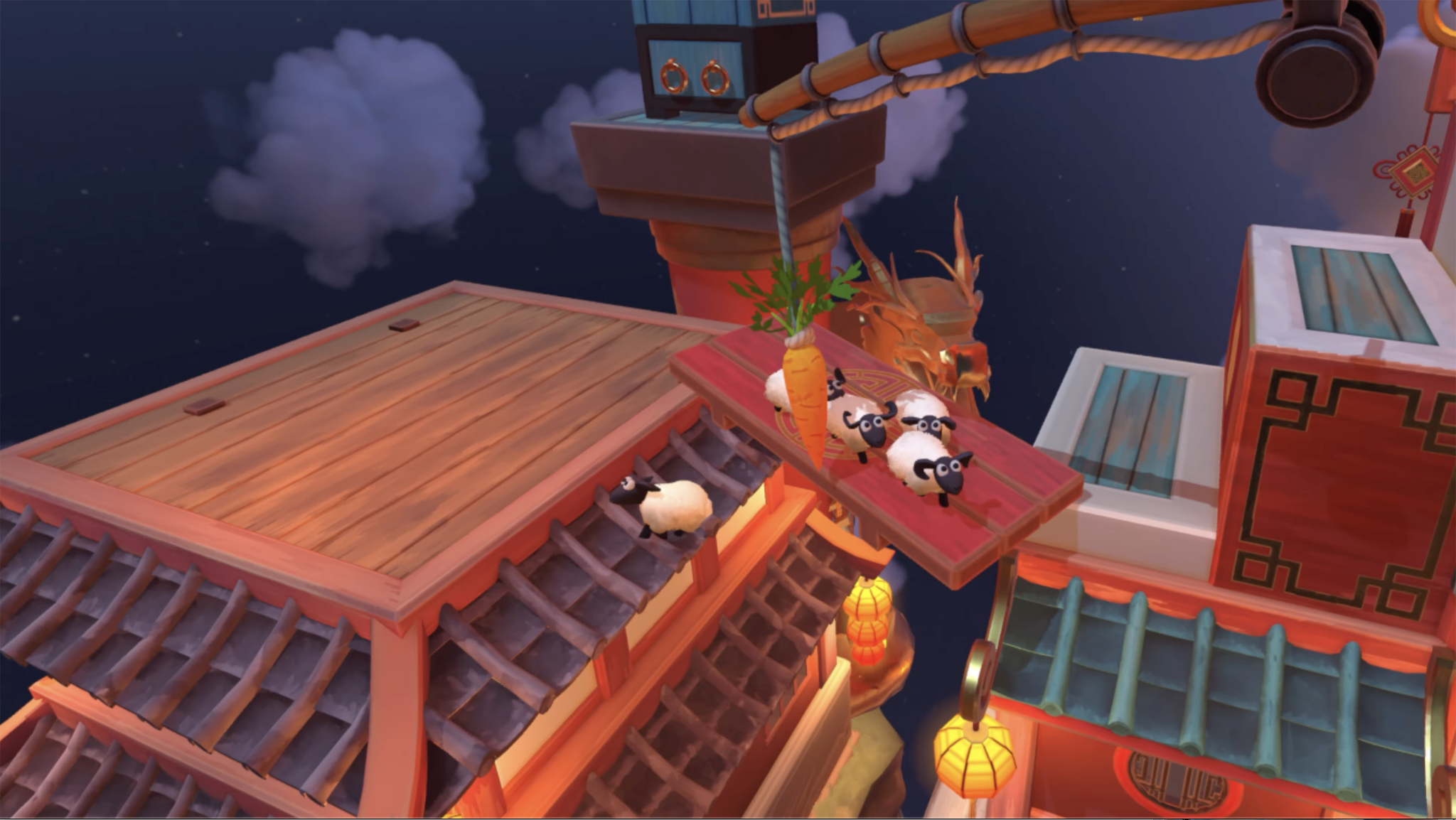
No Brakes Games, the Lithuanian studio whose ragdoll physics platformer Human Fall Flat has <a href="https://curvegames.com/news/human-fall-flat-celebrates-10-year-anniversary/” rel=”nofollow noopener” target=”_blank”>topped 60 million copies worldwide, announced Tiny Flock on August 13 at the VR Games Showcase — a purpose-built VR puzzle game in which players shepherd a small flock of wayward sheep through 21 hand-crafted diorama levels. Unlike Human Fall Flat VR, the 2024 adaptation developed by SneakyBox and published by Curve Games, Tiny Flock is an original project built by No Brakes Games themselves, self-published without a third-party label, and designed from the ground up for virtual reality — using a custom physics system the studio says could not have been built as a flat-screen port.
The announcement came alongside a trailer during the August VR Games Showcase main show, which also featured High On Life VR from Flat2VR Studios and Knights of Fiona from CharacterBank. According to Road to VR’s roundup, Tiny Flock is targeting a September 29 release on PC VRe remains to be confirmed on the Meta side
The game is available to wishlist now on Steam and Meta Quest platform pages.
What Makes Tiny Flock’s Physics Different From a Port
Tomas Sakalauskas, CEO of No Brakes Games, described the game’s design ambition in the official press release accompanying the announcement: “Tiny Flock is our desire to make something really good, polished and ambitious that is strictly VR, with interactions impossible on a flat screen.”
That phrase — “interactions impossible on a flat screen” — points to the specific engineering choice at the center of Tiny Flock. The game uses a custom physics setup built for VR, not an adaptation of the Unity-based physics engine that powers Human Fall Flat. In Human Fall Flat, a player controls a floppy ragdoll with a gamepad — the input is abstract. In Tiny Flock, players reach directly into a miniature diorama world with their bare hands, physically pick up and throw objects, pull levers, and build bridges through direct manipulation. The physics have to respond to the hand as if the hand is a real force in the world, not a button press that triggers an animation.
On Meta Quest hardware, hand-tracking runs through Steam Link — the headset’s cameras capture the player’s hands and transmit that data to a connected PC running SteamVR, which processes the physics and wirelessly streams the rendered frame back to the Quest display. This architecture means the PC handles all computation, with Quest acting as a wireless input device and display — different from a standalone Quest app, but it opens the experience to the full range of Quest 2, Quest 3, and Quest 3S hardware without requiring dedicated native development for the Quest’s Snapdragon processor.
The diorama format is itself a technical choice as much as an aesthetic one. Because the player never moves through the game world as an avatar, Tiny Flock avoids artificial locomotion — the primary cause of VR motion sickness. The player stands or sits in their real physical space, leans into the diorama, and uses their physical reach to interact with a contained world. Proprioceptive grounding (your body’s sense of where it is in real space) stays intact throughout.
How the Puzzle Design Works: No Set Solutions
Each of Tiny Flock‘s 21 levels presents the same basic scenario: a group of sheep that need to reach a designated pasture, and a fully interactive diorama environment in which almost every object can be picked up, stacked, thrown, smashed, or repositioned. There is no correct solution built into the level — the game’s only rule is that sheep follow the player, and that the environment obeys physics.
This open-ended design belongs to a specific genre tradition — games where the player internalizes a rule-set and then discovers their own paths rather than solving pre-authored puzzles. The Steam community has already tagged Tiny Flock with the “Lemmings” label, a nod to the classic 1991 herding game, though the comparison is mostly in premise. Lemmings gave players tools to manipulate a procession of creatures moving on a fixed path; Tiny Flock gives players a fully three-dimensional physics environment and no predetermined route.
Players who prefer methodical problem-solving can build precise bridges and engineer weight-bearing structures. Players who prefer chaos can knock walls down, throw objects across gaps, or find unexpected angles that the level designer never scripted. Steam Achievements and collectibles are built in for those who want additional goals beyond moving sheep from one side of the diorama to the other.
Pass-Through Mode and the Mixed Reality Play Option
On Meta Quest 3 and Quest 3S, which feature full-color external cameras, Tiny Flocksupports pass-through mode. In pass-through, the diorama levels appear to float in the player’s real physical environment — the miniature world can look as though it is sitting on a coffee table or floating in a living room, with the player’s real surroundings visible around it. This is a mixed reality mode distinct from full VR immersion, and it is particularly well-suited to the diorama format, where the conceit of a small contained world placed in your space is already part of the premise.
No Brakes Games’ First Self-Published Title
Tiny Flock marks a notable structural shift for No Brakes Games beyond the technology choices. Human Fall Flat was published by Curve Digital; Human Fall Flat VR was published by Curve Games with development outr — the studio’s first self-published release
The announcement arrives six weeks after Sakalauskas revealed in a July 2026 Game Developer interview that Human Fall Flat 2 had been canceled and restarted as Human Fall Flat 3. He described spending years developing the sequel before concluding that it had followed “the wrong branch of physics” — becoming too stiff and polished rather than retaining the clumsiness that made the original endearing. The studio, now approximately 40 people and headquartered in Vilnius, chose to restart rather than ship a sequel that felt wrong. Tiny Flock appears to be running on a parallel development track as the studio continues work on the mainline sequel.
The Human Fall Flat franchise marked its 10th anniversary on July 22, 2026, with Curve Games confirming 60 million copies as of that date.
How to Try Tiny Flock
Tiny Flock is available to wishlist now on Steam and Meta Quest platform pages. The game is listed in the VR Games Showcase event on Steam. A September 29, 2026 release has been listed by Road to VR but remains tentative — No Brakes Games has not published an official release date on its own website, and the Meta Quest version’s timing has not been confirmed.
A press release accompanying the announcement listed pricing as $18.99 USD / €18.99 (approximately $22 USD at current exchange rates) / £15.99 (approximately $22 USD). The official No Brakes Games website notes that pricing is “subject to change” and will be confirmed closer to launch, so the press release figure should be treated as provisional.
Minimum PC requirements for the SteamVR version: Windows 10 (64-bit), Intel Core i7-4790 or AMD Ryzen 5 1500X processor, 8 GB RAM, an Nvidia GeForce GTX 1060 or AMD Radeon RX 570 XT graphics card, and approximately 3 GB of storage space. The game supports 18 languages at launch, including English, French, German, Italian, Japanese, Korean, Russian, Simplified Chinese, Traditional Chinese, and Lithuanian.
Exchange rates as of August 14, 2026; conversions are approximate.
Frequently Asked Questions
How is Tiny Flock different from Human Fall Flat?
Human Fall Flat is a third-person flatscreen physics platformer in which a player controls a customizable ragdoll character using a gamepad or keyboard and mouse. Tiny Flock is a first-person VR-only experience in which the player uses their actual hands, tracked by the headset’s cameras, to physically manipulate a miniature diorama world and herd sheep to safety. The studio built a custom physics system specifically for hand-tracked VR interaction — it is not a VR adaptation of the original game’s engine, and there is no flat-screen or non-VR version planned. No Brakes Games describes them as fundamentally different puzzle games that share a physics-first design philosophy.
What headsets will Tiny Flock support?
Tiny Flock targets SteamVR (PC VR) and Meta Quest. On Meta Quest hardware, the game runs through Steam Link — the Quest acts as a wireless display and hand-tracking sensor connected to a PC running SteamVR, rather than operating as a standalone app. The game also supports pass-through (mixed reality) mode on Meta Quest 3 and Quest 3S, which overlays the diorama world on the player’s real physical environment. For full details, see the Steam page additional notes.
When does Tiny Flock come out?
No official release date has been confirmed by No Brakes Games. Road to VR’s August 2026 VR Games Showcase roundup listed a tentative date of September 29, 2026, noting that the Meta Quest version’s timing had not yet been confirmed. The game is available to wishlist on Steam and the Meta Horizon Store now.
What do I need to run Tiny Flock on PC?
The minimum Steam system requirements call for Windows 10 (64-bit), an Intel Core i7-4790 or AMD Ryzen 5 1500X, 8 GB of RAM, an Nvidia GTX 1060 or AMD Radeon RX 570 XT, approximately 3 GB of free storage, and a SteamVR-compatible headset. These are mid-range 2016-2017 GPU specs, making the game accessible on headsets paired with older PC gaming hardware. For Meta Quest hand-tracking, a Steam Link connection between the Quest and the PC is required.
ⓒ 2026 TECHTIMES.com All rights reserved. Do not reproduce without permission.
