

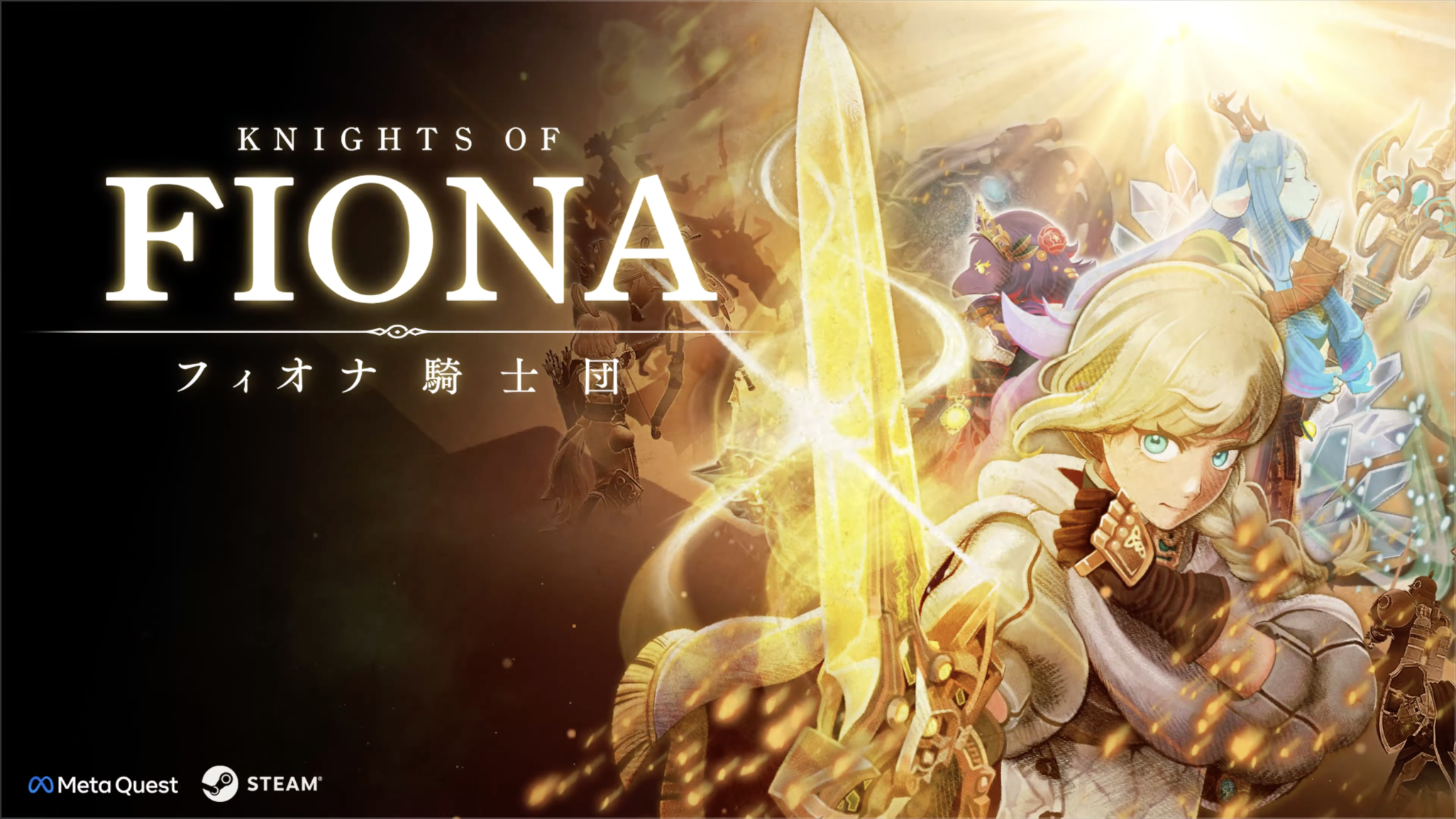
CharacterBank, the Kyoto studio behind 2022’s well-regarded VR role-playing game Ruinsmagus, has confirmed a September 3, 2026 release date for Knights of Fiona — a free-to-play, full-scale JRPG built exclusively for virtual reality. The announcement came at the VR Games Showcase on August 13 alongside a new gameplay trailer and the opening of a public playtest that kicked off early this morning and runs through August 16.
For VR owners who have been waiting for a JRPG that treats virtual reality as the design foundation rather than a gimmick, the September 3 window is worth circling. Knights of Fiona is free to download on both Steam and the Meta Horizon Store; the Story Pass DLC, which unlocks the full narrative campaign, is sold separately.
What Does It Take to Fight Dragons With Your Bare Hands in VR?
Knights of Fiona is set in Gallia, a continent at war — a land that has endured a hundred years of conflict against dragons described in the game’s lore as the physical manifestation of hatred itself, rising from the earth. Players join Knight Commander Fiona, whose defining ability — the Gesh, a sworn oath that converts hope and conviction directly into power — is shared with every knight who answers her call. The player is one of those knights.
The world presents a protagonist facing an enemy that cannot be defeated by strength alone. Fiona’s order fights for a future that, as the Steam store page states, “nobody else believes is possible,” and the game’s central dramatic question is whether sworn belief, embodied by a player physically swinging a sword or drawing a bowstring in their living room, can hold that darkness back. The tone sits firmly in Japanese RPG tradition: epic in scale, earnest in heart, with a cast of story-driven NPCs drawn with enough visual distinctiveness and backstory that players are expected to form attachments, not just use them as quest dispensers.
Between missions, players return to the hub city of Geogallia — a hand-crafted town described by the studio’s CEO, Shuto Mikami, as distinctly larger and more alive than anything in Ruinsmagus. There is a train station, a seaside port, a quest board, and a community notice board that will display player-submitted fan art after launch. Characters in the town include Nebulous Babbege, a purple-skinned alchemist who became an early favorite among those who played the January preview build.
How CharacterBank Rebuilt the Physical Feel of Sword, Bow, and Spell for VR
The technical design choices behind Knights of Fiona are worth understanding before playing, because they determine what kind of RPG this actually is — not just thematically, but mechanically.
VR controllers are uniformly lightweight regardless of what weapon they represent in a game. A player holding a controller is holding the same object whether they are wielding a dagger or a greatsword, because the hardware cannot simulate mass. CharacterBank’s solution, explained by Mikami during the UploadVR preview, is to encode weapon heft in swing mechanics rather than physical weight. A larger sword requires more physical arm commitment to execute a full swing; a lighter blade is faster and more reactive. The difference is communicated through hitbox timing, momentum requirements, and animation feedback — not through the controller itself. The result, according to the preview, is that different weapon classes within the same category feel genuinely distinct.
The three weapon archetypes behave differently enough to support distinct play styles. The bow demands a two-handed physical pullback — one hand on the grip, the other drawing the string toward the shoulder — and fires along an assisted trajectory that compensates for the real-world physics gap. Melee weapons scale from small, fast blades to slower two-handers. Staff-based magic is the closest to Ruinsmagus‘s shooting-adjacent system, but targeting individual enemies with a staff rather than firing area sprays creates different tactical demands. Players are encouraged to switch between weapon archetypes rather than specialize: the card-based progression system rewards diversification.
That card system is the second technical layer worth understanding. After each quest, players receive randomized weapon ability cards as rewards; the rarity of those cards scales with the difficulty level chosen for the quest. Cards can be merged to upgrade weapon strength and to craft improved versions, and passive ability cards can be slotted to augment combat performance. The system creates a replayability loop — the incentive to re-run a quest on higher difficulty for better cards — without requiring complex menu navigation. It is, functionally, a VR-adapted loot system in the tradition of action-RPGs, delivered through a physical-card metaphor that suits the first-person perspective.
CharacterBank was direct about the accessibility intent. Mikami told UploadVR in January: “One of the things we were considerate about was that, when we were designing for the sword and the bow, was that it wasn’t too technical. We want to make sure this is accessible for casual players and people who just want to jump in and experience this world.”
Co-Op Built Around the Oath, Not Around the Lobby
Knights of Fiona supports three-player online co-op — meaning a player and two friends can complete the full adventure together. All quests are structured as party quests, whether the party is human players or AI companions. Solo players are not disadvantaged by the design; AI companions fill the vacant slots.
The co-op framework is tied to the lore rather than bolted on. The Gesh — Fiona’s binding oath — is shared with every knight who joins her order. Playing with two friends is, within the world’s logic, enacting that oath literally: three real people, three shared convictions. In sessions run at CharacterBank’s Kyoto offices in January 2026, Alicia Haddick of UploadVR noted that “lots of the fun of the experience was derived merely by exploring and talking among ourselves, just as much as it was fighting through hordes and large boss fights.”
The technical delivery includes proximity voice chat within the hub world as well as during missions. Cross-platform co-op is confirmed between Meta Quest and SteamVR players.
Why Backing Matters: The Kickstarter and What It Funded
CharacterBank ran a Kickstarter campaign for Knights of Fiona from January 20 to March 6, 2026, to fund post-launch content support. The campaign ended with 527 backers pledging ¥3,613,677 (approximately $22,707 USD) against a goal of ¥1,500,000 (approximately $9,425 USD) — a final total that exceeded the funding goal by more than 140 percent.
Kickstarter campaigns for VR titles rarely exceed their goals by that margin; CharacterBank’s community appears to have been waiting for this one.
What Does It Sound Like in English? The Ogasawara Factor
The English localization of Knights of Fiona is being handled by localizer Nob Ogasawara, one of the most accomplished Japanese-to-English game translators of his generation. Ogasawara translated mainline Pokémon games from Generation 1 through Generation 4 — the titles that taught millions of English-speaking players to read, according to fan letters he has described receiving — as well as Dragon Quest/Dragon Warrior entries on Game Boy Color, Castlevania: Dawn of Sorrow, and significant portions of both Yakuza 5 and Yakuza 0. He parted ways with Pokémon after 2009 when The Pokémon Company moved translations in-house, and has since worked on a smaller number of projects.
For a Kyoto indie studio to engage Ogasawara for a first-person VR game is an unusual signal. It communicates that CharacterBank views the English-language narrative experience as a craft priority — that the weight of Fiona’s oath, the texture of Gallia’s politics, and the personality of NPCs like Nebulous Babbege are meant to land in English with the same intentionality they carry in Japanese. That matters for a game whose director has publicly stated his deepest goal is for players to never want to leave the world.
Is It Ready? What Playing It Early Revealed
UploadVR’s Alicia Haddick played an early build of Knights of Fiona at CharacterBank’s Kyoto offices in January 2026 and described the studio’s ambition as legible in the details: Haddick wrote in her hands-on preview that readers could feel the love the team had for the game in all the subtle details, the care in the card art, and what the project means to the people making it.
The preview covered the game’s first chapter, including a boss fight against a fire-breathing dragon on a burning bridge. The assessment was cautiously positive — qualifying that the studio was charting “ambitious ground for RPGs in VR” and that a full delivery on those ideas would be “truly special.” Enemies of “literally titanic proportions” are promised in later chapters, at a scale designed to make a standing VR player feel physically small by comparison.
Director HOI described the game’s creative goal: “I want people to finish this game and think, I want to spend more time in this world, I want to get to know these characters more… Lately, as soon as a game, a manga or an anime has finished, it’s forgotten by the next weekend, which is a little sad considering the love and work that went into it. Whether on their own or with other players, we want people to keep coming back.”
How to Wishlist, Play the Beta, and Prepare for Launch
The public playtest running through August 16 is the most direct way to gauge Knights of Fiona before September 3. Quest spots cap at 2,500 players; PC VR accessplaytest sessions, meaning time spent now is not discarded when the next session opens
Players who decide this is worth their time can wishlist the game on the Steam store page and the Meta Horizon Store ahead of the September 3 launch. The base game will be free to download; the Story Pass, which unlocks the full narrative campaign, is a separate purchase.
Knights of Fiona requires a VR headset to play and supports Meta Quest 2, Quest 3, and Quest 3S as well as SteamVR-compatible PC headsets. Vive Wands are not supported. Both English and Japanese voice acting are included.
Currency conversions from Japanese yen to US dollars are approximate, based on exchange rates at time of publication.
Frequently Asked Questions
Is Knights of Fiona free to play?
The base game is free to download on both Steam and the Meta Horizon Store. The full narrative campaign is unlocked — including its combat systems, hub world, and co-op modes — without spending anything
How many players can play Knights of Fiona co-op, and does cross-platform work?
Up to three players can adventure together simultaneously — one player plus two friends. Cross-platform co-op between Meta Quest and PC VR (SteamVR) headsets is supported, so you are not limited to grouping with players on the same hardware. AI companions fill any empty party slots for solo players or groups of two.
What makes Knights of Fiona different from other VR RPGs?
Most VR games that carry the “RPG” label are action games with thin narrative layers. Knights of Fiona is designed around JRPG conventions — a hand-crafted hub town, a quest board, a roster of story-driven NPCs, a full narrative campaign, and a card-based weapon progression system with mergeable upgrades and slottable passives. It is built specifically for VR rather than adapted from a flat-screen game, and the physical weapon mechanics (two-handed bow draw, heft-simulated swordplay, staff-aim targeting) are designed to make that genre feel native to a first-person physical medium. The localization is being handled by Nob Ogasawara, who translated the Pokémon series and multiple Dragon Quest titles.
What VR headsets are compatible, and is there a way to try it before September 3?
Supported headsets include Meta Quest 2, Meta Quest 3, and Meta Quest 3S, plus any SteamVR-compatible PC VR headset. Vive Wands are explicitly not supported. A public playtest is open now and runs through August 16 — Meta Quest spots are capped at 2,500 players, so wishlist the game and claim a spot while they last.
ⓒ 2026 TECHTIMES.com All rights reserved. Do not reproduce without permission.
