

Posted in: Comics, Heritage Sponsored, Vintage Paper | Tagged: blue beetle, Dick Briefer, Fox Feature Syndicate, Klaus Nordling, Nathaniel Nitkin, Pierce Rice
Blue Beetle & Washington Attacked, Mystery Men Comics #21 at Auction
Beyond the Blue Beetle cover feature, Mystery Men Comics #21’s D-13 story has the hero taking on a bombing attack against Washington
Article Summary
- Blue Beetle headlines Mystery Men Comics #21, with Charles Nicholas leading off a hard-charging Fox Golden Age feature.
- D-13’s “Double for a Spy” depicts Washington under air attack in a startling pre-Pearl Harbor World War II scenario.
- Dick Briefer’s Rex Dexter adapts Coleridge’s Ancient Mariner into an offbeat science-fiction tale for Fox.
- Scarce and collector-favored, Mystery Men Comics #21 packs Blue Beetle, Briefer, and wartime intrigue into one issue.
Blue Beetle owns the cover feature of Mystery Men Comics #21, but the issue’s most dramatic moment might be near the back: “Washington is being bombed!” The D-13 story turns spies, rooftop spotters, munitions targets, submarines, and an aircraft carrier off Cape Hatteras into a full-scale attack on the United States almost ten months before Pearl Harbor. According to the issue’s Library of Congress copyright date, the issue went on sale February 14, 1941. The United States had not declared war, but, like many Golden Age Comics of the period, Mystery Men Comics #21 already had the country in the middle of World War II.
Washington Is Being Bombed
“Double for a Spy” begins by declaring that the nation’s capital is “infested with spies.” D-13 discovers enemy agents identifying a munitions building and transmitting information in code. When his radio is damaged, he hastily improvises a heliograph from a polished food pan and sends a warning signal with reflected sunlight. Rooftop agents are using secret signals to guide hostile bombers over Washington. The enemy strikes the capital while D-13 traces the operation to a carrier stationed off Cape Hatteras. American bombers attack the carrier, destroyers engage its submarines, and the defeated commander explains that the raids were meant to cripple American industry and defense before an invasion. The enemy nation here is called Prussland, but its agents use obviously German-coded phrases. The story appeared amid a very public federal campaign against espionage and industrial sabotage. A September 1940 FBI bulletin described the coordinated national fight against espionage, sabotage, subversion, and fifth-column activity. In December, the FBI addressed industrialists on the subject of “Sabotage and the Fifth Column.”
The waters off Cape Hatteras became a significant wartime location less than a year after this issue hit the newsstands. After the United States entered the war, German U-boats began Operation Drumbeat along the East Coast in January 1942. The National Park Service notes that Cape Hatteras was a navigational focal point for merchant shipping and that more than 80 ships were sunk off North Carolina during the 1942 campaign, earning the waters the name “Torpedo Junction.”
Blue Beetle, Coleridge, and the Other Mystery Men
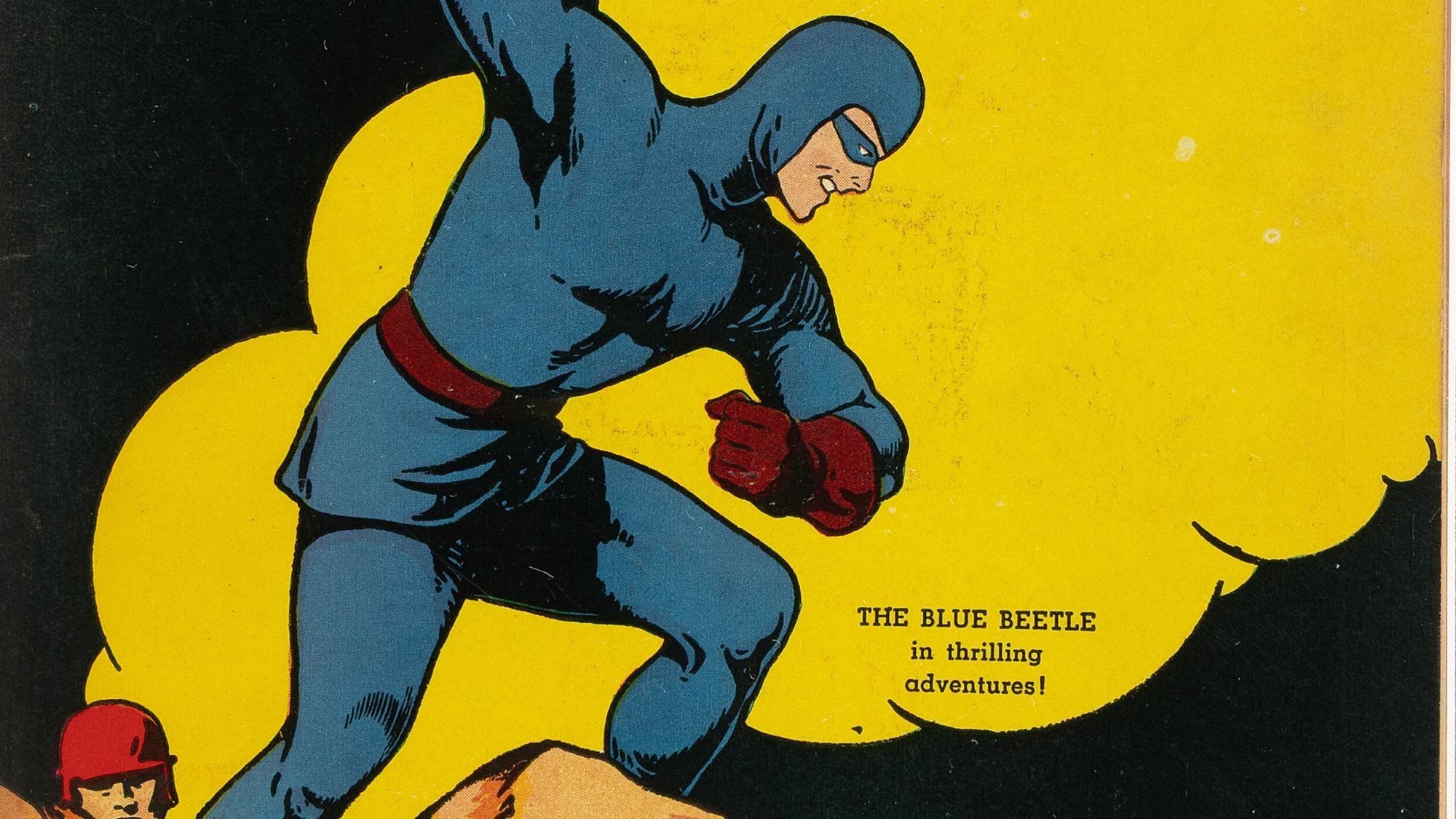
The issue opens with the ten-page Blue Beetle story “Hook Tigo, Super-Criminal,” signed by Charles Nicholas and credited to Blue Beetle creator Charles Nicholas Wojtkoski. A murdered man is found with hook-like marks on his throat, sending police officer Dan Garret after a criminal who uses a metal hook as both weapon and signature. The chase shifts from automobiles to an airplane before Blue Beetle sends Hook Tigo falling to his death. The cover, tentatively attributed to Charles Nicholas Wojtkoski, is a seemingly unrelated Blue Beetle image.
Dick Briefer‘s Rex Dexter story is even more unusual. “Curse of Stratobird” announces on its opening page that it is based on Samuel Taylor Coleridge‘s The Rime of the Ancient Mariner. Briefer transforms the poem’s fatal shooting of the albatross, supernatural punishment, and burden of guilt into a space adventure. In later years, Briefer was dismissive of Rex Dexter in correspondence with historian and fanzine publisher Al Dellinges, but this openly literary episode shows the range of his early Fox work before Frankenstein became his signature feature.
The rest of the issue includes work by a range of Golden Age creators who spent time at Fox. Munson Paddock, whose largest concentration of indexed comic-book work is for Fox, draws the Chen Chang story. Nathaniel Nitkin contributes the aptly titled prose feature “Silent Sabotage,” part of a substantial group of Fox text fillers produced during his wider freelance writing career. Lieutenant Drake and Zanzibar stories are tentatively attributed to Klaus Nordling and Pierce Rice, respectively, while Walter Frehm draws a Green Mask story.
This issue is yet another representation of the rarity of the Fox line. There are 15 census copies across all CGC labels, including 13 Universal copies. Two of the Universal copies are graded 6.0 and only one is graded higher. Heritage says the only higher-graded copy it has offered appeared in 2005. Mystery Men Comics #21 combines a Blue Beetle cover and lead, Briefer’s science-fiction Coleridge adaptation, and one of the more audacious pre-Pearl Harbor attacks on America to appear in a Golden Age comic. For collectors interested in a scarce Fox anthology whose contents are much more startling than meets the eye, there’s a Mystery Men Comics #21 (Fox, 1941) CGC FN 6.0 Cream to off-white pages up for auction at the 2026 August 13 Golden Age Century Comics Showcase Auction V #40377.
Enjoyed this? Please share on social media!

Stay up-to-date and support the site by following Bleeding Cool on Google News today!
