

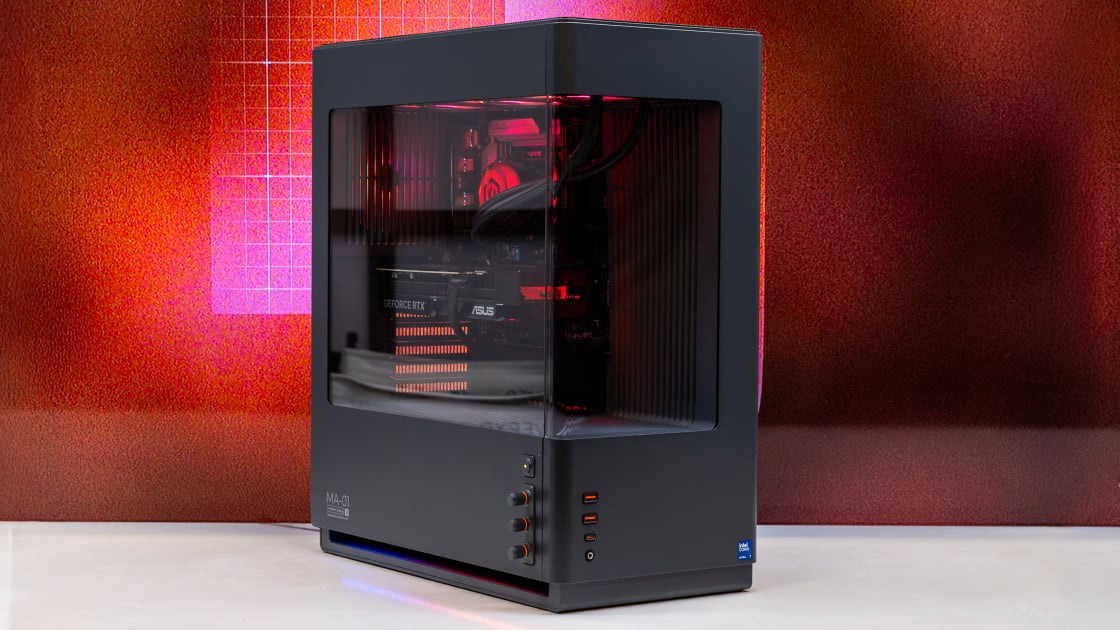
CyberPowerPC has long been a cornerstone of budget prebuilt gaming PCs, but its desktops aren’t often clad in original, distinct cases. The Gamer Xtreme MA-01 ups the CyberPowerPC’s aesthetic game significantly with an identifiably premium design, analog RGB controls, and attractive lighting accents. That’s all thanks to the new MA-01 case from CyberPowerPC.
The Gamer Xtreme MA-01 delivers all this with a more approachable price than a lot of competitors, at $2,299.99 via Best Buy, all while letting you pack in higher-performance hardware out of the box or down the road. CyberPowerPC’s new box also competes well with the Lenovo Legion Tower 5 Gen 10, our current pick for best plug-and-play gaming PC, while filling a space vacated by the now-discontinued iBuyPower RDY Element Pro R07: The MA-01 is our new Editors’ Choice award winner for midrange gaming desktops.
The CyberPowerPC MA-01 is available in select configurations at retailers like Best Buy, which is where you’ll find our $2,299.99 review build. It comes with a 24-core/24-thread Intel Core Ultra 7 270K Plus processor (eight Performance and 16 Efficient cores) with a 360mm AIO CPU cooler, an Nvidia GeForce RTX 5070 GPU, 32GB (2x16GB) of 5,600MHz DDR5 memory, a 2TB PCIe 4.0 solid-state drive, and an 850-watt power supply.
If you can’t find a prebuilt configuration you like, or if you just want to select specific parts yourself, you can configure the MA-01 in more ways than I will bother to count, down to the thermal paste that the system builders will use in the assembly. The absolute cheapest configuration I put together will run you $1,322 for a 10-core/10-thread Intel Core Ultra 5 225F CPU (six Performance and four Efficient cores) with a CPU air cooler, an AMD Radeon RX 6500 XT 4GB GPU, 16GB of DDR5 RAM, a 500GB PCI Express (PCIe) 4.0 SSD, and a 600W PSU.
The most expensive consumer-grade system I configured came in at a stupendous $10,004, and that was limiting myself to the 24-core/24-thread Intel Core Ultra 9 285K CPU (with eight Performance and 16 Efficient cores) with a 360mm AIO CPU cooler, an Nvidia GeForce RTX 5090 GPU, 64GB of DDR5 RAM, an 8TB PCIe 5.0 SSD, and a 1,650W PSU. You’ll also find options for Nvidia Blackwell workstation GPUs that will push this price even higher, and you have countless component combinations in between, so you can build this PC to be whatever you need it to be at various prices.
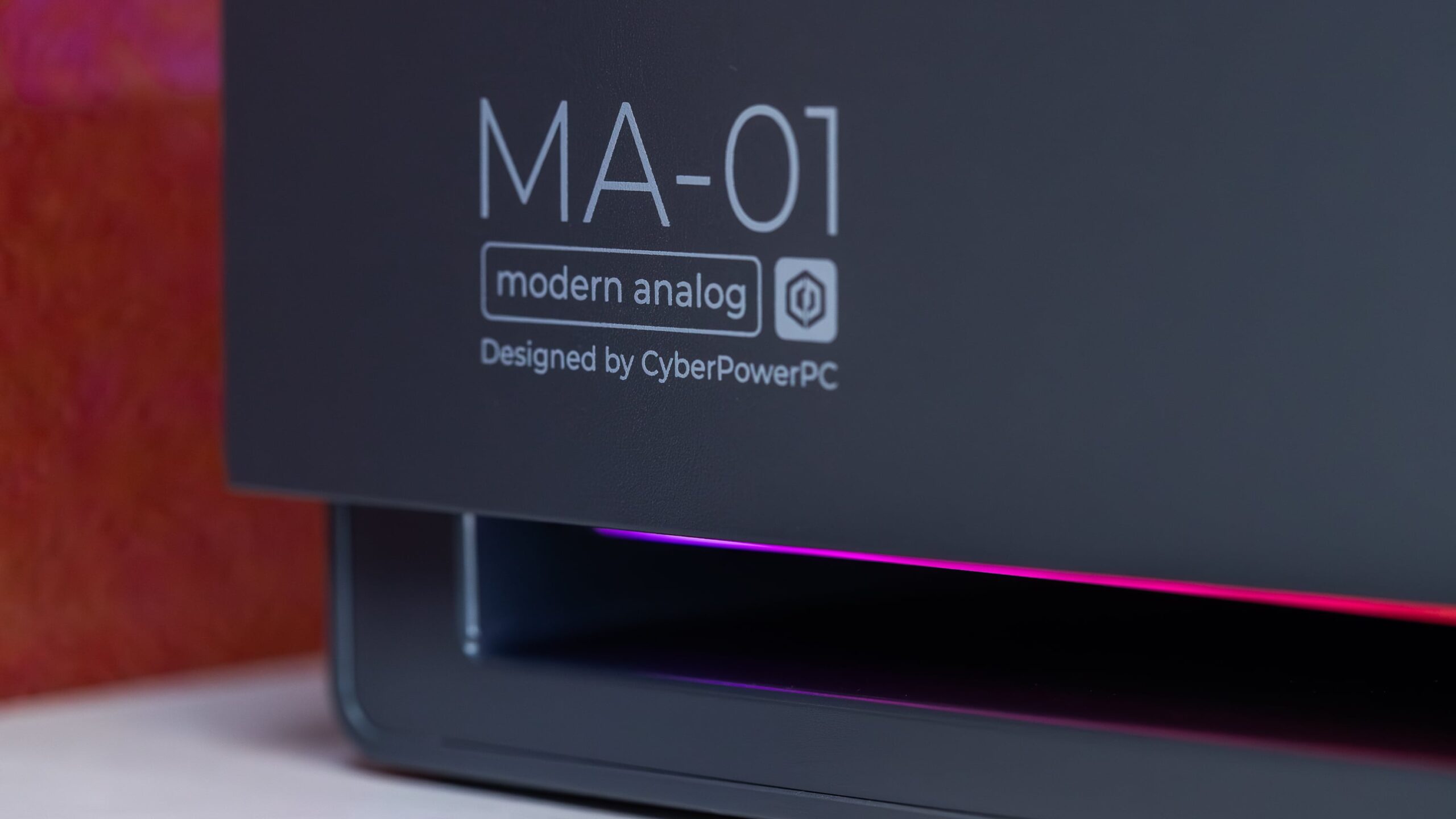
CyberPowerPC builds used to look pretty basic, often leaning on other case builders’ products, but the company has come a long way over the last few years, and the new MA-01 case (18.1 inches long, 9.25 inches wide, and 19.6 inches tall) is a major step up for the company, design-wise. The wrap-around glass panels let you show off the PC’s internals, and they’re seated well between the aluminum panels in your choice of off-white, gray, or dark silver, with a Satin Matte finish. Along the top, the case includes an attractive aluminum mesh grille that feels sturdy while providing enough room for exit airflow from the radiator fans.
The MA-01 case features angled-fin faceplates over its fans to guide the airflow through the case more efficiently. While the glass front panel means no front intake fans, you’ll find room on the side panel beside the motherboard for two 120mm fans to bring cool air in, space for a 360mm AIO radiator at the top of the case, and three 120mm fans at the bottom of the primary chamber. The secondary chamber below has room for a 200mm-long PSU.
On the front panel at lower left, you’ll find two 5Gbps USB 3.0 Type-A ports, a 20Gbps USB 3.2 Gen 2×2 Type-C connection, and a 3.5mm audio jack. Around the corner from those ports are the power button and three control knobs. These knobs manage the PC’s RGB lighting directly, letting you dial in more than 16 million colors and set color cycling, brightness, and dynamic lighting modes.
Along the bottom of the case, you’ll find space for air to flow in or out of the bottom, depending on the orientation of your lower fans, and the underside of the panel above this air gap has ambient RGB lighting, giving the PC something of an RGB halo around the case, a captivating effect.
The mid-tower MA-01 chassis supports both forms of ATX motherboard, as well as Mini-ITX and Mini-DTX, and it can accommodate a graphics card up to 16.5 inches (420mm) long. Beyond that, the specs you start with will determine future upgrades. At least in theory, you could replace every part in this PC without too many issues as long as they’re below the max length for a given compartment.
Contrast this with a comparably-specced Lenovo Legion Tower 5 Gen 10 for almost the same price, and you’ll have a much easier time upgrading and repairing the MA-01. We found Lenovo’s tower particularly difficult to tinker with due to its proprietary case, limited PCIe slots, and few options to upgrade the power supply and cooling system.
To assess the MA-01’s general performance and its capabilities in demanding workloads, like content creation and gaming, I compared its benchmark results with those of several rival gaming desktops.
Starting with our previous Editors’ Choice pick for best midrange gaming PC, we have the iBuyPower RDY Element Pro R07 ($2,599 as tested), followed by our $2,099.99 Lenovo Legion Tower 5 Gen 10 test configuration. The 2025 Alienware Aurora is next ($2,299.99 as tested), and bringing up the rear is our $3,899 2025 Asus ROG NUC review configuration, our Editors’ Choice pick for best ultracompact gaming PC.
The MA-01 falls somewhere in the middle of these systems in terms of parts pricing, but PC pricing has gone bananas since these competitors were reviewed, and some of these models aren’t available anymore at their as-reviewed prices. For how customizable and upgradable the MA-01 is, $2,299.99 is a fine price for this configuration.
Our primary overall benchmark, UL’s PCMark 10, puts a system through its paces in productivity apps ranging from web browsing to word processing and spreadsheet work. Its Full System Drive subtest measures a PC’s storage throughput.
Three more tests we rely on are CPU-centric or processor-intensive: Maxon’s Cinebench 2024 uses that company’s Cinema 4D engine to render a complex scene; Primate Labs’ Geekbench 6.3 Pro simulates popular apps ranging from PDF rendering and speech recognition to machine learning; and we see how long it takes the video transcoder HandBrake 1.8 to convert a 12-minute clip from 4K to 1080p resolution. Finally, workstation maker Puget Systems’ PugetBench for Creators rates a PC’s image-editing prowess through a variety of automated operations in the seminal photo editor Adobe Photoshop 25.
The MA-01 system’s overall productivity performance was dominant, thanks largely to the Intel Core Ultra 7 270K Plus, which outperformed every other processor in the PCs on our list in just about every one of the above workloads. That was true save for single-core Cinebench rendering, not to mention Photoshop, thanks to the iBuyPower rig’s AMD 3D V-Cache chip working better for how that app can utilize extra on-CPU memory stores.
On the other side of content creation, the MA-01 was well ahead of the pack with video encoding. The Core Ultra 7 270K Plus is one of the best desktop processors today for productivity and some creative work, but you may get more spark out of some of AMD’s X3D alternatives in specific scenarios.
We challenge all desktop graphics with a quintet of animations or gaming simulations from UL’s 3DMark test suite. Wild Life (1440p) and Wild Life Extreme (4K) use the Vulkan graphics API to measure GPU speeds. Steel Nomad’s regular and Light subtests focus on APIs more commonly used for game development, like Metal and DirectX 12, to assess gaming geometry and particle effects. We then turn to Solar Bay to measure ray tracing performance.
Our real-world gaming testing comes from the in-game benchmarks of Call of Duty: Modern Warfare 3, Cyberpunk 2077, and F1 2024. These three games—all benchmarked at full HD (1080p or 1200p), 2K (1440p or 1600p), and 4K (2160p) resolution—represent competitive shooter, open-world, and simulation games, respectively. Each game runs at high detail or the highest available settings.
We run the Call of Duty benchmark at the Extreme graphics preset on desktops. Because the test can produce triple-digit frame rates even on low-end PCs, this approach promotes sensible results to evaluate high frame-rate performance. Our Cyberpunk 2077 test settings aim to push PCs to their limit, so we run it on the all-out Ray Tracing Overdrive preset without DLSS or FSR. Finally, F1 2024 measures GPUs’ ability to render high-polygon-count models and densely detailed environments at fast speeds.
As expected, in 3DMark, the MA-01 rig’s RTX 5070 evenly matched the one inside the Legion Tower. Of course, it fell well behind the Alienware Aurora and iBuyPower boxes, thanks to those PCs packing the much more powerful Nvidia GeForce RTX 5070 Ti GPU, and the MA-01 placed well out in front of the down-tuned, laptop-class version of the RTX 5070 Ti GPU in the Asus ROG NUC.
In gaming, the MA-01 proved more than capable of tackling 1440p play, outperforming the Legion Tower overall in our tests, save for some mixed Call of Duty results. Again, the Aurora and RDY Element Pro held a distinct advantage here, thanks to the RTX 5070 Ti. So, if you want the best possible performance for less than three grand, you’ll have to save another few hundred dollars for an RTX 5070 Ti configuration.
Final Thoughts
CyberPowerPC Gamer Xtreme MA-01
Editors’ Choice
4.0
Excellent
What Our Ratings Mean
- 5.0 – Exemplary: Near perfection, ground-breaking
- 4.5 – Outstanding: Best in class, acts as a benchmark for measuring competitors
- 4.0 – Excellent: A performance, feature, or value leader in its class, with few shortfalls
- 3.5 – Good: Does what the product should do, and does so better than many competitors
- 3.0 – Average: Does what the product should do, and sits in the middle of the pack
- 2.5 – Fair: We have some reservations, buy with caution
- 2.0 – Subpar: We do not recommend, buy with extreme caution
- 1.5 – Poor: Do not buy this product
- 1.0 – Dismal: Don’t even think about buying this product
Read Our
Editorial Mission Statement
and
Testing Methodologies.
The CyberPowerPC Gamer Xtreme MA-01 looks sharp coming out of the box, and it only seems to grow more attractive the more you use it, which (in our case) has been quite often, considering how snappy its gaming performance is. It’s far from the most expensive midrange gaming PC, and you have plenty of options when it comes to configurability and later upgrades.
Of course, you can find more potent gaming PCs out there for less than $3,000. So, if you’re looking to play modern games at 4K resolution and you have room in your budget, consider PCs with an RTX 5070 Ti if you can—or even configure the MA-01 with that more powerful 16GB VRAM GPU. For delivering effective 1080p and 1440p play at this price, however, the CyberPowerPC Gamer Xtreme MA-01 earns our Editors’ Choice award for midrange gaming desktops.
About Our Expert
John Loeffler
Contributor
Experience
John (he/him) is a programmer, gamer, activist, and Brooklyn College alum currently living in Brooklyn, New York.
Named by the CTA as a CES 2020 Media Trailblazer for his science and technology reporting, John specializes in all areas of computer science, including industry news, hardware reviews, and PC gaming. He’s also well-versed in general science writing and the social impact of the tech industry.
John has a Bachelor’s degree in English and a Master’s degree in Computer Science. You can usually find him on Bluesky, where you’ll get his hot takes on stuff, as well as his reposts of content that is almost as good as the worst stuff you used to be able to find on Vine. Beyond PC gaming, he spends his evenings building digital circuits, multiboxing Linux kernels, and coding shell scripts.
- Laptops
- Desktop PCs
- Acer Swift 16 AI (2026) Review: A Great Big-Screen Laptop With One Giant Hurdle
- Asus ExpertBook Ultra Review: Elite Performance for the Corner Office
- Lenovo IdeaPad 5i 2-in-1 16 Review: A Decent Convertible Waiting for a Discount
- Gigabyte Gaming A18 Review: This Down-to-Earth, Giant-Screen Gamer Shines
- Samsung Galaxy Book6 Pro Review: A Constellation of Improvements
- More from John Loeffler
