

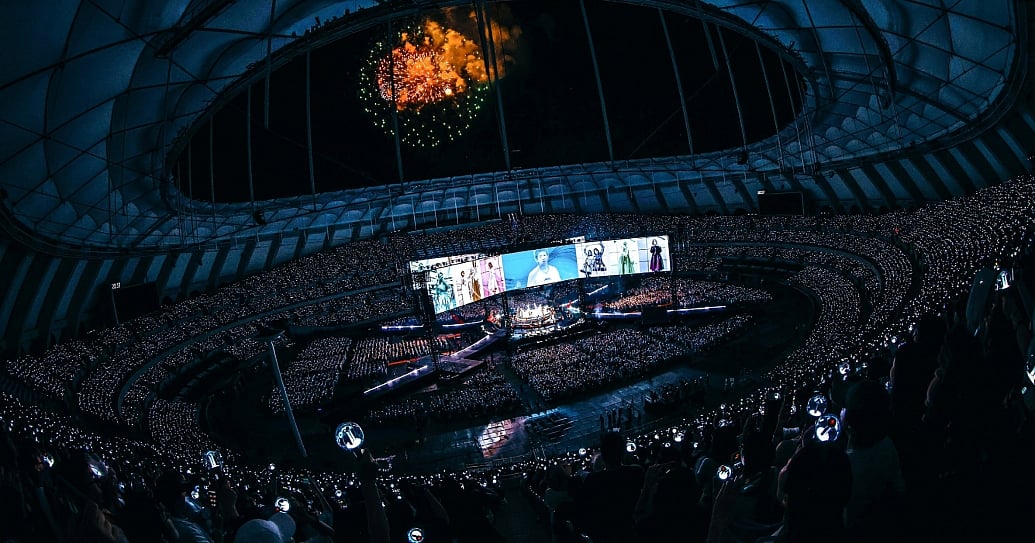
South Korea is building Seoul Arena and planning two 50,000-seat domed stadiums to expand K-pop concert capacity.
South Korea to Grow K-Culture Infrastructure with Stadiums, Arenas
Seoul is expanding physical infrastructures while developing surrounding areas to attract tourists and to gain more value from global cultural exports.
BYDiya Mukherjee
12 AUG 2026, 06:09 PM
Highlights
- South Korea is building a Seoul Arena while planning K-beauty and K-food retail around the venue.
- The country’s government is also looking to construct two 50,000-seat domed stadiums to expand K-pop concert capacity.
- The infrastructure push comes as record tourism boosts demand for K-culture venues.
South Korea is expanding its cultural infrastructure in a coordinated manner, which links municipal development with stadiums and arena constructions to maximize domestic economic returns on its global entertainment exports.
On August 11, 2026, the Special Committee of Balanced Development of the G3 Seoul Plan Planning Committee conducted an inspection of the Seoul Arena construction site in Chang-dong, which is currently 72.5% complete. Notably set to become the country’s largest dedicated performance venue for K-pop and other arts, the Seoul Arena is scheduled to be unveiled in the first half of 2027. Initiated in 2009 under the city’s “Northeast Renaissance Project,” the facility is expected to draw 2.7 million visitors annually to the capital’s northeastern corridor, as noted by The Asia Business Daily.
Seoul Arena to Drive Chang-dong’s Wider Commercial Transformation
According to reports, the municipal authorities will be using the venue to boost local commercial integration with plans of establishing stores selling K-beauty products surrounding the venue arena and Chang-dong Station. They also plan to open a specialized K-foodstreet to channel concert attendance around the venue directly into retail revenues.
The Special Committee members reportedly surveyed the adjoining Chang-dong Rail Yard in Sanggye-dong, Nowon-gu, to review plans for a Seoul Digital Bio City (S-DBC). The municipal government intends to transform the adjacent railway station area into an industrial complex embedding artificial intelligence and biotechnology research along with commercial, cultural, and residential infrastructure.
A bridge connecting Seoul Arena directly to S-DBC is also nearing completion, with an ongoing construction of the underground Dongbu Urban Expressway alongside the Chang-dong–Sanggye section in the Jungnangcheon. The waterfront in the area will reportedly be redeveloped into a public leisure space for venue visitors and tech workforce personnel.
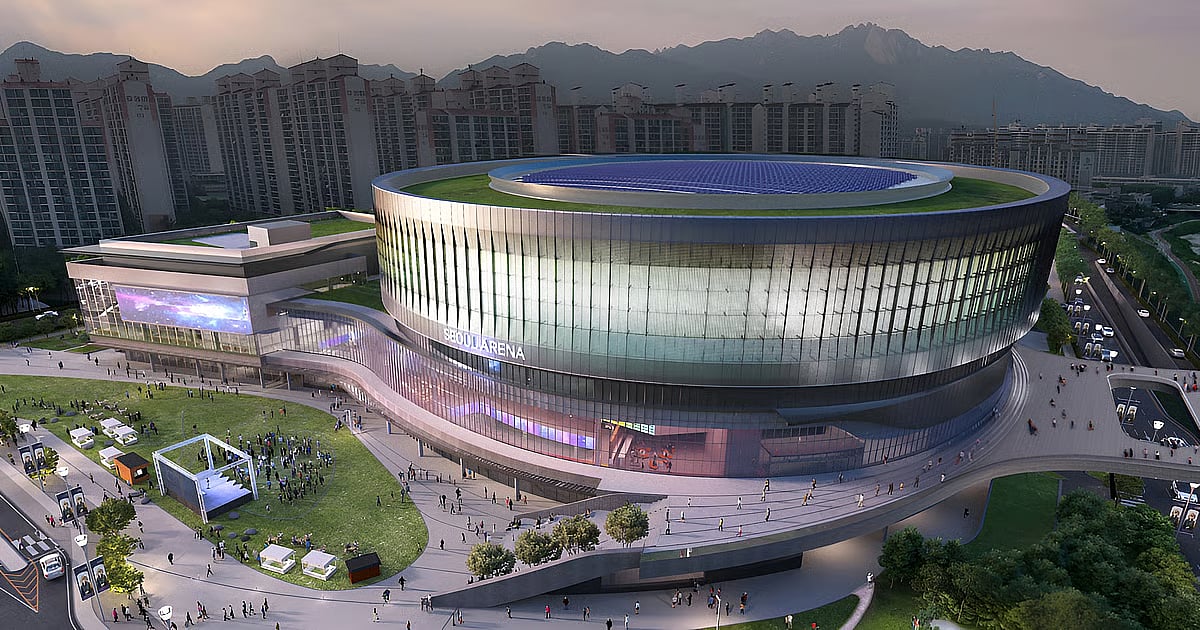
A rendering of the upcoming Seoul Arena (2027) in Chang-dong, Seoul’s new 24/7 K-pop district, which will have immersive live entertainment zones.
“The success or failure of balanced development between southern and northern Seoul hinges on having an attractive vision and concrete strategies to attract both companies and talent,” the special committee stated, as noted by The Asia Business Daily. “Once both Seoul Arena in Chang-dong and S-DBC in Sanggye are established, the area will be reborn as a pivotal zone in Seoul, encompassing functions for culture, tourism, the economy, and jobs.”
Nam Jin, head of the Special Committee notably stated that the “opening of Seoul Arena will serve as a bridgehead for the northeast to rise as a new urban center.” “Chang-dong and Sanggye will be reborn as attractive areas where a K-pop performance venue, advanced industrial complex, and the Jungnangcheon waterfront converge,” he added further.
South Korea Plans Two More 50,000-Seat Domed Stadiums
This development initiative in northern Seoul aligns with a wider push by the central government to create two more large-scale event facilities. During a separate policy briefing on August 5, 2026, the Ministry of Culture, Sports and Tourism presented plans to expand venue capacity throughout the country at the Blue House, in the presence of President Lee Jae Myung.
“We are conducting a commissioned study based on a plan to build about two large multipurpose domed stadiums that can host both sports and concerts,” said Lee Sun-young, the ministry’s director general for sports, as “We are discussing matters including the criteria for selecting locations,” Lee added further
The analysis comes after direction from Culture Minister Chae Hwi-young, who flagged long-term infrastructure hurdles at a December 2025 policy briefing. “In the long term, we also need to build a domed stadium with at least 50,000 seats,” Chae reportedly stated at the time.
Regional Governments Position for Korea’s Next Tourism Wave
The 50,000-seater domes initiative has triggered regional competition across South Korea. Ahead of the June 3 local elections, municipal leaderships from South Chungcheong, Sejong, Busan, and North Jeolla expressed formal interest in developing the projects. Since 50,000-seat facilities need multi-year construction timelines, the ministry, in the meantime plans to grow the smaller cultural and sports complexes to manage the immediate touring demand.
Notably, tourist influx hit a record 10.71 million in the first half of the year, showcasing a 21% surge as compared to the same period last year. “Given the recent growth in inbound visitors, reaching 40 million appears possible after 2030,” said Kang Jung-won, head of tourism policy in the August 5 meeting. “We will expand tourism infrastructure accordingly.”
To accommodate projected volumes, hotel supply, airport and port infrastructure are being expanded alongside facilitating multiple-entry visa issuances, and visa-free travel for tour groups.
Culture Minister Chae Hwi-young notably said that in the second half of this year, they “will begin delivering results that people can feel.” “We will move swiftly on key tasks, so culture brings vitality to local communities and K-culture reaches a wider world, helping Korea become an irreplaceable cultural powerhouse,” highlighted the Minister during the policy talk.
Diya Mukherjee
Diya Mukherjee is a Content Writer at Outlook Respawn with a postgraduate background in media. She has a passion for writing content and is enthusiastic about exploring cultures, literature, global affairs, and pop culture.
Diya Mukherjee
Diya Mukherjee is a Content Writer at Outlook Respawn with a postgraduate background in media. She has a passion for writing content and is enthusiastic about exploring cultures, literature, global affairs, and pop culture.
Published At: 12 AUG 2026, 06:09 PM
Tags:Live EventsBusinessPop CultureK-PopSouth KoreanSouth KoreaMusicConcerts
Advertisement
TRENDING

Japanese Demand Drives 59% Surge in South Korean Resale Market
South Korea to Grow K-Culture Infrastructure with Stadiums, Arenas
Crunchyroll and Sony Secure Rights to Makoto Shinkai’s Next Film

Stray Kids’ Changbin Donates Over $70K to Samsung Medical Center
HYBE India CEO Post Fuels BTS Concert Speculation
South Korea Takes Webtoons, Music IP to Central Asia’s Comic Con

South Korea Turns to YouTubers to Drive Global K-Content Exports

BTS Member V Hits Master Rank on League of Legends Amid Tour
