

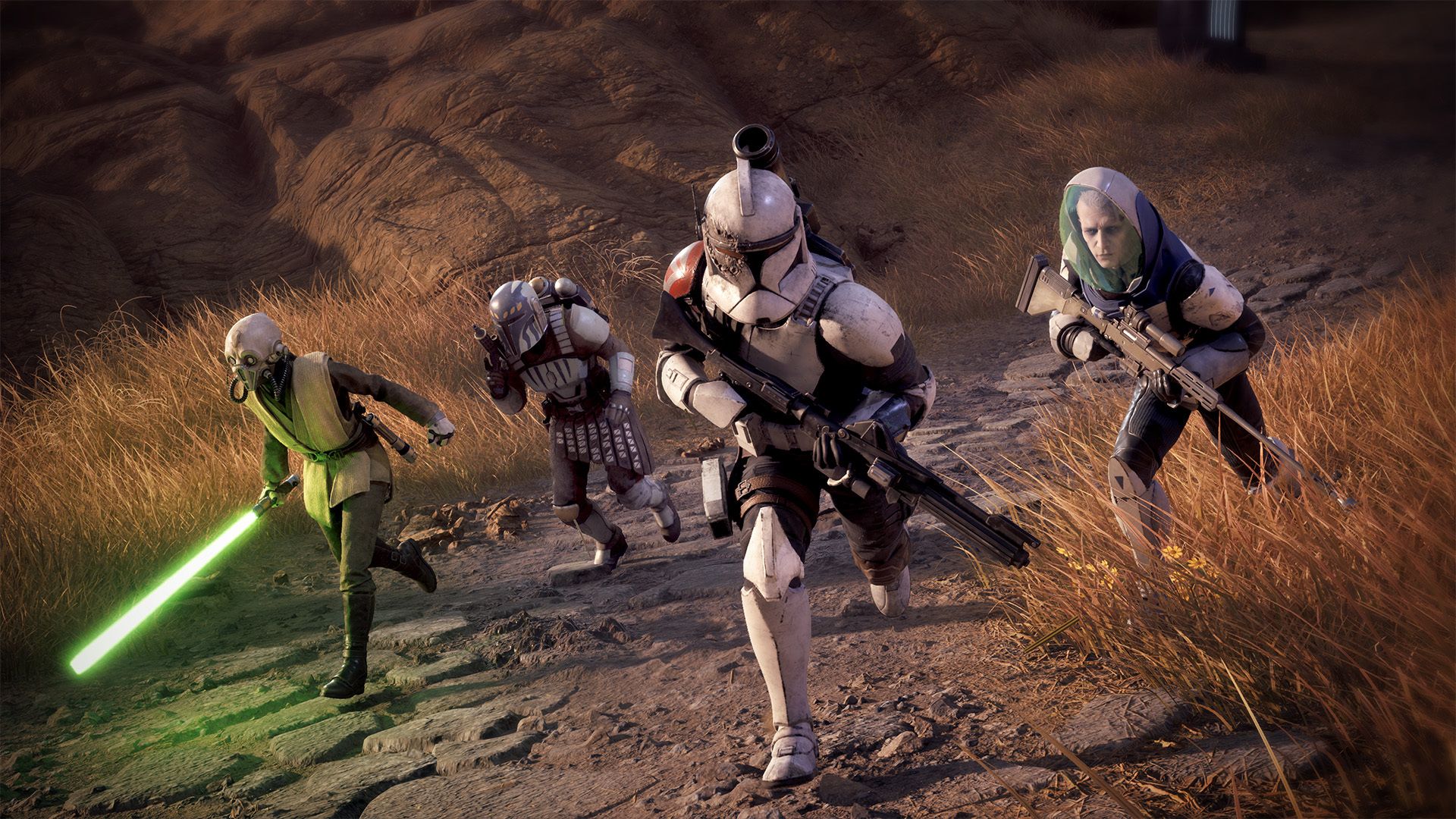
Star Wars: Zero Company is the first game from new studio Bit Reactor, which aims to combine the nail-biting turn-based tactical gameplay of XCOM with the rich, cinematic roleplaying of games like Mass Effect and Knights of the Old Republic.
Bit Reactor, helmed by XCOM and Midnight Suns veteran Greg Foertsch and staffed by 20 other ex-Firaxis devs, has been relatively tight-lipped about Zero Company until now. The tactics game comes out on PC, Xbox Series and PS5 on Aug. 27. I recently got to play a press preview build of it (on PC) and talked to Foertsch and Lucasfilm Games Executive Producer Orion Kellogg.
Zero Company is set just after the Clone Wars during the rise of the Empire between Episodes III and IV, and features a bunch of voice talent from the animated show of the same name. You play Hawks, a former Republic officer turned mercenary-slash-spy with a set backstory but an appearance that’s up to you. Hawks is hired by a Republic spymaster to investigate a shadowy threat called the Infinite Coil, but you’ll be fighting the Roger-Roger robots from the prequel trilogy and the usual scum and villainy, too.
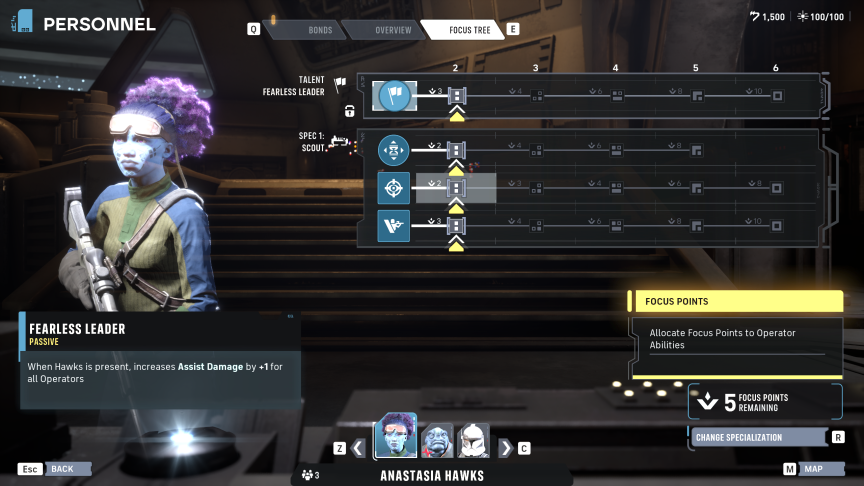
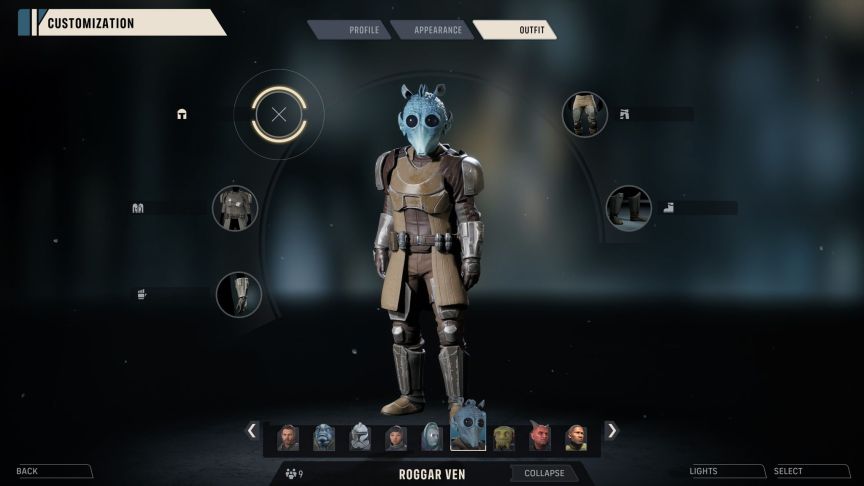
Hawks is as customizable as just about any RPG character I’ve seen. They’re male or female, both fully voiced, and can be any of six different species. I picked a female Mirialan and gave her purple skin, a livid scar on her cheek and tied-back curly hair with purple highlights. I immediately loved her. She perfectly fits her sardonic voice, and her subtle facial expressions quickly drew me into the story.
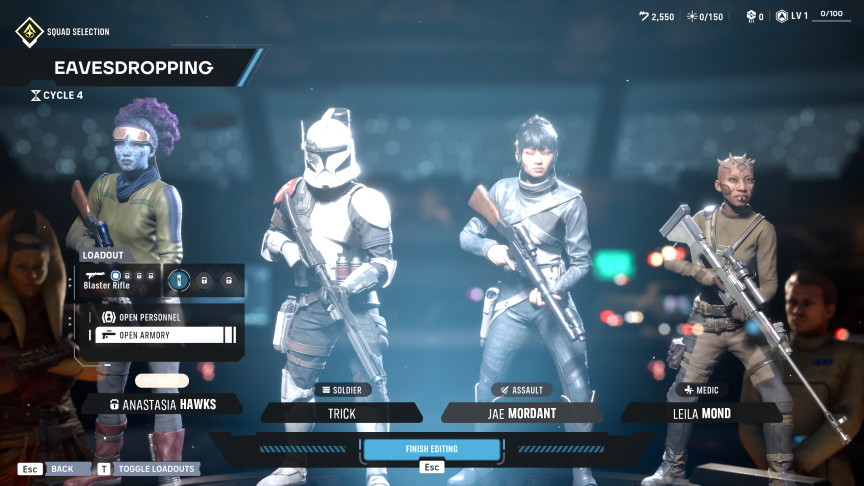
Hawks’s crew is made up of story characters you start with or acquire on missions, including droids, along with operators you can hire and customize as you wish. If you want a whole squad of clones or a team of sassy droids, you can. Only story missions require certain characters – typically Hawks and one other who’s central to that expedition’s events. They can all die, and the game continues with their sad hologram on the memorial board. (If Hawks dies, it’s game over, and you have to redo the mission. Ask me how I know.)
“I love when Star Wars is not about Luke, it’s not about Leia, it’s about the experience of all of them together,” says Foerstch. “And this game delivers on that because it’s all about the experiences with your people that you’re choosing to go out on missions together. You’re along for the ride.”
Hawks and the rest of Zero Company live in an abandoned cargo ship called The Den that berths on the Ring of Kafrene (first seen at the beginning of Rogue One). The vessel is an atmospheric space, with a wide cast of fun characters to interact with, and it fills up as you recruit more operators to your crew. It changes, too, as you build new facilities, which give you more options to customize, level up and equip the team.
From a holotable in the center of the main room, you select missions and quick off-screen operations, similar to those in XCOM 2 or Mass Effect 3, where you spend some intel to help one faction or another in return for credits, gun parts and so on.
But what about the tactics? Isn’t this like Star Wars XCOM? Everyone’s been calling it ZCOM, after all. I was surprised how much RPG stuff there was to do – but it’s almost all optional if you just want to get to the pew-pew.
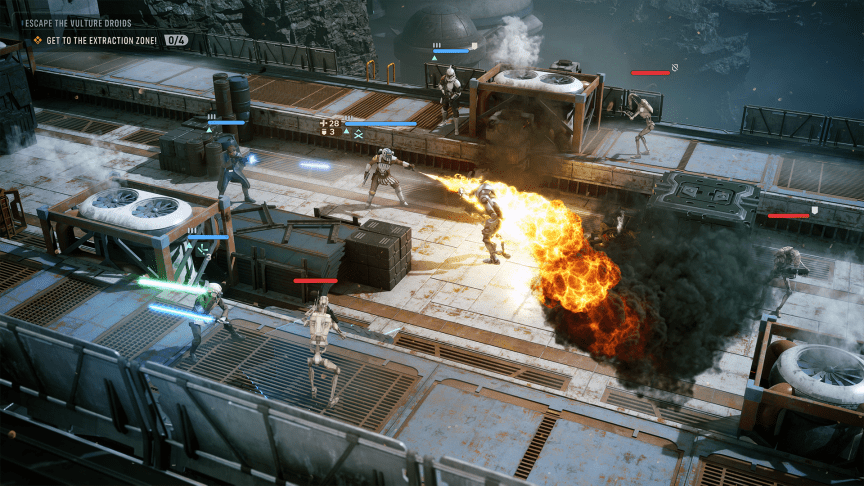
Once you’re on a mission, you have a maximum of four operatives, plus anyone you happen to rescue while you’re on the ground. Each character has three actions per turn to move, shoot or use their unique abilities. That’s fewer squad members but more actions each turn than XCOM, which makes it a tighter experience, more focused on each operative’s capabilities than on fielding a broad team.
Typically, you’ll stick with moving, shooting and overwatch (holding fire until an enemy pops into range), but there’s a plethora of special abilities and equipment like grenades, stims and medkits that come in clutch at the right moment. Some characters, including my favorite, nominative determinism’s Kabb Uppercut, can do melee attacks that (as in Midnight Suns) you can angle to clonk the enemy off their feet — perhaps into another foe to damage both, or even shove them down a hole or off the map.
The game’s interface is simple, intuitive and console-friendly. Overwatch in particular is lovely — you set a cone of coverage within which enemies who move (or are pushed, see above) have a chance of being shot. Your character’s gun determines the angle of the cone, so blasters cover a wider area than sniper rifles. You drag the cone out, with the accuracy diminishing as you cover a larger area, again different for each gun type. It’s a fun trade-off you make nearly every turn.
From what I’ve seen so far, the maps are pretty small compared to XCOM, and there’s no fog of war — you can see the whole map all the time. That means you don’t get the tension of sneaking forward, trying not to alert too many enemies to your presence, which is how missions in XCOM progressed. Instead, new pods of bad guys show up as reinforcements at a marked point, with a turn’s warning so you can set up overwatch.
That was a design decision based on wanting the game to feel as Star Warsy as possible.
“Fog of war was something that didn’t feel right. Early on, we tried it, and it was hiding the ‘Star Wars’ of the game,” says Foertsch. “It was hiding the immersion, which was something that was a core pillar that we wanted to address, and it wasn’t really adding anything.”
The preview had plenty of tactical experience to chew on, but the broader mission selection and galactic perspective are still a mystery. I haven’t seen enough of the galaxy map to get a sense of how deep the decisions are that it offers. It reminded me of Mass Effect 3’s map – you can make choices and earn credits and new equipment by gaining influence in various sectors, but I don’t know if “painting” the map by spreading your clout has any real effect on how the game plays out.
“It gets more and more exponentially complex. [Hawks] gets a second specialization, which you can imagine unlocks a ton. Your companions, their bonds grow, the abilities that they’re gaining grow, and then you meet all new enemy archetypes,” says Kellogg. “You might have trapped the Coil in one corner of the galaxy on this playthrough, but in a completely different one the next.”
I’m yet to be convinced, however, that XCOM die-hards will love Zero Company as a strategy game. Not having seen later character abilities and enemy types, I don’t know how much depth there is. There’s no tech tree and only four gun types, and with a limited roster of maps (even if it’s over 150 in the whole game), combat encounters may end up feeling samey, particularly as there will be no official mod support.
Nevertheless, I know there’s a huge crowd of Star Wars-loving RPG fans who will go bananas for the depth of customization and great voice acting here. The developers promise a deep, rich experience, and from the quality of the writing and character design I’ve seen, I have no reason to doubt them.
I can’t wait to play more, and I’m glad we only have a couple of weeks to do so before the game’s launch on Aug. 27.
