

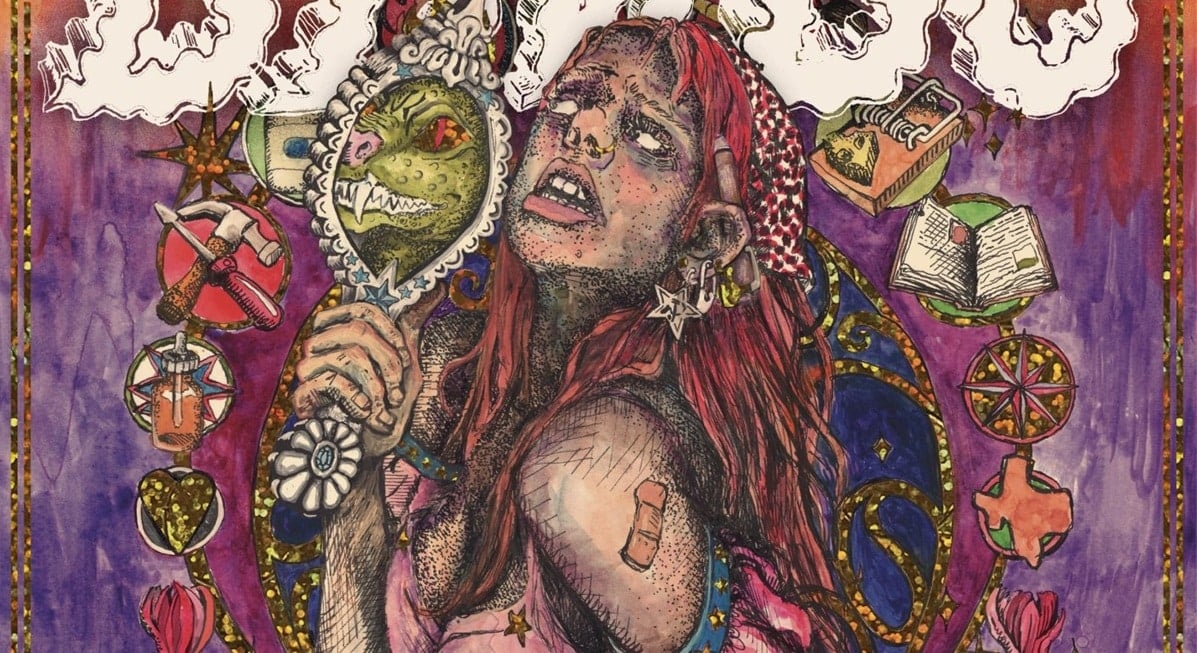

Bimbo Agitprop
Cartoonist: Raquelle Jac
Publisher:Fantagraphics Books
Publication Date:August 2026
Cartoonist Raquelle Jac‘s graphic novel debut, Bimbo Agitprop, will likely hit you hard. Before you’ve even read a word, you’ll be struck by the contrasts of the imagery on the cover, the book design rimmed by a golden sparkly frame, and the sheer heft of an over-sized print format that tops out at close to 350 pages. And if all that weren’t enough, the back has a blurb from comedian Marc Maron, which itself feels like both a feat and a tone-setter for all the deeply confessional comics art storytelling that is to come.
Then you start reading, and find yourself immersed in a chaotic graphic memoir of the highest order, lacquered with an aesthetic that owes a debt to the loose and experimental classics of underground comix. What makes this book really and truly memorable, however, is not quite any of that (although it helps). It’s actually the singularity of the perspective that Jac brings to the work.
Indeed, Raquelle Jac is a relatively young cartoonist raised primarily in the Texas Oil Country (Midland-Odessa), who is quite clearly still making sense of the heavy why, how, and what next of her childhood. As such, there’s a depth of interiority that feels evocative of memoir comics past, but there’s also a newness throughout the book that comes from the specificity of what feels like an unexplored (at least in comics, to my knowledge) background.
The term new voice gets thrown out often, but I really can’t think of another cartoonist raised post-Y2K in deep red state America that has been so bold and honest and detailed about their experiences, seeming to at no point hold anything back. It is not uncommon in these pages to find horrific childhood incidents — from demon expulsion to bleach baths — based on misinterpretation of the bible. And, as a warning, Jac’s mother was deeply disturbed throughout her childhood, and there’s no shying away from that. It can, to be blunt, feel hard to read in places.
But Jac’s voice and visuals throughout make it so you want to keep going, you want to take the journey back through her past with her, and see what she’s learned on the other side. Bimbo Agitprop accomplishes this with an impressive blend of nervous humor and determination to simply be okay.
And what’s even more impressive about this work is how well the boldness of the confessional memoir comics marries to the chaos of the artwork, both of them playing off of and elevating each other. There were times within the first 50 pages or so where I wondered if the book would manage to go its full length continuing to pull this cohesion off, but at some point thereafter, I became so immersed in the scenes, characters, and anecdotes that any concern I had melted away.
There is at certain points difficulty knowing what to read or look at and in what order, but it never really effects the experience. And in fact, I can’t help but wonder if maybe disorientation within the fragments of memory is something that really benefits the work. A lot of the visuals hew closer to capturing memorable objects and places than they do realistically conveying any sequential recollections. When Jac draws people, for example, the linework often gets looser and more exaggerated, while at the same time (and sometimes on the same page), she depicts objects like tools or blood machines with the precision of a mechanical engineer (or so I’d imagine).
And I think this speaks to another major strength of this book. Bimbo Agitprop really feels like a journey of discovery for its creator. It dips back into old memories and obsessions to try to make sense of how it all has effected Jac now as an adult. And while the book can get deeply disturbing — there’s children being violently slapped, deliberately orchestrated social isolation throughout, a beloved pet dog who just disappears, and so on and so on — there’s also an undercurrent of hope that runs through this book, and to me it comes from how clear-eyed the creator seems about it all, capable of both laughing in places (what else are you going to do?) and taking solace from the lessons these incidents have provided her.
Another facet of the book that I think bears mention here is the deep fascination with and reverence to the cartoonist’s influences, and underground comix more generally. The history of underground comix shows up a few times alongside the other material in the book, and it’s always interesting to see how Jac thinks about it and what her history is with her influences.
There’s a five-page section — among my favorites in the entire book — that starts out as, essentially, a history of Chick Tracts, and it features some of Jac’s best cartooning. It also intermingles her own history with comics, and captures the alchemy that helped shape her into the person she became, citing some of her later influences as well (specifically Aline Kominsky-Crumb), and looking for how it’s all connected.
Overall, Bimbo Agitpropis an absolutely stunning graphic novel debut, one that is disturbing, moving, chaotic, and inspirational all at once.
Bimbo Agitprop is available now
Read more great reviews from The Beat!
