

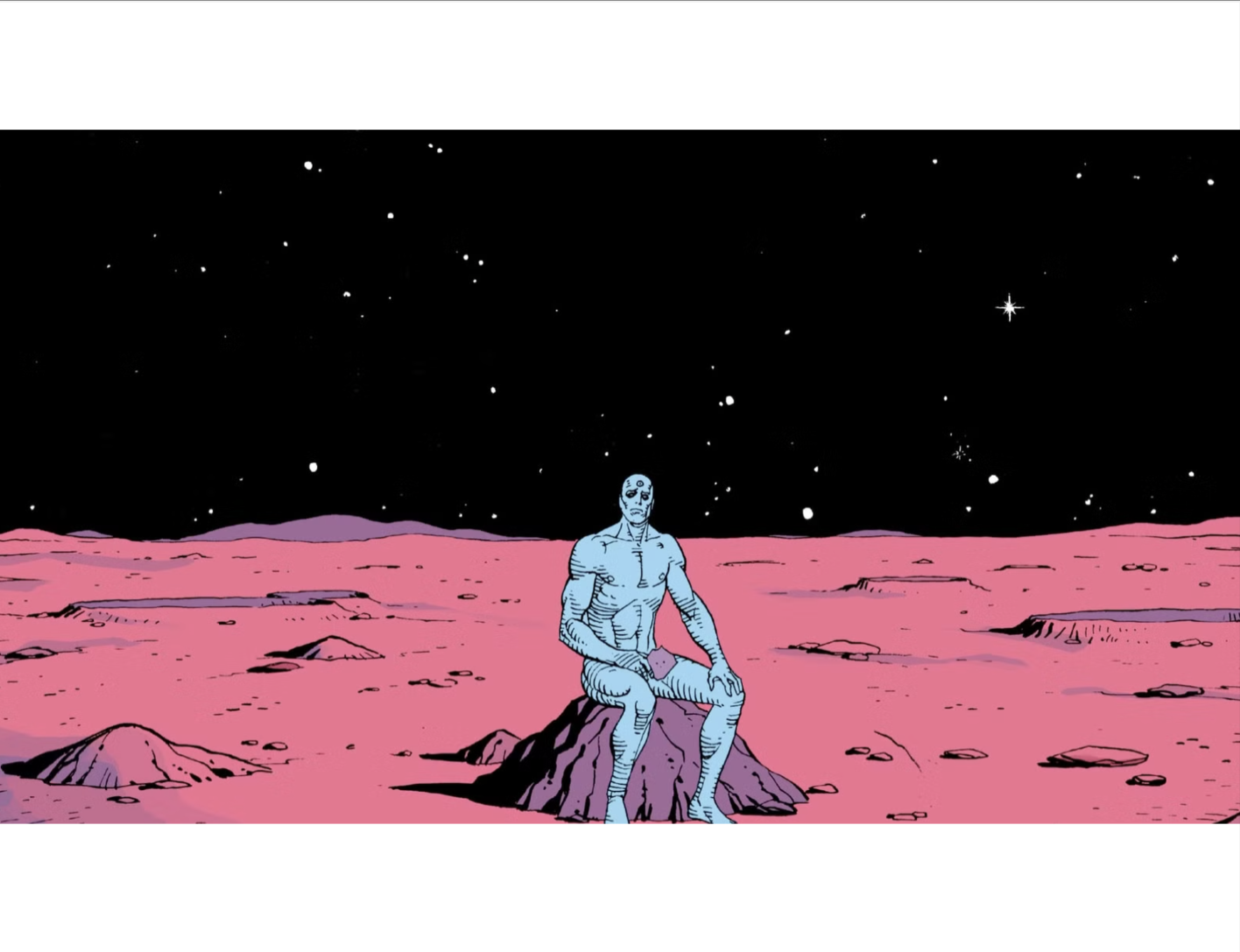
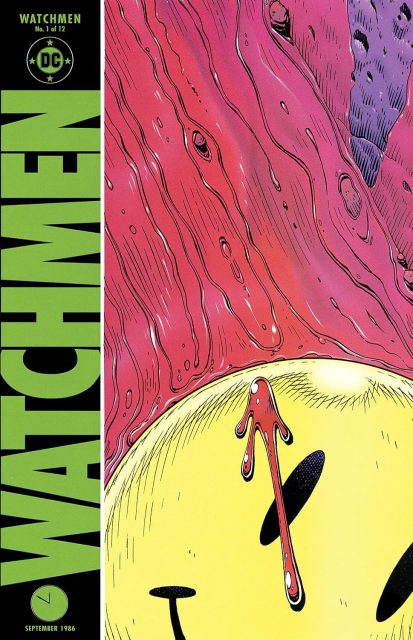
we are incapable of dealing with the problems caused by our existence.
Caroline Fraser.NYRBApril 23, 2026
human nature is incurably mad.
At some point in the late 1980s or early ‘90s, when I was working to establish cred withThe Comics Journal,I told an editor that I consideredWatchmenthe best novel of the last decade. Oops, I later thought. I should have saidLove and Rockets.
Watchmenhad been lauded at the time. It is taught, I see, in high schools today, which means it has been deemed no more troublesome thanTo Kill a Mockingbird. It does not excite Moms as do transsexuals and Toni Morrison. (Only in Missouri have school districts banned it.) Was it not the driven and demented work which had hooked me? It has fallen out of the conversations in my cafe – if it ever had been part of them. Perhaps the poorly received movie, which I didn’t see, or the highly lauded HBO series, which I’ve been unable to watch, had overwhelmed the knife’s edge I had sensed sheathed between its covers. When I told a friend I was writing about the graphic novel, he was flabbergasted to learn it did not concern African-Americans. Its place in the pantheon might be worth a second look. While it was the only graphic work onTimemagazine’s list of the greatest novels ever, the more elitistComics Journalranked it only the 91stbest English-language comic of the 20th century.
Watchmenhad appeared as a 12-issue (32-page) monthly comic in 1986 and 1987, before being collected into a single volume in November that year, the twisted vision of a 33-year-old Englishman, Alan Moore, possessed by the Ban-the-Bomb fervor of a Trafalger Square Sunday soapbox. The cover credits the illustrator Dave Gibbons as co-author and the title page gives equal billing to the colorist John Higgins, but I suspect both were but enablers of Moore’s mania andWatchmensoap bubbles without it.
The book presented as a superhero saga, and I had never been a superhero fan. I’d read scattered issues but none after turning ten when EC peeled the blankets from the sordid and steamy. When Marvel hit the scene in the early ‘60s, my eyes were onThe Stranger,and I remained ignorant of DC’s universe (or universes).Watchmenmay have drawn from established conventions, but I am sure much was as shake-out-the-synapses original as it seemed to me.
Actually, it is unclear ifWatchmen’s protagonistsqualify as superheroes. Moore incresses this confusion referring to them variously as “costumed heroes,” “masked adventurer(s),” “masked avengers,” “Super-Hero(es),” “Superhumans,” “super-people,” “costumed heroes,” and “costumed adventurers.” This last, which seems the term most frequently applied, suggests capacities attainable by all. Only Jon (“Dr. Manhattan”) Osterman has powers that set him apart from normal beings. He can alter molecules, “manipulate… matter,” and move himself and others through time and space due to an accidental exposure to nuclear energy, like the insects and crustaceans in 1950s B-movies, who’d experienced similar exposures and only gained gigantism. The others have trained themselves into physical form reachable at Planet Fitness. Adrian “Ozymandias” Veidt also educated himself to become the World’s Smartest Man. Dan “Night Owl” Dreiberg utilized a background in auto mechanics to develop a vehicle that can both fly and travel underwater. Walter (“Rorschach”) Kovacs was driven by molten paranoid fury and Edward (“The Comedian”) Blake an unflinching amoral cynicism. The only woman among them, the Crimebusters, Laurie (“Silk Spectre”) Jupiter, seems to have been pushed into felon fighting by her mother. They brought to their crusade the traumas of illegitimacy, parenting by prostitutes, and flight from the Reich’s ovens. They did not count one sustained, mature relationship among them.
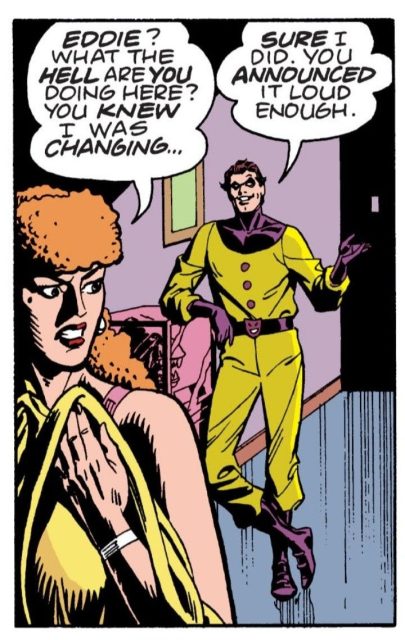
Moore provides the group a back story, wittily blending comic book and American history. It seems Superman’s appearance in April 1938 inAction#1 caused several thrill-seeking do-gooders around the country to don costumes and fight crime, uniting the following year as Minutemen. (The criminals were often as outlandish as they were: The Screaming Skull; Dr. Axis.) Their good works carried them through WW II, but age, alcoholism, mental illness, and sexual deviancy took their toll. Criminals donned suits and moved into corporate board rooms, making fighting them no longer fun. In 1949, just as HUAC was launching an investigation, the Minutemen disbanded,
Then, in 1964 (about when Marvel resuscitated superheroes), the Crimebusters emerged to protect America from sex, drugs and campus unrest. But the public turned on them, attacking them as due process-bashing vigilantes, masked to avoid identification like the KKK. Police departments struck, saying their job had become impossible, and riots swept the country. Congress outlawed them in 1977, except for the Comedian, who carried out covert ops against Marxists, and Dr. Manhattan, whose powers gave the US a geo-political advantage it had lacked since Moscow got the bomb. (He had helped the US triumph in Vietnam, enabling Nixon to continue as president.)
Weathermenopens eight years after the ban.
Moore immediatelyimmerses readers in a bath of vileness. Gutters flood with vermin drowning in blood. Krystallnacht and Pale Horse, with whose names regurgitating the Third Reich and Revelations, headline rock concerts. “The End is Nigh,” a mad-eyed picketer proclaims. “Doomsday Clock Stands at Five to Nine,” a headline trumpets.
“The American dream has disintegrated into a riotous mob,” Nite Owl instructs. Ours is a “world of horror and madness” (in which)… we are alone… born from oblivion… go(ne) into oblivion,” dronesDark Freighter, a comic a teenager reads. Life is “a successful virus clinging to a speck of mud suspended in nothing,” a psychiatrist, concludes. The universe will not notice, Dr. Manhattan points out, “if everyone dies.”
Russia has invaded Afghanistan. The United States fears Pakistan and Europe are next. Nixon retreats to a bunker. Missiles are expected to fly; America east of Iowa will burn. The Crimebusters may be all that can prevent nuclear annihilation, but when the book begins, one has just been killed and the rest seem to face elimination.
These inter-woven story lines – can the murderer be caught; will Earth escape being reduced to a cinder? – seem sufficient to keep readers turning pages. But Moore also puts in play a romantic triangle, a stew of mini-dramas centered around a corner newsstand, and, most notably,Dark Freighter’s saga of pirates, sharks, and rafts afloat on bloated corpses, which parallels in insanityWatchmen’s narrative.
He buttresses his tale with purported memoir chapters, scrap book clippings, academic articles, and portions of medical files. He studs his lines with references to William Burroughs and Kitty Genovese,Hustler, andTijuana Bibles.Heinterjects post-Einstein physics (“All time is simultaneous”) and issues of moral debate (If by murdering a friend/colleague you would save millions of lives, would you do it?) He flashes back and leaps forward. Panels flow by wordlessly or are borne upon a voice not directly addressing the depicted. Moore sometimes switches focus after a single panel; other times he advances steadily across pages like a card sharp emptying his deck.
These independent but interwoven story lines and scattered facts may clarify a larger picture; they may tug free drift away. A reader – like anyone passing through life – must make sense of his collected information as he progresses toward an end.
The best thing about most art in Golden Age superhero comics is they wouldn’t be comics without it. They’d be a bunch of pulp paper with a narrative carried by over-heated captions and cliche-reliant dialogue. Gibbons has deliberately positioned Moore’s characters in this world, working most frequently with its traditional nine-panel page. This allows him to draw identifiable figures and weaponry but allows little room for etched portrayals of human emotion, particularly if you’re humans are masked. His sex scenes whimper like old tea and his nudes suggest he never took a life drawing class. Like many comic artists of mid-20th century comics though, given a shot at pouring sweat and spewing saliva, he was golden. And when he cuts loose in Issue 12 with six wordless full pages of bleeding bodies, sprawled across roof tops, jamming sidewalks, choking gutters, joining the vermin with which the book began, you can practically hear Gotterdammerung playing.
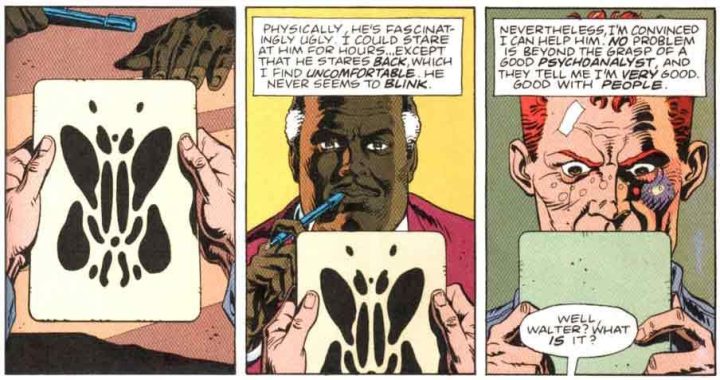
A nice – only-in-comics – use of Gibbons’s art occurs when Rorschach is asked what he sees in an ink blot test. “A pretty butterfly,” he lamely replies, which a panel limply shows. But what Rorschach actually saw and an adjoining panel drops in the viewer’s lap is the bloodied head of a German shepherd whose skull he had halved with a cleaver after it had eaten the remains of a six-year-old girl fed it by its owner. (He’d then handcuffed the owner to a pipe, drenched him in kerosene, and set him on fire. They are teaching this to high school kids?)
In writing this article, I read nothing aboutWatchmen.(Wikipedia alone offered 163 footnotes, but I wanted nothing – even facts – to corrupt the vapor I was trying to flesh.) I relied on my own unfiltered, if uninformed, thinking. This left me no way of knowing whether Moore directed the POVs from which panels were drawn or if this was left to Gibbons. Either way, their variance – close-ups, long shots, over-heads growing increasingly distant, views behind railings, and between legs – support the in-and-out, back-and-forth complexity on which the story swings.
A visual component to which there is no trouble attaching praise isWatchmen’s color. Higgins consciously shades each panel to comfort or distresses, increase sublimity or grief, give stature to the banal or glory to the already magnificent. He not illustrate scenes for identification by the eye but flips emotional control switches in our heads. He lays scrim-like sheets of color – sometimes swathes of several scrims – across Gibbon’s pen-and-ink compositions. The same character viewed from the same angle within the same place may vibrate with red or black,yellow, green or blue. Higgins does not adhere to the “real.” His aim is nightmare or dream.
Moore lets his characters take different routes to the Armageddon for which he has destined them. One says helping others is “ all that means anything,” while another equates fighting bad guys to playing whack-a-mole. Smite one, and another will pop up in the next issue. Two others elect to pursue personal happiness “because we’re not dead (yet).” That seems the best most of us can manage, even if we recognize the Titantic is steering toward the iceberg and Icarus the sun.
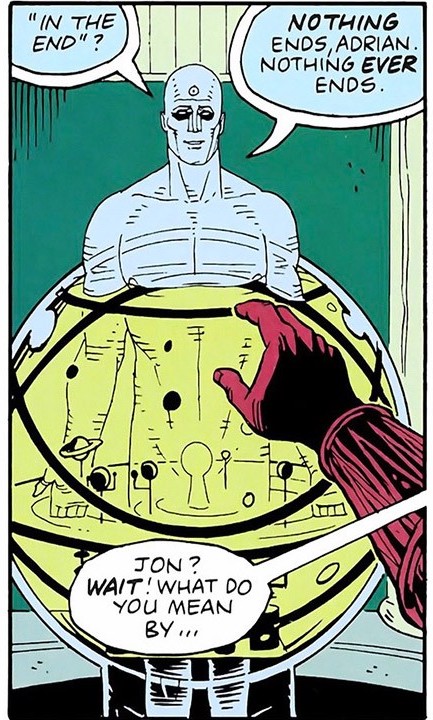
The solution Veidt comes up with atWeathermen’s end, is to prevent a holocaust by creating “a monstrous life form,” capable of killing millions and driving millions more insane. The survivors, he expects, believing Earth has been attacked by aliens, will put aside national differences and unite in order to survive. But, as Dr. Manhattan points out, if some men survive, man is likely to resume behaving as it always has.
“Nothing ever ends,” are his final words.
The Doomsday Clock is at 85-seconds before midnight now. Only two nuclear powers disturbed Moore’s sleep. Now nine nations have the bomb. InWatchmen, as now, defense spending had stolen money from children, the aged, the homeless, the infirm. Ordinary people withdrew into fantasies of the future or past. The super-rich factored social rupture into investment portfolios. They established private islands to which they – and Jeffrey Epstein – could flee. Mars was capable of crystal towers where Elon Musk could dwell.
There is, of course, no World’s Smartest Man to save us. Even he would be no match for any self-respecting AI system. I can see one, avoiding Veidt’s mistake and, like the urban legend Roomba tasked with ridding the house of fleas, killed the family dog, eliminating usd’un seul coup. Or maybe, at 84, with at least two cardiac interventions awaiting, I am predisposed to foresee hordes joining me to muffled drums and silenced dogs beneath the hood of the condemned.
