

At Northwestern University, where he is a professor, Bill Savage teaches a course that examines baseball in American narratives. He is also a Cubs fan and season ticket holder. So it’s fitting he is giving a talk next month at the Art Institute titled “Norman Rockwell and the Chicago Cubs — The Making of Baseball’s ‘Lovable Losers.'”
The Art Institute recently acquired Rockwell’s 1948 painting “The Dugout,” originally created for the cover of the Saturday Evening Post. It depicts, per the museum’s description, “a springtime doubleheader that (Rockwell) attended during which the hometown Boston Braves swept the visiting Chicago Cubs.” Chicago’s North Side team members sit slumped in the dugout. A batboy stands in the foreground looking miserable. And the Boston fans behind them, yelling jeers, could not be having a better time.
The painting helped solidify a perception about the Cubs that has stuck with them ever since, regardless of their actual standings or even a World Series title 10 years ago
What’s that about?
Savage says one of his friends is adamant that “you win it all, or you’re a loser. So if you say, ‘Well, the Cubs are pretty good,’ you’re an apologist for failure. But this is where it becomes a bigger story about American culture, where second place is the same as last place. Americans claim to root for the underdog, but reality doesn’t bear that out.”
And yet perceptions around the Cubs, he argues, have successfully pushed back on this idea. “And that’s because baseball is a game of failure. If you’re a great hitter, you’re hitting .300 — meaning, you’re striking out seven times out of 10 — but you’re probably a Hall of Fame player. So baseball is a game of failure, and you have to be OK with that as a player or a fan. If the only thing you can embrace about the game is if your team wins, that’s a pretty grim situation you’re going to be in.”
Hence, the lovable losers. “But for everyone who calls them lovable losers, there are just as many people who will say they’re just losers,” Savage said. “Lovable is in the eye of the beholder.”
This loser-dom aura, lovable or not, belies the team’s earlier history. “Three years before the Norman Rockwell painting was produced, the Cubs were in the World Series,” Savage said. “They were in 10 of the first 41 or 42 World Series.”
In other words, they were good
“Yes! They were a dominant team. They were not a good team the year Norman Rockwell made that painting, but they were not commonly understood to be losers, per se
“By comparison, at that point, the Philadelphia Phillies had never been to a World Series. So there were a lot of teams in baseball that were bigger losers than the Cubs. From 1906 to 1910, the Cubs had the best five-year record of any team in baseball. And to this day, no one has ever had a better five-year span. The team was so good that they inspired sports writers in rival cities to write poetry about them.” That includes the 1910 poem “Baseball’s Sad Lexicon,” by Franklin Pierce Adams, written from the point of view of a depleted New York Giants fan watching the Cubs complete a double play.
But the team would go downhill after 1945. Without a winning record to tout, the ballpark itself became the marketing focus, Savage said
“Sit in the sun and have a hot dog and a beer and the kids can have an ice cream. The point of the Cubs was going to the ballgame and having a good time, not winning. They didn’t market themselves as winners. The old scorecards, they show fans having fun; they don’t show grim, dominant players. The Wrigley family, who were still the owners at the time, they didn’t market them as lovable losers, but the perception became, yeah, they’re losers, but at least it’s a good time at Wrigley Field.”
Pop culture has helped solidify this idea. The 1977 play “Bleacher Bums,” from Chicago’s Organic Theater Company (and based on an idea by actor Joe Mantegna), is a “depiction of fan culture, where of course the Cubs are going to lose,” Savage said. “And they do. Because that’s what the Cubs do.”
Savage said he plans to bring up “Bleacher Bums” during his talk, as well as Steve Goodman’s song “A Dying Cub Fan’s Last Request,” which leans into the lovable loser-dom of the team’s ongoing persona: “Do they still play the blues in Chicago / when baseball season rolls around? / When the snow melts away, do the Cubbies still play / in their ivy-covered burial ground?”
Goodman wrote a far less sardonic follow-up a few years later called “Go, Cubs, Go,” which has become the team’s anthem. But the lovable loser label was already firmly in place
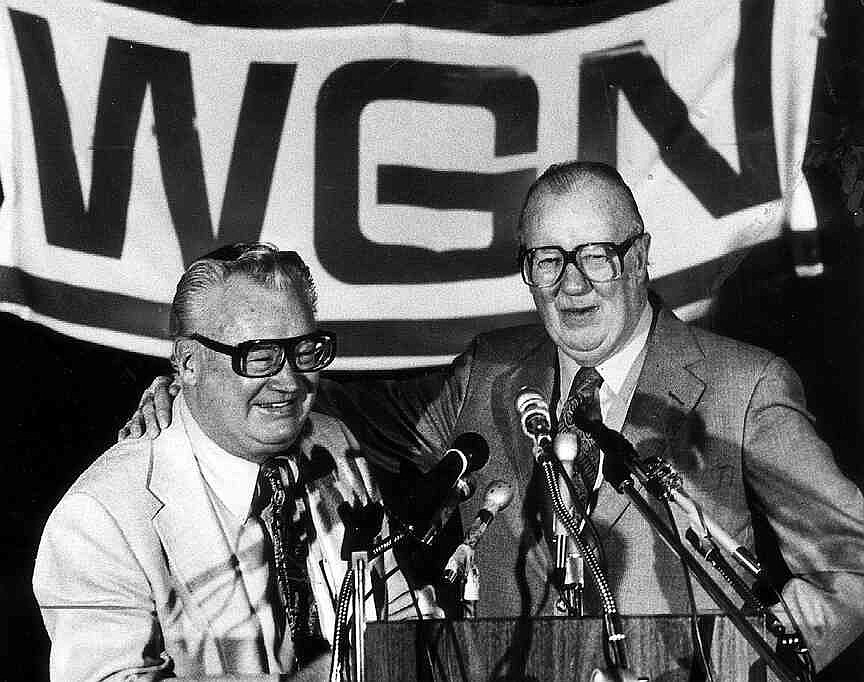
In 1978, this perception expanded beyond Chicago when WGN-TV, which carried Cubs games, became a superstation. “Before you had streaming and the internet, if you had cable TV, certain stations were available nationwide. So WGN was a local Chicago station — like TBS in Atlanta — but anybody in America could watch if they had cable.”
When the Cubs won the National League East Division in 1984, “the stories were all couched in this ‘lovable losers become winners’ framework,” Savage said. “But then of course they lose in the National League championship series, so they are losers again.” Or as Cubs play-by-play man Jack Brickhouse once said sardonically, “Any team can have a bad century.”
When a rollicking Harry Caray was in the broadcast booth, the “good time with the lovable losers” became even more ingrained for TV viewers outside of Chicago. “Attendance figures shot up when WGN became a national TV phenomenon,” Savage said, “and that’s because going to Wrigley became a pilgrimage to take in the ballpark atmosphere. And hey, if the Cubs win, great. But we’re not here for that. It’s the aura of Wrigley.”
The 1993 movie “Rookie of the Year” played into a longtime joke “that the only way the Cubs could ever win was if some child had a magical arm. Like, you can’t just have a team find some good pitchers. You need a miracle child. But really, this just cements that the Cubs were a go-to punchline in popular culture. If you need to make a loser joke, you just mention the Cubs.”
And it’s not because they had the losing-est record. It just became a broader cultural assumption that the Cubs were always going to struggle
Are the Cubs still lovable losers in the popular imagination?
“The text at the Art Institute that accompanies the Rockwell painting says it helped cement the idea that they’re lovable losers. But the thing is, when they start winning, it’s always talked about as, hey, the lovable losers are winning now! Paul Sullivan has written columns in the (Chicago) Tribune asking, ‘Are the Cubs lovable at all when they’re a team that dominates?’ Was the lovableness related to the loser-dom?”
The larger question that arises out of this conversation, Savage said, is “what are sports for? If winning is the only thing that matters, why would we put ourselves through this? Even the Yankees don’t win every year. There are 30 major league baseball teams and only fans of one team at the end of the season will be happy, if all that matters is winning
“If going to the ballgame is fun in and of itself, that’s a different kind of value. But again, American culture is very much ‘win or lose, and that’s all that matters.'”
“Norman Rockwell and the Chicago Cubs: The Making of Baseball’s Loveable Losers” lecture will be 7 p.m. ET July 16 at the Art Institute, 111 S. Michigan Ave.; free with registration and regular museum admission at 312-443-3600 and artic.edu
