

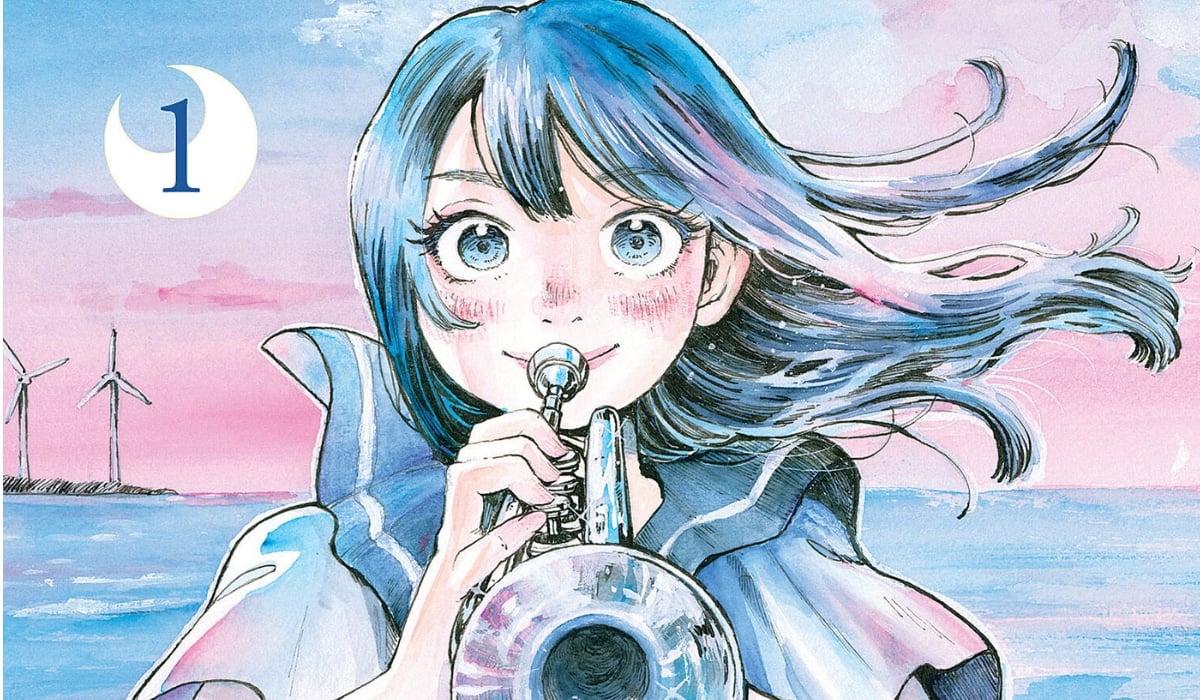

Crescent Moon Marching vol. 1
Created by Hamachi Yamada
Colors by Culture Weavers
Lettered by Barri Shrager
Translation by Arthur Miura
Graphix
August 4, 2026
$11.17 paperback, $23.29 hardcover
Buy Crescent Moon Marching on bookshop.org
Sixteen-year-old Mizuki has nothing that she wants to do. She’s tired of doing nothing but studying and terrified of becoming “a boring old adult”, but when her mom asks her what she’d rather do instead of studying, Mizuki doesn’t have an answer for her. So she runs away from Tokyo to her supportive aunt Yuki in Akita prefecture, where she encounters the brilliant but blunt trumpet player Akira and stumbles into a rehearsal for Senshu High School’s marching band. The performance captivates Mizuki so much, she wants to try joining in herself. Despite having no musical experience whatsoever, and despite her parents’ disapproval, Mizuki transfers from her old school to Senshu High School in Akita and signs up to join the marching band as a trumpet player. But will she be able to perform when it counts at the regional marching band festival a month into the school year?
Manga about teenagers getting into new hobbies are a dime a dozen, but what makes Crescent Moon Marchingcompelling is the specificity of this particular hobby and how rarely it’s depicted in such detail. Mizuki’s first day in the marching band has her and the other handful of newbies spending the whole day practicing walking, until all of them can take one single step in perfect sync. Mizuki has to memorize drill sheets and learn how to play the trumpet from zero, all with barely a month to go before their first big competition! Fortunately, the other members of the club can help her out… at least some of them.
Akira is a part-timer helping out at Yuki’s cafe, as well as working several other jobs in an attempt to save up enough money to travel and see the best marching bands in the world. He has little patience for Mizuki’s shyness, or crying, or clumsiness, or inability to ride a bike (though he does let her ride on the back of his bike while she adjusts to her new life). His words are harsh and uncompromising, but he has moments of kindness, like the aforementioned bike riding that show he’s more than just a grouch. And he really shines when he plays his trumpet. The other students are quick to tease him about Mizuki being his girlfriend, setting up a possible romance subplot for the two of them.
What stood out to me the most about the Graphix edition of Crescent Moon Marchingis the color treatment. Crescent Moon Marchingwas originally published in black and white, but for the middle-grade US market, the artwork has been fully recolored in cool blues and watercolor-textured pastels. The colors add a lot to the emotional expressiveness of the musical performance sequences. The use of dark blue for the linework instead of black allows the colors to meld seamlessly with the lines, and the textured gradients add depth to backgrounds. It looks really, really good! Honestly, I think the colors here are more effective than in previous Omoi-for-Graphix manga Hikaru in the Light,which I also quite liked.
The lettering is… fine. Not distracting, but not impressive in the same way as the colors. I’m not sure the main font matches the art as well as the colors do. But the translation reads very naturally, and I think this could be a good entry point to manga for fans of, for example, Scout Is Not A Band Kid,Brass & Sass,or just younger readers who are already participating in or planning to join a marching band someday. Readers expecting something more action-packed or plot-heavy would probably find the slow pace boring, but fans of slice of life and hobby manga would love this beautiful full-color release.
