

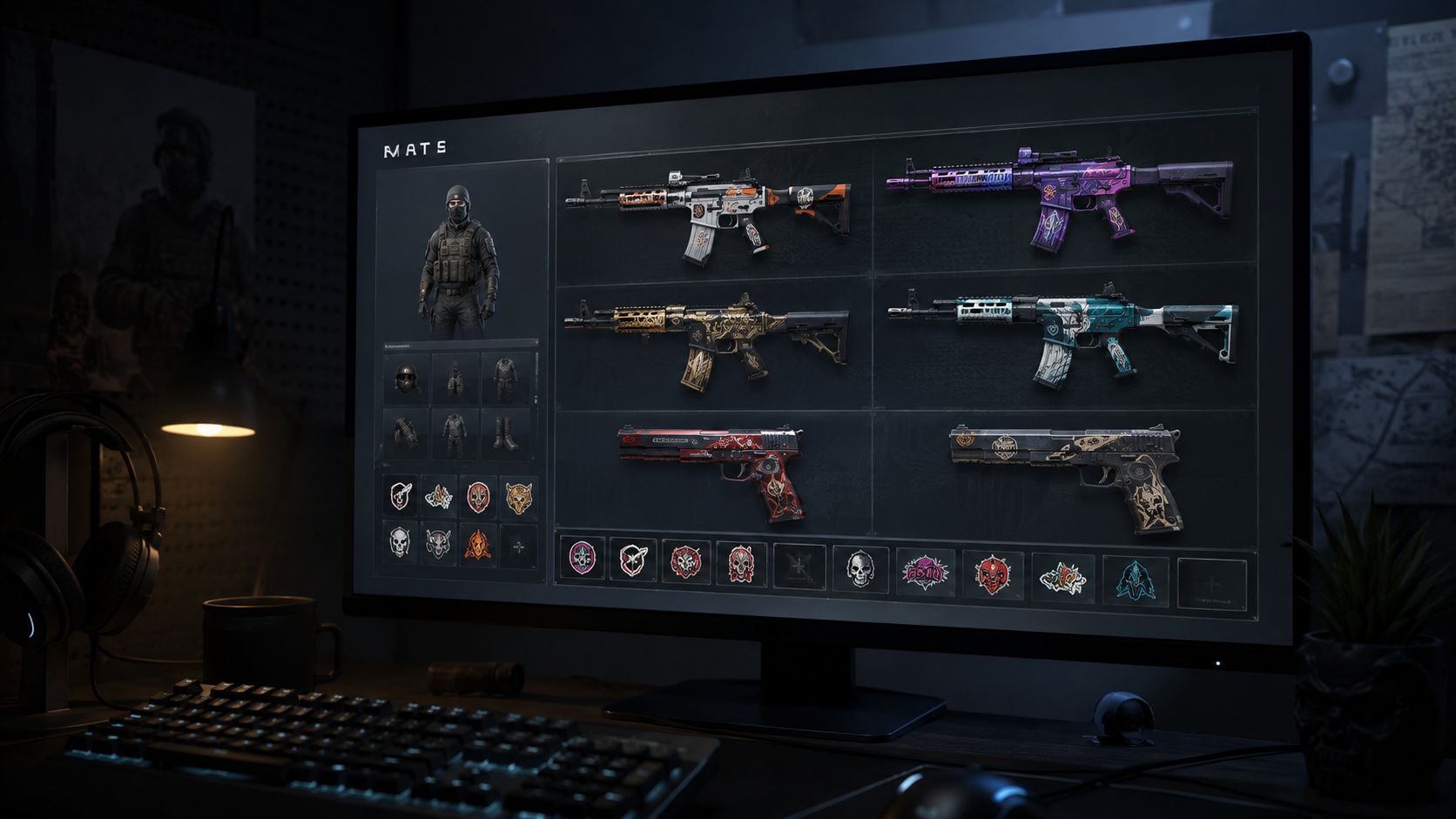
It has no effect on how a Counter-Strike 2 match plays out. Yet for millions of players, skins have become one of the clearest ways to show personality inside the game.
That makes more sense when you look at how people express themselves elsewhere. In the physical world, identity is tied to clothes, tattoos, sneakers, records, cars and the objects we keep around us. Online, that same instinct shows up through avatars, profile designs, emotes and digital items.
Counter-Strike skins sit right in the middle of that shift.
The loadout as a personal signature
Counter-Strike has always looked more restrained than many other multiplayer games. Its maps and weapons are instantly recognisable, but players do not constantly swap between elaborate costumes or fantasy characters.
This gives the loadout more weight.
Some players build an inventory around a single colour. Others prefer worn finishes, minimalist designs or loud patterns that stand out the moment a weapon is drawn. Stickers add another layer, often referencing professional teams, tournaments, creators or specific moments in the game’s history.
Over time, those choices can become a personal signature. Teammates recognise a familiar rifle. Viewers associate a certain design with a streamer or professional player. An item that started as decoration becomes tied to memories of matches, teams and different periods of a player’s life.
It is not so different from the attachment someone develops to a favourite guitar, jacket or skateboard. The meaning comes from use.
Digital collecting is now part of gaming culture
Collecting used to be understood mainly as a physical hobby. People collected records, trading cards, comics, figurines or sporting memorabilia. Gaming has carried that same tradition into digital spaces.
Counter-Strike is a strong example because its cosmetic ecosystem combines design, rarity, condition and community history. Players pay attention to finish, wear rating, pattern and stickers. Two weapons with the same base design can look completely different because of their individual details.
Players looking through collections of cs2 skins do not simply scroll through alternate weapon colours. They are seeing years of taste, trends, tournament culture and changing ideas about what makes a digital item desirable.
The attraction is not always about money. Plenty of players enjoy building a loadout that feels consistent, finding a finish that suits them or holding onto an item linked to a particular period in the game.
A connection to Counter-Strike history
Counter-Strike 2 replaced Counter-Strike: Global Offensive in 2023, but the culture around skins did not restart. Existing inventories carried across, which meant years of history moved into the new version of the game.
That continuity matters.
Older skins can remind players of earlier versions of Counter-Strike, past competitive eras or the first teams and personalities they followed. Tournament stickers work like digital memorabilia, connecting an item to a specific event long after the professional scene has moved on.
The result is an unusual mix of new technology and inherited culture. Counter-Strike 2 runs on a newer foundation, but much of its identity still comes from the community that formed around Global Offensive.
Few gaming ecosystems preserve their past so visibly in the everyday act of playing.
Esports have helped turn skins into cultural objects
Professional Counter-Strike has played a major role in making skins recognisable beyond a player’s own inventory.
A finish used by a popular player can suddenly attract attention. Tournament broadcasts place customised weapons in front of huge audiences. Team and player stickers let fans carry a piece of the professional scene into their own matches.
The same thing happens in music, fashion and sport. People notice what influential figures wear or use, then adapt those choices to suit their own identity. In Counter-Strike, that process happens through the weapon sitting at the bottom of the screen.
Skins have become part of esports branding and fan culture, not just an extra feature buried inside the game’s menus.
What digital ownership actually means
The popularity of skins also raises a bigger question: what does ownership mean online?
Players now spend a significant amount of time in digital spaces. Friendships form there. Communities build their own language, history and traditions. The objects attached to those spaces can carry real emotional weight, even if they cannot be placed on a shelf.
At the same time, digital items still exist inside platforms controlled by publishers. Their availability, rarity and use can change. That tension sits at the centre of digital ownership. An item can feel personal and valuable while still depending on rules and systems outside the player’s control.
For players, it is worth separating cultural value from guaranteed financial value. A skin can be rare, meaningful or desirable without being a stable investment.
A visual language built by players
Counter-Strike skins have lasted because they do several things at once. They are collectible objects, pieces of esports history, markers of personal taste and part of a shared visual language.
They do not change the basic point of Counter-Strike. The game still comes down to communication, precision, positioning and decision-making under pressure.
Instead, skins change how players inhabit that world.
They bring personality into a deliberately competitive environment. They create continuity across thousands of matches. Most importantly, they show that identity does not disappear when people enter a digital space – it simply takes a different form.
