

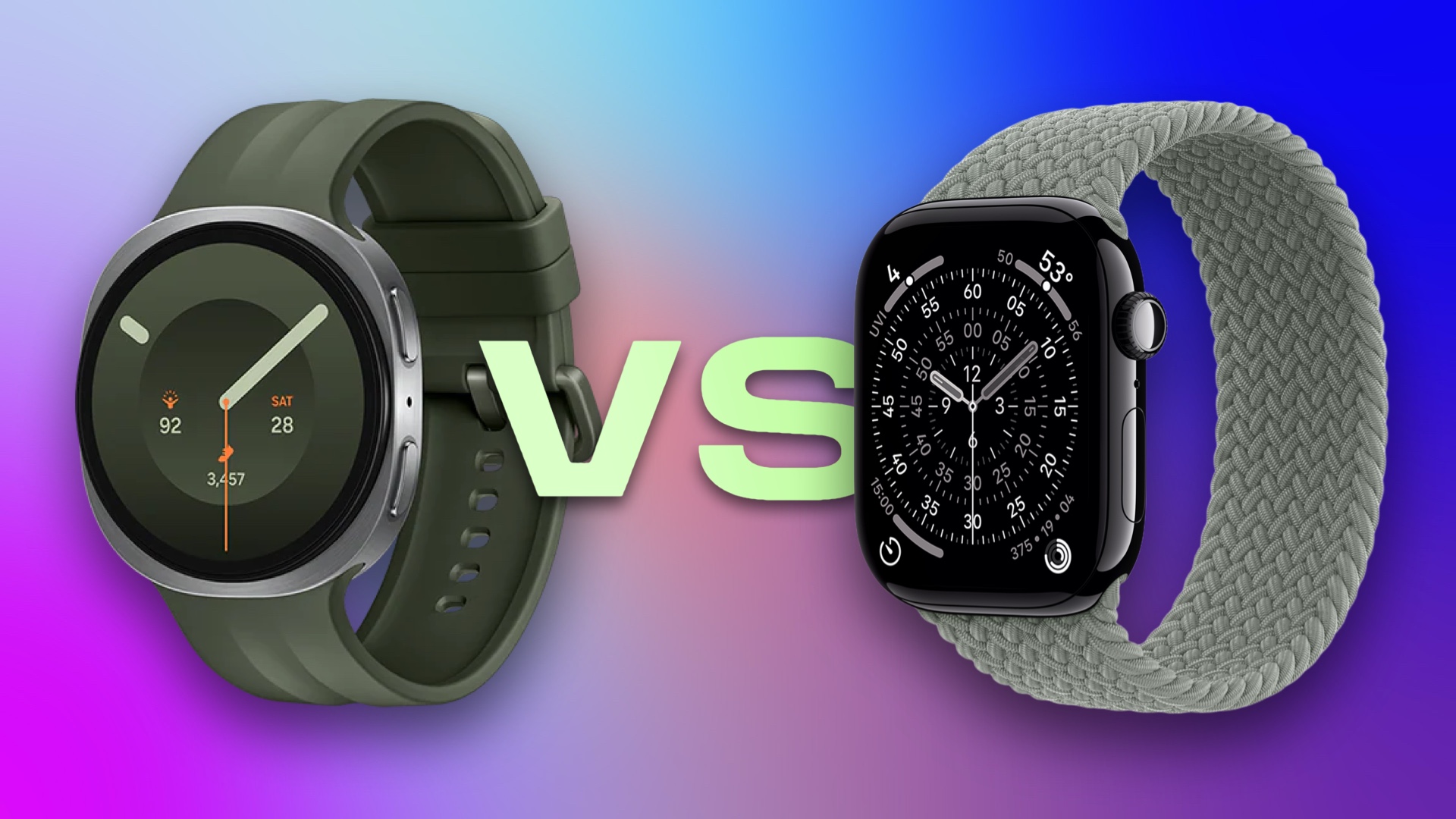
With the announcement of Samsung’s Galaxy Watch 9, you now have another option in the ever-growing field of smartwatches. With more fitness features, a new processor and a larger battery than its predecessor, it looks to be a solid upgrade. In her hands-on with the smartwatch, CNET Principal Writer Katie Collins wrote that “Samsung has subtly improved its catch-all smartwatch in a series of impressive and meaningful ways.”
But how does it compare to the popular and ubiquitous Apple Watch? The latest Series 11 model is an Editors’ Choice Award winner and earned CNET’s Labs Award for most accurate heart rate tracking.
If you’re wedded to either the iOS or Android ecosystems, your choice is a lot easier: an Apple Watch works only with Apple devices, and a Galaxy Watch works only with Android devices. If you’re looking at each platform through the lens of their smartwatches and are open to either, however, here’s how they compare side by side.
Pricing the Galaxy Watch 9 and Apple Watch Series 11
The Galaxy Watch 9 and the Apple Watch Series 11 both represent the standard, nonpremium option in their smartwatch families. For both, pricing depends on body size and whether the watch is equipped with a cellular radio to connect to the internet and make calls independently of a paired smartphone.
The Galaxy Watch 9’s smaller 40-millimeter size starts at $380 for the Bluetooth model and goes up to $430 if you opt for the LTE cellular model. The larger 44mm model costs $410 for Bluetooth and $460 for LTE.
The Apple Watch Series 11 comes in aluminum or titanium, so I’m sticking with aluminum pricing to make for a better comparison with the Galaxy Watch 9. The 42mm model in aluminum costs $399 for the GPS option and $499 for the cellular model. Kicking up to the 46mm size adds $30 to each configuration: $429 for GPS and $529 for cellular.
If you do choose the titanium Apple Watch, the price jumps to $699 for the 42mm size and $749 for the 46mm size; that model is available only with GPS and cellular connections built in.
It’s also worth mentioning that the Apple Watch line also has a less-expensive model, the Apple Watch SE 3, which costs $249 for the 40mm size and $279 for the 44mm size. And for the sake of completeness, you can also buy an Apple Watch Hermès model, which is a Series 11 with fancier bands and custom watch faces, starting at $1,249. For this comparison, we’re really not going to go there.
Size and design: Galaxy Watch 9 vs. Apple Watch Series 11
Watch models are measured by the longest diagonal distance of case, which is why the Galaxy Watch 9 has 40mm and 44mm models, while the Apple Watch has 42mm and 46mm sizes.
In terms of physical dimensions, one key metric is thickness, and each watch is fairly slim (especially compared to their chunkier counterparts: the Galaxy Watch Ultra 2 and Apple Watch Ultra 3). Both models of the Watch 9 are 8.6mm thick, while both Series 11 models are 9.7mm thick.
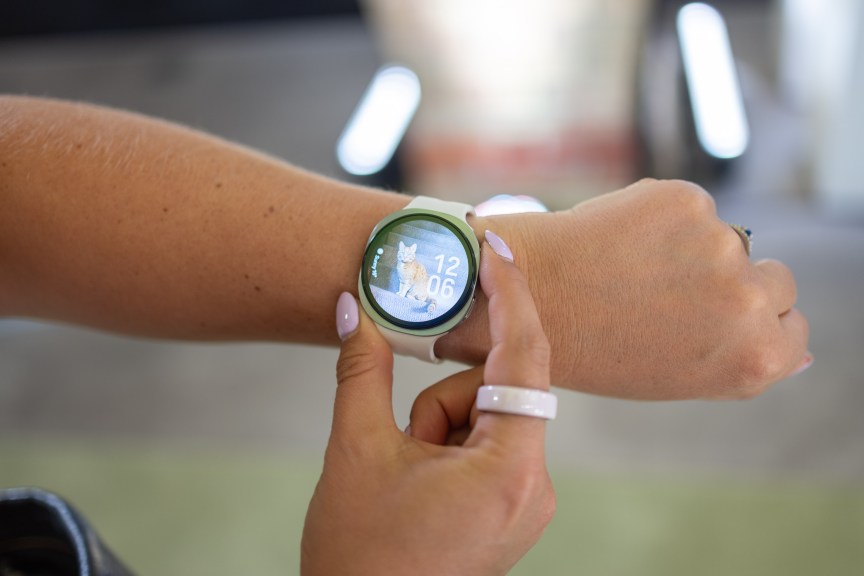
Another important consideration is weight, and in both cases they’re pretty similar: the Watch 9 weighs 31.5 grams and 34g for the 40mm and 44mm models, respectively, while the Series 11 weighs 30.3g and 37.8g for the 42mm and 46mm models, respectively.
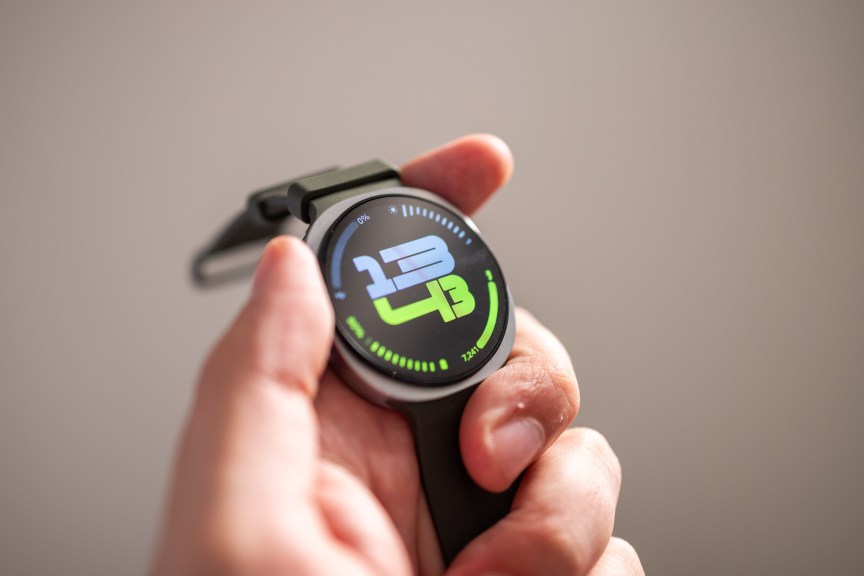
For some people, the overall shape is just as important as what the watches can do. Apple has stuck with a rounded-rectangle design since the Apple Watch was first introduced, while Samsung’s watches are mostly circular — the screen is a circle, but it’s mounted on a “squircle” base that’s a midway mix between square and circle.
Each watch has easy-to-install band systems that work with hundreds of watch bands available from the companies themselves and outside sellers — but only in their own respective ecosystems.
Comparing screens on the Galaxy Watch 9 and Apple Watch Series 11
The screen is everything on a smart watch.
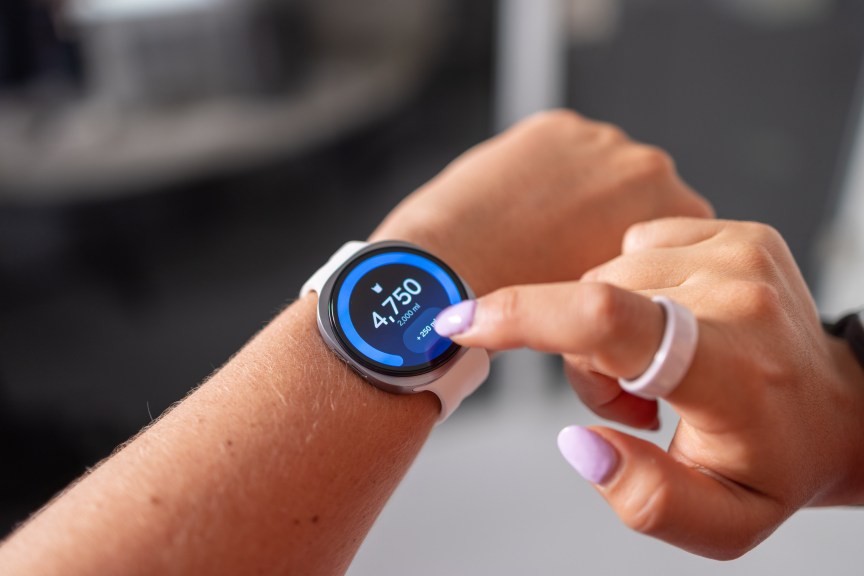
The Galaxy Watch 9 uses a Super AMOLED (Active-Matrix Organic Light-Emitting Diode) screen at a 438-by-438-pixel resolution for the 40mm watch, and 480-by-480-pixel resolution for the 44mm watch. It’s capable of 3,000 nits of brightness to view the display clearly in bright sunlight.
Andrew Lanxon/CNET
The Apple Watch Series 11 has an LTP03 OLED Retina display, which is also an organic LED that can adjust its refresh rate down to 1 Hz to save energy (the LTP03 designation). With its rectangular shape, the resolution for the 42mm model is 446 by 374 pixels and the 46mm model is 496 by 416 pixels. Apple also calls the screen a wide-angle OLED because it still has good visibility when viewed from the edges.
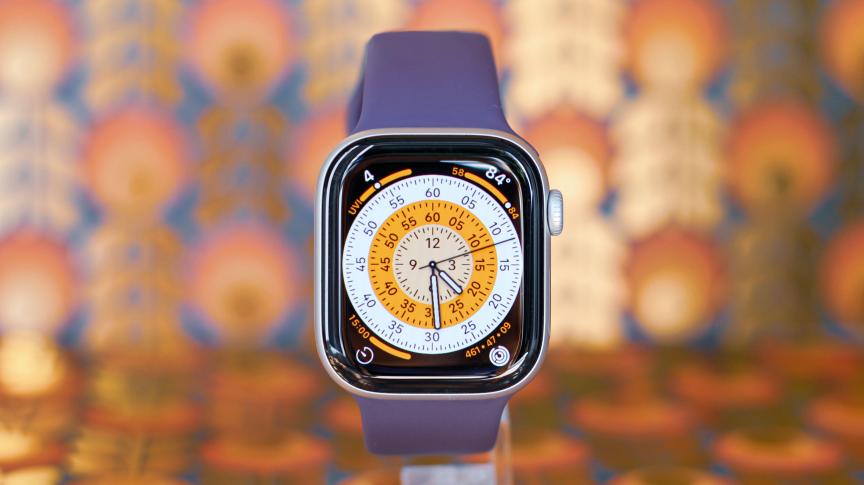
Vanessa Hand Orellana/CNET
Battery power: Galaxy Watch 9 vs. Apple Watch Series 11
Unlike a screenless health tracker like the Whoop band, both watches require more frequent recharging, making battery life a prized quality. Samsung and Apple have incorporated various strategies to eke out the longest time between charges, so these estimates depend highly on how you use the watch.
Samsung says the Watch 9 can go for up to 30 hours between charges when the always-on display is enabled. With that feature off, it can get up to 40 hours before needing a charge. It also has a low power mode that turns off some features to save battery life, but Samsung hasn’t listed those estimates.
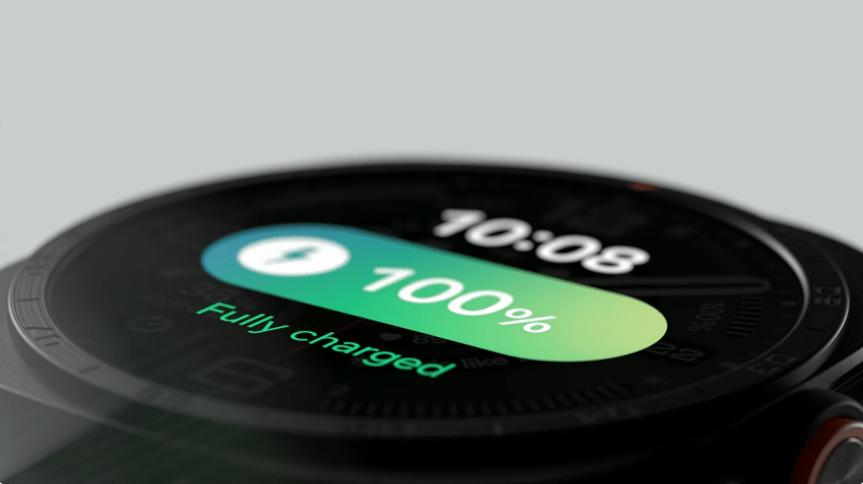
When it’s connected to power, the 40mm model will fast charge to 50% capacity in 30 minutes and to 100% in 80 minutes. The 44mm Watch 9 will climb to 45% in 30 minutes and hit 100% in 90 minutes.
Samsung/Screenshot by Joseph Maldonado/CNET
The Apple Watch Series 11, by comparison, gets up to 24 hours of life before needing a recharge or up to 38 hours in its Low Power mode. It fast charges to 80% in 30 minutes and 100% in 60 minutes. Apple also notes that when the battery gets low, a 15-minute charge should add 8 hours of normal use, or a quick 5-minute charge while you’re brushing your teeth at night can add 8 hours of sleep tracking. (Disclaimer: Apple did not specifically mention dental hygiene, but you should brush regularly.)
Part of the Watch 9’s advantage is larger batteries than the ones in the Galaxy Watch 8, rated at 390 mAh (40mm size) and 445 mAh (44mm size). Apple doesn’t list the battery capacity of the Series 11.
Connectivity: Galaxy Watch 9 vs. Apple Watch Series 11
Both companies’ watches are available in noncellular and cellular configurations. Samsung calls the first a Bluetooth connection while Apple calls it GPS, but the idea is that the watch needs a phone nearby or be signed on to a known Wi-Fi network to connect to the outside world.
The Watch 9 includes Bluetooth 6.0 capability for communicating with its paired phone. The Series 11 uses Bluetooth 5.3. You probably wouldn’t notice a difference, but Bluetooth 6.0 has less demanding power requirements.

The cellular models, called LTE on the Watch 9 and GPS Plus Cellular on the Series 11, allow you to take the watch out of range of your phone and Wi-Fi network and connect to the nearest wireless network — a benefit for runners who don’t want their phones slapping their legs with every stride, for example.
Apple has a slight edge here by including a power-efficient 5G radio in the Series 11, while Samsung is still using a 4G LTE radio in the Watch 9. That said, in real-world conditions you probably wouldn’t notice a difference.
Fitness features of the Galaxy Watch 9 and Apple Watch Series 11
Since companies discovered that smartwatches can track all sorts of health data, the fitness features have grown exponentially over the years. For instance, both watches track information during the night, such as heart rate, respiratory rate and wrist temperature and calculate the results in a Vitals app.
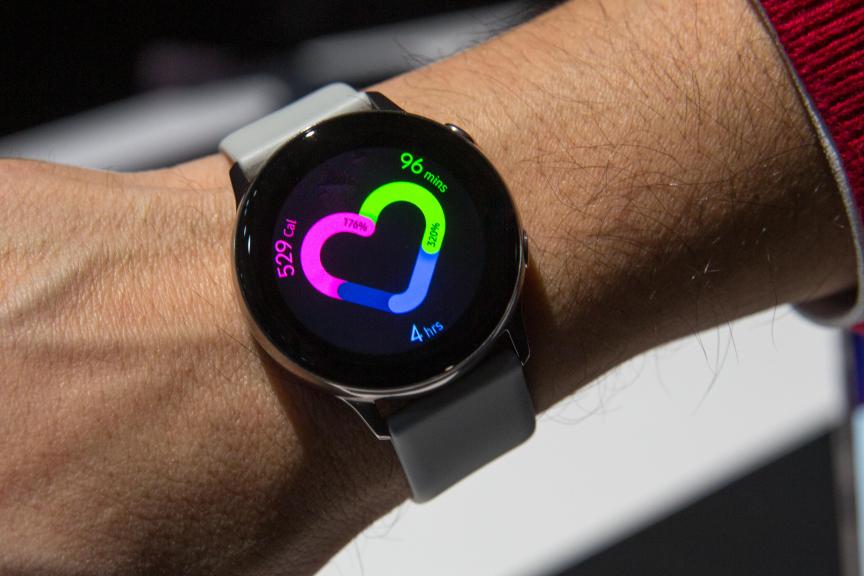
The Watch 9 can check your blood pressure once you’ve calibrated it with a separate blood pressure cuff, as another example. A new Fitness Index feature acts as a guide for helping you reach fitness goals, and a Heart Health Score is designed to give you a glimpse into your wellness based on several metrics.
The Series 11 also tracks similar data and can alert you if there are signs of hypertension. It does not offer a feature for checking blood pressure from the watch. Workout Buddy is Apple’s motivational coach that can talk to you during workouts to keep you going (or interrupt the podcast you’re listening to).
Samsung Galaxy Watch 9 vs. Apple Watch Series 11
| Apple Watch Series 11 | Samsung Galaxy Watch 9 | |
| Design & sizes | Rectangular, 42mm, 46mm | Round, 40mm, 44mm |
| Display | 42mm: 446 x 374 pixels, LTPO3 OLED Retina display, wide-angle OLED; 46mm: 496 x 416 pixels, LTPO3 OLED Retina display, wide-angle OLED | 40mm: 438 x 438 pixels, 1.3-inch Super AMOLED; 44mm: 480 x 480 pixels, 1.5-inch Super AMOLED |
| Brightness | Between 1 and 2,000 nits | Between 1 and 3,000 nits |
| Thickness & weight | 42mm size: 9.7mm; 30.3 g (aluminum), 29.7 g (aluminum GPS+cellular), 34.6 g (titanium); 46mm size: 9.7mm; 37.8 g (aluminum), 36.9 g (aluminum GPS+cellular), 43.1 g (titanium) | 40mm: 42.7 x 40.4 x 8.6mm, 31.5g; 44mm: 46 x 43.7 x 8.6mm, 34g |
| Material & finish | Aluminum: Space Gray, Jet black, Rose gold or Silver finish; Titanium: Slate, Gold or Natural finish | Aluminum. 40mm: cream, graphite; 44mm: silver, graphite |
| Durability | 5ATM Water + IP6X (dust) | 5ATM Water + IP68 (dust) |
| Battery life | Up to 24 hours, up to 38 hours Low Power (always-on); fast charge: 80% in 30 min, 100% in 60 min | Up to 30 hours (AOD on); up to 40 hours (AOD off); fast charge: 40mm: 50% in 30 min, 100% in 80 min; 44mm: 45% in 30 min, 100% in 90 min |
| Sensors | ECG, 3rd-gen optical heart sensor, skin temp, depth gauge, SpO2, noise monitoring, water temperature, compass | Accelerometer, barometer, bioelectrical impedance analysis sensor, electrical heart sensor, gyro sensor, geomagnetic sensor, infrared temperature sensor, light sensor, optical heart rate sensor |
| Emergency features | Satellite SOS, Emergency SOS, Fall detection, Crash detection, Check in and Backtrack | Fall detection, Emergency SOS |
| AI & coaching | Siri (voice assistant); Workout Buddy | Google Gemini (voice assistant); Fitness Index (feature) |
| Processor | S10 SiP with 64-bit dual-core processor, W3 Apple wireless chip | Qualcomm Snapdragon Wear Elite |
| RAM/storage | 64GB (storage) | 32GB (storage) |
| Payments | Apple Pay | Samsung Wallet, Google Wallet |
| Price (US) | $399-$750 (titanium) | $379-$459 |
