

Review
Pop Culture Happy Hour
‘Hadestown’ is a Broadway smash you can finally see at the movies
- Download
- Embed
<iframe src="https://www.npr.org/player/embed/nx-s1-5904447/nx-s1-mx-5904447-1" width="100%" height="290" frameborder="0" scrolling="no" title="NPR embedded audio player"> - Transcript
LINDA HOLMES: The musical Hadestown cleaned up at the 2019 Tonys, winning Best Musical and seven other awards. Now, a filmed performance of Hadestown is in movie theaters, with the principal original Broadway cast on board. It retells the Greek tragedy of Orpheus and Eurydice, separated by Hades, and fighting to be reunited. But it places them not in ancient Greece but in a Depression-era American dystopia, where Hades isn’t just a god. He’s a boss. I’m Linda Holmes. And joining me today on NPR’s Pop Culture Happy Hour is my co-host, Glen Weldon. Hello, Glen.
GLEN WELDON: Hey, Linda.
HOLMES: And also here is culture writer Margaret H. Willison. Hello, Margaret.
MARGARET H. WILLISON: Hi, Linda.
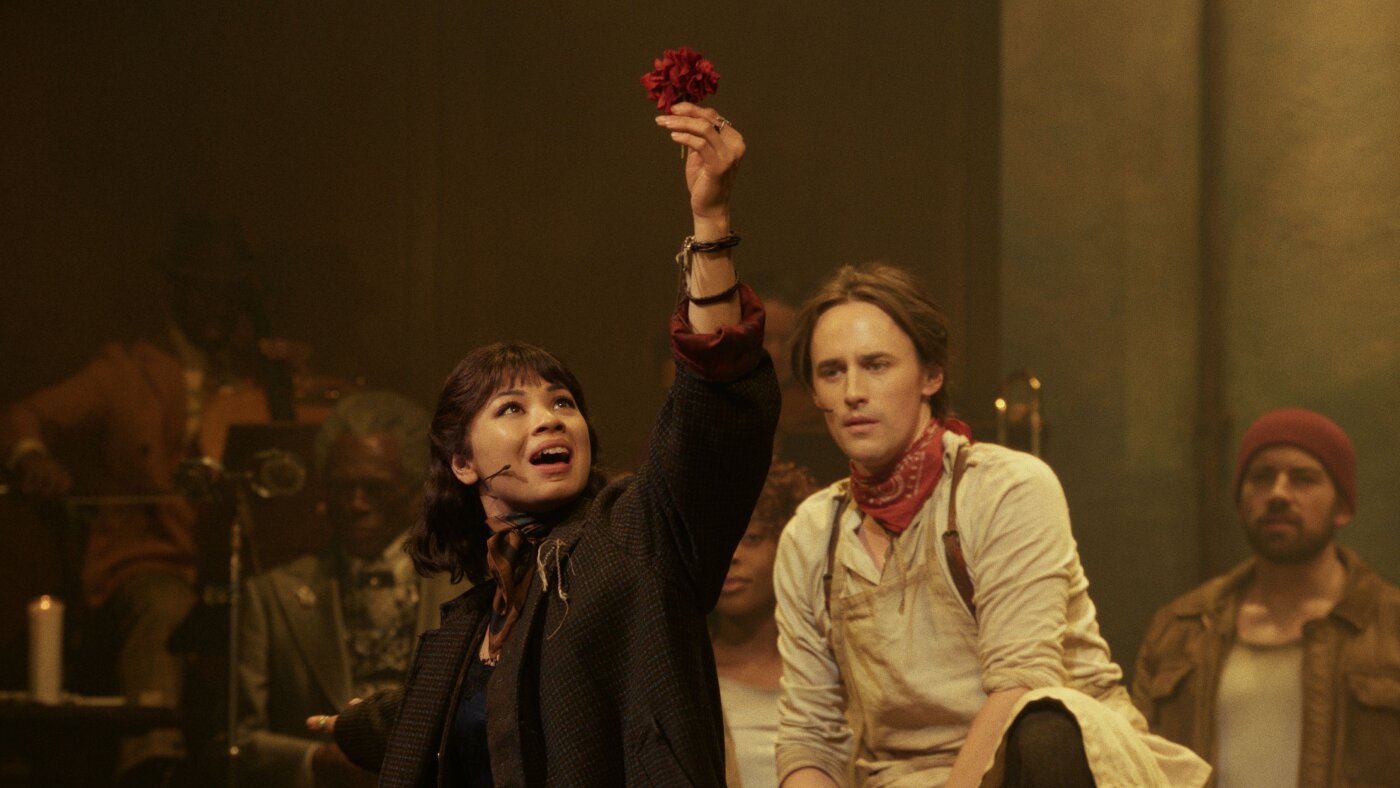
HOLMES: So Hadestown was written by singer/songwriter Anaïs Mitchell. This film version of the show was recorded in London in 2025, when the five Broadway principals reunited for a short run of performances. In the show, Orpheus and Eurydice fall in love. They are played by Reeve Carney and Eva Noblezada. They are deeply impoverished, and Hades is preventing his free-spirited wife Persephone from bringing them sunlight and renewal. Patrick Page and Amber Gray play Hades and Persephone. Orpheus is obsessed with writing a song he thinks can bring back the world he and Eurydice knew, if only he can finish it. But Eurydice falls into despair, and is successfully tempted by Hades to leave him and travel to the underworld, where the dead can only labor forever, extracting coal and oil and other buried riches for Hades’ benefit, but where Hades promises she will be provided for. When Orpheus learns Eurydice is gone, he travels to Hadestown to try to rescue her. The story is narrated by Hermes, who is played by André De Shields. You’re going to hear a bunch of music in this episode from Hadestown. That’s from the original Broadway cast album. Beginning tonight, Hadestown is in movie theaters for only five days. Glen, I’m going to start with you. What did you think about Hadestown?
WELDON: I mean, I loved it. You know, and on paper, it’s maybe not for Glens. I mean, sure, the Greek myth stuff is very much for Glens. But like, don’t get it twisted. This is heterosexual love story. Those are thick on the ground. This style of music– what are we calling this? Country, honky-tonk? What are we– like, that’s kind of the vibe here?
HOLMES: Americana?
WELDON: Yeah, OK. Not usually my thing. Also, the musical formula of this particular show, this is a very ballad-heavy show. It’s also the kind of musical I call the “fingerless glove” musical, just stylistically. Usually, I don’t have a high tolerance for those, but I love it. It is a love story. I would argue that it is a love story to musical theater. It shows you what theater can do, which is why I’m so glad that they chose to film the stage show instead of trying to adapt it, because I think you’d lose the magic. You’d lose the spark. The whole thing feels– I was going to say cramped, but not not cramped. I mean, it is intimate. I mean, the performers are kind of on top of each other. The theater itself, when they do the crowd shots, looks pretty small. That helps. The camera, I think, really captures the sense that this performance is special. It feels like a reunion. I think even if you didn’t know it was a reunion of these performers, I think you’d pick up on it because there’s an electricity to it. But I mean, theater, right? When a song mentions trees, the chorus lifts chairs above their heads upside down to suggest the branches of the trees. The orchestra is on stage, and they’re in the show as characters. They are acting and reacting. We see that there is a round table built into the stage from the jump, and we keep waiting for that throughout the entire first act to see it used. So it’s kind of Chekhov’s round table. And the song “Wait For Me” famously involves these suspended lamps whipping across the stage, and that makes it feel alive and kind of dangerous in a way. And people might say, well, it’s just an exercise in practical physics because the laws of physics dictate that those lamps are going to perform exactly the same way every night. So it’s not that big a deal. It is a big deal. It’s live theater.
-: – Wait, I’m coming with you
WELDON: Live theater introduces variables. Things go wrong, and your brain might be–
HOLMES: I guarantee you, things have gone wrong on the set.
WELDON: Absolutely. So you might be thinking, well, it’s the string times the acceleration due to gravity. But your heart’s going–
HOLMES: I don’t think there are many people thinking that, Glen, I got to say.
WELDON: Well, I was thinking that. But my heart was going, they’re going to crash! Oh, my god, they’re going to crash! And also, not for nothing, I’ll close with this. The hottest chorus on Broadway to West End, in another not insignificant data point, the very tightest of pants. So, loved it.
HOLMES: I have one question for you, Glen.
WELDON: Mm-hmm?
HOLMES: What is a fingerless gloves musical?
WELDON: A fingerless gloves musical is just that style of, like, it’s kind of– this isn’t steampunk, but that whole kind of steampunk, you know, rebel vibe kind of thing. It’s a feeling that I can’t articulate, but you know it when you see it.
HOLMES: Got it, got it, got it. OK, Margaret, what did you think?
WILLISON: I really enjoyed it. But I have a complicated relationship with the material, because I’ve been a fan of it for such a long time. I’ve been a fan of Anaïs Mitchell’s work as a songwriter, and this was released as a concept album. I loved the concept album. Then it was released as an Off-Broadway show at the New York Theater Workshop. And that’s maybe one of the best theatrical performances I’ve ever seen in my life– like, life-changing. And then it took its final form as a Broadway musical. And I saw that in London in 2018 in its pre-Broadway run, and then on Broadway as well. And it’s so heartening to hear Glen love it as much as he did. Because I was definitely watching with Glen’s eye and being like, oof, I wish he could have seen the version I saw because I just think it would work so much better for him. But I’m glad to know this version really worked for you. The staging is phenomenal. I really like most of the principals. But the weakest part for me is Reeve Carney as Orpheus. He just does nothing for me. I’m so glad Eva Noblezada loves him so much that she married him, but I don’t love him. And some of the changes that get made to the character of Orpheus make this a little harder for me. But I think it’s still spectacular. And it’s still capable, in this form, of inspiring intense devotion. And I think this filmed version is really well done.
HOLMES: Margaret, when you say that the version that you were afraid would have worked better for Glen, what are you talking about?
WILLISON: So a lot of the changes that got made make it a lot more Broadway palatable. So if you’re a Greek mythology nerd, like, you don’t need to be told that Hades is the king of the Underworld. But if you’re an average Broadway person, it’s going to be spelled out for you. Similarly, the sort of tie between, like, current global warming and the world being out of rhythm because of the gods is a lot more sort of poetically suggested in the 2016 version rather than here. It gets very sort of literal-minded. There’s like a lot of, like, petroleum and stuff like that. And you’re like, oh, OK. We can– we can pull it back on that.
HOLMES: Mm-hmm.
WILLISON: But the biggest thing is that in the 2016 version, Orpheus is just presented as a boy. He’s a boy who believes his song can change the world. But Hermes doesn’t tell you that’s true. Nobody tells you that’s true. You don’t see him performing magic with his song. So it really gets at the sort of central struggle of the Orpheus myth as dramatized by Anaïs, which is like, what do you do when you’re an artist and, like, you believe your art has the power to change the world, but it’s also– to pursue it, it leaves your family screwed, right? Like, nobody is paying you for it. You’re very poor, and you just have to ask loved ones to sort of hang in there and believe in you and let you keep doing this stuff that could look like frippery. And I think that that is so much stronger when the conviction that this could fix the world is internal, and it’s not confirmed by the structure of the play. This Orpheus, they describe him as touched, which feels to me like a call-out to Stephen Sondheim’s Into the Woods, where that’s also how Jack, the giant beanstalk climber, is described. And he’s very naïf-like, right? He’s just sort of stumbling around, and they get some really good laugh lines out of it. But as a character archetype, it doesn’t do as much for me.
HOLMES: Mm-hmm. I see. Yeah, I did not have much history with this show, which is just one of those things that I always figured I would probably like, but I– sort of the stars never aligned. I have never seen it performed. And I don’t often get really into cast albums for shows that I have not seen first. But I really loved this, and I thought it was– you know, it’s a fantastic piece of theater. I think, you know, Margaret, you may have felt that the suggestion of kind of industry and those kinds of things was a little heavy-handed. I thought it was very smart, and very on point. It didn’t feel particularly heavy-handed to me, right, having nothing to compare it to. I thought it was very interesting to make literal the idea of the underworld, right, so that you have Hades in charge of oil and coal and other things that are found underground, and transforming it into really– you know, a big part of sort of the center of this show is a labor story–
WILLISON: Right.
HOLMES: –right, about the people who– I mean, they’re dead– but the people who work in this sort of miserable environment that Hades has created. And I think the way that they bring kind of contemporary ideas into it is, to me, done in the right way. There have been a lot of conversations about this song, “Why We Build the Wall,” which is essentially about why Hades has created this world separate from the other world. And it has a lot of stuff in it about keeping out the enemy, and keeping out, you know, the people who make us insecure. And I think, you know, that’s obviously going to feel resonant–
WILLISON: Yeah.
HOLMES: –for a few reasons to anybody. But I also think it’s emotionally rich, right? It doesn’t feel to me like a grafting on of contemporary politics. It does feel rich to me.
-: – (SINGING) How does the wall keep us free? The wall keeps out the enemy And we build the wall to keep us free That’s why we build the wall We build the wall to keep us free
HOLMES: I hugely admired all the performances. It was so funny to me to read later that one of the early Orpheuses was Justin Vernon, because I was, like–
WILLISON: Yeah.
HOLMES: –of course it was, right? Having seen the show, you’re like, of course it was. But I do really love all these performances. And as I felt when they did the recording of the original Broadway cast of Hamilton, I think you can both respect a piece of theater as something that can be done over and over again, and done by new people, and remain powerful. And also understand that sometimes it is worth capturing specific performances that are kind of lightning in a bottle performances. I think, you know, in the same way that, like, a lot of the legacy of Pippin comes from Ben Vereen having been the leading player, right?
WILLISON: Mm-hmm.
HOLMES: And I think in this– you know, André De Shields was not the first, first, first Hermes. But I think the way that he plays Hermes has defined–
WILLISON: Yeah.
HOLMES: –in a lot of ways for a lot of people who that character is. And it’s such a spectacular performance– all of them, right? And Patrick Page, it’s so funny watching this, because Patrick Page is in this big orthopedic boot.
WILLISON: I didn’t notice it for the longest time.
WELDON: Yep.
HOLMES: –so that he could continue to do these performances under these special circumstances. And his performances– well, all of them, really, like, I think it’s worth capturing specific performances in a specific moment. So I think it works really well in that way.
WILLISON: And just to speak to André De Shields, that is the character that’s most changed, and it is so informed by who he is as a person. So he didn’t necessarily originate the role Off-Broadway. But the version that exists in the musical is, like, 50% him, 50% his stage presence, his vocal inflections, everything that he brings to the role. When they were sort of panning over the cast in the intro, and I saw him and Amber Gray, who plays Persephone, I was just like, yeah! I mean, I knew they were going to be there, but I was still excited.
-: – Songbird versus rattlesnake.
-: – Mmm.
-: – What is it?
-: – Eurydice was a hungry young girl.
-: – Mmmm.
-: – Your ticket.
-: – And Hades gave her a choice to make.
HOLMES: Yeah.
WELDON: Yeah, I mean, this show was featured in the 2019 Tony Awards telecast, where it cleaned up. This cast performed a kind of compressed version of “Wait For Me” that brought in some other elements from the show, the way that Tony performances do. And that performance quickly became one of the– it joined the ranks of the videos that I watch with my husband when we get back from the bars, put it that way.
WILLISON: Yeah.
HOLMES: Mm-hmm.
WELDON: I’ve seen it 100 times. So I was wondering how it would feel watching this. It’s like, I’ve seen the Oscars clip. Where’s the movie?
HOLMES: Right.
WELDON: It’s like, you know, those foam toy dinosaurs where you add water and they become bigger foam toy dinosaurs?
WILLISON: Yeah.
WELDON: I mean, I still admire the concentration of that Tony’s performance. But I’m so delighted that I get to see more Patrick Page, and especially more Amber Gray as Persephone. Because the number where she is introduced, essentially, living it up on top, it has to do so much work in this show. Structurally, it has to. It’s kind of the central dynamic. Also, this character has been kind of built up, so she’s got to nail it when she in. And it’s such a high bar to clear, and she sails right over it.
WILLISON: Yeah.
WELDON: And, ah, man.
-: – (SINGING) –living it up on top Who makes the summer sunshine bright? That’s right, Persephone Who makes the fruit of the vine get ripe? Persephone That’s me
WELDON: And it’s not like I needed another reason to be mad at the show, The Gilded Age, but–
WELDON: Just seeing Patrick Page in this, and then seeing him in The Gilded Age, where they are keeping that Maserati up on blocks in the driveway–
WILLISON: Squandered.
WELDON: –it makes me angry every time [LAUGHS] I think about it.
WILLISON: That whole show is just a Maserati up on blocks. It’s the most infuriating thing.
HOLMES: So much of it is theater. So much of it is theater people, you know?
WELDON: Absolutely.
WILLISON: And similarly, Patrick Page, he out, and with one line, “I missed ya,” he has everybody–
WELDON: I missed ya.
WILLISON: –everybody eating out of the palm of his hand.
HOLMES: Mm-hmm.
-: – You’re early.
-: – I missed ya.
WELDON: Yeah, I think, in the Bible, they would say, great with child.
HOLMES: Mm-hmm. Mm-hmm.
WELDON: Makes everyone great with child.
WILLISON: Yeah, yeah, that is exactly how that line makes me feel. Well said.
HOLMES: I had one problem watching this. I had one problem with it. And if you don’t happen to know how this myth ends, feel free to just be aware. I’m about to talk about how this all goes down. Obviously, at the end, you know, right when Orpheus is about to rescue Eurydice, he looks back at her, which he’s not supposed to do, and she has to stay in hell forever. And I will admit, it was too sad.
WILLISON: It’s so sad!
HOLMES: And I think it’s because it’s so effective, right?
WILLISON: Yes!
HOLMES: You know, people talk sometimes about, like, reading a biography of Abraham Lincoln, and you keep wanting him not to go to the theater.
WILLISON: Yes.
HOLMES: I sort of, like, I think it’s very difficult to watch this and not be at the end being like, OK, just don’t– just don’t do it. Just don’t do it. And, you know he’s going to do it–
WILLISON: You do.
HOLMES: –but you feel like, don’t do it, don’t do it. And I think it’s so well constructed that it really pulls you into it in the same way that, like, every time I watch Breaking Away, I’m not sure they’re going to win the bicycle race.
WILLISON: Yes!
HOLMES: And I think I could watch this a hundred times, and I would still be hoping that he wouldn’t do it. And that’s sort of the point of the show. They go into that, and then there’s a whole thing about, like– not every show has a lesson, I want to be totally clear. I don’t demand that it have a lesson. But the structure of this show, and the way that Hermes is kind of walking you through it and narrating it and telling it to you as a story, and a myth, it does have a lesson, right? And the way they conceive of it in this show, to me, seems to be sort of, well, even though everything is going to end badly, you just have to keep doing it because that’s what life is. And I got to the end of it, and I was like, oh my god, I’m so depressed.
HOLMES: And it’s not that I regret watching it, because it’s extremely powerful. It’s beautifully done, and it’s gorgeous art. But I did get to the end, and I was like, I don’t know if I ever want to watch this again. Because, like, this is not an album I think I would sit down and listen to a lot because it’s just too sad for me, personally.
WELDON: Yeah. I mean, you were warned. It’s a sad song.
HOLMES: I know!
WELDON: And we’re going to sing it again.
HOLMES: It’s– I mean, it’s literally a tragedy. I know this.
WILLISON: Yeah.
HOLMES: I wasn’t surprised by it. I was just surprised by how powerfully I felt, like, this is too sad.
WILLISON: Yeah, it’s staggering. It’s really incredible. Because, again–
WELDON: Yeah.
WILLISON: –like, I’ve known Eurydice stays trapped in the underworld since I was, like, 9, reading D’aulaire’s Book of Greek Myths. I know this story. And I– you just, you really believe it could work out in a different way. You really feel like it– maybe they’re going to change it. And then when you see her going back, it just poleaxes me.
WELDON: Yeah, and I think, to your point Margaret, it redounds to the performance of Eurydice, not Orpheus.
WILLISON: Yeah.
WELDON: The main surprise going from the Tony’s performance to this show itself, is that the Tony’s performance could lead you to believe that this show is about Orpheus, and Eurydice is off to the side as the love object. This, I would argue– check me if I’m wrong– I think this is Eurydice’s show. She is centered.
WILLISON: 100%.
WELDON: He’s the flighty artist. He’s the emo, mopey artist.
HOLMES: Yeah, there is part of this that’s, like, don’t date musicians.
WILLISON: He’s the shallow archetype, too, right?
WELDON: Yes.
WILLISON: Like, he’s not given a lot of internal life. He’s a little bit of a manic, pixie dream boy. One of the reasons why Justin Vernon, especially as Bon Iver, worked so well on the concept album is because he has that particular sort of falsetto styling that he does–
HOLMES: Of course, sure.
WILLISON: –with layered vocals that can really make that falsetto tolerable. But a falsetto is like, it’s hard. And the la, la, la, la, la’s that have to be sung are a very high register.
WELDON: And look, this is theater. With theater comes a certain amount of cheese, a certain amount of corn, a certain amount of cringe. At one point, Orpheus comes to the realization that– and it’s tough for me to even say this– the gods have forgotten their song of love. And just the plaintiveness of that, the abject sincerity of it, that’s kind of cringe. But– but at the end of the show, when the gods are reminded of their– [SIGHS]
HOLMES: Song of love.
WELDON: –song of love, we see that realization kind of detonate–
WILLISON: Yeah.
WELDON: –on stage, and it ripples out. And the Fates, who have been sitting back, and sneering, and smirking, and judging all these stupid humans throughout the show, at once they uncross their arms, and it’s like, boom! Theater, baby!
HOLMES: Yeah.
WILLISON: Yeah.
WELDON: –it wouldn’t work without the fringe, you know what I’m saying?
HOLMES: Yeah, I’m glad you mentioned the Fates. Shout out to the Fates, played in this production by Bella Brown, Madeline Charlemagne, and Allie Daniel. I think they are wonderful. There is a lot of close harmony between–
WILLISON: Oh, it’s so good.
HOLMES: –these characters. The music is gorgeous. The performances are great. The charisma of the Fates is spectacular. And I think instantly, even if you didn’t understand what the Fates were, I think they’re very well utilized in the show in a way that would tell you what the Fates were, even if they were called something else, right? You understand how they may be the ones who take something away from you. They may be the ones who tear away what you need. They also may be the ones who fill your head with doubt and fear. And I think those performances, and those characters, are particularly beautifully done. And I– I loved them very much. Thank you, Fates.
-: – (SINGING) And there ain’t a thing that You can’t do When the weather takes A turn on you Set for hurry up and hit the road Anyway the wind blows
WILLISON: There were some directing choices that were made in the filming of this, where I was like, oh no! Like, I feel like this would have been better in a wide shot. I guess I just kind of wanted everything to be in a wide shot. But particularly with Eurydice, she has a big number called “Flowers” that’s just her on the stage alone. And I think they got the camera cuts I would have done opposite. Because at the beginning of the song where the acting is really small and she’s working up to it, they’re far away. And then when she gets to this huge crescendo moment that can feel, if you’re not watching in a theater, a little much, the camera’s, like, right up in her face. And I was like, I feel like you should have pulled back and shown the way, what Eva Noblezada was doing, played to the whole house.
HOLMES: Always– always an issue with, I think, with these–
WILLISON: Inevitable.
HOLMES: –filmings of stage performances, you always get a little bit of that. Like, up close it feels like it’s too much–
WILLISON: Yeah.
HOLMES: –because they are literally playing to a theater full of people. Yeah, I think there’s a lot going on in this that is wonderful, even though I will probably not revisit it until a time in my life when I feel less fragile than I do right now. Well, we all enjoyed this production of Hadestown. It is in theaters for only a few days, so check it out. It’s an opportunity to see something that many of us did not get to see. And up next, what’s making us happy this week. Now it is time for our favorite segment of this week and every week, what’s making us happy this week. Margaret Willison, what’s making you happy this week?
WILLISON: So this summer has been a big journey for me. And the journey has been I’ve finally become the Bravo girlie I always knew was locked away inside of me. You know, the combination of a big, newsy scandal on the show Summer House, and the premiere of The Real Housewives of Rhode Island right in my backyard, it took me down. And as a result, I’ve been going deep on this stuff, I’ve been researching it. And in that process, I recently listened to the audiobook of Brian Moylan’s The Housewives– The Real Story Behind the Real Housewives. And I was just so impressed with it. This is talking about a lot of shows I’ve never watched, because I’m new to this universe. This is my first Housewife franchise. So I don’t know– I mean, like, I live in culture. I watch Traitors. I know Housewives. But I don’t know the drama. And the behind-the-scenes reporting that he does on how all the shows grew, how the casting worked, what the production team does, everything, is so remarkable. And what I think is also really impressive is he did all of that, not just without cooperation from Bravo, but with a certain degree of active antagonism from Bravo.
HOLMES: Mm-hmm.
WILLISON: And so I just really wanted to salute that book. I thought it was an incredibly fun listen, and super informative. And if you’ve ever wanted more about the phenomenon that is The Real Housewives without necessarily watching it, this is a great way to go.
HOLMES: All right. And give me the again?
WILLISON: So that’s The Housewives– The Real Story Behind the Real Housewives by Brian Moylan. And that’s what’s making me happy this week.
HOLMES: All right. Thank you very much, Margaret Willison. Glen Weldon, what is making you happy this wee?
WELDON: Sesame Shakespeare is an Instagram account wherein a dude takes those Sesame Street Playskool figures– you know what I’m talking about?
HOLMES: Mm-hmm.
WILLISON: Mm-hmm.
WELDON: Those blocky Playskool figures, and just sort of has them enact scenes from Shakespeare, from Sondheim, from Death of a Salesman– new plays, old plays. He does the Sesame Street voices– or I will say, he takes a game stab at the Sesame Street voices– and he just holds them in front of the camera and sort of shakes them when they’re speaking or singing. I mean, the whole appeal of it is how low-fi it is– well, that and the choice of material. The one I just watched is Snuffleupagus and Oscar the Grouch doing the “You have AIDS, Roy” scene from Angels in America.
WILLISON: Wow.
WELDON: Do I need to tell you that Oscar is Roy Cohn? I don’t, right? You get it. You figured that out. So that’s Sesame Shakespeare on Instagram. It’s also on TikTok, but TikTok is none of my business. It’s for the young. It’s for people who still have hope. Instagram is for those of us who have given up. So that’s Sesame Shakespeare on both Instagram and TikTok.
HOLMES: All right. Thank you very much, Glen Weldon. So what is making me happy this week, a while ago, upon learning that Stephen A. Smith, the sportscaster, had a recurring role on a soap opera, John Oliver said on his show that he also wanted to be on a soap opera. And he said, I will come and do it. My demands are I want to have a very ridiculous character name. I don’t want to play myself. I want to have a real character. I want to do something really outrageous, like, for example, you know, kill someone, or slap someone, or be slapped by someone. And I want there to be a very dramatic close up of my face. And we have now seen his appearances on General Hospital, where he played a man named Z, who was one of the bosses of the WSB, which is part of the spy infrastructure on General Hospital, and has been for many, many years. He came in and he played Z. And he had some fights with some people, and he got slapped. And there were, I would say, a couple of different dramatic close ups of his face. And it was delightful to see him take this both seriously enough, and not too seriously. It did not come off like he was making fun of this thing that is people’s job, and that people who actually know anything about soaps will tell you you can learn a lot about how they make television and how to make television from soaps, just because of the pace and all of that. But at the same time, I think it reveals that everybody in that world kind of understands it’s all very heightened. And so it really does not play to me like mockery. It plays to me like gameness. And it was super fun. You can find various clips of him on General Hospital all over the place. And as if that’s not enough, he also has an upcoming short arc on Days of Our Lives, which will be on Peacock. And I have seen a little tease of that, which suggests he’s going to have an outrageous looking wig, which I think has got to be one of the other things that’s going to be a lot of fun for him. So John Oliver getting into soaps, that is what is making me happy this week. If you want links for what we recommended, plus some additional recommendations, sign up for our newsletter at npr.org/popculturenewsletter. And that brings us to the end of our show. Margaret H. Willison, Glen Weldon, thank you so much for being here.
WILLISON: Thank you so much for having me.
WELDON: Thank you.
HOLMES: This episode was produced by Lennon Sherburne, Liz Metzger, and Mike Katzif, and it was edited by our showrunner, Jessica Reedy. Hello Come In provides our theme music. Thank you for listening to Pop Culture Happy Hour from NPR. I’m Linda Holmes, and we’ll see you all next week.
Accuracy and availability of NPR transcripts may vary. Transcript text may be revised to correct errors or match updates to audio. Audio on npr.org may be edited after its original broadcast or publication. The authoritative record of NPR’s programming is the audio record.
