

“It was a golden age, a time of high adventure, rich living, and hard dying … but nobody thought so.”
The opening line of Alfred Bester’s classic (and I mean “classic,” not just “old”) science fiction novel is probably as good a description of American comics publishing in the late 1970s as one could find. The old world was dying and a new world was struggling to be born. The direct market was coming into being, a new generation of creators were very much the mirror image of New Hollywood’s Enfants Terrible, and Will Eisner had already coined the term “graphic novel,” fighting to give legitimacy to a medium that (in the United States at least) was seen as childish and simple. Things were changing. Evolving even.
The thing about evolution, though, is it’s not a straightforward process. It is not a direct line from “less” to “more.” It is a process of trying and failing, of finding new niches and seeing what fits them. The “graphic novel” as we know it today 1 is a product of that period: size and spine aside, the graphic novel still uses the same visual language as the comic book and the comic strip before it. The panels, the speech bubbles, the empty gutters. But it didn’t have to end up like that. Some strands of evolution, some mutations, show us an alternative path. Not necessarily “better,” but no less beautiful in their strangeness.
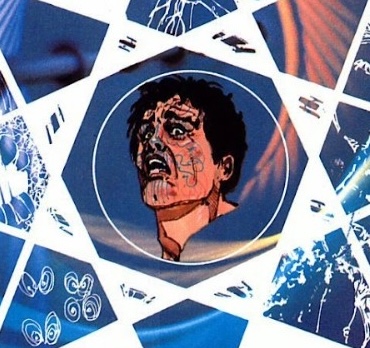
Case in point Alfred Bester’s The Stars My Destination by Byron Priess and Howard Chaykin. A graphic novel that often doesn’t feel like part of the comics medium. Sometimes it seems like a novel with the illustrations shoved to the side (like some Victorians tome). Sometimes it’s like an illustrated manuscript where the words are part of the image (like something out of William Blake). And sometimes, just sometimes, it has panels and pictorial juxtaposition of the type that makes Scott McCloud happy. Whatever category you would put it in, it seems out of place.
The Stars My Destination wasn’t the first, or last, of its ilk. Priess’ experiments with “illustrated fiction” are mostly of the noble failure variety. At a time when American comics conception of science fiction was still mostly stuck in the pulp of the 1930s and ’40s Priess gave his attention to the likes of Roger Zelzany, Harlan Ellison and Thedore Sturgeon — writers of considerable skill and daring (even if the daring often outweighed the skill). His Fiction Illustration initiative is notable, if nothing else, for producing one the very few completed Jim Steranko works, Chandler: Red Tide, and thus rarer than hen’s teeth. yet for all their ambition and the mighty talent involved almost none of Priess’ projects was actually, when you come down to it, “good.”
Red Tide looks pretty enough, but it is no more than a copy of a copy. Even if one were to consider it as a put-on, a wink and a nod meant to be taken in jest, it fails. It doesn’t pass muster as a Mickey Spillane wannabe, never mind Raymond Chandler. When the art is stripped from it, and it is quite easy to separate the art from the text in most Priess’ projects, is stands bare like a paperback even an airport book store wouldn’t touch. The same is true for the more high-minded science fiction adaptations. You would think that with the typewriter of Ellison at their back and the brushes of Tom Sutton, Ralph Reese and Jim Steranko (him again!) at the front The Illustrated Harlan Ellison would be a no-brainer when it is, instead, a “no brainer.” It just stands there, two halves that fail to come together, the art distracting from the writing and vice versa. Same is true with pretty much every other Priess’ project I tired. A noble failure is, after all, still a failure.
There is one exception. An exception so strong it makes all others worth it. One could a stumble a dozen times on a rickety stairway to heaven, but as long as one reaches their destination they would not complain too much. Alfred Bester’s The Stars My Destination works. It works in such a manner, and to such a degree, that would make the question, “Is it even a comics by any proper definition?” irrelevant. I would as soon let it go as cinema would let go of La Jetée. Or the world of comics to let go of The Far Side. Is the art not truly sequential? Is there not enough juxtaposition of imagery? Does the text stand by itself sheered of all visual accoutrements? Yes, yes and yes. None of this matters. No one else would take it, and so it is up to comics to embrace it warmly.
After all, it was published, after a lot of hiccups, in comics mainstay Heavy Metal and collected via Marvel’s Epic Comics imprint. It is drawn by Howard Chaykin, a comics artist par excellence who basically rolled up everything he knew into that tight package. It is written by Alfred Bester, whose history in comics is all-but forgotten2 but cannot be ignored. I suspect it is Bester’s early attempts at comics writing, even though they are now a footnote to his novels, that made The Stars my Destination such a success as an adaptation. His stories move, often in a breakneck pace that makes more sense if you think about twenty pages at a time. His imagery is strong and clear. Bester thinks and writes visually, but not to a degree where all he has to offer is plot. Instead, like the true greats of science fiction, he has the ability to make the impossible comprehensible with words alone. Even when the protagonist tumbles through space and time in far-out manner Bester can make the reader understand the physical operation of it all.
Re-reading through Alfred Bester’sThe Stars My Destination made me think of Jack Kirby. It has a pulp brain, it blasts you with one improbable idea after another (human teleportation, a radioactive man that fries technology around him, a bewitched albino lady who can only see in infra-red) with such ferocity that one doesn’t stop to think about it all. At the same time, it has the heart of a cosmic guru: it is a story about a man transcending, becoming something more. The closest thing would be either Kirby adapting 20013 or the “rising up through history” scene in From Hell. Yet Foyle’s ascendence in power and importance, the transformation of the everyman into the superman, is not a singular event. As the story reaches its climax Bester makes a choice, through Foyle, that feels singular. As powerful as it is naïve. When he learns the secret of the mysterious substance PyrE, an explosive of immense power that can be detonated simply by the power of thought, he does not keep for himself or hides it. Instead, he shares that knowledge with rest of humanity, giving everyone and anyone the power to destroy humanity.
A bad idea in the real world, a prisoner’s dilemma with a nuclear trigger, but it’s one of the greatest conclusions of science fiction history. After two hundred pages of betrayals, revenge, rape, assault, murder, torture, persecution, oppression, war … after every possible vice of humanity has been laid bare Bester chooses to believe that is not only his fictional creation that be better. That everyone can.
That is the novel. The graphic adaptation is such an odd beast that even while making the claim I find it hard to call it “comics,” changes little. The reason one struggles with what to call to it is how little it exorcises from the original text. I didn’t do a line-by-line comparison, but it seems at least 80% of Bester’s text survived directly. The changing is in the adding rather than of subtracting. Chaykin’s visual interpretation sits alongside the original lines. Yet our artist/co-creator does more than simply draw the text directly. He draws it emotionally, reaching into the heart and mind of Gully Foyle, the scum that becomes a savior, and gives us the world in flashes and beats, as he sees it. To do that Chaykin doesn’t limit himself to one style — if not for the name on the cover and some particular choices in the faces you wouldn’t guess it was him. He does “standard sci fi comics stuff,” but he also plays around with computer graphics, gives us a shot of impressionism and occasionally reaches towards a classicism that wouldn’t be out of place in the Tate. He does everything, as if trying to showcase all that he could do. This tendency has a danger of its own — a showcase for its own sake becomes not a story but a mere exercise — but the power of the text anchors Chaykin. Whatever else he does, he tells the story (in his own manner).
I don’t think there is a world in which this type of storytelling becomes the dominant mode of the graphic novel, or even a semi-recurring feature of the comics industry. A text that isn’t made for comics usually won’t fit (see the other attempts by Priess), and an attempt by a comics scribe would probably reveal their prose deficiencies 4. Best to take this adaptation of Alfred Betster’sThe Stars My Destination as what it is, like its protagonist, nothing and everything — “prepared to await the awakening.”
- What is a “graphic novel”? A question with as many answers as “what is comics”? I can only borrow a note from the United States judiciary by saying that, like pornography, I know it when I see it. Also, like pornography, some shame might be involved.
- With the possible exception of being the creator of the Green Lantern’s oath.
- Speaking of comics that have not been reprinted in ages that can at least lay claim for the title of “one of the best.”
- I’m looking at you Grant Morrison.
