


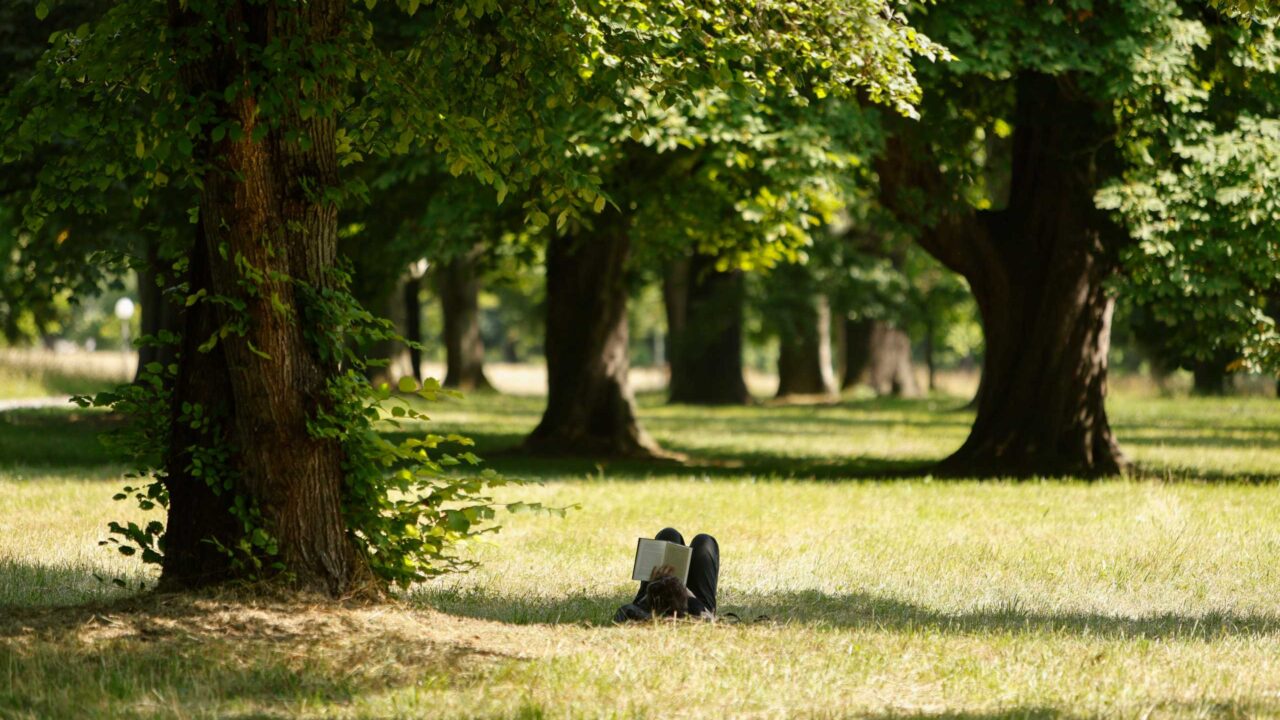
Summer is here, and with it ECFR’s entertainment list. As the year passes its midpoint, with headlines dominated by uncertainty, crises and conflict, it’s time to take a break. And with the Annual Council Meeting 2026 held in Vienna, a city which provided one of the biggest intellectual movements of the 20th century, this year’s entertainment list could hardly be anything but enlightening.
This year, our contributors’ choices take us to the US—but far beyond the newspaper headlines—to learn about the country’s people, their fights and their struggles. With Russia’s war in Ukraine showing no sign of abating, another recommendation for a book about the difficulty to survive provides insights about real life on the ground. We’ll take a quick stop in Alexandria to learn more about books, libraries and the written world, and jump forward in time to England’s Tudor court and what it meant to be powerful. Then our journey takes us to Nigeria’s civil war, where we explore themes of identity, displacement, trauma, love and the enduring legacy of colonialism.
Enjoy all of this and much more with the recommendations below. ECFR wishes its readers pleasant journeys and a restful summer.
“Half of a Yellow Sun”, by Chimamanda Ngozi Adichie
Nele Anders
Senior Advocacy Officer
“Half of a Yellow Sun” recounts the Nigerian Civil War (1967–1970), also known as the Biafran War, through the eyes of Ugwu, a village boy who comes to work for Odenigbo, a university professor. Alongside Odenigbo lives his partner, Olanna, who abandons her privileged life in Lagos to be with him; Olanna’s twin sister, Kainene, who takes over her parents’ business; and Kainene’s British lover, Richard. Through their intertwined lives, Adichie explores identity, displacement, trauma, love and the enduring legacy of colonialism with remarkable empathy, allowing the reader to immerse themselves in Nigerian and Biafran perspectives of the time. She creates deeply compelling characters who exist against the vivid backdrop of the social and political realities of 1960s Nigeria. By foregrounding voices that have long been marginalised in European narratives, Adichie demonstrates exceptional prose and storytelling.
“Beloved”, by Toni Morrison
Teresa Coratella@TaszuC on X
Deputy Head, Rome office
Policy Fellow
“Beloved” is inspired by the true story of Margaret Garner, an African-American slave who in 1856 escapes to the free state of Ohio. The book tells the story of escaped slave Sethe, her daughter Denver and a mysterious woman named Beloved. It covers multiple topics, including slavery, identity crisis, discrimination, the condition of female slaves, trauma and madness; “Beloved” mixes history, fiction and the supernatural. Morrison won the Pulitzer Prize for Fiction in 1988 for her novel, and the Nobel Prize in 1993 for her work.
Ozark, available on Netflix
Teresa Coratella@TaszuC on X
Deputy Head, Rome office
Policy Fellow
“Ozark”,an American crime thriller tv series with Jason Bateman, Julia Garner and Laura Linney (yes, the Laura Linney from Love Actually!) follows the story of the Byrde family, who move from Chicago to the Lake of the Ozarks region in Missouri. Family fights, strong women, weak men, strange people, plot twists, and beautiful and peaceful landscapes will keep you on the edge of your seat from beginning to end of this four season and 44-episode show.
“My Life on the Road”, by Gloria Steinem
Mireia Faro Sarrats@Mireiafaro.bsky.social on Bluesky
Communications Officer
“My Life on the Road”, by Gloria Steinem, is a splendid biography of the author’s life as a writer, reporter and activist. This book is a compilation of the stories she learned on the road while growing up—and afterwards, throughout the rest of her life.
Here she describes her campaign trail: from Bobby Kennedy to Hillary Clinton, her early experience with social activism in India, of organising ground-up movements in the US and listening to people whose voices, ideas and values would inspire change and revolution. This book has some of everything: it is shocking, it is funny and it is inspiring.
“My Life on the Road” is a great book for anyone who wants to understand the people behind the headlines. As Steinem points out, focus on country capitals often overshadow the lives of ordinary people and paint a distorted picture of a country. But through her travels, she shows how the true character of a place is found on its streets and roads.
“The Odyssey”, attributed to Homer (translated by Emily Wilson)
With Christopher Nolan’s big-screen version of “Odyssey” hitting cinemas in mid-July, there is no better moment to revisit Emily Wilson’s translation, which deserves a place on any reading list. The story—a man’s 20-year journey home from war—is well known, but Wilson’s rendering lays bare the flaws in both its hero and his household. Odysseus, for all his cunning, loses all his men during his voyage back to Ithaca and, once home, dispatches every one of Penelope’s suitors in a scene of slaughter that is excessive and genuinely uncomfortable to read. His son Telemachus, meanwhile, spends much of the poem sulking, more petulant adolescent than budding king.
Wilson does not sand down these rough edges, nor does she soften the poem’s darker vocabulary: where earlier translators reached for “servants”, she writes “slaves”, restoring an uncomfortable truth that previous polite translations had smoothed away. The effect is a text that feels more modern and raw; with heroes who are flawed, and their misfortunes partly the result of their own natures. Those wanting more should turn to the film “The Return” (2024), Ralph Fiennes’s stripped-back 2024 take on Odysseus’s homecoming.
“Endling”, by Maria Reva
Lena Krause
Programme assistant, Africa programme
“Endling”, by Maria Reva, is a witty, powerful novel about three women whose lives intersect through Ukraine’s booming marriage industry. What begins as a search for a missing mother and a fight to protect a rare species soon becomes an unforgettable road trip across a country on the brink of Russia’s full-scale invasion. Blending dark humour with emotional depth, Reva explores gender, survival and resilience in a story that lingers long after the final page.
“Bundyville”, a podcast by NPR
Nevada Joan Lee@nevadajoan on X
Policy Fellow
Like most folk, I have an outsized love for my hometown community and, as a result, an exaggerated view of its historical importance. Thus, I believe that an armed standoff between a libertarian Mormon ranching family and the federal government outside of Las Vegas in 2014 was a precursor to the Trumpian years that followed—and thereby I recommend my favourite podcast.
Structured like a true-crime series, “Bundyville” follows the Bundy family of Bunkerville, Nevada, through interviews with people at the centre of their fight with the federal government over cattle-grazing rights. Compared to January 6th 2021 and the right-wing unrest that followed, the conflict looks almost quaint; but it reveals just how deep American distrust of the government runs, and how far people will go in the name of “freedom”.
“Salvage the Bones”, by Jesmyn Ward
Ana Martínez Sillero
Communications Intern
If you’re looking for a light summer read, this is not it. “Salvage the Bones” begins like a coming-of-age novel as 14-year-old Esch discovers love, desire and her changing body, all during a long Mississippi summer. But she is also growing up in a world shaped by poverty, neglect and misogyny, where the consequences of her choices fall far more heavily on her than on the boys around her. Hurricane Katrina approaches, but it is only one of the many forces threatening her family. Over 12 days, the novel paints a devastating portrait of those living on the margins, abandoned by the systems meant to protect them. This novel describes the quiet resilience of people forced to survive with almost nothing. It is a powerful reminder that disasters are never equal, and that for some, the storm began long before Katrina made landfall.
“Papyrus: The Invention of Books in the Ancient World”, by Irene Vallejo
Irene Olombrada
Office Coordinator
“Papyrus”, by Irene Vallejo, is a captivating journey through the history of books, libraries and the written word in the ancient world. From Egyptian papyrus scrolls and the legendary Library of Alexandria, to the rise of the codex, Vallejo traces how books shaped civilisations and preserved human knowledge. Blending history, mythology, literature and personal reflection, she introduces a vibrant cast of emperors, librarians, scholars, poets and rebels whose lives were intertwined with the power of words. Along the way, she explores enduring themes such as education, censorship, identity and cultural memory. Both scholarly and accessible, Papyrus is a celebration of humanity’s enduring love of stories and a tribute to the books that have carried ideas across centuries.
“The Automobile Club of Egypt”, by Alaa Al Aswany
Daria Jankiel
Office and Programme Coordinator
Alaa Al Aswany’s “The Automobile Club of Egypt” is entertaining and easy to read: but it is above all a thought-provoking account of Cairo in the 1950s that blends history, politics, love and family drama. Through the lens of a corrupt British-run club, Al Aswany exposes the hypocrisy and class struggles of colonial Egypt. The novel’s multi-layered narrative follows a variety of characters—from the club’s elitist members to its marginalised Egyptian employees—each grappling with power, identity and resistance. The book explores themes of power, justice, loyalty and social change, while Al Aswany’s storytelling blends satire, social critique, sharp dialogue and vivid descriptions to make it the perfect summer read.
“Wolf Hall”, by Hilary Mantel
Amy Sandys@_amyms on X
Editorial assistant
There’s a reason everybody likes the Tudors. The dynasty, which began with Henry VII becoming king in 1485 and ended with the death of Queen Elizabeth I in 1603, was so embedded in rivalry, passion and intrigue that it has long provided rich material for all manner of cultural outlets. But perhaps no one captured the emotion behind the machinations of the Tudor court quite like the late Hilary Mantel. “Wolf Hall” is the first in her trilogy of novels which imagine the consolidation of power and eventual fall from grace of Thomas Cromwell, the son of a blacksmith who rose from obscure beginnings to become one of Henry VIII’s most trusted advisers. While “Wolf Hall” is a hefty book, with the paperback clocking in at 672 pages, it is nothing less than a page-turner; the plot, with its twists and turns, is aided by Mantel’s gift for writing as if she were alongside Cromwell at court. For anyone who wants to remember why the Tudors remain so fascinating—or who is discovering their story for the first time—”Wolf Hall” is one of the best places to begin.
“Empire of Pain: The Secret History of the Sackler Dynasty”, by Patrick Radden Keefe
Elsa Scholz
Programme Coordinator, Middle East and North Africa programme
“Empire of Pain” is about three generations of the Sackler family. As the owners of the pharmaceutical company behind OxyContin, they are renowned for their philanthropy—but notorious for the role they have played in the US opioid crisis. This book is a gripping story about greed, impunity, justice and the importance of investigative journalism.
I also recommend, as an accompaniment, the book “Demon Copperhead” by Barbara Kingsolver. Where Keefe does not let the reader forget that his book is non-fiction, Kingsolver makes them feel the impact and human cost of the opioid crisis.
“The Power of the Powerless”, an essay by Václav Havel
Mark Carney’s speech at Davos brought renewed attention and relevance to Havel’s 1978 essay, in which he analyses how the communist regime in Czechoslovakia functioned and sustained itself for decades. In his essay, Havel describes dissidence as a form of opposition that brings together thinkers from conservative circles, liberals and radical leftists, with Havel serving as a central and unifying figure. The core of the movement—and its power—lies in its non-negotiable demand to live in truth and in the parallel society of dissidents who shared this worldview. This is exactly what Havel brings to today’s world of unorder: reject conformity and the ruthlessness dictated by others, stand for truth, and engage with those who share this bare-minimum vision and values.
The European Council on Foreign Relations does not take collective positions. ECFR publications only represent the views of their individual authors.
Author
Mireia Faro Sarrats@Mireiafaro.bsky.social on Bluesky
Communications Officer
