

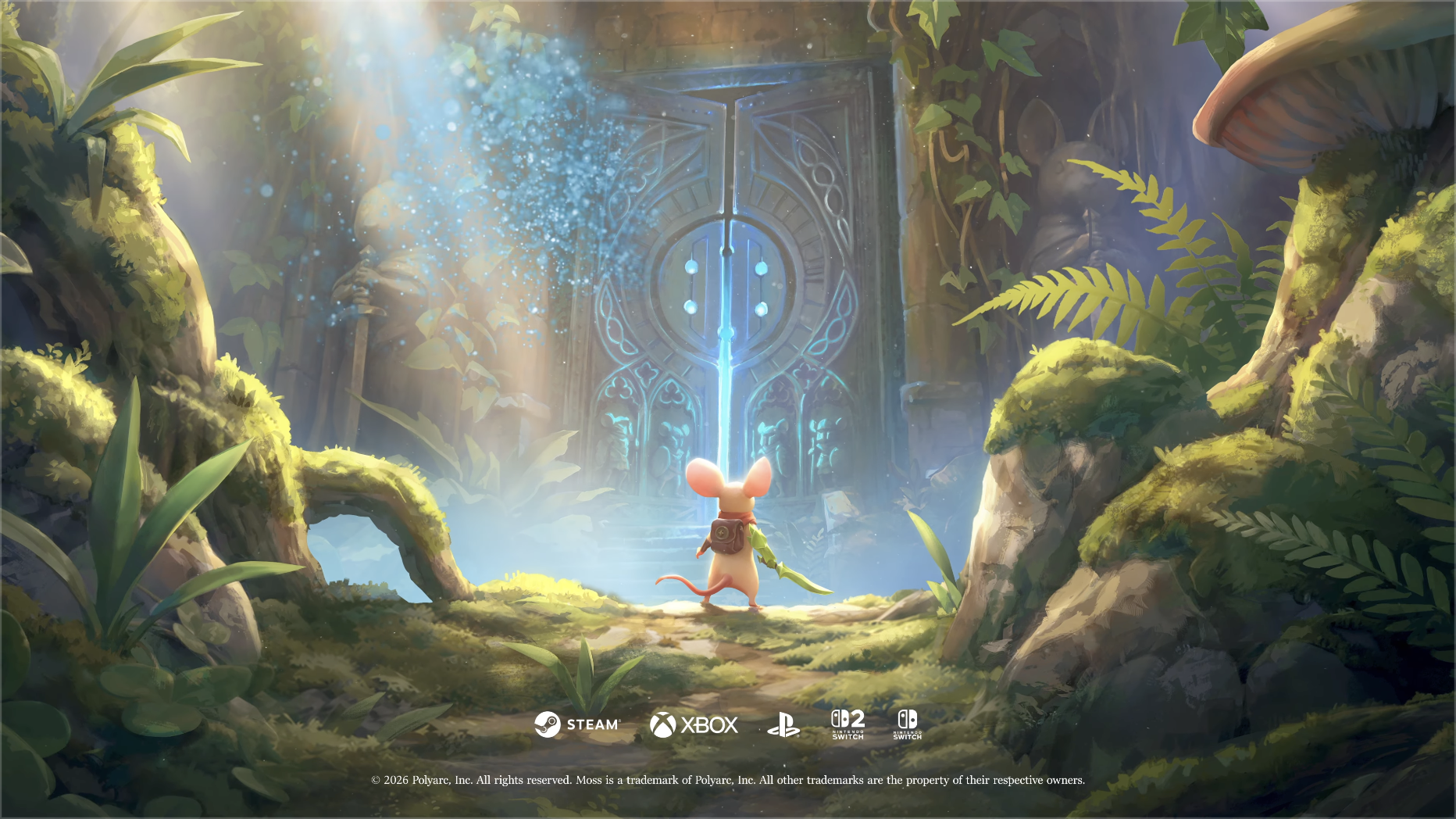
Moss: The Forgotten Relic launched today across Nintendo Switch 2, Nintendo Switch, PlayStation 5, Xbox Series X|S, Xbox One, and Steam — ending eight years as a VR exclusive and making Quill the mouse accessible to the broadest audience the franchise has ever reached, no headset required. Polyarc’s launch announcement confirms all platforms went live simultaneously on July 16, 2026.
The release carries more weight than a typical port. Polyarc, the Seattle studio behind both Moss games, laid off approximately 30 employees — roughly two-thirds of its staff — in late March 2026, after a major unannounced project lost funding amid Meta’s pullback from VR game development and a broader collapse affecting studios across the VR ecosystem. The Forgotten Relic was built by a significantly downsized team and represents the studio’s first commercial release outside virtual reality. It is as much a survival story as it is a product launch.
The timing is not incidental. 2026 has seen nDreams close two studios, Rec Room announce shutdown, Cloudhead Games cut staff by 70%, and Meta’s own internal VR game studios — including Twisted Pixel, Sanzaru, and Armature — shuttered or reduced, as UploadVR’s industry crisis coverage documented in detail. Polyarc’s decision to bring Quill to flat screens is the most visible example yet of a VR-native studio betting its future on an audience it couldn’t previously reach.
What Comes in the Package
The Forgotten Relic bundles the complete Moss (originally released February 2018 on PlayStation VR) and Moss: Book II (2022) together with all Twilight Garden DLC content — the full arc of Quill’s story in a single purchase. Polyarc’s launch announcement confirms the originals earned more than 160 awards and nominations between them, including Best VR/AR Game at The Game Awards 2022 for Book II — two complete, critically acclaimed games for less than the cost of most standard releases this cycle.
The price is $19.99 across all platforms, confirmed by Polyarc’s pricing announcement on July 2, 2026. The compilation also includes newly handcrafted cutscenes and a Skip Combat accessibility option, which allows players to bypass combat encounters and focus entirely on exploration and puzzle-solving — a feature built specifically for the flat-screen release, as noted in GameGrin’s price confirmation.
How Does a VR Camera Work Without a Headset?
The central engineering problem Polyarc had to solve was not the control scheme — it was the camera.
In the VR originals, the player (called the Reader) contributed camera work simply by existing in the space: leaning in to look around corners, physically moving to frame the diorama. The headset’s head tracking handled all of this transparently. Remove the headset and that camera system disappears entirely.
Polyarc’s solution is the Smart Follow Camera: a scripted, dynamically repositioning camera system that reads Quill’s position and movement and continuously repositions to keep her and the relevant puzzle space legible and cinematic, as AllKeyShop’s release coverage details. The camera cannot be manually adjusted by the player — both analog sticks are already committed to the game’s dual-control setup.
That dual-control setup, which Polyarc calls “Twofold,” is the other key mechanical translation from VR. The left stick controls Quill directly — movement, combat, platforming. The right stick controls the Reader’s cursor, the in-world pointer that manipulates objects in the environment, activates switches, and interacts with puzzle elements, according to TheGamer’s launch review. In the VR originals, that Reader-layer of interaction was handled by motion controllers and physical hand movement. On a standard controller, it maps to the right stick and right trigger. On Switch 2 in handheld mode, it also supports direct touch-screen input.
The result is functional — but imperfect. Nintendo World Report reviewer John Rairdin, writing before launch embargo lifted on July 14, gave the Switch 2 version 7.5 out of 10 and described the scripted camera as producing angles that were “not especially good,” sometimes making it “impossible to judge platform positions” and causing spatial disorientation when revisiting areas, in his Switch 2 review. He noted that gyro support — available on both Switch hardware options — could have provided a partial corrective without consuming additional stick input, but was not implemented.
How Critics Scored It
Seventeen publications weighed in ahead of launch. On OpenCritic, The Forgotten Relic holds an 80 out of 100 average, earns a “Strong” rating, and is recommended by 94% of critics — placing it in the top 17% of games by overall score.
Among the highlighted scores: IGN awarded 8 out of 10, calling the game “an incredibly charming fairy tale” and noting the flat-screen adaptation does not feel compromised by breaking free of its VR-exclusive origins, aside from minor camera and one bug issue. ZTGD scored it 9 out of 10. Nintendo World Report landed at 7.5 out of 10, citing camera limitations as the primary friction point. TechRaptor awarded 7 out of 10, noting the first half of the experience felt slower but that things picked up.
The recurring theme across reviews: the VR-to-flat translation preserves the franchise’s emotional core — Quill’s expressiveness, the diorama-scale environments, the storybook narration from Morla Gorrondona — while losing some of the felt presence that made the originals distinctive. TheGamer’s George Foster, who scored it 4 out of 5, summarized the consensus: Quill’s adventure “absolutely manages to stand on its own two paws as a slightly more traditional puzzle platformer,” even if a little of the personal magic tied to VR presence is gone.
What Platform to Play On
For players on the fence about which version to buy: performance is solid across the board. The Switch 2 version runs at 60 frames per second in both docked and handheld modes with fast area loading times. The Steam version is Verified for Steam Deck, with Steam Deck HQ’s performance review noting typical play runs at 70–80 FPS and a capped 60 FPS setting is recommended for stable performance; only the opening sequences of Book I see occasional dips
Total playtime, according to Steam Deck HQ’s playthrough without full collectibles, runs approximately seven hours for both books combined. Completionists targeting all collectibles will add time. At $19.99, that calculates to under $3 per hour of playtime even at the baseline — a favorable ratio for the genre.
The game also ships with full localized voice acting in English, French, German, Japanese, Simplified Chinese, and Traditional Chinese, with additional text localization in Spanish, Italian, Korean, and Brazilian Portuguese, per Polyarc’s official FAQ.
What This Release Means for VR-to-Flat Adaptations
The Moss franchise presents a particularly challenging test case for VR-to-flat adaptation. Unlike room-scale shooters or first-person experiences that translate more cleanly to standard screens, Moss was built around a design idea — physical presence in a miniaturized space — that headsets enabled at a fundamental level. If any franchise was going to lose something essential in the translation, it was this one.
What Polyarc’s result shows is that the emotional core of a VR game can survive the move to flat screens when the underlying game design is built around a controllable character rather than the player’s physical body. The Twofold mechanic — controlling both Quill and a spatial cursor simultaneously — translates because it was always a controller-adjacent design. The diorama framing survives because the player was always looking down into it from outside, not standing inside it. The camera system is the clearest point of friction, and the reviews reflect that honestly: this is a 7.5-to-9 game depending largely on how much camera scripting bothers a given player.
For the industry, this matters beyond the single title. Polyarc emerged from the VR crisis with a credible flat-screen debut, even after losing most of its staff. If The Forgotten Relic performs commercially, it demonstrates a path for VR-native IP to reach mainstream audiences — one that other downsized VR studios may need to follow.
The full game is now available on Steam.
Frequently Asked Questions
Does Moss: The Forgotten Relic require a VR headset?
No. This is the explicit purpose of the release: The Forgotten Relic is the first time either Moss or Moss: Book II has been playable without a VR headset. It is a full flat-screen adaptation — not a separate VR mode with an optional standard-screen mode. The game is designed from the ground up for traditional controllers and screens.
What specifically changed from the VR originals to make this work on flat screens?
Three major things. First, the camera: in VR, players physically moved their heads to look around the diorama environments; The Forgotten Relic replaces that with the Smart Follow Camera, a scripted dynamic system that repositions automatically. Second, the Reader interaction layer: motion-controller hand movement now maps to the right analog stick and trigger, or touch screen in Switch 2 handheld mode. Third, the package adds new handcrafted cutscenes and a Skip Combat accessibility option not present in the VR originals. The control architecture otherwise retains the dual-input “Twofold” design — left stick for Quill, right stick for the Reader cursor.
Is Moss: The Forgotten Relic worth buying if you’ve already played the VR versions?
Reviewers who addressed this question directly were less enthusiastic about a second purchase. The absence of physical VR presence — the felt sense of being in the diorama space — is the irreducible difference, and no camera system fully replicates it. Steam Deck HQ noted the game might be a hard sell for players returning from VR. For players who haven’t experienced the series, the answer was consistently yes: two complete critically acclaimed games, a full orchestral score by two-time BAFTA winner Jason Graves, and one of the most distinctive protagonists in independent gaming, for $19.99.
Why is Polyarc releasing a flat-screen version now, after 8 years as a VR-only studio?
The business context: Polyarc laid off approximately 30 employees — two-thirds of its staff — in late March 2026, after failing to secure funding following the cancellation of a major unannounced project. The timing coincided with widespread VR industry contraction, including Meta closing multiple internal game studios and pulling funding from external projects. The Forgotten Relic, co-developed with Blackbird Interactive, was built with the studio’s remaining team as both a commercially necessary pivot and a genuine expansion of the franchise to an audience that couldn’t previously access it, as documented by Road to VR and GeekWire’s studio report.
ⓒ 2026 TECHTIMES.com All rights reserved. Do not reproduce without permission.
