

Why GameStop’s legal saga matters for shareholders
GameStop (GME) is back in focus after a stockholder class action over executive options and share authorization was resolved in Delaware, closing a short but intense chapter in the retailer’s governance story.
The complaint, filed in June 2026, aimed to block two votes at the July annual meeting that would have shaped Ryan Cohen’s incentive package and sharply increased authorized Class A shares to 2.5 billion. For investors, both topics touch directly on dilution risk and leadership pay.
Facing the challenge, the company supplemented its proxy materials and withdrew the CEO option proposal from the ballot. That adjustment removed the immediate flashpoint around a new performance-based nonqualified stock option award tied to Cohen.
Proposal 5, which covered the jump in authorized share count, still went to a vote. Stockholders approved the amendment on July 7, 2026, giving GameStop more flexibility to issue equity in the future, whether for capital raising, acquisitions, or employee compensation plans.
The plaintiff then treated a key part of its case as resolved. After the revised proxy and the removal of Proposal 4, the stockholder withdrew its motion for a temporary restraining order, and the parties moved to wrap up the matter through a mootness fee arrangement.
GameStop agreed, without admitting wrongdoing, to pay US$3,500,000 in attorneys’ fees, expenses, and costs to plaintiff’s counsel. That payment is described as full satisfaction of claims for fees and related costs, turning the dispute into a closed chapter rather than a drawn-out courtroom battle.
On November 24, 2026, the Delaware Court of Chancery dismissed all claims with prejudice as to the plaintiff and without prejudice as to other potential class members. The judge did not evaluate or rule on the size or fairness of the mootness fee, which is often the case in such negotiated resolutions.
For you as a shareholder or potential investor, the takeaway is straightforward. The litigation over these specific proposals has ended, the share authorization increase is in place, and management retains added equity flexibility while avoiding the uncertainty of a prolonged legal fight.
Recent trading has reflected that shifting story. GameStop’s 30 day share price return of 8.71% and 90 day gain of 43.31% suggest momentum has been building, while the 1 year total shareholder return of 16.91% and 3 year total shareholder return of 74.18% show how prior surges are now feeding into a longer track record.
Fresh analyst coverage and a focus on trading cards and collectibles, now estimated at about 45% of revenue, have helped keep attention on the stock, even as the latest 1 day share price return of 2.34% declined against a broader market advance. Recent commentary on GameStop’s reduced store footprint, sizable net cash position of about US$2.5b, and CEO share purchases around US$119m has added another layer to the way investors weigh both upside potential and execution risk ahead of the next earnings report.
Compare GameStop’s post-lawsuit setup with other retailers showing strong balance sheets and momentum using the hand picked list of solid balance sheet and fundamentals (23 results)
GameStop’s latest run, backed by collectibles growth and a large net cash cushion, mixes real business change with a powerful shift in mood. How much of today’s price reflects each side of that story?
Most Popular Narrative: 2% Overvalued
GameStop last closed at $26.34, slightly above the $25.85 fair value set out in the most followed narrative. This gap is small enough that execution around the next earnings print matters more than the headline valuation label. According to DanielOliveira, an investor in the Simply Wall St Community, the key question is how collectibles and the slimmer store base shape that upcoming quarter.
The gap to consensus is collectibles. They grew 65% in Q1 and 57% in Q2, to $356.3 million, or 45.1% of sales. In fiscal 2025, Q3 collectibles came in 17% above the first-half average, and in fiscal 2024 24% above it. I use 13% because growth is slowing, which gives $382 million, up 49%. Video games and pre-owned I put 4.5% under their first-half average, at $384 million, after 727 US store closures last year. If collectibles repeat last year’s 17% step, revenue lands near $778 million and the miss disappears.
See why 1 investors see GameStop as 2% overvalued.
Result: Fair Value of $25.85 (OVERVALUED)
Still, the narrative can unravel if collectibles growth cools faster than expected or if the company makes aggressive use of that larger share authorization for future equity issuance.
Find out about the key risks to this GameStop narrative.
Another View on GameStop’s valuation
The community narrative pegs GameStop as 2% overvalued at $26.34 versus a $25.85 fair value. Our DCF model tells a different story. It puts future cash flows at $27.63 per share, which implies the stock trades about 4.7% below that estimate. Which signal do you treat as more important right now?
That difference comes from method, not magic, and it highlights how sensitive any single fair value is to the inputs sitting behind it. Look into how the SWS DCF model arrives at its fair value.
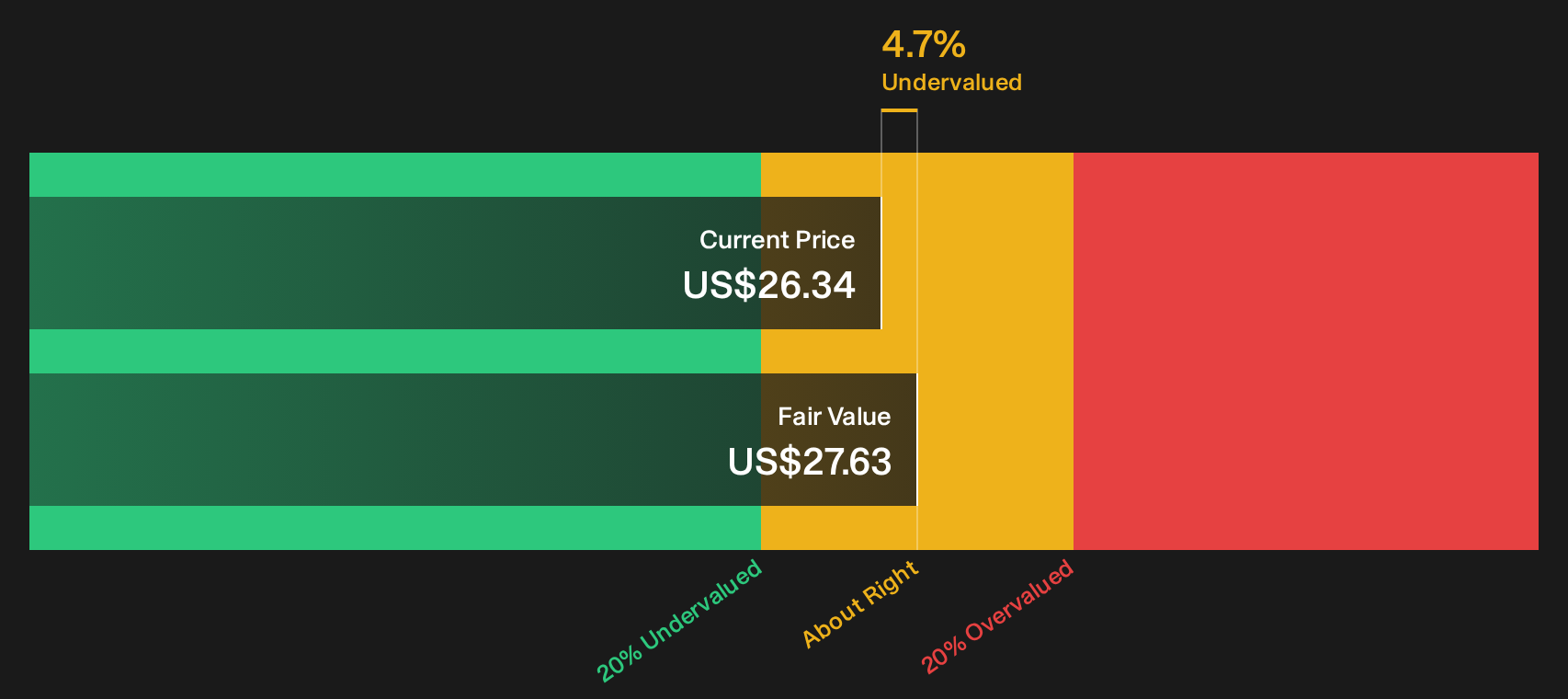
Simply Wall St performs a discounted cash flow (DCF) on every stock in the world every day (check out GameStop for example). We show the entire calculation in full. You can track the result in your watchlist or portfolio and be alerted when this changes, or use our stock screener to discover 33 high quality undervalued stocks. If you save a screener we even alert you when new companies match – so you never miss a potential opportunity.
Next Steps
Mixed signals on GameStop’s story so far. Act while the data is fresh, review the upside and downside drivers, and weigh the full picture through 2 key rewards and 1 important warning sign
Looking for more investment ideas beyond GameStop?
If GameStop has you thinking differently about risk, reward, and timing, do not stop here. Fresh ideas often come from comparing a few very different setups.
- Explore resilient potential by scanning companies with sturdy finances and clean balance sheets through the list of solid balance sheet and fundamentals (23 results).
- Look for mispriced opportunities where quality might outweigh pessimism by running the 33 high quality undervalued stocks.
- Build a watchlist of quieter potential compounders that fewer investors are talking about with the 21 high quality undiscovered gems.
Have feedback on this article? Concerned about the content? Get in touch with us directly.Alternatively, email editorial-team@simplywallst.com
Weekly Picks
RTRTRockeTelleron Modern Mining Technology·14 days ago
Modern Mining Technology: Turning Yesterday’s AI & Tech Trash Into Money
Fair Value:US$19.1384.5% undervalued
12followersusers have followed this narrative
·0commentsusers have commented on this narrative
·2likesusers have liked this narrative
WA

Wavefareron Accenture·5 months ago
High-quality global services company facing an AI-driven valuation reset.
Fair Value:US$30119.7% undervalued
30followersusers have followed this narrative
·1commentusers have commented on this narrative
·8likesusers have liked this narrative
JO

John_Ericon Veeva Systems·3 months ago
AI-Powered Veeva Systems Poised for Solid Growth Amid Regulatory Stability
Fair Value:US$383.1429.1% undervalued
56followersusers have followed this narrative
·0commentsusers have commented on this narrative
·6likesusers have liked this narrative
IN

Investingwillyon Mastercard·5 months ago
Mastercard: The Best Dividend Stock You’re Ignoring
Fair Value:US$75011.1% undervalued
164followersusers have followed this narrative
·1commentusers have commented on this narrative
·11likesusers have liked this narrative
Open the full report
Valuation, forecasts, financial health, risks and every Narrative on GME.
Mitch Lawler
Mitchell Lawler is a Senior Investment Editor at Simply Wall St, where he oversees Market Insights and the platform’s published editorial content. He also leads The Foxhole, a daily forum for contrarian investment ideas and constructive debate, drawing on nearly a decade of personal investing experience and more than five years in professional equity research and financial publishing.
