

Extended Reality (XR) Market Size, Key Companies, Company Market Share, User Adoption, Technology Deployment, Revenue Growth, Competitive Positioning, and Demand Forecast
ICT industry specialist Gautam Mahajan estimates the extended reality (XR) market at USD 50.79 billion in 2026, with continued technology adoption expected to take the market to USD 293.05 billion by 2035 at a CAGR of 21.50%. Leading extended reality (XR) market providers such as Meta, EssilorLuxottica, Apple are expanding their capabilities across segments including component, technology, end use and region.


Revenue,
2025
USD 41.80 Bn

Forecast Year,
2035
USD 293.05 Bn

CAGR,
2026 – 2035
21.50%

Key Takeaways
- Market size in 2025: USD 41.80 billion
- Estimated market size in 2026: USD 50.79 billion
- Projected market size by 2035: USD 293.05 billion
- CAGR (2026-2035): 21.50%
- North America led the market in 2025 with a 38.40% share, worth USD 16.05 billion.
- Asia Pacific held 30.60% of the market, worth USD 12.79 billion, in 2025. It is expected to be the fastest-growing region, with a CAGR of 23.00% from 2025 to 2035.
- Europe accounted for 22.80% of the market, worth USD 9.53 billion, in 2025.
- By component, Hardware held a 44.60% share, worth USD 18.64 billion, in 2025.
- By technology, Virtual Reality led with a 46.80% share, worth USD 19.56 billion, in 2025.
- By end use, Gaming & Entertainment held the largest share at 36.40%, worth USD 15.22 billion, in 2025.
Extended Reality (XR) Market Size and Forecast, 2025-2035 (USD Billion)
Note: 2025 is the base year; 2026-2035 values are forecasts.
database and Precedence Research analysts
The extended reality (XR) market is expected to grow from USD 41.80 billion in 2025 to USD 293.05 billion by 2035. This growth is mainly supported by the rising use of AI smart glasses, mixed reality headsets and enterprise XR solutions.
AI smart glasses are making XR technology more common by bringing digital features into everyday eyewear. Mixed reality headsets are being used for gaming, entertainment and work. Businesses are also adopting XR for employee training, product design and remote assistance.
The growing availability of display-equipped smart glasses, new technology platforms and better content is expected to attract more users. These developments are projected to take the market to USD 110.68 billion by 2030 and support a CAGR of 21.50% from 2026 to 2035.
- Analyst View: We prepared the market estimate by calculating XR device shipments across different product types and regions and multiplying them by their average selling prices. We also included spending on software, content, enterprise XR solutions and services. The estimates are based on the adoption of XR technology by consumers and businesses.
Device shipment estimates consider new headset and smart glasses launches, along with product replacement cycles. Enterprise spending estimates cover the use of XR in training, design and field services.
We also compared the total market estimate with the XR-related revenue of major device manufacturers, chip suppliers and software companies. Published market estimates vary widely, and some are much higher than what actual device and software revenues appear to support. For this reason, we selected a base-year estimate that is higher than the highest credible comparable figure.
The expected growth reflects strong demand for smart glasses and enterprise XR solutions. However, the forecast also considers weaker VR headset sales and the high cost of advanced devices.
Market Trends
- AI-powered smart glasses are supporting device market growth.
- Display-equipped glasses are becoming available at prices closer to mainstream products.
- Android XR is creating new opportunities for the XR market.
- VR headsets are adding more mixed reality features.
- Businesses are expanding their use of XR for employee training.
- Lighter optics and waveguide technology are making XR devices more comfortable to wear.
Drivers, Restraints and Opportunities
Driver
AI assistants are making smart glasses more useful in everyday life. Mixed reality headsets are improving with better displays and passthrough features. Businesses are using XR to reduce training and design costs. New technology platforms are attracting more developers. Component costs are also expected to decrease over time.
Restraint
Demand for VR headsets has become weaker. Premium XR devices are expensive, while comfort, battery life and social acceptance remain important concerns. Content options outside gaming are still limited. Camera-equipped smart glasses also raise privacy concerns.
Opportunity
Display-equipped smart glasses could replace some everyday smartphone activities. Healthcare, defense and industrial training offer new business opportunities. Spatial computing for workplace productivity is also developing. Education could benefit from wider XR use as devices become more affordable. Asian markets also offer strong potential for consumer adoption.
Extended Reality (XR) Market by Component 2025 Share
Note: 2025 is the base year.
database and Precedence Research analysts
Hardware held the largest share of the extended reality market in 2025, accounting for 44.60% or USD 18.64 billion. This is because headsets, smart glasses, processors, displays and optical components make up the largest part of XR spending.
Software and content accounted for 31.20%, worth USD 13.04 billion. This category includes games, media, software platforms and enterprise applications. Services held the remaining 24.20%, worth USD 10.12 billion. These services include XR development, system integration and managed XR programmes.
Extended Reality (XR) Market by Technology 2025 Share & Size
| Segments | 2025 Share | 2025 Market Value |
| Virtual Reality | 46.80% | USD 19.56 billion |
| Augmented Reality | 33.60% | USD 14.04 billion |
| Mixed Reality | 19.60% | USD 8.19 billion |
Note: 2025 is the base year.
database and Precedence Research analysts
Virtual reality held the largest technology share in 2025, accounting for 46.80% or USD 19.56 billion. This was mainly due to the large installed base of VR headsets and the wide range of games and training simulations available for these devices.
Augmented reality accounted for 33.60%, worth USD 14.04 billion. It is the fastest-growing technology segment as more people begin using AI smart glasses and display-equipped glasses.
Mixed reality held a 19.60% share, worth USD 8.19 billion, in 2025.
Extended Reality (XR) Market by End Use 2025 Share
Note: 2025 is the base year.
database and Precedence Research analysts
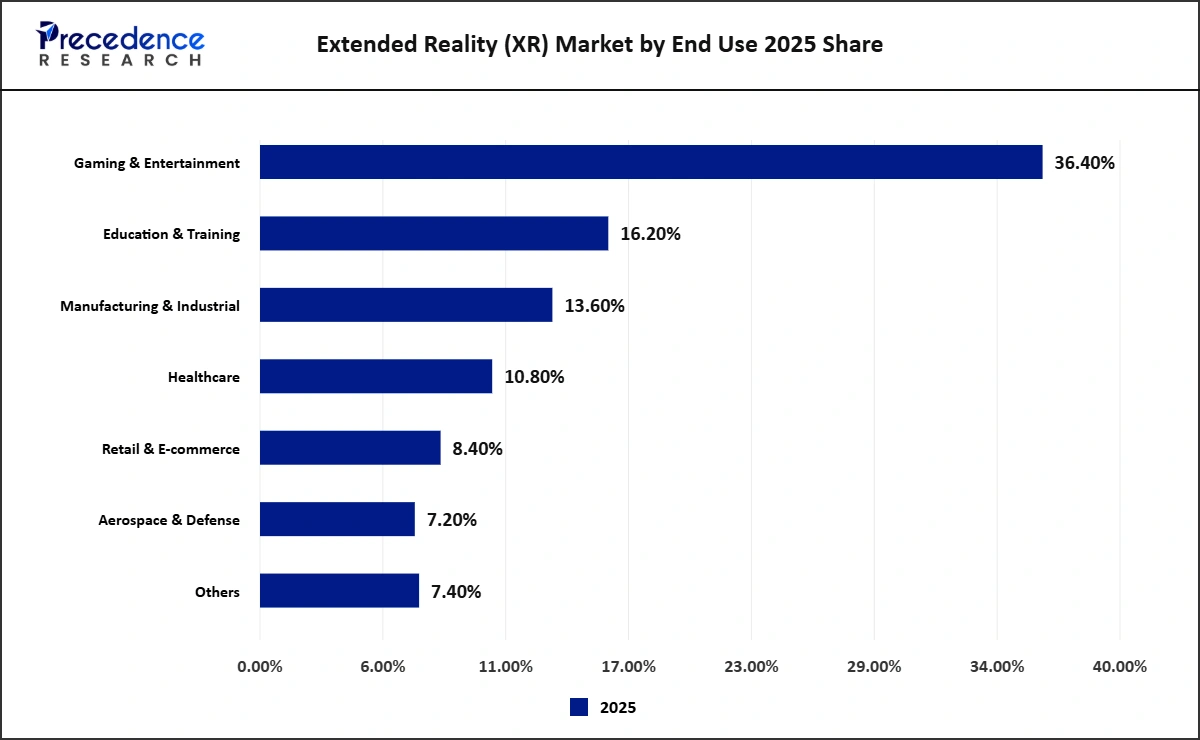
Gaming and entertainment held the largest end-use share in 2025, accounting for 36.40% or USD 15.22 billion. Consumer headsets are mainly used for gaming, fitness, video viewing and social experiences.
Education and training accounted for 16.20%, worth USD 6.77 billion. Manufacturing and industrial applications held 13.60%, worth USD 5.68 billion. Healthcare accounted for 10.80%, worth USD 4.51 billion. Retail and e-commerce held 8.40%, worth USD 3.51 billion. Aerospace and defense accounted for 7.20%, worth USD 3.01 billion, while other uses made up 7.40%, worth USD 3.09 billion.
- Analyst View: We calculated the value of each segment by matching device shipments, selling prices and software and service spending with different components, technologies and end-use industries. We used company disclosures and adoption data to support these estimates.
Hardware, VR and gaming currently lead the market because of the large number of consumer headsets already in use. However, we expect augmented reality, smart glasses and enterprise applications to account for a larger share of the market over time.
Regional Analysis
Extended Reality (XR) Market by Region 2025 Share
Note: 2025 is the base year.
database and Precedence Research analysts
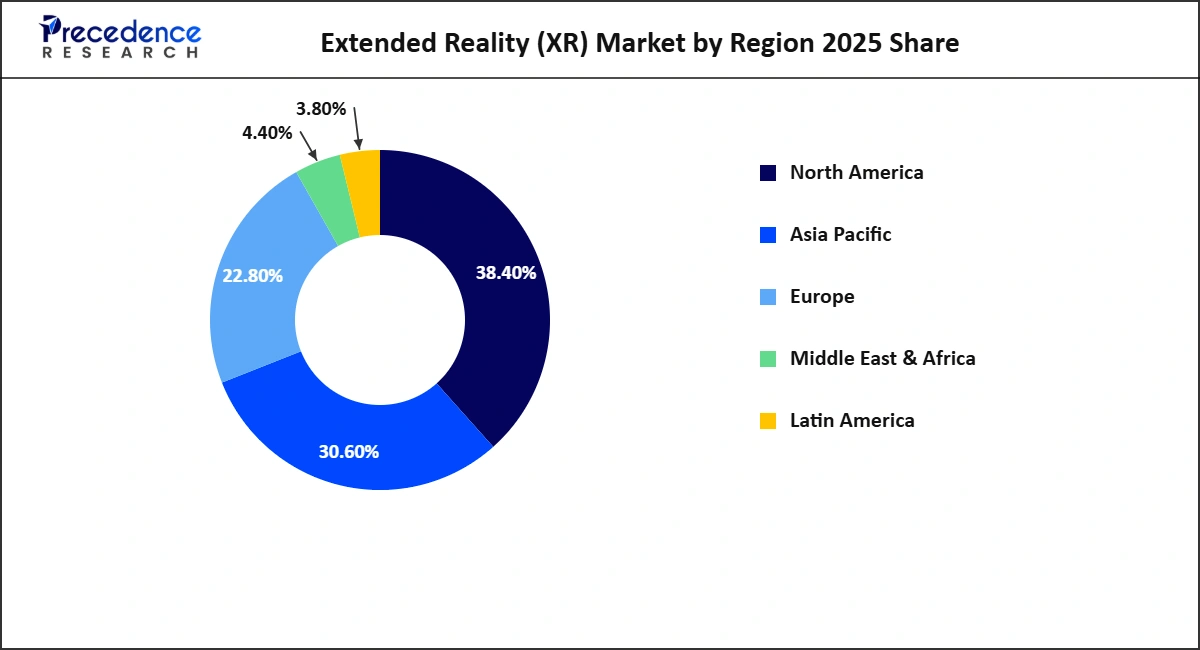
North America held the largest share of the extended reality market in 2025, accounting for 38.40% or USD 16.05 billion. Its position is supported by major companies such as Meta, Apple, Microsoft, Qualcomm and Google. Strong consumer demand for gaming and the use of XR in enterprise and defense training also support the region.
Asia Pacific accounted for 30.60% of the market, worth USD 12.79 billion. It is expected to be the fastest-growing region. This growth is supported by Chinese smart glasses companies such as Xiaomi, XREAL and RayNeo, Samsung’s Galaxy XR in South Korea and the strong device manufacturing base across the region.
Europeheld a 22.80% share, worth USD 9.53 billion. Its market is supported by the growing use of XR in manufacturing and automotive industries, along with EssilorLuxottica’s smart eyewear business.
The Middle East and Africa accounted for 4.40% of the market, worth USD 1.84 billion. Latin America held a 3.80% share, worth USD 1.59 billion. Both regions are seeing growth through entertainment venues and enterprise training applications.
North America accounted for 38.40% of the market, worth USD 16.05 billion, in 2025. Meta is a leading company in consumer headsets and smart glasses, while Apple Vision Pro focuses on the premium spatial computing market.
Asia Pacific held a 30.60% share, worth USD 12.79 billion, in 2025 and is expected to grow faster than other regions. Chinese brands are quickly introducing AI and display-equipped glasses. Samsung also launched Galaxy XR in October 2025.
Europe accounted for 22.80% of the market, worth USD 9.53 billion, in 2025. Automotive and industrial companies are using XR for product design and employee training. EssilorLuxottica also manufactures Ray-Ban Meta and Oakley Meta glasses.
The Middle East and Africa held a 4.40% share, worth USD 1.84 billion, in 2025. Entertainment and tourism projects in Gulf countries are creating demand for immersive experiences.
Latin America accounted for 3.80% of the market, worth USD 1.59 billion, in 2025. Gaming and education are supporting early XR adoption in countries such as Brazil and Mexico.
Analyst View: We calculated regional market shares using device shipments, selling prices and software and service spending in each region. North America leads because it has major XR platform companies and strong consumer demand. We expect Asia Pacific to record the highest growth because smart glasses launches and XR device manufacturing are expanding quickly across the region.
Competitive Landscape
Top 10 Companies in the Extended Reality (XR) Market, 2025
| Rank | Company Name | Market-Specific Revenue (USD Billion) | 2025 Share | Key Products / Business | Headquarters |
| 1 | Meta | 2.30 | 5.50% | Quest headsets and Meta AI glasses | United States |
| 2 | EssilorLuxottica | 1.60 | 3.83% | Ray-Ban Meta and Oakley Meta smart glasses | France |
| 3 | Apple | 0.90 | 2.15% | Apple Vision Pro | United States |
| 4 | Qualcomm | 0.80 | 1.91% | Snapdragon XR and AR platforms | United States |
| 5 | Microsoft | 0.40 | 0.96% | Mixed reality software and enterprise XR | United States |
| 6 | Sony | 0.35 | 0.84% | PlayStation VR2 | Japan |
| 7 | ByteDance (Pico) | 0.30 | 0.72% | Pico VR headsets | China |
| 8 | Samsung Electronics | 0.30 | 0.72% | Galaxy XR headset | South Korea |
| 9 | Xiaomi | 0.25 | 0.60% | AI smart glasses | China |
| 10 | XREAL | 0.20 | 0.48% | AR display glasses | China |
Note: Company revenues and shares are 2025 estimates.
ces, Precedence Research database and Precedence Research analysts
Meta led the extended reality (XR) market in 2025, with an estimated 5.50% share of revenue, worth USD 2.30 billion. EssilorLuxottica ranked second with a 3.83% share, worth USD 1.60 billion. Apple followed with a 2.15% share, worth USD 0.90 billion.
Meta holds a leading position through its Quest headsets, Horizon platform and AI smart glasses developed with EssilorLuxottica. Together, these products account for most XR device shipments.
EssilorLuxottica manufactures and sells Ray-Ban Meta and Oakley Meta glasses through its eyewear retail network. Apple focuses on premium spatial computing through its Vision Pro headset.
Other important companies include Qualcomm, Microsoft, Sony, ByteDance, Samsung Electronics, Xiaomi and XREAL. These companies compete in areas such as XR chipsets, enterprise software, console-based VR, consumer headsets, Android XR devices, AI smart glasses and display-equipped glasses.
The top 10 companies accounted for an estimated 17.70% of market revenue in 2025, equal to USD 7.40 billion. The remaining 82.30%, or USD 34.40 billion, came from XR software platforms, content developers, enterprise solution providers and component suppliers.
The XR market has a strong concentration in the device segment, but software and services remain more fragmented. Companies mainly compete by improving device comfort and weight, display and optical quality, AI features, battery life, content availability, pricing and enterprise integration.
Competition between platforms such as Meta, Apple and Google’s Android XR is also influencing the devices and applications that developers choose to support.
Companies Ecosystem
The extended reality ecosystem includes several connected groups. Chip, display and optics suppliers provide the main components. Device manufacturers use these components to build headsets and smart glasses. Platform companies provide operating systems and development tools, while content creators and enterprise solution providers develop applications for users.
| Ecosystem Stage | Role in the Market | Key Companies |
| Chips, Displays & Optics | Supply processors, micro-displays, waveguides and sensors | Qualcomm, Sony Semiconductor, Samsung Display, Lumus, BOE |
| Device Makers | Build headsets and smart glasses | Meta, Apple, Samsung, Sony, ByteDance, Xiaomi, XREAL, EssilorLuxottica |
| Platforms & Tools | Provide operating systems, engines and app stores | Meta Horizon OS, visionOS, Android XR, Unity, Unreal Engine |
| Content & Enterprise Solutions | Develop games, media and business applications | Game studios, PTC, Siemens, training and healthcare XR firms |
| Users | Consumers, enterprises, schools, hospitals and defense organisations | Gamers, workers, students, clinicians, militaries |
ces, Precedence Research database and Precedence Research analysts
Precedence Research Companies Quadrant
The Precedence Research Companies Quadrant compares major companies in the extended reality (XR) market based on their market position and future growth potential.
Market strength is measured by factors such as revenue, market share and geographic reach. Innovation and growth strategy are assessed through product range, research and development activities and business partnerships.
Company positions are based on estimated 2025 XR revenue and our assessment of their device plans, software platforms and partnerships.
ces, Precedence Research database and Precedence Research analysts
Leaders: Meta, EssilorLuxottica, Apple and Qualcomm are leading companies in the XR market. They have strong XR revenue, well-developed products, established platforms or chipsets and wide business networks.
Challengers: Microsoft has established XR products in the market, but its progress in newer device categories has been slower.
Innovators: Samsung Electronics, Xiaomi and XREAL are developing Android XR headsets, AI smart glasses and display-equipped glasses that are attracting more users.
Niche Players: Sony and ByteDance (Pico) focus on specific parts of the market, mainly console-based VR and regional headset products.
Recent Developments
- October 2025: Samsung launched Galaxy XR, its first headset powered by Google’s Android XR platform. (Source: news.samsung.com)
- October 2025: Apple updated its Apple Vision Pro headset with the M5 chip. (Source: apple.com)
Extended Reality XR Market Segments
- Hardware
- Software & Content
- Services
- Virtual Reality
- Augmented Reality
- Mixed Reality
- Gaming & Entertainment
- Education & Training
- Manufacturing & Industrial
- Healthcare
- Retail & E-commerce
- Aerospace & Defense
- Others
- North America (U.S., Canada, Mexico)
- Europe (Germany, U.K., France, Italy, Spain, Rest of Europe)
- Asia Pacific (China, Japan, India, South Korea, Taiwan, Rest of Asia Pacific)
- Latin America (Brazil, Argentina, Rest of Latin America)
- Middle East & Africa (GCC, South Africa, Rest of MEA)
Research Methodology
The extended reality (XR) market covers VR, AR and MR hardware, software, content and services worldwide. This includes headsets, smart glasses, software platforms and enterprise XR solutions.
We developed the 2025 base-year estimate using a bottom-up approach. This involved calculating XR device shipments by product type and region, multiplying them by average selling prices and adding spending on software, content and enterprise solutions.
We then checked the total using a top-down approach by comparing it with the XR-related revenue of leading device manufacturers, chip suppliers and software companies.
Market values for different segments, regions and companies were allocated based on components, technologies, end uses and regional demand.
We checked the main estimates against company disclosures, regulatory information, industry data and published third-party estimates. Inputs that could not be matched or supported were excluded.
All segment, regional and company estimates were aligned with the same 2025 base year. The 2026–2035 forecast was then calculated using a constant CAGR from the 2025 base and checked for consistency.
Analyst View: Overall Market
The extended reality market is gradually moving beyond traditional VR headsets toward AI smart glasses and mixed reality devices. At the same time, businesses are continuing to increase their use of XR solutions.
Our market estimate connects expected demand with device shipments, selling prices and software and service spending. This means the forecast reflects the adoption of smart glasses, the development of new platforms and the growing use of XR in businesses.
The biggest growth opportunities come from display-equipped smart glasses and enterprise training applications. However, weaker demand for some headsets and the high cost of advanced devices remain important risks.
- The Register. “Headset hype meets harsh reality as Apple and Meta VR shipments fizzle in 2025”. January 2026. Headset demand in 2025. (Source: theregister.com)
For inquiries regarding discounts, bulk purchases, or customization requests, please contact us at sales@precedenceresearch.com
Frequently Asked Questions
Answer : The extended reality (XR) market was valued at USD 41.80 billion in 2025. It is estimated to reach USD 50.79 billion in 2026 and is expected to grow to USD 293.05 billion by 2035.
Answer : The extended reality (XR) market is expected to grow at a CAGR of 21.50% from 2026 to 2035. This growth is mainly driven by rising demand for AI smart glasses, mixed reality headsets, enterprise training solutions and new XR platforms.
Answer : Hardware leads the extended reality (XR) market, with a 44.60% share in 2025. This is because headsets, smart glasses, processors and optical components make up the largest part of market spending.
Answer : North America leads the extended reality (XR) market, with a 38.40% share in 2025. Asia Pacific is expected to be the fastest-growing region during the forecast period.
Answer : Some of the major companies in the extended reality (XR) market are Meta, EssilorLuxottica, Apple, Qualcomm, Microsoft, Sony, ByteDance (Pico), Samsung Electronics and Xiaomi.
Extended Reality XR Market Report 2025 2035
Ask For Sample
No cookie-cutter, only authentic analysis – take the 1st step to become a Precedence Research client

