

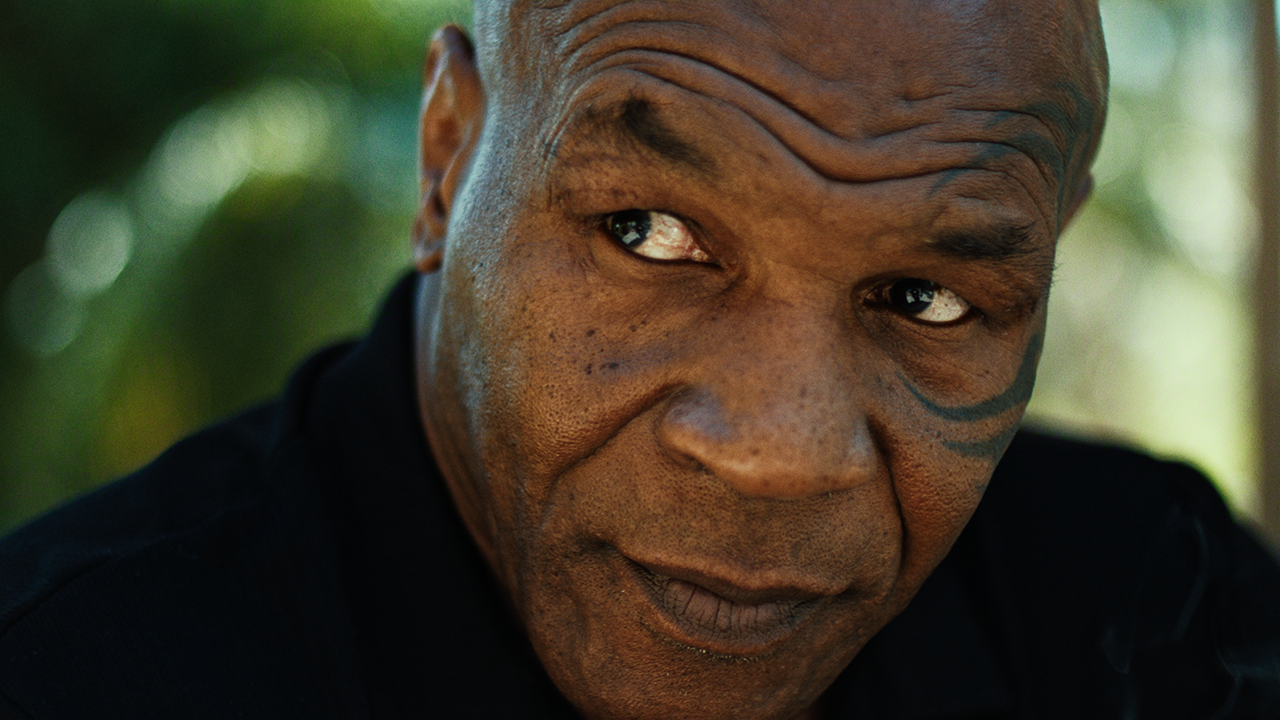
I can’t believe we’re in a timeline where two Mike Tyson documentaries about Mike Tyson are simply called Tyson. Yet here we are, and while I haven’t seen James Toback’s 2009 doc, something tells me that was better. Floyd Russ’ (Untold, American Manhunt: The Boston Marathon Bombing) four-part Netflix documentary gives the titular boxing legend a larger-than-life tale that is like the figure is rough-edged and periodically candid to a fascinating yet frustrating degree.
The 60-year-old ex-heavyweight boxing champ legend is an anomaly that nobody can really pin down, and this new confessional bio docuseries (for which he had no producing involvement) provides viewers a detailed tale of all of his sprawling career and controversies. Cradle-to-current from a close-knit orbit, so extensive, Donald Trump jump scares appear ever so often in the wrong areas.
From Brownsville to the Ring
In Tyson’s opening episode, we see him driving through his grassroots present-day Brownsville, Brooklyn, interacting with fans young and old. All before transporting viewers back to the 70s, when it was the most desolate and impoverished neighborhood in America. Neglected by his sex-working mother and a carelessness for school, Tyson addresses how a life of crime was normalized, considering how little NYC did for its Black community. While skipping school, he began to have an affinity for pigeons. A bully took one from him, snapped its neck, and his inner anger was activated, knocking him out cold.
Following frequent arrests, he’s transferred to an upstate youth facility where he forms a newfound love for boxing. Subsequently leading him to meet prolific professional manager Cus D’Amato, who took a chance on him as a mentor and a surrogate dad, fighting for his approval to shape him to be the greatest heavyweight of all time. Once he passed before winning his championship belt at 21, he had no proper guidance for his career. The doc suggests that enablers and financial vultures, media leeches, especially boxing promoter Don King, and his lack of a moral compass and a trusting support system, alongside a fast-track lifestyle, contributed to his struggles with addiction and a myriad of controversies that molded him into the Mike Tyson he is today.
Dodging the Darkest Chapters
For anyone with only a slight knowledge of his past, the authorized biography is detailed… to a point. Oftentimes the figure himself is too closed off to add any more interesting insight into his darkest demons; his hostility suggests moving on with cold aggression. There are sporadic instances of vulnerability that give the eponymous doc some weight, but his constant lack of reflection and introspection, if not straight-up mean-spirited behavior (particularly referring to his ex-wife Robin Givens as a “fucking bitch” at the discussion of a Barbara Walter’s interview about their violent-filled marriage), bears frustration.
The muddied waters get murkier when his darker chapters are discussed, specifically the domestic violence against ex-wife Robin Givens and the Desiree Washington rape conviction, which he served three years in prison for. Tyson only gives denial to the claims; Floyd probes, and Tyson gives so little, if anything, bop and weave, leaving any real reflection or sort of accountability or remorse for his violent actions to be desired. For Washington not participating in the doc, the conversations about sexual abuse are messily executed as a slew of yes-men within his orbit try to come to his defense, with Trump adding insult to injury. When the best you have to speak about rape is Donald Trump going, “The media is rough on Mike, but it just made Mike harder. They’re rough on me, and I’m the president,” you can’t help but cringe.
Think this is where Russ’ weakness illuminates, not exacerbates any real newfound insight from the source nor questions anything that justifies the doc’s existence. It’s more concerned with straightforward detail than depth. Going for the easy marks for the average Netflix doc viewer with insight to be desired. Actively avoiding any real depth, and Russ oftentimes complying with Tyson’s demand to move on when in need of being pressed further. So much so Tyson convinces him to do DMT with toad venom with him during the doc’s final moments. The figure’s overall singularity, oscillating between unapologetic and bratty to volatile and confusing all in one go, is, like the toad drug scene, a mesmerizing display. But that’s not to negate how surface-level it all comes across.
Evolution Without Change
Tyson’s estranged son Miguel says it best in the finale: “He didn’t change but rather evolved.” That evolution is noted, but the lack of change impedes the doc. Though he has been able to reinvent himself and have the ability to mock himself for the sake of art (his infamous cameo in The Hangover really being the true turning point to his comeback and his co-created Mike Tyson Mysteries cementing his status), this is proof he hasn’t done enough to fully reflect on experiences. However, how can one do so when he has suffered so much personal harm, albeit not as much as he has inflicted upon others throughout his life? Perhaps if the doc had been made by someone close to him, the results would’ve been stronger and rounded out a tale about the lack of trust and a support system that rounded out an unpredictable career full of emotional instability.
The doc about Iron Mike is candid to a tee but with little less insight across otherwise a middling crash course that fails to throw as big as punches (or better yet, bears a little bite to ear) to the height of its potential.
