

Whether we like it or not, entertainment has become the continuing education for most of America’s adult population. I’m sure I’m not the only one who learned about the Tulsa Race Massacre from the Watchmen TV series, or the crimes against the Osage Tribal Nation from Killers of the Flower Moon. There’s a whole slew of narratives considered too obscure or subversive for public or private education to cover, which leaves it up to artists to make sure those stories aren’t forgotten. Derf Backderf’s newest graphic novel The Dissidents is in this same tradition of edutainment, filling in the parts of World War I that your history teacher failed to mention.
The story follows the political cartoonists ofThe Masses, an American leftist magazine that covered a range of topics from popular revolutions abroad to labor disputes at home. Their drama is seen through the eyes of the fictional Joe Hertle, a German-American “hyphenate”—a euphemism used in the 1910s to describe first-generation European immigrants—who joins the ranks of The Masses as a cartoonist contributing to the cause. While I don’t think Hertle’s character adds much to the comic, the true story ofThe Masses is a timely reminder that the United States has a long history of suppressing dissent.
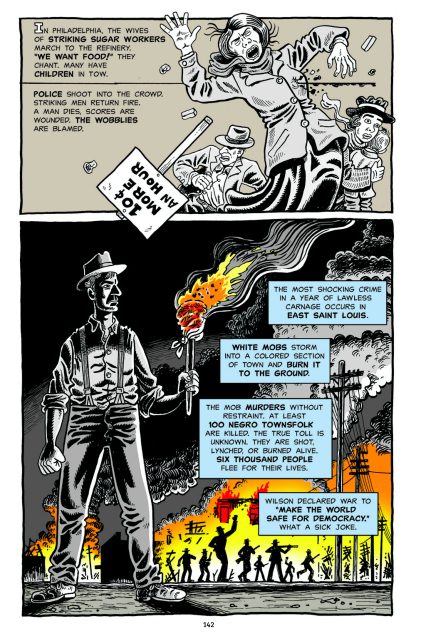
The irony throughout the book is how the country wasn’t just waging a war on Prussia, it was fighting against its own citizens as well. Striking workers were being shot by police, white mobs attacked and burned black neighborhoods, and suffragettes were beaten and imprisoned for protesting. Backderf also introduces readers to an underreported blemish on our history: the American Protective League (APL), a volunteer vigilante group of hyper-patriots who assisted law enforcement in detaining any and all “undesirables”. This mainly led to wrongful arrests of men caught without their draft cards, German immigrants baselessly accused of spying for the enemy, and raids on speeches being performed by leftist leaders. It’s surprising that this group isn’t talked about in the same way as the Pinkertons, or other vigilante groups in the U.S.
The battle to control dissent wasn’t just fought on the streets, it was also in the papers. Two laws were passed to control public perception of the war: The Espionage Act in 1917, which made it illegal to interfere with the success of the military, and The Sedition Act in 1918 which made it illegal to print, publish, or even say anything negative about the military or the government. The media not only followed these laws, they also swayed public opinion in subtler ways. Derf mentions the popular Hans and Fritz newspaper comic strip changing its name to The Captain and the Kids, a move newspaper syndicates made to avoid associating with the Germanic enemy.
 Political cartoonists were also sent the Bulletin for Cartoonists, a publication from the Committee on Public Information on how they could encourage citizens to contribute to the war effort. While some of the more innocent political cartoons promoted buying war bonds or rationing meat and fuel, many were reduced to caricaturing the enemy as barbaric fools who would be defeated by noble and heroic U.S. soldiers. These artists couldn’t have known historians and students would be using their cartoons years later as resources to understand the past. Alternative opinions, like those showcased in The Masses, could’ve easily slipped through the cracks of history due to the sheer amount of consistent pro-war propaganda that was being churned out at this time.
This is the state of the country when The Masses was being published. Although there were a variety of contributors, the book focuses on the extremely talented — and extremely underpaid — political cartoonists who made the magazine so memorable. These include Boardman Robinson, Kenneth Chamberlain, Henry Glintenkamp, Maurice Becker, Bob Minor, Cornelia Barns, and, most significantly, Art Young. If you’re unfamiliar with any of these cartoonists’ work, this book also functions as a “Best of The Masses” collection, with samples of their cartoons peppered throughout the comic alongside commentary that contextualizes and explains some of the subtler artistic choices to the reader. This was a smart move considering most of these artists, apart from Art Young, haven’t seen mainstream print since the 20th century.
The most interesting parts of this book involve the myriad of ways The Masses cartoonists brushed up against the law. The magazine went to trial twice for violating the Espionage Act, leading Glitenkamp and Becker to both flee the country. They expected an unsympathetic jury, considering the patriotic vitriol of the time. Art Young famously, almost cartoonishly, fell asleep during both of the trials, and cracked jokes during the entire fiasco. Outside of the trials we have Bob Minor, who was abroad covering both the Mexican and Russian revolutions — he even got an interview with Vladimir Lenin himself. His story of getting arrested and released could’ve been a book on its own, but here it receives criminally little focus.
With so much interesting material begging to be expanded upon, one major element holding the graphic novel back is its fictional protagonist. Joe Hertle is an audience surrogate meant to show the consequences of using your first amendment rights in the worst possible time. While other nonfictional characters experienced consequences for speaking out against the powers that be — being arrested, brought to trial, or even deported due to their beliefs — his fabricated problems feel disingenuous by comparison. His character is more of a vehicle to showcase the real stories surrounding him — he attends speeches by feminist anarchist Emma Goldman and Wobblies leader Big Bill Haywood, stands in line to get drafted alongside most of the American public, and becomes a part of The Masses inner circle. But the book also spends time talking about his relationship with his family, his love affair with the also-fictional femme fatale Ethel, and his own evolving politics over the course of three years. These moments feel like a distraction from the more interesting story surrounding it, and are only here to add some cohesion to the graphic novel.
The creative choices Backderf makes to spice up the facts work in some scenes better than others. The noir clichés he’s toying around with — the misty shipyards in the dead of night, the discreet meetings on park benches, the looming threat of the APL — they make the story more fun to read, but it adds a level of artificiality. I did appreciate other moments where the exaggeration provided a layer of truth to the story: Big Bill Haywood is a behemoth in front of the giant International Workers of the World banner, making you understand how a flesh-and-blood leader can become a larger-than-life symbol. A faceless sea of people look like ants in front of a massive Washington Square Arch, turning the monument into a symbol of patriotic oppression. The tone of the story was built by moments like this, where an emotional charge turns events into history.
With that being said, the balance of truth to fiction wasn’t where I wanted this comic to be. Backderf’s previous graphic novels My Friend Dahmer and Kent State are remarkable because he synthesized a cohesive narrative out of bits of raw, factual material, and he didn’t need to make up too much to fit it all together. Any piece of information that wasn’t available via an archive or an article he was able to get through an interview he conducted. His transparency at the end of those books, where he cites his sources and admits his embellishments page-by-page, add an aura to those projects that The Dissidents is lacking. Granted, there’s no way he could replicate that level of journalistic scrutiny when the story is set more than a hundred years ago. He was limited by recorded history and specialized archives. Still, I wish we could’ve gotten something closer to Harvey Pekar’s The Beats, where we focus on a handful of related individuals and themes in shorter segments instead of a large, linear narrative.
Overall, The Dissidents is a solid historical fiction that I wish could’ve quit it with the fiction. The marketing for this book has described it as extremely relevant to our current political climate, and upon first reading this was a turn off. I felt like it was almost reactionary, where history was being warped to fit into the current discourse surrounding autocracy and government overreach. This was a mistake on my part: most of this book was written before the 2024 election, when our headlines weren’t saturated with local ICE crackdowns, slashes in public funding, and new developments in a war no one asked for. Probably the biggest tragedy is how similar the story of The Masses parallels the recent verdicts against Ines and Elizabeth Soto, two protesters sentenced to fifty years in prison for publishing and distributing anarchist zines. Eerily enough, they were both a part of an Emma Goldman Book Club, a name I didn’t recognize before reading this comic. While there’s no way Backderf could’ve predicted any of these events with his book; it just shows that these conflicts aren’t anything new, even if a history textbook doesn’t bother to mention it.
