

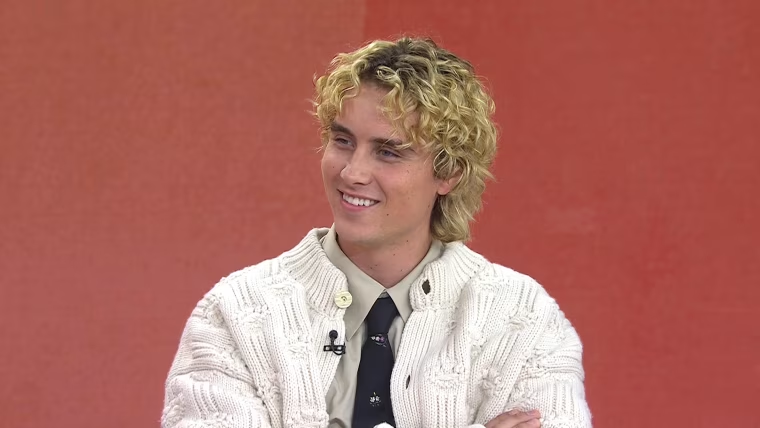
Joseph Zada on Playing Cal Trask in ‘East of Eden’ Adaptation
03:42
“Take it From Me” is a TODAY series where experts use their wisdom to explain trends or make recommendations within their fields.
Jeffrey Yeager sat down to watch the Netflix adaptation of the book he’s spent his career studying.
The vice president of the International Society of Steinbeck Scholars went into “East of Eden,”the seven-episode series directed and written by Zoë Kazan, with a “skeptical eye.” The show premiered just one day earlier, but he’d already heard chatter about how “it’s different than the book.”
Seven episodes later, he was won over by Kazan’s interpretation, which came over 60 years after her grandfather Elia Kazan directed the 1955 film adaptation.
“I came out very pleased. I thought it was fantastic,” Yeager tells TODAY.com.
“East of Eden” was the book Steinbeck considered his epic. At over 600 pages, the book is long enough to contain the origin stories of two sets of brothers, both loosely based on the Genesis story of Cain and Abel. The sprawling book, spanning the Civil War era to World War I, also maps out how two families came to live in California’s Salinas Valley; the Hamiltons and the Trasks.
Both the book and its characters are concerned with good and evil, free will and fate.
“Do our genes dictate who we are? Do our genes dictate the path we have in life, or do we have freedom in who we become?” Yeager summarizes the questions “East of Eden” asks.
Cal Trask (Joseph Zada in the show) is particularly consumed by these questions the more he finds out about his mother, Cathy Ames (Florence Pugh), and wonders if he’s destined to carry her less-than-golden legacy.
Steinbeck experts say Cathy’s nuanced depiction in Kazan’s “East of Eden” is what makes it so remarkable.
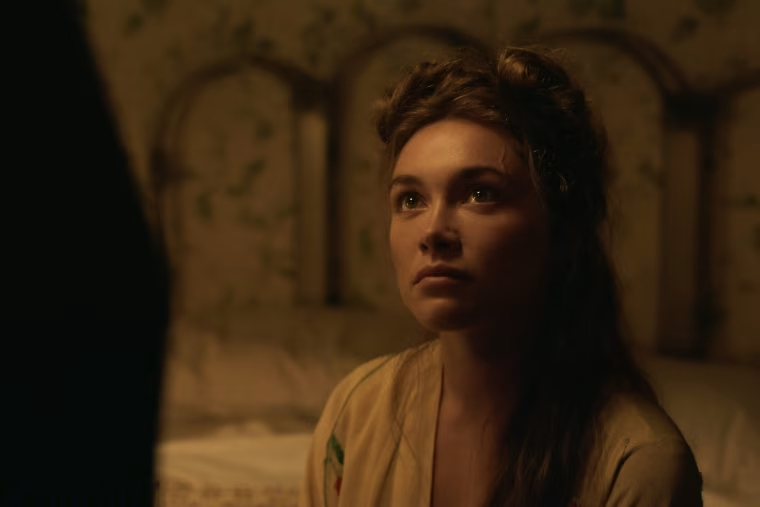
“I like the opening episode, and I like the fact that (Kazan) sets out the themes really clearly in terms of Cathy and the meditation on good and evil,” Susan Shillinglaw, a professor of English at San Jose State University who served as the university’s director of the Steinbeck Center for 18 years, tells TODAY.com.
In “East of Eden,” Steinbeck likens Cathy to a monster, writing in his introduction of the character, “The face and body may be perfect, but if a twisted gene or a malformed egg can produce physical monsters, may not the same process produce a malformed soul?”
According to Yeager, Cathy, in the book, is depicted as the “epitome of evil,” and “somebody who’s just missing something that is key to being human.”
Certainly, Cathy does evil things in both the TV show and book, including killing her own parents and attempting to kill the father of her twins (and that’s not all).
But Kazan says she set out to understandwhere Cathy’s monstrousness came from, reframing her childhood to include sexual assault.
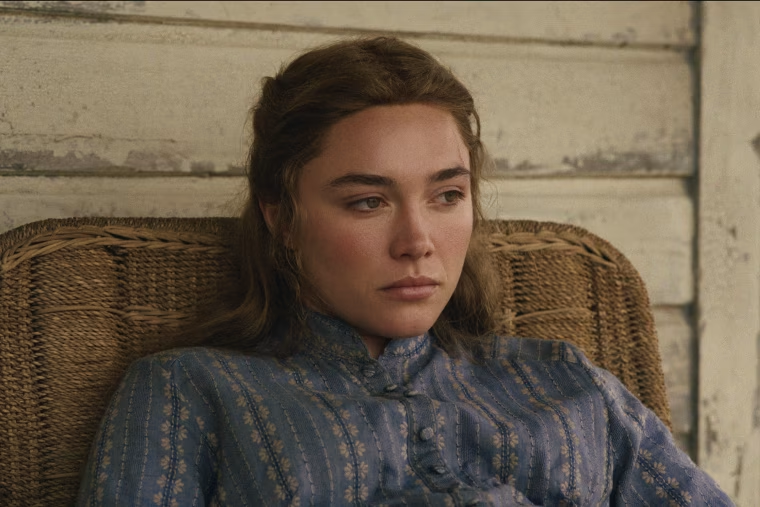
Take the situation with her teacher as another example of how the show casts a different light on Cathy. In the book, she clearly manipulates a teacher to the point that he takes his own life. “But in the show, the teacher is trying to abuse her, and then she takes advantage of the situation,” Yeager says.
Rather than being wicked, Yeager says Pugh’s Cathy is “trying to redefine morality in her own way.”
Yeager applaudes Pugh’s performance, which shuffles between “reptilian eyes” and scenes that can draw empathy.
“I feel like the show can’t make its mind up on where it wants to go (with Cathy), and in some ways, that makes the show richer than the novel. It makes us think more about that character. How does evil come into the world?” Yeager says.
“The whole point of ‘East of Eden’ is to engage readers in an assessment of who Cathy is.”
For Shillinglaw, the show’s changing interpretations of Cathy are right in line with the legacy of the book.
“The whole point of ‘East of Eden’ is to engage readers in an assessment of who Cathy is,” Shillinglaw says. “She’s like the white whale in ‘Moby Dick.’ You have to keep looking at her. What does she mean? What is her purpose in the book?”
Yeager, after watching all seven episodes, wishes more attention had been given to the Hamiltons, the family Steinbeck based on his own.
“The Hamilton family was Steinbeck sort of tracing his lineage, and I can see why that wouldn’t be important for the story the show was trying to tell,” Yeager says.
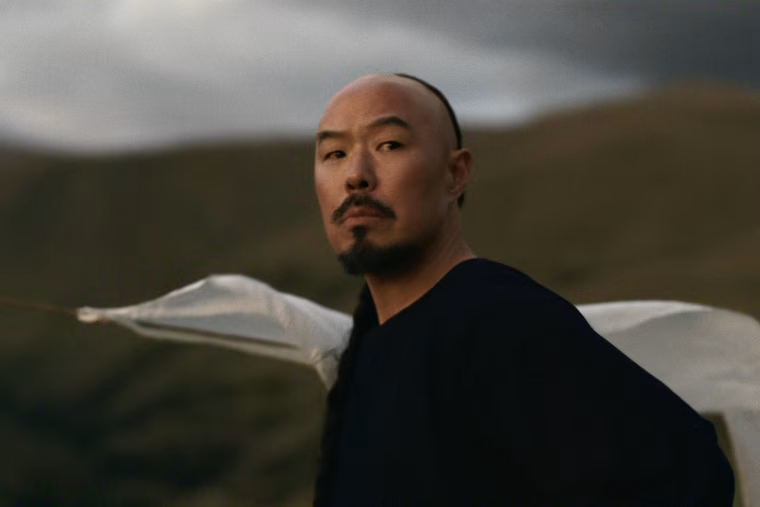
He praises Hoon Lee’s “emotionally charged performance” as Lee, Aron and Cal Trask’s caretaker who plays an important role in healing the family at the end of the show. He’s also the voice of the story’s most overarching lesson: Timshel, a Hebrew word that’s translated to allow for free will in the triumph over evil, rather than fate.
For Shillinglaw, who taught a course on Steinbeck, says the conversations around “East of Eden” were always her favorite, and anticipates more brought on by the show, currently No. 1 on Netflix in the U.S.
“Students just found (the book) fascinating, and it was because of Cathy — what she meant and her legacy.”
