

- Share
- Tweet
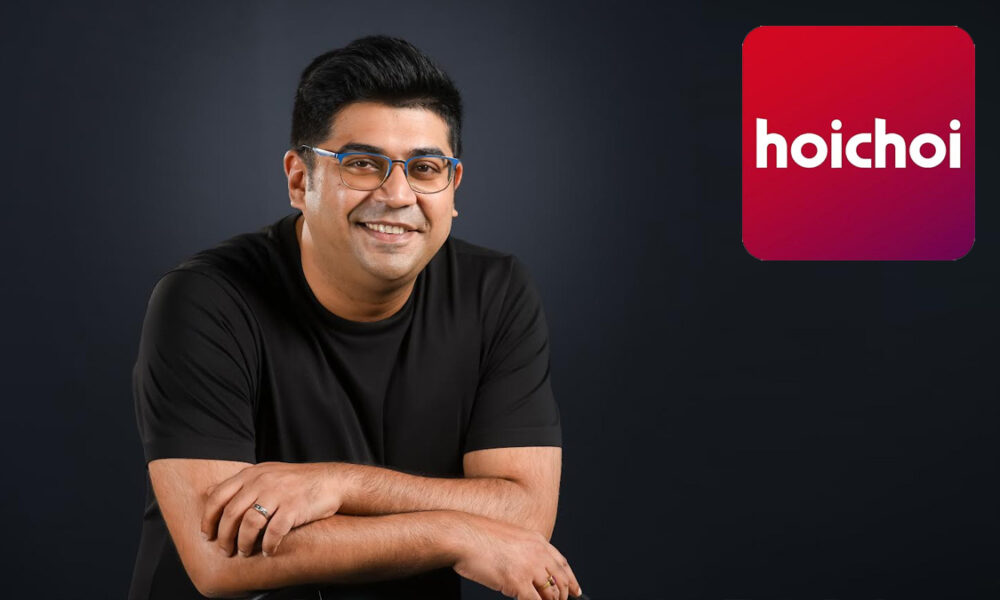
KOLKATA: Ten years after entering the streaming landscape with a singular focus on Bengali entertainment, Hoichoi is stepping into its second decade with ambitions that extend well beyond being a language-focused OTT platform.
What began as a Bengali streaming proposition has evolved into a broader entertainment ecosystem spanning original streaming content, theatrical releases, dubbed content, IP adaptations, branded storytelling, audio, multilingual short-form content and AI-led production. Yet, according to Hoichoi chief operating officer Soumya Mukherjee, the platform’s core proposition remains unchanged: creating high-quality Bengali content for audiences in India and across the global Bengali diaspora.
The evolution has also been accompanied by a deliberate focus on financial sustainability. Unlike platforms that have historically chased subscriber numbers, monthly active users or app downloads, Hoichoi has focused on paid transactions, audience loyalty and disciplined spending. Mukherjee says the company maintains a hard cap of 30 per cent of subscription revenue on marketing, with the larger emphasis remaining on content.
The platform has also sought to extend the life of its intellectual property beyond its own service. While the original Bengali titles remain behind Hoichoi’s paywall, their dubbed versions are licensed to other platforms, allowing the stories to reach audiences in Hindi and, soon, Tamil and Telugu. Hoichoi has also been adapting its successful Bengali IPs for other OTT platforms and broadcasters.
As Hoichoi marks 10 years, Mukherjee speaks to Indian Television.com about the business behind the platform, the growing value of Bengali IP, its approach to profitability, the role of AI in production, emerging content formats and what the company hopes to build over the next decade.
Hoichoi started as essentially a Bengali streaming proposition. Ten years later, it is being described as an entertainment ecosystem. What has evolved in the way you think about the business?
We are still a pure-play content-tech OTT platform catering to millions of subscribers globally on the basis of Bengali content. But what has evolved is the diversification around other business verticals.
For example, we are localising content and it is travelling not only in India but also to LATAM, Russia and other international markets. We are also remaking our own IPs and producing them for other OTT platforms and broadcasters.
Then comes Hoichoi Studios, which is our theatrical wing. We were one of the first in India to do this. Eken Babu, one of our most iconic properties, was the first web content to become a theatrical IP. We have now done three Eken Babu films after nine seasons on the web, and it has become one of the biggest success stories from the Bengal box office.
Another area is how we work with brands. Hoichoi does not have advertisements on the platform, but we realised that many brands wanted to work with us. So we started creating a different slate of content outside the premium slate. At the same time, it is fiction storytelling with the quality that Hoichoi brings to the table, where we incorporate the branded message very seamlessly.
We have worked with more than 100 brands, including all the major ones.
Additionally, there are other areas we are experimenting with. Hoichoi FM is our audio-story vertical, while Super is a multilingual micro-content vertical. Super is currently in beta, and we still have a lot to learn from it.
Another major diversification is around Logline AI, where we have started incorporating AI into our content workflows. We also did a massive international exhibition and realised that the product had significant potential to travel. Logline Studios is primarily our AI content arm, where we are doing vertical production for other platforms and incorporating AI seamlessly into content workflows.
That is how you will see the evolution of Hoichoi from a pure-play OTT platform to more of an entertainment ecosystem. But at the heart and core, we remain a content-tech OTT platform catering to Bengalis across the world.
Hoichoi has also taken its Bengali content beyond the platform through dubbed versions and adaptations. How do you measure the value of that distribution when viewers may not necessarily become direct Hoichoi subscribers?
What we have done at Hoichoi is diversify the business model.
Firstly, it is important to understand that the positioning of Hoichoi is Bengali. We cater to millions of users worldwide, including the Bengali diaspora in India, Bangladesh, the US, UK, Australia and the Middle East. That is a massive user base where people regularly come for original Bengali content as well as the big theatrical films that we produce and acquire for Hoichoi.
When it comes to diversification, one of our biggest philosophies has been to take our content everywhere. That means not restricting it to Bengali, but slowly expanding into other languages.
While Hoichoi’s positioning is purely Bengali and everything is behind a paywall, there are two major aspects to our content diversification business.
One is the dubbing piece. We dub our shows in Hindi, and very soon we are starting in Tamil and Telugu. This caters to a different audience base. It is another million users or more who regularly watch this content, not on Hoichoi but on other OTT platforms.
We have always stuck to one principle. We have not distributed it across five OTT platforms. We have done major partnerships with one OTT platform and stayed with that. It does not impact the core business because we look at it as an additional
Hoichoi’s positioning is purely Bengali, while the long-term monetisation of the IP also happens through dubbing. The content travels and caters to a very different set of audiences.
The second aspect is content diversification, which we started around one-and-a-half to two years ago. We are also working with other OTT platforms and broadcasters to produce content for them.
We take successful IPs and remake them for other platforms. Chiraiya, for example, is an adaptation of one of our shows, Sampurna, and has become one of the most viewed OTT titles this year.
We have done four such shows, two in Telugu and two in Hindi, and many more are in the process. So those are the two major aspects of the content diversification that we are pursuing.
What has adapting Bengali IP for other languages taught you about the ability of regional stories to travel?
Historically, Bengali content has always had a much more universal appeal. It is not restricted to Bengali.
If you look at iconic characters such as Feluda and Byomkesh, or even a lot of the work done by Satyajit Ray, these are stories that have already travelled.
Today, when we make content for Hoichoi, our intention has always been to create universal content that can travel not only in Bengali but also in other languages.
A lot of Hoichoi shows have been dubbed in Spanish and have travelled internationally and performed well. There are other such examples as well.
That is how we invest in building content with strong universal appeal, whether through localisation and dubbing or through pure-play adaptations where we produce them for other OTT platforms or broadcasters.
How do you scale Bengali IP nationally and internationally without diluting what makes it distinctly Bengali?
There are two aspects to this.
One is that Bengali content generally has universal IP. We are fortunate to come from a part of India where the history of content creation and creative acumen is very rich. That is the first big advantage when it comes to scaling Bengali IP without losing its essence.
At the same time, when we remake something, we take the core storyline but adapt it very locally.
For example, with Chiraiya, we adapted it very locally and placed it in Rajasthan. We built uniqueness into the story, added elements and introduced new tracks.
It is not always a pure-play adaptation. We work according to the needs of the platform or the audience base it is catering to, and that is how we craft it.
Hoichoi has pursued profitability rather than simply chasing subscriber scale. What did you consciously choose not to do that helped make the business sustainable?
It goes back to the point about marketing.
We were not really a platform that wanted to showcase MAUs and DAUs. We were very clear that we needed transactions and people paying for the content we were putting out.
Instead of chasing vanity metrics and app downloads, our focus was on building a backbone of great content and a community of loyal users.
Of course, we have millions of app downloads and millions of users, but that has been built on the strength of our content and our loyal community. That has been the secret for us.
You have spoken about keeping marketing spend below 30 per cent of subscription revenue. How important has that discipline been?
We spend less than 30 per cent. But 30 per cent is the hard cap. We do not spend more than 30 per cent of our subscription revenue on marketing.
I would like to think it has worked in our favour because that is how we have been able to grow at a sustainable pace.
The entire P&L is focused on creating great-quality content, and whatever we earn goes back into creating better content.
We are extremely P&L-conscious. We are a self-funded OTT platform, so we knew from day one that if we were not tight with how we operated, we would soon be out of business.
I think that has been one of our most successful strategic business outcomes. We have been able to build sustainable growth.
What is the biggest misconception about building a successful regional OTT platform in India?
Personally, I don’t like the word ‘regional’. I think we are a language OTT.
There is no secret sauce, honestly. We have simply been very true to the thought process from day one that we wanted to create great-quality content that our users would love. We have been able to build that loyalty over the years.
Audience loyalty is at the core.
But we have also been successfully able to build a very sustainable business model. We don’t spend more than 30 per cent of the entire subscription revenue on marketing. We are very rigid about that. It is a hard cap.
That is how we have become very stringent on the P&L.
We believe that the content we create is our biggest advocate when it comes to marketing. At the same time, we have successfully built a community of loyal users, which in general generates a lot of word of mouth.
That is how we look at the business.
The audience today has access to multiple formats, from long-form shows and reality programming to micro-dramas and vertical content. Is Hoichoi looking at newer formats?
When it comes to short vertical drama, we have already started experimenting with it. It is going to be multilingual, and we are trying to figure out the right product-market fit.
It is still an experiment, and we would love to figure out the right way to grow it sustainably.
When it comes to different formats of content, we experimented last year with something we call TV Plus, which involves multiple episodes of one series. That has been a very successful experiment, and you will see a lot more TV Plus content being part of our slate.
At the same time, we are definitely on the lookout for great non-fiction storytelling that will primarily cater to the premium audience Hoichoi has.
We have done a lot of brand-led non-fiction shows that have worked in the past. We have a massive property with Sunrise called Bhootan Bila Sheikh, which is a cooking show where the anchor travels across parts of Bengal to discover hidden recipes.
We are also working on several new non-fiction formats that we are keen to launch soon.
Where does AI fit into Hoichoi’s content and production workflow?
Today, we live in a world where we cannot ignore AI.
What we have realised is that AI is an important tool that can make content creation more efficient and bring a different level of quality. Sometimes, because of re very ambitious in nature
AI can help bridge some of those gaps.
We have incorporated AI into various workflows. At the same time, the heart remains human. We still have directors, writers, costume designers and DOPs who use AI to enhance the content. That is how we are using it.
Is AI being used while writing scripts?
Not necessarily. Different content will have different needs, and it is completely the director’s call as to how they want to use it.
Where is AI currently making the biggest impact in production?
I think the major aspect of production where AI is definitely being used is VFX, particularly AI-led VFX work. That is what really elevates the quality of the content you see on screen.
If the first decade was about proving that a language-focused streaming platform could become a sustainable business, what does Hoichoi need to prove in its second decade?
There are two or three very important aspects here.
One is that we still want to obsessively focus on the customer experience, from the kind of content we provide to the technology backend and tech stack. We have now built it in-house, and one of our biggest objectives for the next decade is to significantly improve the user experience.
At the same time, we want our stories to travel globally.
We have had decent success with our stories travelling within India, but I think the next stage is taking the content globally and ensuring it reaches more territories, where it can be localised and remade.
The third aspect is focusing on how we can grow distribution and reach customers in the last mile.
There has been considerable interest around the distribution of Hoichoi content beyond its own platform. Is there any plan for Netflix distribution?
You will hear some news very soon. I am unfortunately bound by an NDA, so let’s wait for that news to break.
Finally, what should the Hoichoi of 2036 be known for that the Hoichoi of 2026 isn’t known for yet?
It has to be known as one of the biggest media conglomerates not only from India but also in Bangladesh.
That is the simplest messaging. The aspiration is to become one of the largest media conglomerates in India and Bangladesh by 2036.
For Hoichoi, the next decade is therefore not about moving away from Bengali storytelling, but about extending its reach and commercial life. Dubbing, remakes, theatrical adaptations, branded entertainment, new formats and AI-led production are becoming additional avenues through which the platform can take its intellectual property to wider audiences.
At the same time, Mukherjee’s emphasis on paid transactions, audience loyalty, content-led marketing and P&L discipline reflects a business philosophy built around sustainability rather than scale for its own sake.
Having spent its first decade establishing Bengali OTT as ay larger canvas. Its stated ambition for 2036 is to evolve into one of the largest media conglomerates in India and Bangladesh, while continuing to build on the Bengali storytelling ecosystem that brought it to its 10-year milestone


2 Comments
Pingback: Rajinikanth's old promise on Raghavendra Mandapam surfaces amid reports of massive property revamp emerge - Comic Vibe
Pingback: AMC Entertainment Holdings, Inc. (AMC) is Attracting Investor Attention: Here is What You Should Know - Comic Vibe