

Close Menu

    Subscribe to Updates

    Get the latest creative news from FooBar about art, design and business.

    What's Hot

    Xbox is paying “significantly less” than reported $400M budget for Kojima’s PHYSINT

    September 28, 2026

    FNCS 2026: Most Popular Esports Tournament In Seven Years

    September 28, 2026

    Gaming Microphone Set Market To 2035: Content Creation and Esports Drive Forward Growth – News and Statistics

    September 28, 2026
    Facebook X (Twitter) Instagram
    Facebook X (Twitter) Instagram YouTube TikTok
    Comic Vibe
    Monday, September 28
    • Home
    • Comics
      • Comic Vibe News
    • Gaming
    • Movies
    • TV
    • Anime
    • Toys & Collectibles
    • Cosplay
    • Tech
    • Digital Culture
      • Creators & Fan Culture
      • Creator Economy & Fan-Driven Platforms
      • Digital Fandom & Online Communities
      • Metaverse & Virtual Worlds
      • NFTs & Digital Collectibles
      • Virtual Events & Online Conventions
      • Virtual Identity & Avatars
    • Shop
    Comic Vibe
    • Home
    • Contact Us
    • Terms & Conditions
    • Advertise With Us
    • DMCA Policy
    • Privacy Policy
    • About Us
    Home»Gaming»What was the original first-person shooter? Two largely forgotten computer games from the 1970s ushered in the genre
    Gaming

    What was the original first-person shooter? Two largely forgotten computer games from the 1970s ushered in the genre

    JamesBy JamesSeptember 28, 2026No Comments5 Mins Read
    Facebook Twitter
    What was the original first-person shooter? Two largely forgotten computer games from the 1970s ushered in the genre
    Share
    Facebook Twitter

    Curious Kids is a series for children of all ages. If you have a question you’d like an expert to answer, send it to CuriousKidsUS@theconversation.com.

    What was the first “first-person shooter” video game?
    – James, age 12, Batesville, Arkansas

    Before “Call of Duty,” before “Counter-Strike” and before “Doom,” there was “Maze War.”

    Generally considered the earliest first-person shooter game, or FPS, “Maze War” was developed at a NASA research center beginning in 1973. A year later, another FPS, “Spasim,” debuted. It was developed at the University of Illinois.

    In first-person shooters, players experience the game through the eyes of a character, using a gun or other weapon to attack enemies. To pull off this first-person perspective, developers needed to create a 3D world for the players to move through – no easy feat in the early 1970s.

    At the time, the computer hardware behind the most popular arcade game, “PONG,” and the first home video game system, the Magnavox Odyssey, wasn’t powerful enough to render the kind of 3D depth that allowed players to move forward into a virtual space, with objects appearing in the distance.
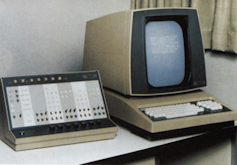
    A vintage desktop computer from the 1970s with a small, narrow screen and a keyboard attached to it.
    ‘Maze War’ was developed on the Imlac PDS-1.
    Electronics/Wikimedia Commons

    That’s why both games were developed on systems that had more processing power and speed. “Maze War” first appeared on an Imlac PDS-1 minicomputer, while “Spasim” – short for “space simulator” – launched on PLATO, an early networked computer system.

    Since everyday people couldn’t easily access the Imlac PDS-1 minicomputer or PLATO, these two games have been largely forgotten. But they paved the way for one of today’s most popular video game genres.

    Out of sight, but not out of mind

    Both games allowed players to move through a 3D space and shoot enemy figures that appeared onscreen in the player’s view.

    In “Spasim,” movement and shooting didn’t occur in real time. You moved by jumping from one position to another, with a short lag time needed to render the next view.

    In “Maze War,” players could move relatively smoothly in a straight line down hallways. Turning, however, needed to be done in 90-degree increments, which created some potentially confusing graphics as entire scenes abruptly appeared. In the single-player mode, danger could lurk just around the corner: Robots would automatically shoot you if they were in line with you down a hallway.

    “Maze War” and “Spasim” also had multiplayer modes that allowed networked players to shoot at each other. Before video games, popular shooting games – the kind found at fairs and carnivals – generally involved friendly competition, with players competing to see who could hit targets most accurately. The kill-or-be-killed death matches of “Maze War” and “Spasim” completely upended the way guns were used in play and competition.

    In ‘Maze War,’ players are required to turn in 90-degree increments.

    ‘Maze War’ introduced another new twist: the possibility of getting shot at and killed from behind, without ever seeing your attacker. Instead of the fixed and unchanging point of view found in a shooting gallery, ‘Maze War’ required you to constantly look around to try to keep track of everything in your immediate area.

    And unlike most video games up to this point, players didn’t see the entirety of a game’s world from a godlike perspective. Instead, there was a sense of offscreen space surrounding the player, with events occurring out of the player’s sight.

    Building a 3D world with lines

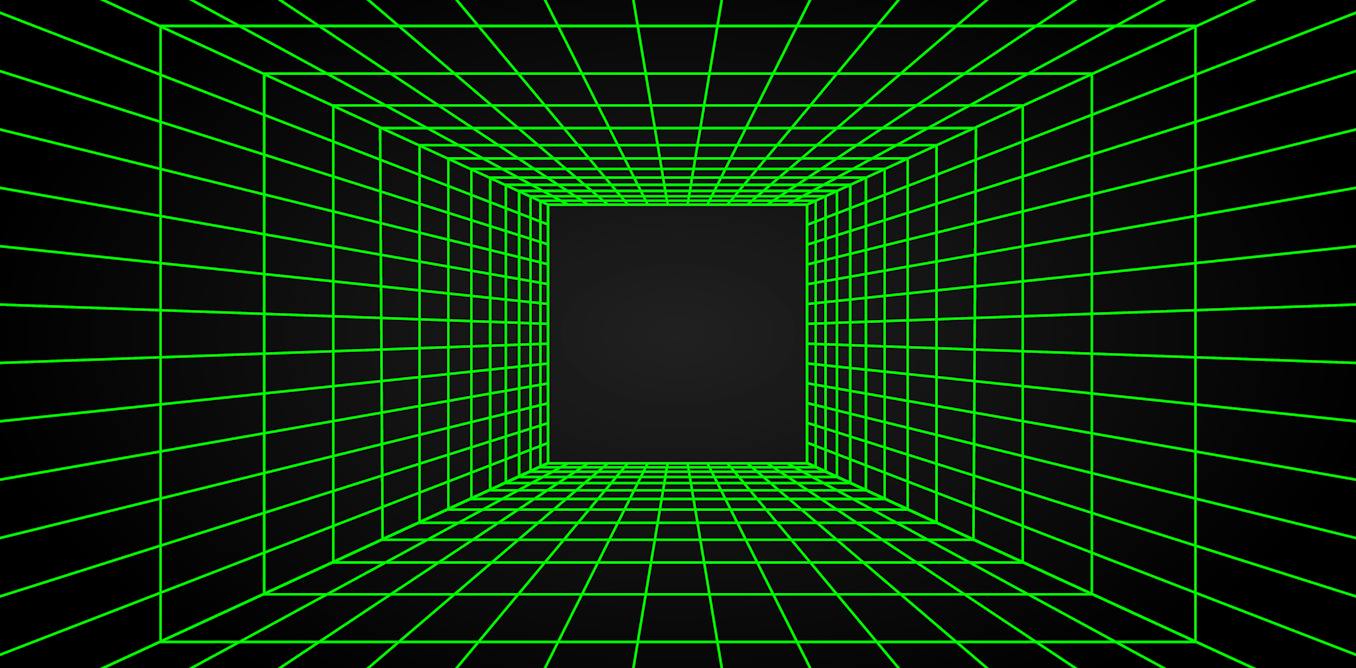
    Both ‘Maze War’ and ‘Spasim’ used what are called vector graphics, which are images made by drawing lines directly between points on the screen.

    Compared with the other popular form of computer graphics, known as raster graphics, vector graphics were particularly well suited for creating a first-person perspective. They contain clean lines that converge at a vanishing point, making a flat screen appear to stretch into the distance. Raster graphics, on the other hand, create pictures by filling in a grid of tiny pixels, an approach that was less suited to drawing the crisp lines needed to create this kind of perspective.

    Diagonal lines create vanishing points that make a flat surface appear to stretch into the distance.
    InkScape/Wikimedia Commons, CC BY-SA

    “Maze War” and “Spasim” didn’t have the aiming capabilities that players are used to today. Shooting was done with a keystroke, with aiming limited to facing in the right direction. Nor did they have the speed, spectacle and realism of their modern descendants. But they introduced something more fundamental: a new way of seeing and experiencing a video game.

    Hello, curious kids! Do you have a question you’d like an expert to answer? Ask an adult to send your question to CuriousKidsUS@theconversation.com. Please tell us your name, age and the city where you live.

    And since curiosity has no age limit – adults, let us know what you’re wondering, too. We won’t be able to answer every question, but we will do our best.

    FirstPerson largely original Shooter What
    Share. Facebook Twitter
    Previous ArticleFive Nights at Freddy’s Collab Reveal Breaks Fortnite Record
    Next Article ‘Super Why’s Comic Book Adventures’ Premieres October 5
    James

    Related Posts

    Xbox is paying “significantly less” than reported $400M budget for Kojima’s PHYSINT

    September 28, 2026

    What to Watch on Disney+ and Hulu in October 2026

    September 28, 2026

    Slow Roads Is A Game For Drivers, Not Racers

    September 28, 2026

    Xbox and PlayStation Gamers, Logitech Clears Out Racing Wheel and Pedals at Its Lowest Price on Amazon

    September 28, 2026
    Leave A Reply Cancel Reply

    Our Picks

    Xbox is paying “significantly less” than reported $400M budget for Kojima’s PHYSINT

    September 28, 2026

    FNCS 2026: Most Popular Esports Tournament In Seven Years

    September 28, 2026

    Gaming Microphone Set Market To 2035: Content Creation and Esports Drive Forward Growth – News and Statistics

    September 28, 2026

    September 30’s New Marvel Comics: The Full List

    September 28, 2026
    • Facebook
    • Twitter
    • Instagram
    • YouTube
    • TikTok
    • Telegram
    Don't Miss
    Gaming

    5 Gaming Handhelds With Better Battery Life Than The Nintendo Switch 2

    By JamesJuly 14, 20260

    The Nintendo Switch 2 is a major upgrade over the original. The console has better graphics, loads games faster, and lets you control certain titles with mouse controls. When was the last time a game console let you do that without purchasing a dedicated peripheral? However, the Switch 2 has several disadvantages, most notably its…

    New Zealand’s Iconic Star Sam Neill Passes Away at 78

    July 14, 2026

    Jelly Roll admits one mistake sent him on a food binge amid Bunnie Xo divorce

    July 14, 2026

    New series filmed in Alberta with major stars hitting Netflix soon | Daily Hive

    July 14, 2026

    Subscribe to Updates

    Get the latest creative news from SmartMag about art & design.

    About Us
    About Us

    Comic Vibe is a pop-culture destination created for fans who live and breathe comics, movies, anime, TV shows, gaming, tech, cosplay, and collectibles.

    Our mission is to deliver engaging news, reviews, features, guides, and opinions that celebrate geek culture in all its forms. From the latest comic releases and blockbuster films to anime trends, gaming updates, cutting-edge tech, and collector culture, Comic Vibe brings everything together in one vibrant hub.

    Our Picks

    Xbox is paying “significantly less” than reported $400M budget for Kojima’s PHYSINT

    September 28, 2026

    FNCS 2026: Most Popular Esports Tournament In Seven Years

    September 28, 2026

    Gaming Microphone Set Market To 2035: Content Creation and Esports Drive Forward Growth – News and Statistics

    September 28, 2026

    Subscribe to Updates

    Get the latest comics, anime, movies, TV, gaming, cosplay, and pop culture news delivered directly to your inbox. No spam—just the stories every fan should know.

    Facebook X (Twitter) Instagram YouTube TikTok
    • Home
    • Contact Us
    • Terms & Conditions
    • Advertise With Us
    • DMCA Policy
    • Privacy Policy
    • About Us
    © 2026 Comic Vibe. Designed by Comic Vibe.

    Type above and press Enter to search. Press Esc to cancel.