

Imagine loving a summer blockbuster so much that you want to experience it again the moment you walk out of the theater. Today, that desire is effortlessly fulfilled. You can stream the film a few months later, buy a 4K disc, watch endless video essays online, or listen to the official soundtrack on your phone during the drive home.
In the 1970s and early 1980s, your options were far more limited. Once a movie completed its theatrical run, it vanished into a cultural void. You might get lucky if an independent theater hosted a midnight revival screening, or you could wait three to four years for a heavily edited, commercial-interrupted broadcast on network television. Home video recorders were expensive luxury items, and blank tapes cost a small fortune.
If you wanted to take the magic of a cinematic universe home with you, you walked into a supermarket, airport newsstand, or mall bookstore and headed straight for the wire spinner rack. There, sitting between mystery thrillers and romance paperbacks, was the ultimate souvenir: the official movie novelization.
For roughly three decades, novelizations were a massive publishing industry force. They sold millions of copies, regularly topped bestseller lists, and created an entire subculture of tie-in fiction. Yet, the way these books were written created a strange parallel universe of cinema, full of deleted scenes, invented character backstories, and bizarre plot divergences that never appeared on the silver screen.
The Portable Movie Before Home Video
The concept of the movie tie-in book dates back to the silent era, when publishers released “photoplay editions” of classic stories illustrated with black-and-white film stills. But the modern paperback novelization boom began in earnest during the 1960s and 1970s, fueled by the explosive growth of mass-market paperbacks.
Publishers like Ballantine Books, Bantam, Berkley, and Del Rey realized that fans did not just want to read original literature. They wanted a tangible, permanent record of the movie experience. A three-dollar paperback was the only affordable, on-demand way for a consumer to re-experience the plot, dialogue, and atmosphere of their favorite film at their own pace.
The peak of this phenomenon arrived in November 1976, six months before a little-known science fiction movie called Star Wars debuted in theaters. Ballantine Books published Star Wars: From the Adventures of Luke Skywalker, credited on the cover to George Lucas but secretly ghostwritten by veteran science fiction author Alan Dean Foster.
Writing in the Dark: The Early Script Dilemma
To understand why vintage novelizations read so differently from the movies they adapt, you have to look at the brutal logistics of publishing schedules.
Publishers needed novelizations to hit bookstore shelves two to four weeks before a film opened in theaters to capitalize on the studio marketing blitz. Printing, binding, and shipping hundreds of thousands of physical books across the country took months. That meant authors had to write the entire novel six to nine months before the movie was finished.
As a result, novelizers rarely saw footage or rough cuts of the films they were adapting. Instead, the studio sent the author a package containing an early shooting script, concept sketches, and black-and-white production stills.
Any film historian will tell you that a screenplay is a fluid, evolving document. Directors constantly rewrite scenes on set, actors improvise dialogue, and editors cut major sequences in post-production to fix pacing issues. But the novelist was working from an early draft frozen in time.
This dynamic produced fascinating discrepancies between page and screen:
- The Alien Cocoon: In Alan Dean Foster’s 1979 novelization of Ridley Scott’s Alien, the protagonist Ripley discovers her captain, Dallas, alive and cocooned inside the alien nest, begging to be killed. Scott filmed this sequence but cut it from the theatrical release for pacing, meaning book readers experienced a crucial piece of horror lore decades before it was officially restored in the 2003 director’s cut.
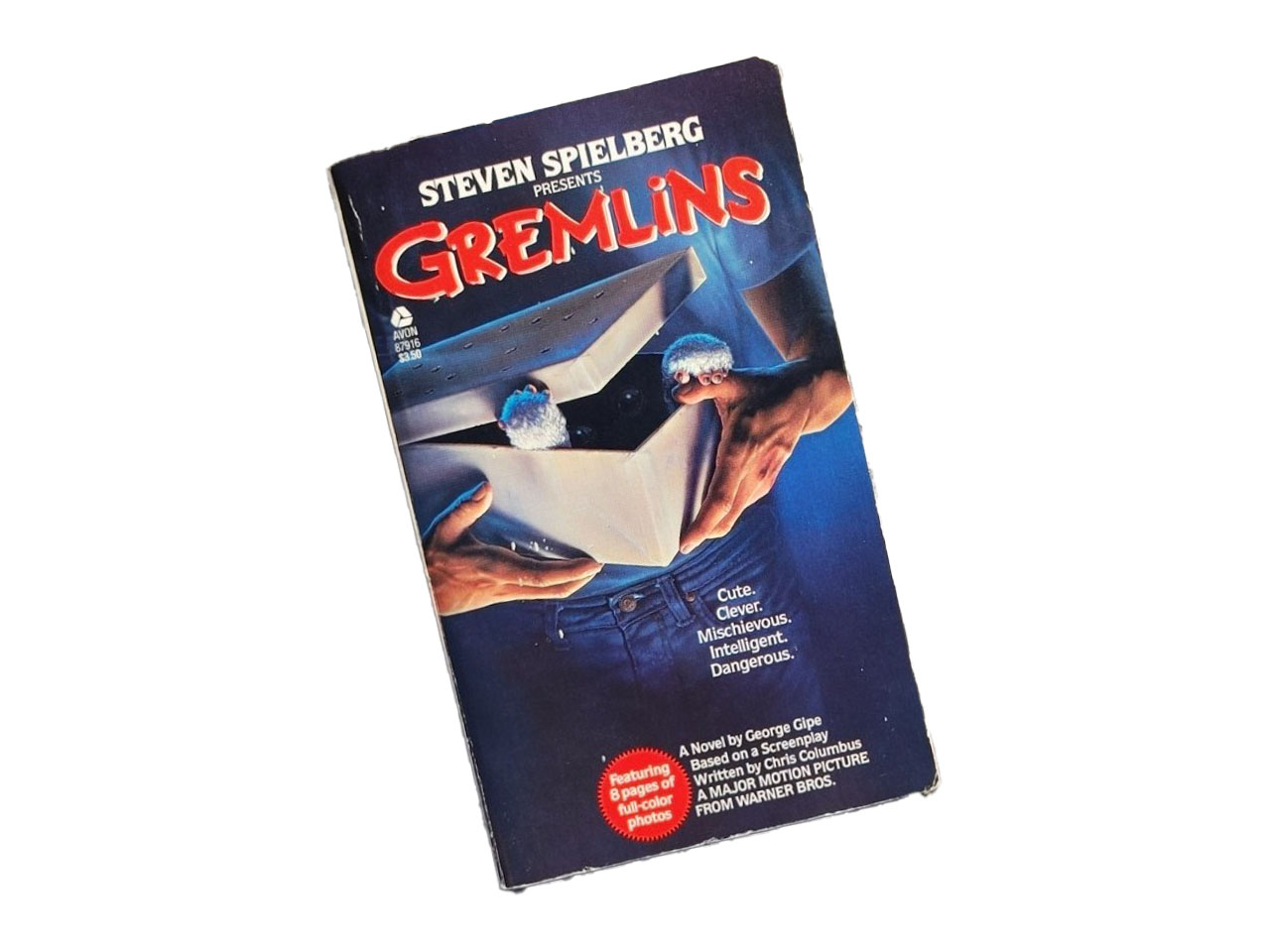
- The Galactic Lore of Gremlins: When author George Gipe novelized Gremlins in 1984, he needed to flesh out a 100-page screenplay into a full-length book. Working with minimal guidance, Gipe invented an elaborate backstory stating that the Mogwai were peaceful alien creatures genetically engineered by a benevolent scientist named Mogturmen on the distant planet Enik, an origin completely absent from the film.
- The Back to the Future Video Games: In Gipe’s 1985 novelization of Back to the Future, Marty McFly is depicted as an avid arcade gamer who uses his video game reflexes to help navigate the climax, a character trait from an early draft by Robert Zemeckis and Bob Gale that was abandoned during filming.
- Alternate Endings and Missing Deaths: In the novelization of Poltergeist, written by James Kahn, the supernatural origins of the house are explained in deep theological detail. In other adaptations, characters who died in early script drafts survived in the book, while characters who lived on screen met tragic ends on the page.
The Unsung Masters of the Craft
Adapting an 85-page script into a 250-page novel was difficult work, often completed under extreme deadlines. Studios frequently gave writers as little as four to six weeks to deliver a completed manuscript.
A specialized group of talented authors became masters of the format. Writers like Alan Dean Foster (Alien, The Thing, The Black Hole), Donald F. Glut (The Empire Strikes Back), James Kahn (Return of the Jedi, Indiana Jones and the Temple of Doom), Craig Shaw Gardner (Batman), and Peter David (numerous superhero and sci-fi adaptations) elevated the craft.
These writers did not just transcribe dialogue. They provided internal monologues, explored character motivations that visual mediums could not express, and built world-building lore that gave life to cinematic universes.
When Tim Burton’s Batman arrived in the summer of 1989, Craig Shaw Gardner’s novelization spent weeks at the top of The New York Times bestseller list, selling millions of copies alongside the iconic soundtrack album and merchandising tsunami.
The VCR and the Shift to Expanded Universes
The golden era of the standalone movie novelization began to wane in the 1990s as the home video market matured. Once consumers could buy affordable VHS tapes of films six months after their theatrical debuts, and later DVD editions packed with deleted scenes and director commentaries, the novelization was no longer needed as a surrogate home theater.
Publishing strategies shifted. Instead of focusing primarily on straightforward adaptations of two-hour movies, publishers began investing in “expanded universe” tie-in literature. Original novels set in the worlds of Star Wars, Star Trek, and Halo allowed fans to explore entirely new stories rather than re-reading the scripts of films they already owned on physical media.
While novelizations still exist today for major franchise releases, they are niche collector items rather than mainstream cultural necessities. Yet, for an entire generation of readers who grew up before the digital age, those dog-eared paperbacks were sacred artifacts. They were the only way to carry a galaxy far, far away directly in your back pocket.

1 Comment
Pingback: Bigg Boss Tamil 10: Avinash in the dock as Shathiga and Muthazhagi question his captaincy - Comic Vibe