

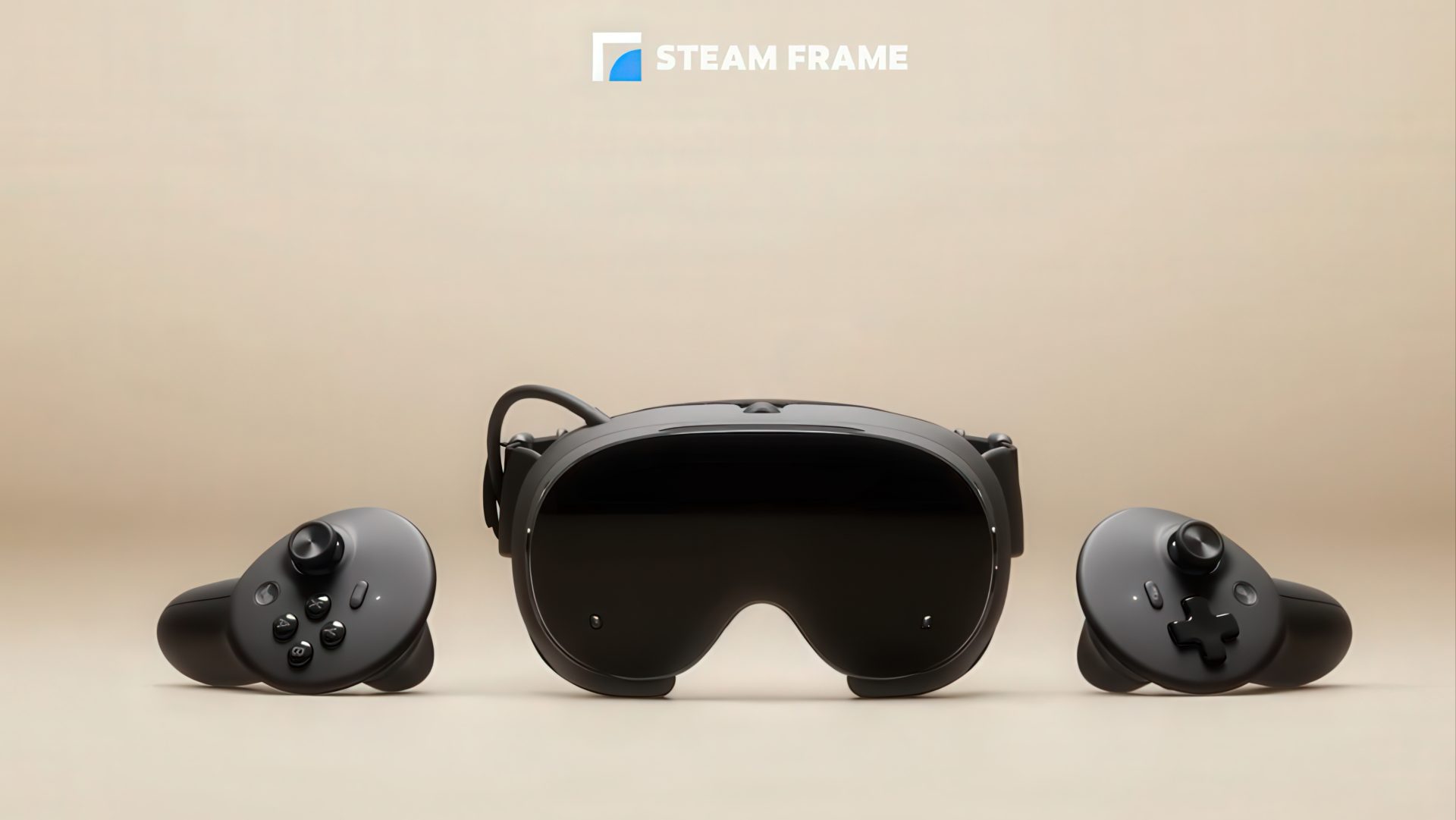



The Steam Frame, Valve‘s first standalone headset, finally launched yesterday, with the Steam company billing it as more than just a mere successor to 2019’s Valve Index. The Steam Frame runs SteamOS on ARM hardware, streams from your PC over a dedicated wireless link, and plays a chunk of your existing library without a PC at all.
The first reviews are in, and they’re strikingly consistent: this is the most comfortable headset anyone has worn, the <a href="https://comicvibe.com/golden-axe-animated-series-now-streaming-on-paramount/” title=”Golden Axe animated series now streaming on Paramount+”>streaming is excellent, the price is painful, and the battery is a serious problem. Let’s start with the pricing, though.
Pricing and What’s in the Box
Two configurations are available, both including the Steam Frame Controllers, the Wi-Fi 6E wireless adapter, and a copy of Half-Life: Alyx:
- 256GB Kit: $1,059
- 1TB Kit: $1,299
Surprisingly, a power supply is not included in the box. Valve sells a 45W USB-C unit separately for $29, and the headset requires at least 45W.
Other accessories include an Ergonomic Accessories Kit at $59, an Accessory Replacement Kit at $49, prescription lens inserts through Zenni, and the Arcturus Vision camera at $149, which adds the color passthrough the base unit lacks. The microSD slot takes the same cards as the Steam Deck and Steam Machine.
The Full Steam Frame Specs
| Component | Steam Frame |
|---|---|
| Processor | 4nm Snapdragon 8 Gen 3, ARM64 |
| Memory | 16GB unified LPDDR5X |
| Storage | 256GB or 1TB UFS, plus microSD slot |
| Display | 2160 × 2160 LCD per eye, 72–144Hz (144Hz experimental) |
| Optics | Custom pancake lenses, glass and non-glass elements, up to 110° FOV |
| IPD range | 60–70mm |
| Glasses clearance | 140mm max width |
| Tracking | Inside-out, camera-based |
| Cameras | 4 outward-facing monochrome for tracking, 2 interior for eye tracking and Foveated Streaming |
| Passthrough | Monochrome, via the outward-facing cameras |
| Low light | IR illuminators for tracking and passthrough in the dark |
| Expansion | User-accessible front port: dual high-speed camera interface (8 lanes @ 2.5Gbps MIPI) or PCIe Gen 4 (1 lane) |
| Wi-Fi | Wi-Fi 7, 2×2, dual radios for concurrent 5GHz Wi-Fi and 6GHz VR streaming |
| Wireless adapter | Wi-Fi 6E (6GHz), included, direct low-latency PC link |
| Bluetooth | 5.4, plus a dedicated 2.4GHz link for the controllers |
| Audio | Dual speaker drivers per ear built into the headstrap, dual microphone array |
| Battery | 21.6Wh rechargeable Li-ion, rear-mounted |
| Charging | USB-C 2.0 rear port, charging and data, 15V ⎓ 3.0A (45W max) |
| Headstrap | Modular, 245g, with integrated audio drivers and battery; core module detaches for third-party straps |
| Size | 175 × 95 × 110mm (core module plus facial interface) |
| Weight | 185g core module, 440g with headstrap |
| OS | SteamOS 3 (Arch-based), KDE Plasma desktop |
| Component | Detail |
|---|---|
| Tracking | Full 6-DOF with IMU support |
| Face buttons | A/B/X/Y on the right controller, D-pad on the left |
| Thumbsticks | Full-size magnetic TMR sticks with capacitive touch |
| Triggers | L and R analog triggers, L and R bumpers |
| Grips | Dual-stage grip buttons |
| Other buttons | View, Menu, Steam |
| Haptics | One haptic motor per controller |
| Finger tracking | Capacitive sensing across all input surfaces |
| Connectivity | Dedicated 2.4GHz link to the headset radio |
| Size | 126 × 73 × 87mm each |
| Weight | 130g with battery, 107g without |
| Power | One replaceable AA per controller, 40 hours |
The Most Notable Features
Foveated Streaming is the most interesting technology and the reason for those two interior cameras. By rendering at full fidelity only where you’re actually looking, the Steam Frame can push considerably more apparent detail through a wireless link than the bandwidth would otherwise allow. The bundled Wi-Fi 6E adapter is designed so the headset doesn’t compete with everything else on your network, with the headset’s dual radios handling 5GHz Wi-Fi and 6GHz VR streaming concurrently.
SteamOS 3 on ARM comes complete with a KDE Plasma desktop. A significant portion of your existing library runs on the headset itself rather than being streamed, and Steam Frame Verified flags the titles that support it.

The modular design deserves more attention than it’s getting. The 245g headstrap contains the battery and the speakers, and the core module detaches entirely, with Valve explicitly noting this allows for other headstrap solutions from third-party manufacturers. The front expansion port is user-accessible and carries either eight MIPI camera lanes or a single PCIe Gen 4 lane. That’s how the color passthrough camera attaches, but the PCIe option hints at rather more than cameras.
The controllers handle both 6-DOF VR tracking and conventional gamepad input, so the same pair works whether you’re playing Alyx or a flat 2D game on a virtual screen. They run on a single replaceable AA each, good for 40 hours.
What the Reviewers Found
As mentioned earlier, the early verdicts are unusually consistent, calling the Steam Frame the most comfortable virtual reality headset on the market and praising the PC streaming as superb (though the standalone experience is rougher). Two big things stand between it and a straightforward recommendation, though.
- Comfort is the runaway win, thanks to the battery placement. Putting the 21.6Wh cell in the rear of the strap counterbalances the lens housing, so the Frame doesn’t pull forward or slide down your nose the way heavier, front-loaded designs do. Reviewers who’ve tested everything on the VR market repeatedly describe it as the most comfortable headset they’ve worn, and several noted they weren’t in a hurry to take it off. The nose cutout and the foam padding both drew specific praise.
- Wireless PC streaming is the Steam Frame’s high mark. The bundled 6GHz adapter delivers a stable, low-latency link without the fiddling that usually accompanies wireless PC VR, and the SteamOS integration means you put the headset on, pick a game, and play. Tracking accuracy on the controllers drew praise across the board, as did the fact that the same controllers handle flat games and VR titles alike.
- Standalone gaming is a soft spot. Several outlets found titles flagged as running well on the hardware that wouldn’t launch at all, and the higher-performance power mode was reported to spin the fan audibly while venting warm air toward the forehead. The desktop and multi-window functionality works, but it was widely described as unstable, with crashes occurring from time to time. More than one review characterized the software side as unfinished.
- Battery life is the near-unanimous, sharpest criticism levied against the Steam Frame. The practical ceiling is around two hours, and the specifics are worse than that average suggests. Standalone VR at high refresh rates has been measured at under an hour in the bundled Half-Life: Alyx, with other VR titles landing in the same range. Streaming from a PC improves things, roughly doubling the figure in some tests, but still leaves you well short of a long session. Projecting a flat 2D game onto a virtual screen fares best at around an hour and 40 minutes. Anyone planning extended play is buying a USB power bank, and multiple reviewers said as much outright.
- The price is the other thing every single review flags, though it was to be expected following the RAMpocalypse. At $1,059 before you’ve bought a power supply, this isn’t the headset that brings VR to a mass audience, and reviewers didn’t hesitate to mention that first-time buyers are better served by a Quest 3 at a fraction of the cost. Existing Quest 3 owners were also told to think carefully, since the displays, while good, aren’t a generational leap over what they already have. The monochrome passthrough, which costs $149 extra to fix, came up repeatedly as an odd omission at this price.
What’s notable is that despite all of that, several reviewers still called it the best gaming VR headset currently available. The engineering is genuinely innovative, and the fundamentals are solid. The caveats are real, but they’re caveats on a recommendation rather than an outright rejection.
Perhaps the biggest issue is the lack of true killer applications for VR. The Index benefited a lot from the hype surrounding Alyx, but there’s no such thing pushing the Steam Frame now. There were rumors that Half-Life 3 would launch alongside the Steam Machine and possibly be compatible with VR as well, but it looks like they were unfortunately unfounded.
About the author: With over two decades of experience in gaming journalism, Alessio Palumbo has led the gaming vertical at Wccftech since August 2015. He started working at a young age for Italian websites like Everyeye.it, Gamestar.it, Nextgame.it, and Multiplayer.it before kickstarting the indie English-language publication Worlds Factory as its founder and Editor in Chief.
In the last decade, he has coordinated the overall output of Wccftech’s gaming section, managed PR relations, assigned reviews, produced daily news coverage, edited gaming content as needed, and delivered game reviews.
Arguably, his trademark content is the long series of exclusive developer interviews that have been cited by Wikipedia and by the biggest news media and gaming publications.
His passion for technology also makes him knowledgeable when it comes to gaming hardware and tech. His favorite genres include RPGs, MMORPGs, and action/adventure games.
Follow Wccftech on Google to get more of our news coverage in your feeds.
