

<img src="https://comicvibe.com/wp-content/uploads/2026/09/COMICS_BEAT_LILITH_BB_728x90-Copy-26.jpg” alt=””>
Dan Houser is the creative director and head writer of Grand Theft Auto and Red Dead Redemption, two of the most influential video games of all times. Both games changed the way we view storytelling in video games and their influence continues to be felt in every medium.
All the way back on June 13th – THE DAY THE NEW YORK KNICKS WON THE CHAMPIONSHIP – I attended a panel at the Tribeca Film Festival entitled “Luminaries: Dan Houser’s Absurd Ventures,” which focused on the continuing storytelling ventures of the man who changed video games forever.
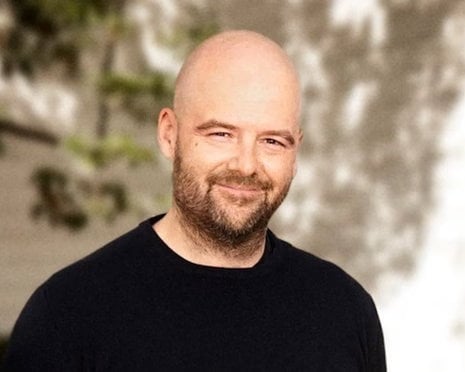
As the panel explained, since leaving Rockstar Games in 2020, Houser and his writing partner Lazlow have been working on a company called Absurd Ventures which will create games, animation, books and….comic books.
Their projects thus far includeA BETTER PARADISE, an audio drama (produced withSmilegate) about an ambitious immersive game that turns into a dangerous AI construct (timely much?). It’s also been adapted into a novel. The panel also teased some Adult Swim-style animation that Absurd Ventures is developing.
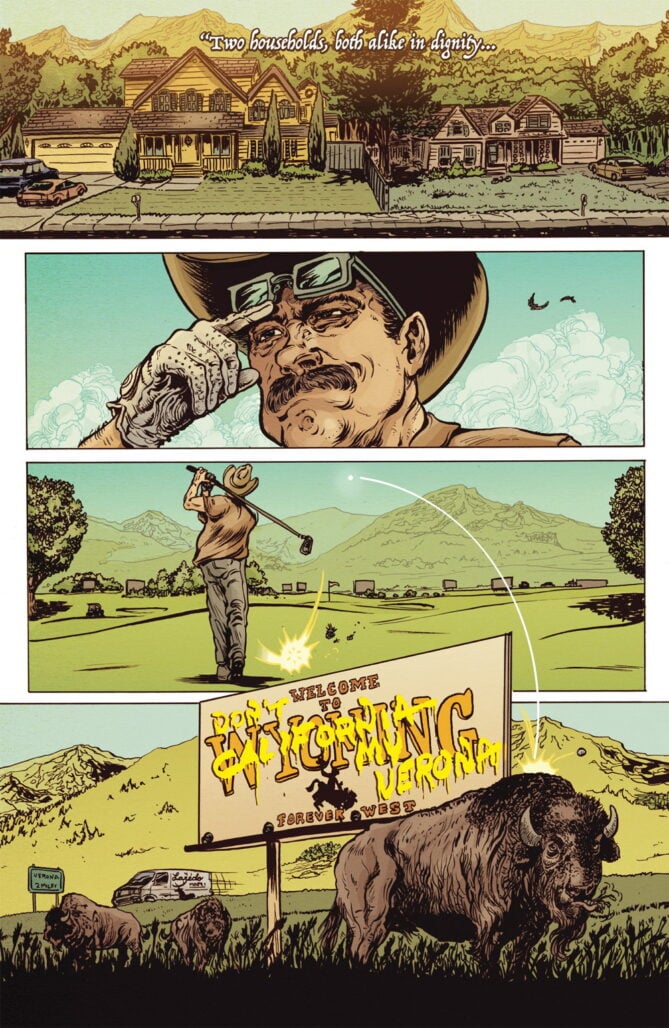
But why we’re here today is that they’ve also moved in to the comics world withAMERICAN CAPER a 12 issue maxi-series about a shady Wyoming lawyer who gets involved with a Mormon hitman, a Mexican beauty queen, a billionaire turned cowboy, and other strange figures. It’s a wild caper that takes today’s political divide and turns it into an action packed satire with one explosive mise-en–scéne after another
The series has some top notch talent involved: writing by Houser and Laslow, art by David Lapham and Chris Anderson, colors by Lee Loughridge, letters by Nate Piekos, all under the watchful eyes of editors Shelly Bond and Daniel Chabon. Oh and also covers by Tyler Boss, Simon Bisley, Martin Simmonds, Joe Quinones, Marguerite Sauvage, and more.
The panel covered a wide range of topics on storytelling, including video games, comics, humor and much else. Those TFF panels don’t mess around.
Dark Horse’sTim Wieschwas also on the panel, and somewhat to my amusement, in the Q&A portion, most of the questions were directed at him by aspiring comics makers (including a fellow in a kilt) – it seems even at the TFF, where schmoozing about your upcoming indie film project has been honed to a fine art, making a comic book is still one of the most alluring ways to get your story out there.
Thefirst American Caper collectionis out now, titled American Caper Volume 1: Red Pilled Blues,and it’s four issues of manic world-building and also some of the startling David Lapham storytelling we’ve come to know and love.
After the panel, I got a chance to talk with Houser about American Caper, the difference between making comics and video games, and whether fictional absurdity can hold a candle to the world we actually live in in 2026.
ComicsBeat: With GTA, it’s like it’s almost a feedback loop in a way because people say all the time about real life, oh, this is like a video game. So how do you approach storytelling now that so many of your visions have come true?
Dan Houser:Well, I think Lazlow really hit the nail on the head [on the panel.] We’re really careful. Even Red Dead Redemption or GTA had their own relationship with reality. With the new worlds or new universes we’re trying to evolve I think we’re very careful to keep them echoing reality. But they’re not set in the real world, so that you can get some themes out of this strange moment in which we live, but not be so tied to it. Trump said this, and then Trump said that, and then Biden did this, and no, we’re not interested in Trump and Biden. We’re interested in the processes that led to Trump and Biden.
So we have our fictional versions of a bullish president, a fake left-leaning politician in another country, whatever it might be. Things that we find interesting about these kinds of characters, I think that’s got more legs to it. It’s something where you’re not as worried about suddenly the real world has pivoted in such an odd direction. You no longer match it but you can still see themes. Every country is in crisis. Every country thinks it’s the worst moment of their history, and that they and they alone are failing. There are things you can pick apart about the modern moment that translate really well into fictional content and that we can reflect on it without being so caught in the exact precise moments of what Trump did in June 2026 or what Justin Trudeau did when he left office. While they might be amusing, they are going to feel very dated in not too much time.
ComicsBeat: So it’s an incredible time to be telling these kinds of stories.
Houser:I think it’s really fascinating. It’s also, as with all this stuff, whether it’s interesting, dull or whatever, it just is. And so you’ve got to kind of do your job. If you think you should be writing about the times, your job is to write about them as they are, not to go, I wish it was the 1970s. Unless you’ve got something to say about 1990 or 2001 or whatever that really reflects the energy, then of course that’s valid. But just to set a story in 2006 because it was easier because the smartphone didn’t exist yet is slightly feeble. I think these times are really interesting. There are always going to be challenges to see what the times are about while we’re living them. But also when you’re living it, you also can soak up the energy of it. We’re not writing sociology, we’re not writing history, we’re writing fiction, and so if the times change, we will have at least made a document that’s interesting. Hopefully we’ve done a good job to reflect what things are like now.
ComicsBeat: I always ask people who are coming from other mediums when they move into comics, “What is the hardest thing about learning how to do comic storytelling.” What was the lesson that you learned going from a super duper collaborative art form to one that’s a little less collaborative.
Houser:In video games, they’re so long, they’re so discursive, and you can get these great spikes in difficulty where it’s just literally hard to play. We’re constantly afraid of losing the player. So really, we’re trying to every five minutes, every 10 minutes, to reconvince them to keep playing, and then also remind them: here’s what the story is. You might not play for two weeks. Here’s what’s going on. Here’s why you’re doing this. So all these storytelling tricks. I think with comic books, each issue has to work as a standalone. You want a flow through story. You want a story arc. We’ve got a 12 issue story arc for this, and then we’ve got another volume set in a different place that we’re beginning work on right now. It’s going to have its own arc. You want them to work as standalone issues. You want them to work as a four-issue arc and a 12-issue arc. It’s a lot of the same tricks. And then the other thing video games want and movies need and comics also need is big visual set pieces. If we’re dealing with murder, death, violence, make it interesting, make it funny, make it surprising. It can’t be. “And then I shot another guy in the head. I shot another guy in the head.” The one thing I feel as a comic book reader, when I flick through, if it’s lots of nine panel pages, one after the other, they get bored. They won’t read it. I so really wanted to work with artists and storytellers and editors who felt the same way and would help me restructure the story so you get a nine-panel double spread and the next one something that’s visually really interesting. It’s a visual storytelling medium more than it’s a written medium. As the writers, Laz and I are driving the action, but people are there for the art more than what I do, and I fully am grateful for that.
ComicsBeat: As you got to work with David Lapham more, did you actually think about things that that he’s good at?
Houser:Yes and [the artists] were great at something that I love. First of all, he’s great at action. He’s great, and he’s got this beautiful cinematic composition. But the other thing that I love as a consumer, which I used to think occasionally Hergé was the master of (I’m a big Hergé fan), was how you turn it over and it’s a full-page big scene, and what [Lapham] does which I particularly love, is we use these montages. So every issue has at least one or two big complex montages. And I then end up buying the art, because I love them so much!
ComicsBeat: His storytelling relies a lot on just the contrast of it. and also just drawing great emotions, great expressions on the characters.
Houser:The other great French bande desineé series is Asterix. Which is amazing at action. amazing at comedy, and so at some level we’re trying to sort of square the circle. Lapham is amazing. We can have this very high velocity, big complex shoot up, people being hit with spades, big complicated Mexican standoffs, and he can draw them. So it almost is quite fun for me because I can make it as hard as possible and he likes to challenge himself. He never goes this is too hard, he always goes, “Can we get more of this?” Laz often does the interface stuff just because he’s producing the whole thing. But speaking with David, it’s never, “Can you calm it down a bit?” He likes the big comics moments.
ComicsBeat: You’re also working with Shelly Bond.
Houser:I love Shelly. She’s amazing. She found David and she’s a comic book person down to her soul. I said, listen, I want notes, but I don’t want notes for the sake of notes, and so I want you to give me notes that turn it into a better comic book. And she was very clear about okay, we need to be a little bit more this, like just nudging it forward, picking out what she likes and doesn’t like in the writing. And then we’d debate tiny things, details around lettering and [panels]. I love that stuff. She speaks the language and is incredibly detailed. The goal with anything we do, arguably even more with a comic book, is to make something that’s very pretty, make something beautiful that we’re proud of. I really wanted it so when you flick through it, you’re captivated because the art is just displayed as an instrument. Both her and Lapham really leapt on that and tried to give us a really interesting rhythm of the double page spreads. Often when you turn the page, it’s not what you’re expecting. So visually, you’re getting pulled through the book.
ComicsBeat: On the panel you were talking about a lot of different mediums. In this time with so many avenues and so many different things, as a storyteller, what inspires you to think this should be a novel. This should be a comic. Not where do you get your ideas but what do you do with your ideas?
Houser:The characters are the initial idea. Characters and some confusion in the world, and then just talk about it. Talk about it with Lazlow. Talk about it with other people. Put it in my head. And sometimes I’ve got a couple of other ideas that I really like, but I don’t want to do them yet. And maybe it’ll be just pages of notes for now. But then these ones stood the test of being worlds, not just stories. American Caper is a tonal comment on America. This one is set in Wyoming and Montana because I thought it’s very interesting to do an ironic version of a modern Western. It kind of worked, and it’s a bit of the world I know. I’m trying to tell an American story not set in New York, or LA. It felt very interesting to look at it from a totally different angle.
So we had the world, we had a couple of characters. We thought their conflict was really interesting, and then we just flesh it out. And over time, we were thinking about making a TV show with American Caper, thinking about a movie, not really sure if we wanted to do either if it was going to take us away from doing games. And then I was playing around with a comic book for another thing, and was like, “It doesn’t really work,” and I got rid of that. But [with American Caper] I thought “This is definitely a comic book.” I see it now, and it will help me aggregate these ideas, and I don’t know if there’s [another medium] ever. We’re just playing around. Maybe there’s a game, a different kind of a game, an open game on the back of it. Maybe we’ll do something in the linear space, but maybe we won’t. I don’t really care about that.
What I want is it to be a great graphic novel arc, and I really like the rhythm of these 12 issue stories because they don’t last forever, but they’ve got a bit of depth to them, and then we’ll reset it. Some ideas are coming for the second series, or just coming for the third series. We’ve done 36 issues so we have a good body of work. That might be enough, or we might do something else. But it’s sort of really focused on trying to make the issues interesting and sometimes make them subtly different but so you don’t feel a big change. So you really go, oh, this one’s really weird. We want it to be slightly disconcerting.
ComicsBeat: Can you tell me more about the whole idea behind Absurd Ventures? It’s a company for developing IP in many mediums.
Houser:The goal is to own the IP. We also have a book publishing imprint that will print other people’s books as well, but we’re just kicking that off. We are making games, TV possibly, probably, but not fully figured that out yet. Comic books, novels. It’s a way of owning it, aggregating the ideas, and sort of platforming it. Obviously, the focus is on games. We’re also hands-on making the games, but using lots of outside partners.
ComicsBeat: On the panel you showed some animation for another project – that’s a test?
Houser:That’s some shorts that we’re using as a pilot that we are in the middle of figuring out how to bring them together, and we’ve got a game from that world as well. That’s an out-and-out adult animation tone, slightly teenager comedy. American Caper is a dark, very dark, violent comedy. And then A Better Paradise is science fiction, a semi-futuristic tragedy, but not as tragic in the end, slightly optimistic, something more serious.
After this very interesting afternoon, everyone went out and watched the Knicks and the whole city was dancing in the streets all night. What a day!
American Caper Vol 1 is on sale now at all good comics shops, and also available digitally on Neon Ichiban, Comixology, and GlobalComix.
